PART 1
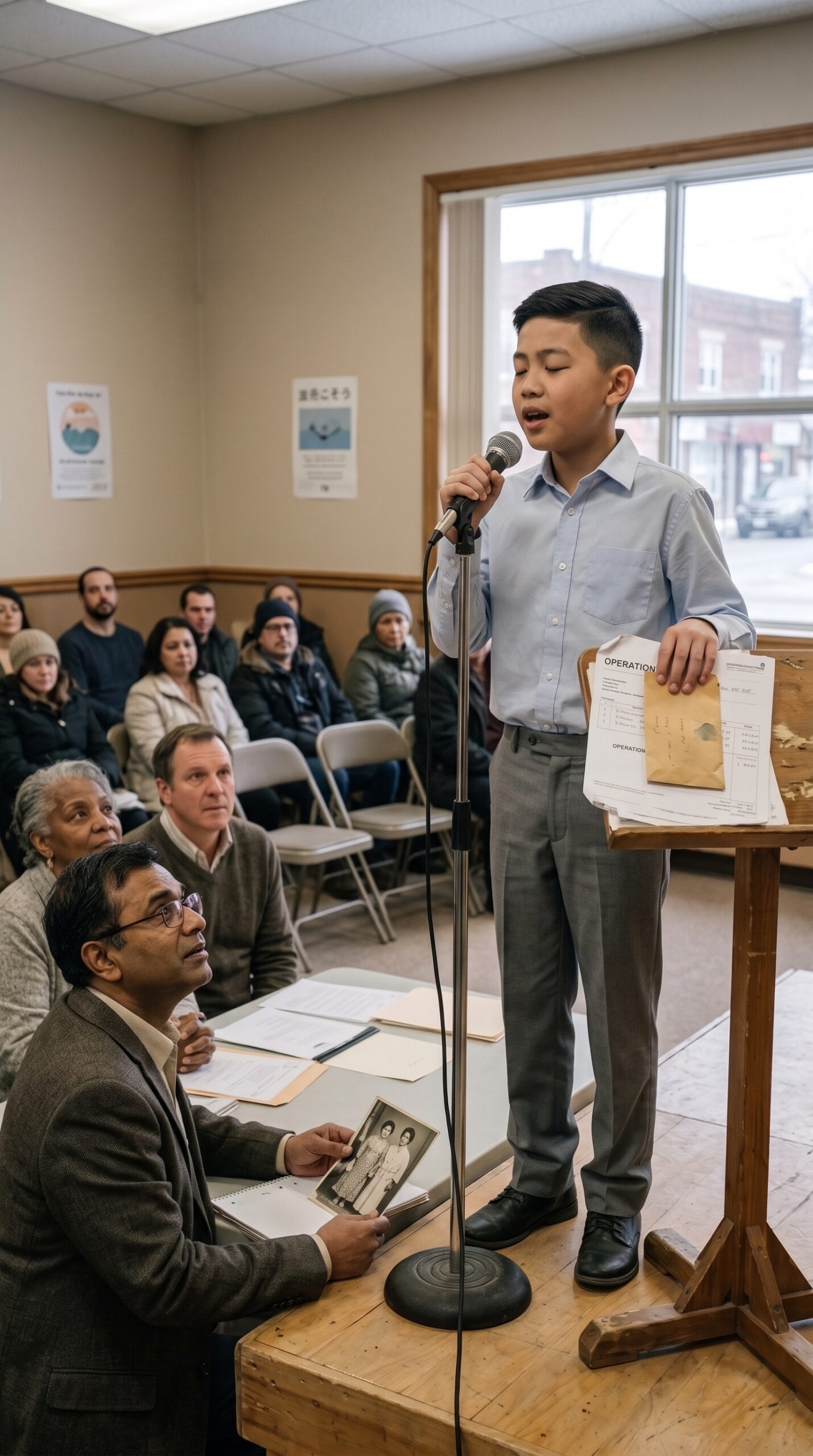
Tomás Rivera arrived at the Popular Theatre of Coyoacán with wet sneakers, a borrowed shirt, and a shoebox clutched tightly against his chest.
He was 10 years old, coming from a tenement in the Doctores neighborhood, walking as if he carried something much heavier than that box.
Inside, the place shone with white lights, cameras, perfumed moms, and kids dressed like television stars.
Tomás only wanted to sing.
Not for fame.
Not for likes.
Not to appear on Facebook.
He wanted to win the children’s contest “Voices of Mexico” because the grand prize was 1,500,000 pesos, just what he needed to pay for his mother’s surgery, Clara Rivera, hospitalized in the General Hospital.
The medical budget said 1,250,000 pesos.
And that number had stabbed into his mind like a death sentence.
At the registration table was Regina Montiel, the program director. She wore a white blazer, red lips, and a gaze that weighed more than an insult.
When she saw Tomás, she didn’t even smile.
—Are you here with someone?
Tomás shook his head.
—My mom is sick. I’m here to sign up.
Regina looked him up and down. Her eyes stopped at the torn sneakers, the worn pants, the old box, and the hair still damp from the rain.
—This contest isn’t a neighborhood fair, kid.
Tomás tightened his grip on the box.
—I have the registration fee.
—It’s 4,800 pesos —she said, as if speaking to someone who couldn’t count—. We’re not charging for a tamale sandwich.
—I know.
Regina took the form he had filled out in careful handwriting.
She read his name.
She read his address.
She read “no email” and “no landline.”
Then she let out a cold laugh.
—Here, we look for prepared kids. With classes, teachers, presence. Not kids from a tenement trying to evoke pity to get on stage.
Some people turned around.
Tomás felt his face burn, but he didn’t cry.
His mom always told him that dignity was the only thing that should never be handed over to anyone, even if the world turned cruel.
—I didn’t come to evoke pity —he responded quietly—. I came to sing.
Regina lifted the form with two fingers and let it fall to the floor, right where the rain from her shoes had formed a puddle.
The ink began to run.
Tomás's name slowly disintegrated.
—What a shame —she said—. It got ruined.
Tomás looked at the wet paper.
For a second, he thought about leaving.
He thought about his mom coughing in bed, pretending it didn’t hurt.
He thought about the nights washing cars, carrying bags at the market, sweeping hair at a salon, saving every coin.
Then he lifted the shoebox.
He placed it on the table.
Regina frowned.
—What are you doing?
Tomás opened the lid and emptied everything out.
Coins of 10, 5, and 2. Crumpled bills, taped together.
The sound of money filled the reception.
—It’s 4,800 pesos —he said—. Not a cent less.
The silence was so loud that even the guard stopped chewing gum.
At that moment, a door opened behind Regina.
A tall, elegant man, with a well-groomed beard and tired eyes, stepped out. It was Julián Santoro, a famous singer, music producer, and the main judge of the contest.
He was about to say something but froze upon seeing Tomás.
His face changed as if he had seen a ghost.
Tomás didn’t understand.
Regina tried to smile.
—Mr. Santoro, it’s just a kid who doesn't meet the profile.
Julián wasn’t listening.
He gazed at Tomás’s face, his eyes, his jaw, that way of pressing his lips together when he was about to break.
—What’s your name? —he asked with a hoarse voice.
—Tomás Rivera.
Julián blinked.
—Your mom’s name is Clara?
Tomás stepped back.
—How do you know that?
And Julián went so pale that Regina, for the first time, stopped feeling in control of the situation.
PART 2
Julián took a few seconds to react.
Regina looked at him, confused, uncomfortable, as if she had lost control of the scene.
Tomás wouldn’t let go of his empty box.
—Do you know my mom? —the boy asked.
Julián opened his mouth but didn’t respond right away. There was something stuck in his throat, something old, something he had been fleeing for years.
—I met her a long time ago —he finally said.
Regina hurried to intervene.
—Mr. Santoro, really, we can’t make exceptions. If we let anyone in, the contest loses its level.
Julián turned to her.
—Did he pay the registration?
—Yes, but…
—Is he 10 years old?
—Yes, but…
—Then he can participate.
Regina gritted her teeth.
—He’s not prepared.
—That will be decided by the stage, not your prejudice.
The phrase fell like a slap.
Tomás received a new form. This time he filled it out with trembling hands, but without lowering his gaze.
When he wrote “Clara Rivera” in the guardian section, he noticed Julián shudder.
Regina stamped the page with rage.
—Friday, 6 PM. If you arrive late, you’re out.
—I won’t be late —said Tomás.
He left the theater in the rain, with soaked sneakers and his heart pounding like a band drum.
That night, in the tenement, Clara was sitting on the bed with a blanket over her legs. The illness had stolen her weight, color, and strength, but not her tenderness.
—Did they sign you up?
Tomás smiled.
—Yes.
Clara cried unwittingly.
—Oh, my boy.
He pinned the contest flyer next to the medical budget. The two papers stood on the wall like enemies.
Prize: 1,500,000 pesos.
Surgery: 1,250,000 pesos.
Tomás stared at them for a long time.
—I’m going to win, Mom.
Clara wanted to tell him that it wasn’t his obligation to save her.
But she saw his eyes.
And understood that for Tomás, it wasn’t an obligation.
It was love.
On Friday, the theater was packed.
There were children in expensive outfits, girls in glittering dresses, dads recording with new cell phones, and teachers giving last-minute instructions.
Tomás arrived alone.
Clara couldn’t accompany him. The fever had spiked that morning.
She sent a folded note in his pocket:
“Sing as if I’m in the front row, because I’ll be there with my heart.”
Tomás touched the paper before going out.
Regina announced his name with a twisted smile.
—Participant number 45. Tomás Rivera. No musical track.
There were murmurs.
Someone let out a “poor thing.”
Tomás closed his eyes.
And sang “Cucurrucucú Paloma.”
He didn’t do it perfectly.
He didn’t have academic technique or trained breathing.
But his voice carried the backyard of a tenement, the hospital bed, the fears of a child, and a mother who said “I’m fine” when she was breaking from pain.
The first note trembled.
The second held steady.
The third broke something in the audience.
Julián, from the judges' table, stopped breathing.
Because that voice not only reminded him of someone.
It reminded him of an entire life he had abandoned.
When Tomás finished, no one clapped right away.
The silence lasted a few seconds.
Then the theater erupted.
Don Beto, the neighborhood barber, who had managed to squeeze in at the back, shouted:
—That’s it, my boy! Give it your all!
Tomás opened his eyes, not understanding why so many people were crying.
The scores came in high.
9.5.
9.6.
9.4.
Regina raised a 7.7.
The audience protested.
—Emotional, yes —she said into the microphone—. But he lacks technique. This isn’t a video to evoke tenderness on social media.
Julián didn’t argue there.
He simply raised his card.
10.
The theater exploded.
That night, someone uploaded the video to Facebook.
“Poor boy sings to pay for his mother’s surgery and makes a judge cry.”
The next day, the video had 3,000,000 views.
Then 5,000,000.
Then 8,000,000.
A nurse opened a donation campaign.
In 24 hours, they gathered 380,000 pesos.
It was a lot.
But it wasn’t enough.
And Regina Montiel was not willing to allow Tomás to reach the final.
On the day of the final, at 11 AM, Clara’s old cellphone received an email.
“Subject: Urgent eligibility review.”
The committee said they had found old videos of Tomás singing known songs on a homemade YouTube channel, without copyright permissions.
According to the rules, he could be disqualified.
He had until 1 PM to submit legal documents.
Tomás read the message three times.
—We don’t have that —he whispered.
Clara put a hand over her chest.
—My love…
—I’m going to be disqualified.
The cellphone vibrated again.
It was a message from Julián.
“Come to the theater. Now.”
Tomás ran as if the city were closing behind him.
He arrived sweating, in a borrowed jacket that was too big.
Julián was waiting for him at the entrance.
He didn’t say much.
He took him straight to Regina’s office.
She was there with her son Emiliano, another contestant in the final. A well-dressed boy, proper, with a beautiful voice and an embarrassed gaze.
Regina stood up.
—This is a lack of respect.
Julián placed a folder on the desk.
—A lack of respect is inventing a disqualification against a child the same day as the final.
—I’m applying the rules.
—Then apply them fully.
Julián opened the folder.
—Emiliano submitted his audition with an edited commercial track. Without a license. If Tomás is out, your son is too.
Regina lost color.
—That’s different.
—No. The difference is that he is your son and Tomás is not.
Emiliano lowered his gaze.
—Mom, enough —he said softly.
Regina shot him a glare.
—Shut up.
Julián pulled out another document.
—I also have four complaints from families who said you humiliated their children for coming from popular neighborhoods. Tepito, Iztapalapa, Neza, Doctores. All archived because you had contacts. It’s over, Regina.
She trembled with rage.
—Are you threatening me?
—I’m giving you a chance to do the right thing before all of Mexico sees who you really are.
Regina looked at Tomás with hatred.
Then sat down, typed, and sent an email.
—The disqualification is withdrawn.
Tomás exhaled.
In the hallway, he stopped in front of Julián.
—Why do you help me so much?
Julián lowered his gaze.
—Because years ago I was a coward with someone who didn’t deserve to be left alone.
Tomás didn’t understand.
But something inside him stirred.
That night, Clara arrived in a wheelchair, accompanied by the nurse who started the campaign and half the tenement.
Don Beto brought a handmade blanket:
“Team Tomás.”
Doña Chayo, the quesadilla lady, was crying even before the contest started.
When Tomás saw his mom in the front row, his legs nearly buckled.
She raised her hand.
He touched the note in his pocket.
This time, she was really there.
Emiliano sang before him. He did it flawlessly.
As he passed by Tomás, he stopped.
—My mom treated you horribly.
Tomás looked at him in surprise.
—Yeah.
—I’m sorry.
Tomás nodded.
—You sing great.
Emiliano smiled sadly.
—You too, man.
Then they announced Tomás.
—Participant number 45. Tomás Rivera, with an original song titled “Get Up.”
Tomás stepped to the center of the stage.
No track.
No dancers.
Nothing.
Just his voice.
He sang about a house with damp walls, a mother who smiled even though her body hurt, and a boy who learned to count coins before learning to dream.
He sang about the worn-out shoes that also deserve to step on clean carpets.
He sang about the people who tell you “you don’t belong here” because they’re afraid to see you shine.
And in the last verse, he looked directly at Clara:
—If the world wants me small, I’ll make myself giant for you.
The theater fell silent.
Then it exploded.
People were crying on their feet.
The scores came in.
9.8.
9.9.
9.7.
Regina raised an 8.8.
This time, even that wasn’t enough.
Julián raised a 10.
Tomás Rivera won “Voices of Mexico.”
First place.
1,500,000 pesos.
When he heard his name, he didn’t run for the check.
He ran to his mother.
He knelt in front of the wheelchair and hugged her as if he were stopping the world.
—You did it —Clara cried.
—We did it —he said.
But when the cameras turned off and the theater started to empty, Julián approached.
—Clara… Tomás… I need to talk to you.
Clara stiffened.
—No.
Tomás looked at her.
—Mom?
Julián swallowed hard.
—Just five minutes.
They went to a small room behind the stage.
There were cables, folding chairs, and old posters.
Julián closed the door.
He looked like a different man.
Not famous.
Not powerful.
Just guilty.
—I should have said this 11 years ago —he murmured.
Clara began to cry.
—Julián, don’t do it like this.
Tomás felt cold.
—What’s going on?
Julián knelt in front of him.
—Tomás… I am your father.
The boy didn’t move.
He looked at Clara.
—is it true?
She nodded, crying.
Tomás stepped back.
—No.
Julián lowered his head.
—I was young. Selfish. A coward. Your mom was pregnant and I thought a child would ruin my career. I left. There’s no excuse.
Tomás looked at him with clean, terrible rage.
—You left us.
—Yes.
—You left my mom alone.
—Yes.
—You made me grow up thinking my dad didn’t want me.
Julián closed his eyes.
—Yes.
Tomás clenched his fists.
—So don’t come now, when I’ve won. Don’t come when everyone is applauding me. Don’t come when there are cameras.
—I didn’t come for that.
Julián pulled out an envelope.
Clara opened it with trembling hands.
Inside was the hospital bill.
The entire surgery was paid for.
Medications.
Post-operative care.
Everything.
—The prize is yours, Tomás —Julián said—. To study, to live better, for your future. Your mom goes into surgery without waiting.
Tomás looked at the paper.
Then looked at Julián.
—Thank you.
Julián lifted his eyes with hope.
But Tomás spoke again.
—That doesn’t make you my dad.
The phrase shattered the room.
Julián accepted the blow without defending himself.
—I know.
—My dad would have been there when we couldn’t pay for the electricity. When my mom cried in the bathroom. When at school they asked me why no one came for me.
—You’re right.
—I don’t know if I’ll ever be able to forgive you.
—I understand.
Tomás took a deep breath.
—But if you really want to help, don’t disappear again. Don’t promise like an artist. Fulfill as a person.
Julián cried.
—I’m going to stay.
—And don’t ask me to call you dad.
—I won’t.
Clara took her son’s hand.
—You decide, my love.
Tomás looked at Julián.
—For now, you’re Julián.
The man nodded.
—For now, I’m Julián.
Clara’s surgery was three days later.
It lasted six hours.
Tomás waited seated, counting the minutes.
Julián remained in the hallway. He didn’t enter without permission. He didn’t demand hugs. He didn’t pretend that money erased abandonment.
He was just there.
When the doctor came out and said the operation was a success, Tomás stayed still.
Then he cried like a child.
Like he could finally do.
Clara survived.
Months later, she walked slowly through a small apartment in Narvarte, with sunlight in the window and no leaks in the sink.
Tomás started singing lessons.
Julián kept his word.
He didn’t disappear.
He helped, paid lawyers, rejected programs that wanted to exploit Clara’s story, and secured scholarships for other underprivileged children.
But he never demanded a word he hadn’t earned.
With part of the prize, Tomás created “Casa Levántate,” a community school in Doctores for children from popular neighborhoods.
At the entrance, he put up a sign:
“Here, no one soils the stage. Here, everyone has the right to step on it.”
Regina lost her position when her favoritism and humiliations came to light.
Emiliano ended up helping carry chairs at the auditions.
And one day, a boy from Iztapalapa arrived with a shoebox full of coins to pay for his registration.
Tomás bent down in front of him.
—Keep your box, man. You don’t have to buy your dignity here.
The boy cried.
Tomás did too, but inside.
Years later, when he was already known throughout Mexico, he was always asked what the most important day of his life was.
He didn’t say the final.
He didn’t say the prize.
He didn’t say the viral video.
He said:
—The day my mom walked out of the hospital.
And when they asked about Julián, he replied:
—He came late. Really late. But he learned to stay.
One rainy afternoon, at Casa Levántate, Tomás was reviewing applications with Julián.
Clara appeared at the door with coffee.
Julián handed him a folder.
—This girl sings son jarocho. She’s 11 years old. I think she deserves to join.
Tomás read the application and signed.
—Approved.
Then, without thinking too much, he said:
—Thank you, Dad.
There was no music.
No cameras.
No applause.
Just rain hitting the roof.
Julián stood still, eyes full of tears.
Clara smiled from the door.
Tomás continued reviewing papers, pretending his throat hadn’t closed.
Because sometimes a happy ending doesn’t mean the past stops hurting.
It means the future finally sings louder than the wound.





