PART 1
Valeria's wine glass hung suspended between her fingers when her husband, Diego Alcántara, suddenly stood up and shouted in front of their entire family:
—How dare you say no to my mom?
The dinner at the Las Lomas mansion froze.
There were 22 people seated around a massive table, covered with embroidered tablecloths, expensive dinnerware, and centerpieces of white flowers that smelled more like a funeral than a celebration. Everything seemed elegant, perfect, magazine-worthy.
But Valeria already knew that in this family, elegance was just makeup to hide the rot beneath.
She was 34, an independent architect and the legal owner of an apartment in Roma Norte. She had bought it on her own, through loans, sleepless nights, early morning jobs, and years of saying no to vacations, expensive clothes, and trendy restaurants.
That apartment was her greatest achievement.
But that night, for the Alcántaras, it wasn’t hers.
It was a solution.
Her mother-in-law, Doña Rebeca, had announced during dinner that she would be moving “for a little while” into Valeria’s apartment because her house in Las Lomas had too many stairs, and her blood pressure no longer allowed her to go up and down.
—Besides —Don Arturo, her father-in-law, added with the voice of a businessman who believes the air itself belongs to him—, Valeria can contribute 45,000 pesos a month for your mother’s expenses. It’s the least a good wife does for her husband’s family.
Valeria looked at Diego.
She waited for him to say something.
A phrase. A defense. A “hang on, it’s her apartment.”
But Diego lowered his gaze and drank wine as if the conversation wasn’t meant for him.
For 20 minutes, the family discussed Valeria’s place as if it were an empty storage room. They decided where they would put Rebeca’s old furniture, what room would be for her nurse, and even suggested that Valeria could rent something “simpler” because a young couple didn’t need that much space.
Then Valeria set her glass down on the table.
—No —she said.
She didn’t shout. She didn’t insult. She didn’t tremble.
She simply said no.
Doña Rebeca dropped her fork on the plate.
—Excuse me?
—My apartment isn’t up for grabs, isn’t a gift, and isn’t being transferred —Valeria replied—. I’m also not going to pay 45,000 pesos a month for a decision made without consulting me.
An uncomfortable silence filled the dining room.
Diego stood up so quickly that the chair scraped against the marble floor.
—You’re making me look like a fool in front of my family.
—You’re doing that all by yourself, Diego.
That phrase shattered him.
His face turned red, his lips trembled, and his eyes filled with a rage Valeria already recognized, but had only seen behind closed doors until now.
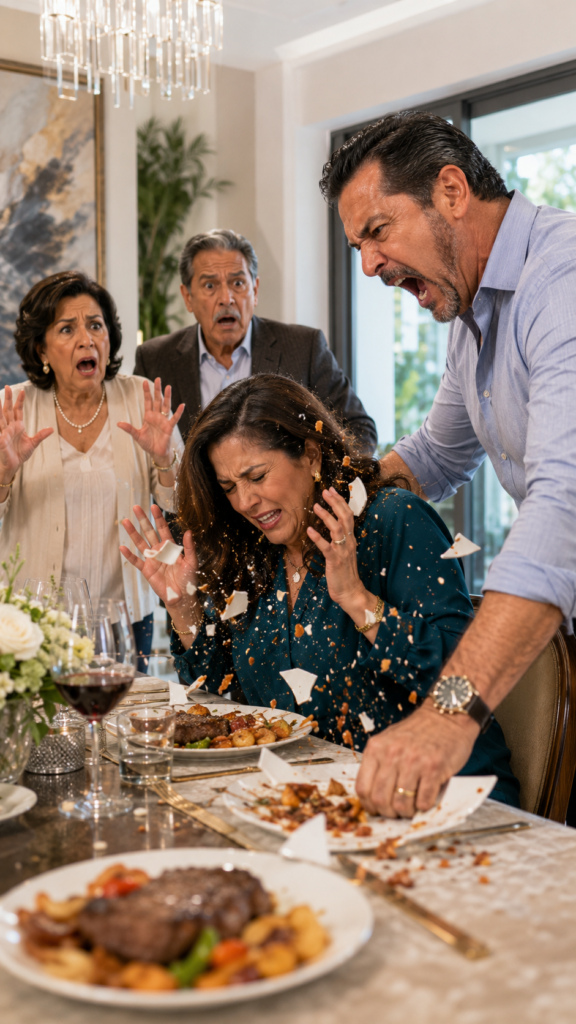
Diego grabbed the ceramic plate where leftover meat and sauce remained and hurled it at her head.
The impact was a sharp crack.
Then came the explosion.
Pieces of plate rained down on the tablecloth, on the floor, on Valeria’s hair. A hot line ran down her left temple, across her cheek, down her neck, staining her white blouse.
No one stood up.
No one screamed.
No one said, “Diego, what have you done?”
A cousin discreetly ushered her children out of the dining room. Don Arturo kept staring at his glass. Doña Rebeca turned her face away, offended, as if Valeria’s blood were ruining the décor.
Valeria braced herself against the table to avoid falling.
In that second, she understood everything.
This dinner wasn’t a family gathering.
It was an ambush.
They wanted to pressure her until she broke. If she cried, they’d say she was hysterical. If she yelled, they’d label her aggressive. If she yielded, she’d lose her home, her money, and the last shred of dignity she had left.
Diego was breathing heavily across the table, convinced he had finally dominated her.
But Valeria straightened up.
She grabbed a linen napkin, wiped the blood from her cheek, and pulled a piece of ceramic from her hair.
Then she looked him straight in the eye.
—You have no idea who you’ve just messed with, Diego.
The entire dining room froze.
Valeria opened her bag, pulled out her blood-stained cell phone, and dialed 911.
When the operator answered, she spoke with a calmness that left everyone pale:
—Good evening. I need a patrol car and an ambulance in Las Lomas. My husband just physically assaulted me in front of 22 witnesses.
Doña Rebeca jumped to her feet.
—Valeria, don’t be ridiculous. It was an accident.
—It wasn’t an accident —she said without looking at her—. It was violence.
Diego took a step toward her.
—Hang up that call right now.
Valeria lowered her gaze to the phone.
—Take another step, and I'll tell the operator exactly where you’re standing.
Then someone moved.
Natalia, Diego’s younger brother’s wife, stepped between them. She was pale but firm.
—Diego, don’t you dare touch her again.
For the first time that night, Diego hesitated.
Five minutes later, the doorbell rang like a sentence.
And when the police crossed the front door, Valeria understood that the Alcántaras still had no idea about the storm they had just unleashed.
PART 2
The two municipal police officers and the paramedics entered the dining room as if they had split the house in two.
The smell of expensive wine and roasted meat was replaced by fear.
A paramedic sat Valeria down in a chair in the foyer and began to clean the wound on her temple. Her head ached, she felt nauseous, and her hands trembled, but she didn’t let go of the phone or lower her voice.
The officer separated Diego from the table.
—Who witnessed the assault? —he asked.
Silence fell again.
That cowardly silence that weighs more than a lie.
Doña Rebeca stepped forward with her Sunday-mass voice.
—Officer, this was just a couple’s argument. My son would never do anything malicious. My daughter-in-law is very sensitive.
The police officer didn’t even look at her.
—Ma’am, return to your seat.
Diego tried to smile.
—Come on, tell them you’re not going to press charges. We’re married, for God’s sake.
Valeria lifted her gaze, the bandage already stuck to her temple.
—We were also married when you broke a plate over my head.
The officer asked her to recount everything.
Valeria didn’t just talk about the blow.
She detailed the apartment. The 45,000 pesos a month. The threats. The “family” loans Diego had asked for over the months. The messages where he hinted that if she embarrassed his mother, no one would protect her when “things got ugly at home.”
She opened her phone and showed one sent three days earlier.
Diego: “If you make my mom look bad at dinner, don’t expect me to control what might happen afterward.”
The officer’s expression changed.
—Do you wish to file a formal complaint?
Diego’s eyes widened, now genuinely scared.
—Valeria, don’t do this.
—Yes —she said—. I’m going to proceed.
Doña Rebeca let out a scream.
—You’re going to ruin my son’s career!
Valeria looked at her from below, her blouse stained with blood.
—No, ma’am. He ruined it when he thought he could hit me and that you all would cover it up.
They took her to the hospital to stitch up the wound. Natalia insisted on accompanying her in the ambulance. Throughout the journey, she said nothing. She just held Valeria’s bag with both hands.
When they arrived at the emergency room, Natalia finally spoke.
—I’m sorry for not speaking up before.
Valeria didn’t grasp the weight of that phrase until the next morning.
After five stitches and a CT scan with no fractures, Valeria sat in the office of Claudia Ríos, her attorney and friend since college. On the desk lay a thick folder: screenshots of messages, bank statements, photos of old bruises, audios of Diego demanding money, and the original deeds of the apartment in Roma Norte.
Claudia reviewed everything in silence.
—This didn’t start last night —she eventually said—. Last night, the mask just fell off.
That same day, they requested a protection order, froze their joint accounts, and went to Valeria’s apartment to change the locks.
The place was intact.
Her plans, her books, her plants on the balcony, her work desk.
Everything was hers.
But Claudia asked to check the building's storage.
Valeria didn’t want to. She was exhausted, dizzy, and shattered. But Claudia insisted.
In the basement, behind some boxes of Christmas decorations, they found a blue folder with Diego’s name on it.
Inside were fake promissory notes, copies of identifications, investment documents, and photographs of Valeria’s apartment. There were also appraisal calculations and a yellow sheet written in Doña Rebeca’s elegant handwriting.
“If Valeria resists transferring the property, apply marital pressure and familial guilt until she breaks her stance. This asset must enter the trust before the quarterly closing.”
Valeria felt the ground shift beneath her.
They didn’t want the apartment because Rebeca was sick.
They wanted it to cover debts.
Claudia put the sheet in an evidence bag.
—This is no longer just domestic violence. It’s an attempt at financial fraud.
That afternoon, they took everything to the Public Ministry.
And when Valeria thought nothing worse could appear, Natalia arrived at Claudia’s office with a USB drive in hand.
Her eyes were swollen.
—I have the master file —she said—. But when this comes out, my husband will never forgive me.
Claudia closed the door.
Natalia looked at Valeria.
—The entire dinner was recorded.
Silence fell heavily.
Natalia explained that Don Arturo had hidden cameras in the dining room to record family meetings, negotiations, and money discussions. Not for security. For control.
He liked to have evidence against everyone.
That night, a micro-camera was hidden in a bookshelf, pointing directly at the table.
—They wanted to record you agreeing to hand over the apartment —Natalia said—. They didn’t expect Diego to lose control like that.
Claudia connected the USB.
On the screen appeared the dining room. The elegant table. The glasses. Doña Rebeca smiling with that false sweetness.
—Valeria will understand —a voice was heard saying—. A decent wife knows when to obey her husband’s family.
Then came Don Arturo’s voice:
—The deed is in her name, yes, but it already belongs to this family.
Then Diego, tense, humiliated, venomous:
—Don’t make me look like less of a man in front of everyone.
The recording continued.
Valeria’s clear no.
Diego’s insult.
The plate lifting.
The impact.
Claudia paused the video just before the ceramic touched her head.
—With this, we won’t need those cowardly witnesses to testify —she said—. The truth stands alone.
Natalia began to cry.
—I live like this too —she confessed—. He doesn’t hit me, but he controls my money, my outings, my calls. When I saw you bleeding and still called 911, I understood that if I stayed silent, I would be next.
Valeria took her hand.
In that moment, her case stopped being just a fight over an apartment.
It became the crack that split an entire family built on fear.
The following months were an earthquake.
Diego was linked to the process for domestic violence, threats, fraud, and attempted dispossession. He was forbidden from approaching Valeria, her office, and her apartment.
He didn’t accept it.
He created fake emails to write to her.
“You ruined my mother.”
“You destroyed my surname over a simple plate.”
“You’re going to regret this.”
Claudia saved every message and added them to the folder as harassment.
Then, the Alcántaras tried another play: to tarnish her name. They told acquaintances, clients, and neighbors that Valeria was ambitious, that she never loved Diego, that she exaggerated an argument to keep the money.
For weeks, Valeria wanted to respond on social media.
But Claudia told her:
—Don’t step into the mud they prepared. Let the files speak.
And the files spoke.
Don Arturo’s video was damning. Diego’s messages, Rebeca’s sheet, the fake promissory notes, and Natalia’s statement finished sinking them.
At the hearing, Diego cried.
He said he was stressed, that his business had problems, that his mom was sick, that Valeria was cold, that he had only lost control for one second.
The judge listened without interrupting.
Then she ordered the audio of the dinner to be played.
The entire room heard:
—How dare you say no to my mom?
Then the blow.
Then Valeria’s voice calling 911.
Doña Rebeca lowered her head for the first time. Not out of regret. Out of public shame, which was the only thing that woman truly understood.
When Valeria spoke before the judge, her voice broke, but she didn’t back down.
—For years, I confused enduring with loving. I thought protecting the image of my marriage was my obligation. But that night, seeing my blood on the white tablecloth, I realized something: saying no doesn’t destroy a family. What destroys a family is believing that a woman was born to obey, finance, and be quiet.
Diego couldn’t look at her.
The sentence didn’t erase the trauma, but it set a steel barrier where fear had once reigned. Diego was convicted, ordered to pay medical expenses, therapy, and reparations. The court declared that neither he nor any member of the Alcántara family had any rights over Valeria’s apartment.
The divorce was finalized months later.
Total separation of assets.
Zero alimony for Diego.
Zero claims over her estate.
But the fall didn’t end there.
A financial investigation revealed that Diego had used Valeria’s forged signature to request private loans, supposedly backing them with the Roma apartment. Don Arturo tried to deny it until they found messages where he ordered his son to “pressure Valeria before she hired lawyers.”
Doña Rebeca’s handwriting on the yellow sheet sealed her role as an accomplice.
The family that believed itself untouchable began to break from within.
Natalia separated from her husband three months later.
One day, she called Valeria and said:
—I don’t want my daughter to grow up believing that a good woman is measured by how much pain she can endure in silence.
Valeria cried after hanging up.
Not out of sadness.
But out of relief.
One year after that dinner, she reopened the doors of her apartment with bags of sweet bread, yellow flowers, and market food.
She had changed the furniture, painted a soft green wall, and placed a round table next to the balcony.
That night, she had dinner with Claudia, Natalia, and two friends from her office. There were no inherited glasses or expensive tablecloths. Just real laughter, pasta, salad, and the city shining outside.
Natalia raised her glass.
—To Valeria. Because that night she said no, and with a single word, she reminded several of us that we could still be saved.
Valeria smiled with tear-filled eyes.
Sometimes she still woke up remembering the sound of the plate breaking.
But she no longer woke up with guilt.
She woke up in her bed, in her home, with her keys at the entrance and her plans spread out under the morning sun.
And every time someone dared to ask her if she didn’t feel remorse for destroying a powerful family, she replied the same:
—I didn’t destroy any family. I just opened the cage and walked out.
Because there are blows that not only break the skin.
They also shatter the lie.
And when a woman truly wakes up, neither a husband, nor a mother-in-law, nor an entire family can put her back into darkness.