PART 1
By any logic, that girl should never have passed the first gate of the mansion.
Neither the guards, nor the sensors, nor the thermal cameras had been installed to welcome innocent visitors.
But that night, beneath a fierce rain that pounded against the glass like stones, a tiny voice came through the intercom and froze Alejandro Valcárcel.
—Boss… there’s a girl at the entrance.
Alejandro stood before the window of his office, in a mansion hidden among the hills of Zapopan.
On his desk lay three things: an untouched glass of tequila, a black gun, and a folder with photographs of the car that exploded six days prior.
Someone had tried to kill him.
A bomb beneath his armored truck had detonated just as his driver moved the vehicle.
The driver died instantly.
Alejandro survived because, for the first time in years, he chose to exit through the back door.
Since then, sleep had eluded him.
He didn't trust even his own shadow.
—A girl? —he asked, not taking his eyes off the glass.
—Yes, boss. She says she’s here for a domestic worker interview.
Alejandro turned slowly.
—Is she alone?
—Yes. She says her mom couldn’t come today.
The phrase sounded absurd in a house where everyone spoke softly, where any visitor was checked four times, and where a mistake could cost blood.
Alejandro clenched his jaw.
In his world, even a child could be used as bait.
—Check her respectfully, but check her well —he ordered—. And bring her here.
Minutes later, the office door opened.
The girl walked in, soaked to the bone.
She looked about eight or maybe nine.
Her dark hair clung to her forehead, she wore muddy sneakers, and an adult-sized apron tied around her waist, so large it nearly reached her ankles.
In her hands, she held a folded sheet inside a plastic bag.
Her black eyes scanned the room in fear, but she didn’t back down.
—Good evening, sir —she said, swallowing hard—. My name is Lupita Ríos.
Alejandro didn’t respond.
He simply watched her.
That girl didn’t have the look of someone who was there to deceive.
She had the look of someone who had to grow up too fast.
—My mom is sick —Lupita continued—. She had an interview today to work here. She had a fever, couldn’t get up, and started crying because she said if she missed this chance, we’d be kicked out of our room.
The girl lifted the bag.
—I brought her résumé. And I put on her apron so you could see that she does know how to work.
One of the security men let out a nervous laugh.
Alejandro shot him a glance, and the man immediately lowered his head.
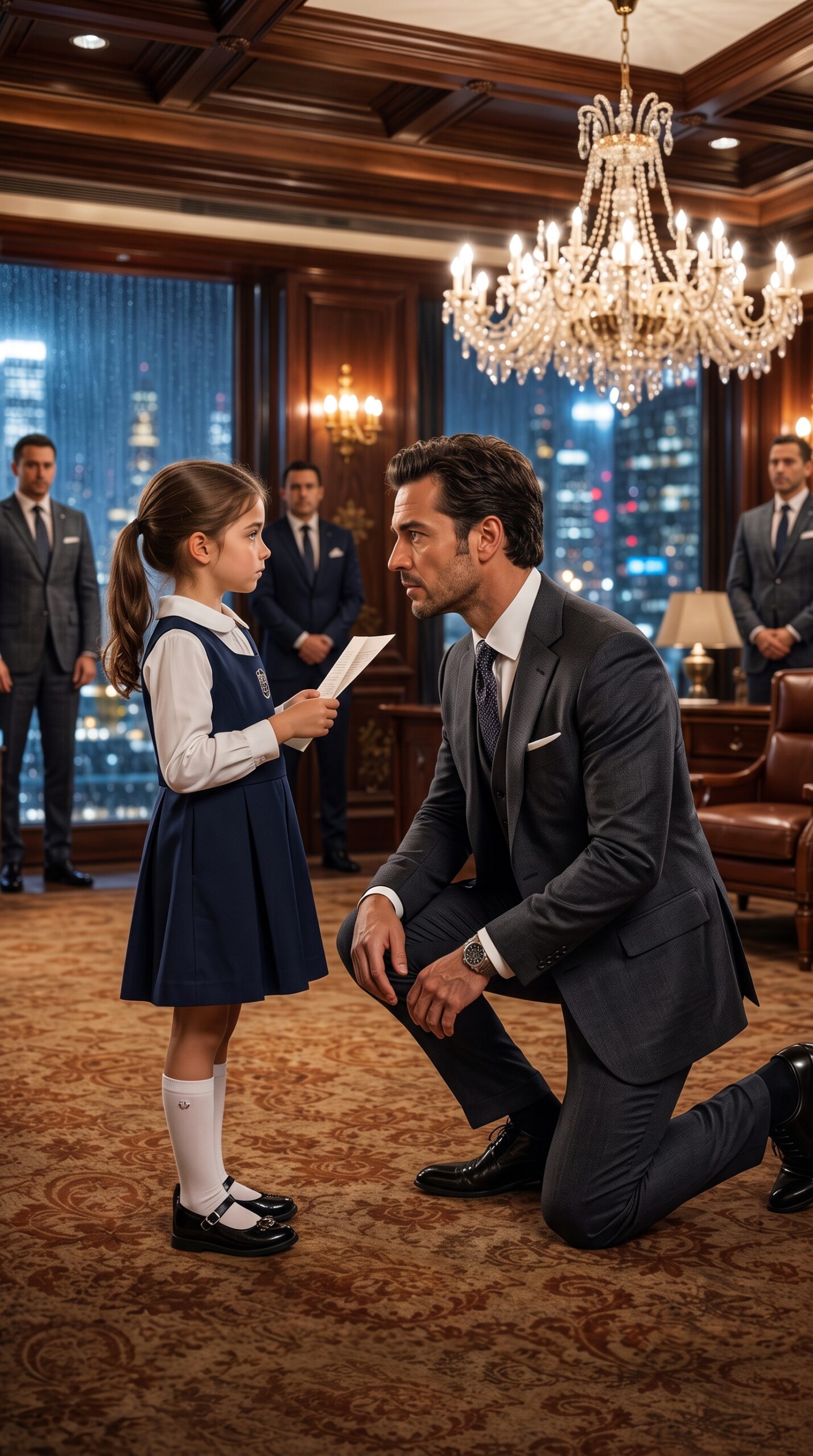
Then Alejandro walked toward the girl and, against everything his guards expected, knelt before her.
—Did you come here alone?
Lupita nodded.
—On two buses. And then I walked where no more passed.
Alejandro felt a strange jolt in his chest.
But before he could say anything else, the girl reached into the bag and pulled out a folded cloth.
—I also brought this. My mom said if she ever saw Mr. Alejandro, to give it to him.
When he opened the cloth, he found an old medallion with his father's initials... and a blood-stained USB drive.
PART 2
The office fell into silence.
Neither the rain, nor the guards’ radios, nor the buzzing of the cameras seemed to make a sound for several seconds.
Alejandro carefully took the medallion.
That object couldn’t be in the hands of a stranger.
It had belonged to his father, Don Aurelio Valcárcel, a man who died eleven years ago in an ambush in Tepatitlán.
The medallion had disappeared that very night.
And with it, many answers.
—Where did your mom get this? —Alejandro asked, his calmness sending chills down one’s spine.
Lupita shrank a bit.
—She keeps it in a shoebox. She always said it was from a man who saved her life.
—What’s your mom’s name?
—Marisol Ríos.
The name fell like a stone.
Alejandro stood up slowly.
He hadn’t heard it in years, but he remembered.
Marisol Ríos.
The girl who worked in the kitchen of his father’s old house.
The same one who disappeared the night of the ambush.
For years, the Valcárcel family said she had sold information.
That it was her fault Don Aurelio died.
That’s why she had fled.
Rogelio, Alejandro’s older brother, repeated that version so many times that everyone accepted it as truth.
But Alejandro had never seen proof.
He only saw hatred.
—Does your mom know you came? —he asked.
Lupita shook her head.
—No. I slept a little next to her, but when I woke up, she was trembling. I took her papers because I didn’t want her to get fired before meeting you.
The head of security, Ramiro, stepped forward.
—Boss, this could be a trap.
Alejandro didn’t take his eyes off the USB drive.
—It could be.
He pulled out his laptop, disconnected from the network, and requested a clean computer from Ramiro.
No one spoke as they connected the USB drive.
Lupita watched it all with her hands clasped, as if she had committed a serious mischief.
Five folders appeared on the screen.
Audios.
Photos.
Accounts.
Aurelio.
Alejandro felt his blood run cold.
He opened the audio folder.
The first recording began with engine noise and a voice he recognized instantly.
It was Rogelio.
His brother.
—The old man doesn’t understand the business anymore. He’s softened because of that maid and the kid. If we don’t take him out today, he’s going to turn us all in.
Then another voice spoke.
Efraín Ortega, a family associate for over twenty years.
—And the girl?
—Marisol will blame herself. We’ve planted money in her room. No one will believe her.
Alejandro stopped breathing for a second.
Lupita didn’t understand everything, but she saw how that enormous man, whom everyone feared, lost color from his face.
—Is he mad at me? —she asked softly.
Alejandro slammed the laptop shut.
—No, girl. Not with you.
Then he looked at Ramiro.
—Bring Marisol. Alive. Don’t scare her. And let no one in this house make a single call.
Ramiro obeyed.
But in a mansion filled with secrets, an order never walked alone.
It was barely twelve minutes later when Alejandro’s private cell phone vibrated.
It was Rogelio.
—What’s up, little brother? I heard a strange visitor arrived. Everything okay?
Alejandro glanced at Lupita.
The girl stood by the fireplace, hugging her wet apron.
—Everything’s fine —he replied—. Just a lost girl.
Rogelio fell silent for a moment.
—A girl?
—Yeah. Nothing important.
—Send her home. We’re not in the charity business, man.
Alejandro smiled without joy.
—Sure.
He hung up.
And at that moment, he knew his brother was already aware.
The trap wasn’t the girl.
The trap was the house.
Alejandro ordered the internal cameras checked for the last thirty minutes.
In one of them, Julia, Rogelio’s niece, appeared walking down the service hallway with a cell phone hidden under the coffee tray.
She didn’t work there.
She claimed to visit her uncle.
But that night, she entered the mansion before Lupita.
Alejandro understood everything.
Rogelio had people inside.
Maybe he always had.
Meanwhile, Marisol was found in a tenement room in Santa Tere.
She had a high fever, was dehydrated, and was clutching an old photo.
When Ramiro told her that her daughter was in the Valcárcel mansion, Marisol nearly fainted.
—No! —she screamed—. She shouldn’t have gone! They’re going to kill her like they wanted to kill me!
They took her in an escorted truck.
Upon arrival, Lupita ran to her.
—Mom!
Marisol fell to her knees and embraced her desperately.
—What did you do, my girl? What did you do?
Alejandro watched the scene from across the office.
The woman had aged prematurely.
Her face was gaunt, her hands trembled, and her eyes carried eleven years of fear.
—Marisol —he said.
She looked up.
For a second, she saw the seventeen-year-old boy Don Aurelio had protected from his own brothers.
—Mr. Alejandro…
—I want the truth.
Marisol took a deep breath.
Lupita clung to her arm.
—Your dad didn’t die because of a war —she said—. Don Rogelio ordered him killed.
The silence became heavy.
—I heard everything because that night I was bringing coffee to the office. Don Aurelio wanted to take you out of the business. He wanted to send you to study in Monterrey, far from everyone. He said you shouldn’t have to bear the family’s sins.
Alejandro clenched his fists.
No one had ever told him that.
His father was always tough, cold, almost impossible to read.
He died believing Don Aurelio was preparing him to take his place.
Not to free him.
—Rogelio wouldn’t allow it —Marisol continued—. He said if you left, the business would fall apart, and he would be out. That night he set up the ambush. And when they caught me, they beat me, took my papers, and left me on the road.
—Why didn’t you come with me?
Marisol let out a broken laugh.
—With whom, sir? Everyone said I was the traitor. There was money in my room, a gun I had never touched, and two bought witnesses. I was a twenty-three-year-old girl. I had no family. I had nothing.
Lupita looked up at her mother.
—Is that why we always moved houses?
Marisol hugged her tighter.
—Yes, my love.
Alejandro opened the USB drive again.
Besides the audios, there were photos of transfers, names of bought policemen, and a folder dated six days before.
He opened it.
Images of his truck appeared.
Security blueprints.
Departure times.
And a note written by Rogelio:
“If Alejandro doesn’t sign the route assignment, let him die like the old man.”
Ramiro cursed under his breath.
Alejandro stood still.
The attack didn’t come from an external enemy.
It came from his own blood.
His brother hadn’t just killed his father.
Now he wanted to kill him.
But the final blow was in another file.
A video recorded in a warehouse.
Rogelio appeared talking to Efraín.
—The girl can be useful if the mother opens her mouth. An accident, a kidnapping, whatever. Alejandro likes those innocent stories. He’ll soften.
Marisol covered her mouth.
Lupita didn’t understand the full phrase, but she saw the terror in her mother’s eyes.
Alejandro closed the computer.
When he spoke, his voice no longer trembled.
—Ramiro, lock down the house. No one enters. No one leaves.
That same night, Rogelio arrived at the mansion with four men and a worried brotherly smile.
—Where’s the girl? —he asked as soon as he crossed the threshold—. I came to help you, brother.
Alejandro welcomed him in the main hall.
The fireplace was lit.
The guards were positioned in every corner.
Marisol and Lupita remained in a room protected by two female security guards.
—How strange —Alejandro said—. I never told you the girl was still here.
Rogelio blinked.
—I figured.
—You always imagine too much.
Rogelio’s smile hardened.
—Don’t start with your paranoia. Since the car incident, you’ve been seeing ghosts.
Alejandro pulled out his father’s medallion and placed it on the table.
Rogelio stopped smiling.
For the first time in years, the man who thought himself untouchable showed fear.
—Where did you find that?
—A girl with a wet apron brought it.
Rogelio exhaled through his nose.
—That woman is still alive.
—Yes.
—Then she’s still lying.
Alejandro gestured.
The speakers in the hall began to play the first recording.
Rogelio froze.
His men reached for their waists, but Alejandro’s guards already had them covered.
—Back off, Alejandro —Rogelio said—. We’re family.
—My dad was family too.
—Your dad was going to destroy us.
—My dad was going to save me.
Rogelio let out a bitter laugh.
—Save you? Don’t be naive. You were born Valcárcel. No one leaves here clean.
Alejandro looked at him with a sadness that hurt more than the rage.
—Maybe not. But an eight-year-old girl had more courage than all of us combined.
Rogelio tried to approach.
—Think carefully about what you’re doing. If you turn me in, everything collapses. Names, accounts, routes. You’re coming with me.
Alejandro remained silent.
And then the real surprise entered.
Through the side door appeared Commander Patricia Sandoval from the Specialized Prosecutor’s Office, accompanied by undercover agents.
Ramiro lowered his weapon.
Rogelio’s eyes widened as if he had just seen a ghost.
—What did you do, idiot?
Alejandro didn’t respond immediately.
For years, he believed power lay in making everyone fear him.
That night, he understood that fear was also a prison.
—What my dad didn’t accomplish —he finally said—. To end this.
Rogelio was handcuffed right there.
Efraín was caught an hour later in a farmhouse in Tlajomulco.
Julia, the niece who filtered information, tried to escape to Puerto Vallarta but was stopped with two suitcases of cash and fake passports.
The news exploded across Jalisco.
A boss long pointed at for dark dealings delivered files, accounts, names, and properties.
Many said he did it to save himself.
Others said it was strategy.
But those who were there that night knew it all began with a soaked girl, an oversized apron, and an unforgettable phrase.
“My mom couldn’t come today.”
Marisol refused to work in the mansion.
Alejandro didn’t ask her to.
Instead, he offered her legal protection, medical care, and a simple house, far from the hills where lives were decided as if they were coins.
She cried when signing the papers.
—I don’t want to owe anything to anyone —she said.
—You owe me nothing —Alejandro replied—. My family took eleven years from you. This is just an apology.
Lupita returned to school two weeks later.
She no longer arrived with wet shoes or fear in her eyes.
On her first day, she brought a new backpack and a lunch her mom prepared while crying tears of joy.
Meanwhile, Alejandro testified for months.
He lost properties.
He lost allies.
He lost the clean surname he never had.
But for the first time in his life, he could sleep without a gun on the table.
One afternoon, before leaving Jalisco under protection, Lupita handed him a drawing.
On the page was a huge house, a girl in an apron, and a man in a suit kneeling before her.
Below, in crooked handwriting, she wrote:
“Thank you for believing my mom.”
Alejandro stared at the drawing for a long time.
Then he carefully folded it and stored it alongside his father’s medallion.
Because sometimes justice doesn’t enter through the front door.
Sometimes it arrives trembling in the rain, with muddy sneakers, carrying a truth that adults lacked the courage to say.





