PART 1
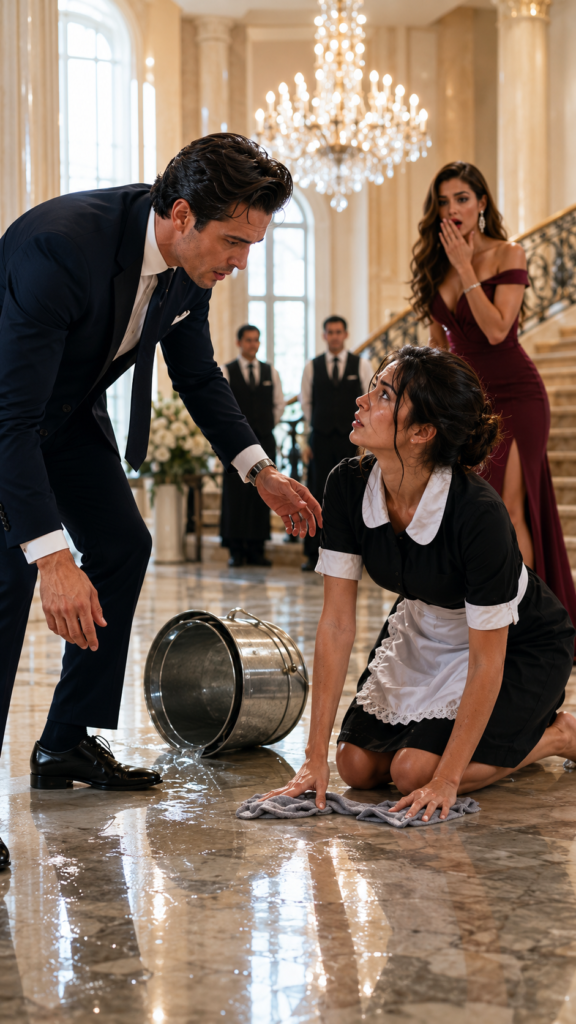
The metal bucket crashed onto the white marble with a sound that shook the very chandeliers.
Dirty water spread across the foyer of the Castillo mansion, that enormous house in Las Lomas where everything shone except the truth. A woman dressed as a maid knelt immediately, barefoot, hands trembling as she tried to clean up before the puddle reached Alejandro's Italian shoes.
—I’m sorry, sir… it wasn’t my intention —she whispered.
Alejandro Castillo dropped the suitcase.
The sharp thud echoed in the living room.
This man, owner of hotels, vineyards, and half a dozen buildings in Reforma, stood frozen as if someone had turned off the world. He had heard that voice in dreams for three long years. In Madrid airports, train stations in Milan, hospitals in Paris, and alleys in Vienna.
That voice had haunted him more than any ghost.
The woman slowly lifted her face.
Alejandro felt the air shatter in his chest.
—Elena…
The name slipped from his mouth like a prayer.
It was her. His missing wife. The woman everyone said was dead or a runaway. The same woman for whom he had sold properties, hired investigators, and lost sleep like a normal person.
But Elena didn’t run to him.
She didn’t embrace him.
She didn’t scream.
She simply lowered her gaze, clutching an old rag between her fingers, as if seeing him brought her more fear than joy.
Her hair was poorly tied, her face thinner, and a fine scar marked her chin. Dark bruises adorned her wrists. The gray uniform hung loosely on her frame. Her dirty and hurt feet touched the cold marble of the house that had once been her home.
Alejandro took a step.
—My love…
She flinched.
That tiny, almost invisible movement shattered something inside him.
Then a dry laugh floated down from the main staircase.
—Oh, what an awkward moment, right?
Viviana Moretti, Alejandro’s older cousin and the mansion’s manager since Elena’s disappearance, descended with a glass of red wine in hand. She wore an emerald green dress, understated jewelry, and that smile of a woman who had already won before the fight began.
—I suppose no one told you the new maid was your missing wife —she said, laced with venom.
The staff pressed themselves against the walls.
Doña Amparo, the housekeeper who had known Alejandro since he was a child, silently wept. Tomás, the gardener, looked pale. No one dared to meet their eyes.
Alejandro turned back to Elena.
And then it sank in.
She wasn’t working there.
They had her there.
—What have you done? —he asked, a calm that was terrifying.
Viviana took a sip of wine.
—I did nothing. Elena arrived confused, without documents, without a clear memory. She was given shelter, food, and work. You should be grateful, cousin.
Elena barely shook her head.
Alejandro saw it.
—Elena, look at me —he pleaded—. You don’t have to speak in front of her if you don’t want to.
But Viviana let out another laugh.
—Now you’re going to play the hero? How sweet. You spent three years searching for her across Europe while she mopped your floors here, in your own house. Seriously, it’s crueler than any soap opera.
Alejandro pulled out his phone.
The glass trembled in Viviana’s hand.
—Freeze all accounts linked to Viviana Moretti —he ordered over the phone—. Review trusts, international payments, and transactions from the last four years. And I want Sofía Rivas here, with the police and a court order.
Viviana's smile vanished.
—you can’t do that.
—I already did.
Elena lifted her head.
For the first time, her eyes weren’t vacant. They brimmed with accumulated pain, buried rage, and a truth that had rotted too long within that mansion.
Alejandro positioned himself between her and Viviana.
—You’ve brought my wife to her knees —he said—. In her own home.
Viviana paled.
And just as Alejandro advanced toward her, Elena spoke in a voice so broken it chilled them all.
—It wasn’t just her… there’s a room behind the blue door.
PART 2
No one moved.
Elena’s words fell into the foyer like a bomb.
Alejandro slowly turned toward the west hallway, where an old blue door, repainted a thousand times, led to a closed wing of the mansion. Since childhood, he had been told there was only old furniture, broken pipes, and memories of his dead father.
He never imagined hell could lie behind it.
—What room? —he asked, not taking his eyes off Elena.
She swallowed hard.
—One without windows.
Viviana gripped the glass so tightly her knuckles turned white.
—She’s delusional. This woman has been unwell since she appeared. She doesn’t know what she’s saying.
—She does know —Doña Amparo said, her voice trembling.
Everyone turned.
The elderly woman stepped forward. She had served the Castillo family for 40 years. She had watched Alejandro grow up, marry Elena, and slowly destroy himself when she disappeared.
—Doña Amparo —Viviana said, icy—. Think carefully about what you’re about to say.
—I’ve thought too much —the woman replied—. And for keeping quiet, this girl suffered 18 months under this roof.
Alejandro felt his stomach tighten.
—18 months?
Tomás stepped forward as well.
—Sir, Miss Viviana told us you were sick, that we shouldn’t mention Elena to you because it could worsen your condition. She said the woman’s name was María Santos, that she was a distant relative from the ranch and needed discipline.
—Discipline? —murmured Alejandro.
Elena looked down.
Doña Amparo cried louder.
—They took away her letters. If anyone tried to speak to you, the messages disappeared. Calls went through Miss Viviana’s office. We were all scared, sir. She threatened to fire us, sue us, leave us on the street.
Alejandro closed his eyes.
Every piece began to fit together with unbearable cruelty.
The emails he never received.
The employees who seemed nervous when he returned from trips.
Viviana insisting on managing the house, the accounts, the investigators’ reports, everything.
And he, broken with pain, believing her.
—Elena —he said, kneeling a few steps from her—. Tell me what happened.
He didn’t touch her.
He understood that even love could feel like a threat when someone had spent years surviving fear.
Elena took a deep breath.
—I was traveling from Milan to Florence. Someone at the station called my name. It was a woman who said she came from the hotel. She showed me a picture of you next to a wrecked car. She said you had an accident.
Alejandro paled.
—I never had an accident.
—I know now —Elena said—. But at that moment, I ran with her. Then I woke up in a room. Without my passport. Without a purse. Without a phone. They told me you no longer searched for me, that you had signed the divorce, that if I returned, I would only ruin your life.
Viviana scoffed.
—How convenient.
Elena looked at her.
—you went to see me.
The silence was brutal.
—you went with a man named Víctor Salvatierra —Elena continued—. You said Alejandro had already replaced me. You said my only option was to sign papers agreeing that I left of my own will.
Alejandro felt his rage turn into something colder.
Víctor Salvatierra.
The private investigator he had hired in Europe. The same one who vanished with millions and false reports. For years, he thought he was a con artist.
Now he understood it was something worse.
Alejandro’s phone vibrated.
It was Sofía Rivas, his lawyer.
He answered on speaker.
—Sofía.
—Alejandro, we’ve reviewed preliminary movements. There are transfers from accounts controlled by Viviana to private clinics in Italy and Switzerland. Also payments to a security company called Northgate Global.
Elena turned pale.
—Who runs that company? —Alejandro asked.
Sofía paused for a second.
—Víctor Salvatierra.
Viviana glanced at the main door.
Alejandro saw it.
—Don’t even think about it.
—you can’t hold me —she spat.
—I don’t need to. The police are already on their way.
Viviana let out a nervous laugh.
—and what are you going to tell them? That your wife reappeared as a maid and now everyone is making up a story about secret rooms? Please, Alejandro. They’ll see you as a poor traumatized man.
Then Elena stood up.
Her legs trembled, but she steadied herself by the edge of a table. Doña Amparo wanted to help her, but Elena raised her hand.
—I can show them.
Alejandro walked toward the blue door.
Behind him were Elena, Doña Amparo, Tomás, and three other staff members. Viviana followed at a distance, her face so rigid she looked like another person.
The hallway was dark.
The blue door smelled of dampness and old paint. Alejandro remembered his father standing there many years before, with a gray face, telling him: “There are doors that close for a reason, son.”
Back then he thought it was a dramatic phrase.
Now it scared him.
—the key is in the study —Viviana said.
Elena shook her head.
She slipped her fingers under the collar of her uniform and pulled out a thin chain. From it hung a brass key.
—I found it in a coat inside the room.
Alejandro took the key.
The accidental brush of their fingers made Elena recoil. He said nothing. He simply unlocked the door.
The mechanism clicked.
The door opened with a creak.
A cold, stale air rushed out from within.
They crossed a narrow corridor. At the end was another door, more modern, with an electronic lock and a metal handle. Alejandro touched it. He couldn’t remember ever seeing that.
—There —Elena whispered—. That’s where they locked me when I didn’t obey.
Viviana spoke in a different, softer voice.
—you don’t understand what you’re about to open.
—Then explain it to me.
—Your father died with secrets.
Alejandro turned around.
—My father died of a heart attack.
Doña Amparo covered her mouth.
That gesture was enough.
—What do you know? —he asked.
The woman trembled.
—the night before he died, don Ernesto asked me to bring him to his study. You were in Madrid. He had found documents. He said someone was stealing money from the family business.
Alejandro looked at Viviana.
—is it you?
She pressed her lips together.
—your father wasn’t the saint you think he is.
—that doesn’t answer anything.
—I didn’t plan Elena’s disappearance —Viviana blurted out.
Elena went still.
—but you knew —Alejandro said.
Viviana didn’t respond.
—you knew and let me search for her.
—Víctor told me she had dangerous information —Viviana exploded—. That your father had left proof with her. That if she returned, everything would fall apart. The company, the fortune, the Castillo name. Everything!
—and that’s why you made her a maid?
—I tried to control the damage.
Elena let out a broken laugh.
—you called me María. You made me clean guest bathrooms while you toasted at dinners wearing my necklaces.
Viviana lowered her gaze for the first time.
Then, from within the room, a phone rang.
Once.
Twice.
Three times.
Elena stopped breathing.
—that phone rang every night —she whispered—. They never answered.
The electronic lock blinked.
A green light appeared.
No one had touched it.
The door opened by itself.
The room was small, without windows, with a narrow bed, a table, a yellowish lamp, and an old black phone. On the wall was a framed photograph.
Alejandro stepped closer.
In the picture, his father, much younger, stood with an unknown woman. Between them was a little girl with dark curls and serious eyes.
Elena pointed at the woman.
—She was the one who picked me up from the station in Milan.
Alejandro felt the ground shift beneath him.
On the desk lay a sealed envelope.
His name was written in his father’s unmistakable handwriting.
Alejandro Castillo.
Below, a phrase froze his blood:
“For Elena, when she finally comes home.”
Viviana began to cry.
Not with clean remorse, but with the desperation of someone watching a lie too large collapse.
Alejandro opened the envelope.
Inside were copies of transfers, names of shell companies, and a letter. His father explained that he had discovered a million-dollar diversion initiated by Viviana and protected by Víctor. But the cruelest twist lay at the end.
Elena wasn’t chosen at random.
She, before marrying, had worked as an external auditor and found the money trail without knowing to whom it belonged. Don Ernesto wanted to protect her but died before handing the evidence to Alejandro.
Viviana knew Elena had copies saved in her personal cloud. That’s why Víctor kidnapped her. That’s why they needed her to sign that she had left. That’s why they never killed her: they wanted her passwords.
—Three years —Alejandro said, looking at Viviana—. You stole three years with my wife.
—I lost things too —she screamed—. My whole life I was the shadow of your family. Your father used me, humiliated me, left me crumbs while you inherited everything.
—and decided to destroy an innocent woman.
Viviana had no response.
When the police entered the room, Elena didn’t cry.
She simply took the letter, pressed it against her chest, and walked out slowly, as if each step returned a part of herself.
Alejandro wanted to follow her, but he stopped.
—you don’t have to forgive me for not finding you —he said.
Elena looked at him with tired eyes.
—I don’t know if I can be your wife again.
He nodded, swallowing the pain.
—Then I’ll start by being the man who helps you be free.
Viviana was arrested that same night. Víctor was caught 11 days later in Monterrey, trying to cross with fake passports. The accounts were frozen, the company investigated, and the mansion forever marked by a blue door that no one painted again.
Months later, Elena returned once.
Not to stay.
She arrived in comfortable shoes, her hair down, and a folder full of evidence. She walked through the foyer where she had been forced to kneel, but this time no one gave her orders.
Alejandro waited for her in silence.
She looked at the white marble and then at him.
—I used to think this house was too big —she said.
He remembered the old promise.
“We’ll fill the rooms.”
But Elena was no longer the woman who dreamed of filling mansions.
She was a woman who had survived luxury turned into a prison.
—Now I think some houses can only be saved when someone dares to open the forbidden door —she said.
And as the blue door was removed in front of everyone, the staff cried, Alejandro lowered his head, and Elena stepped into the sun without looking back.
Because sometimes justice doesn’t return the lost years.
But it can strip the crown from those who believed that money gave them the right to bring another person to their knees.





