PART 1
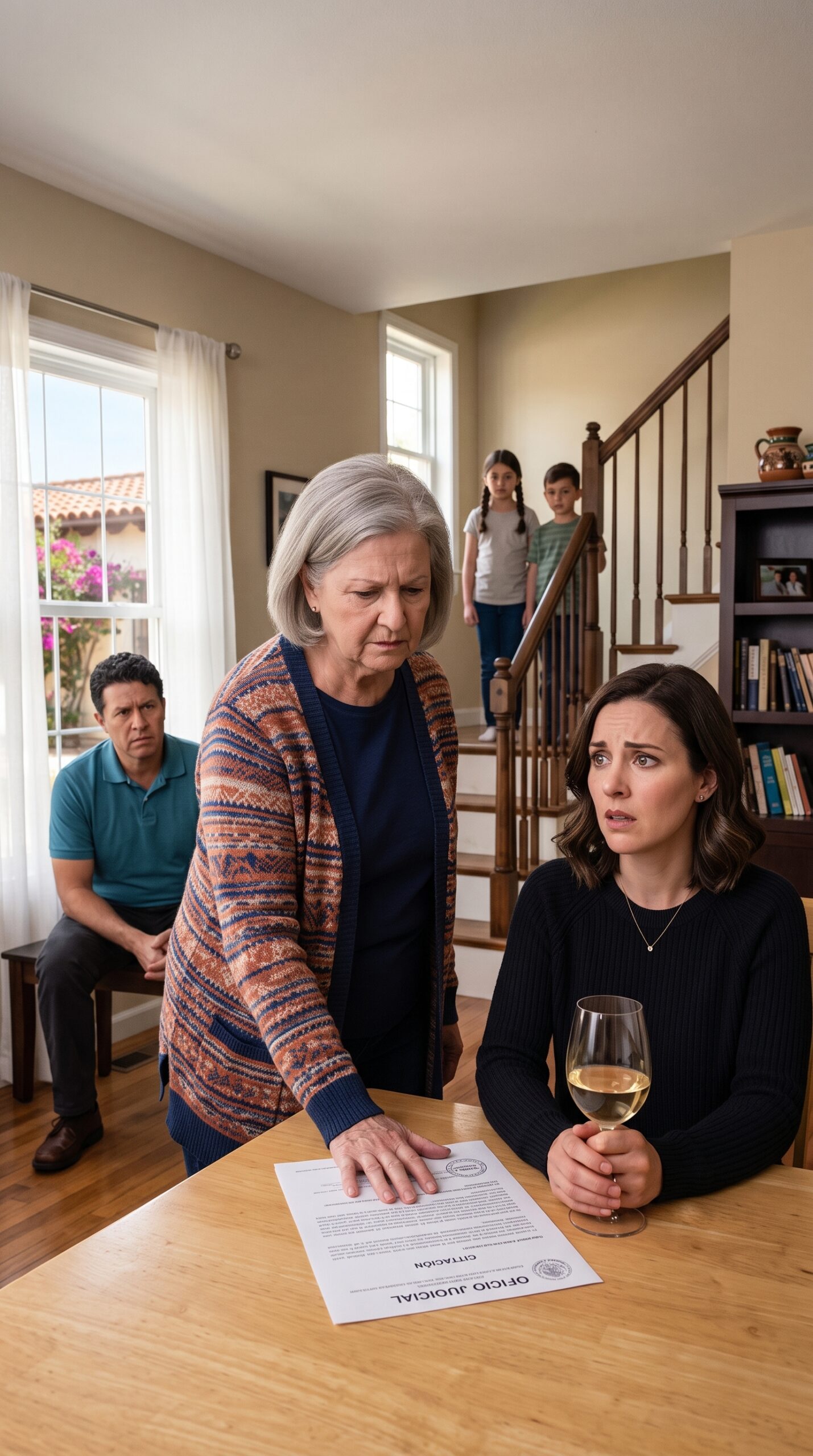
Doña Margarita didn’t cry when her daughter-in-law raised her glass of wine and smiled as if toasting to a victory.
—Thank you for living here all these years without paying a single peso, mother-in-law. But we’ve finally bought our own house. Now, you can finally move out and live alone.
The dining room turned icy.
Not even the clattering of cutlery against plates could hide the cruelty that had just unfurled. Andrés, her son, lowered his gaze and continued cutting his meat as if he hadn’t heard. Jacobo, age 10, froze in place. Lili, age 7, gripped her glass with both hands, her little eyes wide, already understanding too much.
The house stood in a quiet neighborhood of Querétaro, one of those old homes adorned with bougainvillea at the entrance, cantera tile floors, and the smell of coffee brewing in the morning. Doña Margarita had lived there for 12 years since her husband, Don Samuel, had passed away.
Melina, her daughter-in-law, always said the house was “too big for a lonely old lady.” But she never said it with affection. She said it like one might regard an old piece of furniture that was just in the way.
—Mom… —Andrés murmured, not lifting his head.
But Doña Margarita raised a gentle hand, steady and unshaken.
She wasn’t going to beg.
She wasn’t going to ask for a corner.
She wouldn’t allow herself to be humiliated in front of her grandchildren like she was some burden.
She adjusted her napkin on her lap, took a deep breath, and smiled. Not a sad smile. A calm smile. Almost kind.
That was what baffled Melina.
She had expected tears. She expected shame. She expected Doña Margarita to break down like those times Melina had called her “confused” or “nosy” in front of guests.
But the old woman simply said:
—I’m glad, Melina. I’m happy you finally want to start your own life. Because I have news too.
The knife slipped from Melina’s hand, clattering against the plate.
Andrés raised his head for the first time.
—What news, Mom?
Doña Margarita looked at her son with tired tenderness. Andrés had deep circles under his eyes, slumped shoulders, and that face of a man who had been obeying for years just to avoid conflict.
Then she turned to Melina.
—A piece of news that concerns you more than anyone else at this table.
Melina clenched her jaw.
Minutes before dinner, while Doña Margarita was finishing the red rice in the kitchen, she had overheard Melina talking on the phone in the hallway.
—Finally, the old lady’s going to leave —she had whispered—. I spoke with Licenciado Ceballos. Tomorrow Andrés is signing. And if necessary, we’ll make her sign too; she doesn’t understand what’s in front of her anyway.
Doña Margarita had stood frozen by the stove.
“Doesn’t understand.”
That’s how she saw her.
Like an old shadow, useless, half-blind, half-dimwitted, occupying a room that Melina believed she didn’t deserve.
But Melina didn’t know who Doña Margarita really was.
She didn’t know what she had sacrificed.
She didn’t know what Don Samuel had left her hidden away.
Doña Margarita leaned slightly toward the table.
—Your years here haven’t been free, Melina. But neither have mine. And this house… this house isn’t yours.
Andrés dropped his fork.
—What are you talking about?
—I’m saying this house was never in your name, son. It wasn’t in your father’s name in his last years. And it certainly isn’t in your wife’s name.
Melina turned pale.
—That’s a lie.
Doña Margarita didn’t look away.
—This house has been legally in my name for 12 years.
Lili let out a small sob.
Melina stood up so quickly that her chair scraped against the floor.
But the worst part for her wasn’t that the house wasn’t hers.
The worst part was that Doña Margarita had just heard the true plan she had prepared to take everything from her.
PART 2
—You can’t do this —Melina whispered, but her voice no longer sounded arrogant. It sounded scared.
—I’m not doing anything —Doña Margarita replied—. You are.
Andrés stood up slowly, his face twisted.
—Mom, explain.
Doña Margarita didn’t want to destroy him in front of his children. Not yet. So she simply said:
—Your father left documents. Many. And tomorrow you’ll see them.
Melina let out a dry laugh.
—Oh, please. Documents? From a lady who can’t even remember where she left her keys? Andrés, don’t believe her. She’s manipulating you.
Jacobo looked at his dad with anger.
—My grandmother isn’t crazy.
The dining room fell silent again.
That statement, coming from a 10-year-old, hurt more than any scream.
Melina turned to him.
—You stay out of this.
—Don’t talk to him like that —Andrés finally said.
It was a small phrase, but to Doña Margarita, it sounded like a door opening after years.
That night, no one finished dinner. Melina locked herself in the master bedroom, slamming drawers. Andrés sat in the living room, hands on his head. The children went upstairs crying.
Doña Margarita walked to her room, closed the door, and took a dark wooden box from the closet.
Don Samuel had given it to her two weeks before he died, when cancer had already devoured his body but not his mind.
—Mago —he had said, using the youthful nickname—, open this only if one day you feel the family is in danger or if someone tries to take away what we built.
For years, she hadn’t opened it.
She hadn’t opened it when Andrés asked her to stay with them “so she wouldn’t be alone.”
She hadn’t opened it when Melina started rearranging the furniture without asking her.
She hadn’t opened it when they took away the big room “because you are one and we are four.”
She hadn’t opened it when Melina said in front of her friends:
—My mother-in-law is nice, but she’s getting old. Sometimes she gets confused.
Doña Margarita stayed silent for her grandchildren. She stayed silent for Andrés. She stayed silent because Don Samuel always said that a family should first be defended with patience.
But that night she understood that patience could also become a license for others to abuse.
She opened the box.
Inside were the original deeds, the will, mortgage payment receipts, bank letters, and a notarized document. Don Samuel had transferred the entire property into Margarita’s name 12 years ago.
There was also a letter written in his firm handwriting.
“Mago, if you are reading this, forgive me for having carried this secret on your shoulders. Andrés is a good man, but he has a soft heart. If one day someone tries to use him to touch this house, remember: this house isn’t just walls. It’s your refuge. It’s the moral inheritance of our grandchildren. Don’t let anyone drive you out of here.”
Doña Margarita wept silently.
Not out of sadness.
Out of rage.
Because she understood that Don Samuel had seen the danger approaching before she had.
The next morning, she brewed coffee, placed sweet bread on a plate, and left a manila envelope on the table.
When Andrés came down, he looked like he had aged ten years overnight.
—Everything you need to know is in there, son.
He took the envelope with trembling hands.
Melina appeared behind him, hair tied up and cellphone in hand.
—Don’t open anything without my lawyer. Your mom is playing dirty.
Andrés looked at her.
—What lawyer, Melina?
She blinked.
—Well… one who’s helping us with the new house.
—The new house or this house?
Melina didn’t answer.
Andrés left without saying more. He took the envelope to his office at a construction company downtown. He didn’t call for hours.
Doña Margarita spent the morning cleaning slowly, as if each cloth over every piece of furniture reminded her that this house was still hers. At 12:30, the doorbell rang.
It was a man in a cheap gray suit, black portfolio, and a smile devoid of warmth.
—Good morning. I’m looking for Mrs. Margarita Rivas.
—I am.
—Licenciado Ceballos. I’m here to proceed with some pending papers. Your daughter-in-law told me you were already informed.
Doña Margarita opened the door just a bit wider.
—Papers for what?
The man cleared his throat.
—A temporary rights assignment. Something simple. So your son and his wife can use the property as collateral for the new house’s bridge loan.
There it was.
The full truth, standing at the entrance in a gray suit.
Melina hadn’t bought a house.
She had reserved a residence in Juriquilla with borrowed money, using as collateral a house that wasn’t hers.
—And you think I was going to sign that?
Ceballos smiled like he was talking to a child.
—Doña Margarita, these are family procedures. Your daughter-in-law said you trusted them.
—My daughter-in-law also said I didn’t understand a thing.
The man lost his smile.
At that moment, Melina rushed down the stairs.
—What’s he doing here? I told him to come back later!
Doña Margarita stepped aside.
—Come in, licenciado. Now that you’re here, let’s talk.
Melina froze.
—No, it’s not necessary.
—Of course it is.
The man hesitated, but entered. Doña Margarita left the door open, something that didn’t escape Jacobo’s notice, who was watching from the stairs with Lili behind him.
—Kids, go upstairs —Melina ordered.
—Let them stay —Doña Margarita said—. They’ve already heard too many half-truths.
Melina's cellphone started ringing. It was Andrés.
Doña Margarita answered before she could grab it.
—Son.
Andrés’s voice came through the speaker, broken.
—Mom, I’m with Notary Salvatierra. Everything you said is true. The house is yours.
Melina clutched her chest.
Andrés continued:
—And not only that. I just reviewed the bank statements. Melina withdrew money from the kids’ savings account. 480,000 pesos.
Lili began to cry.
Melina shouted:
—It was for the family!
—It was to secure your loan —Andrés replied through the phone—. And the licenciado just admitted they were going to present your signature as authorization if mom “didn’t cooperate.”
Licenciado Ceballos stepped back.
—I didn’t formally admit anything.
Doña Margarita pointed to the corner of the room.
—Don Samuel installed cameras years ago, licenciado. With audio.
The man turned pale.
Melina looked up. For years, she had mocked Don Samuel for installing cameras “as if they lived in a drug lord’s mansion.” Now those cameras were watching her as witnesses.
Andrés arrived 20 minutes later with the notary and a lawyer. He walked in without kissing Melina, without touching her, without asking for permission.
His eyes were red.
—Why? —he asked her.
Melina, cornered, changed her tone.
—Because I couldn’t stand living with your mom breathing down my neck. Because we never had privacy. Because everyone treats her like a saint and I always ended up being the bad guy.
Doña Margarita looked at her with sadness.
—I never asked you to love me. Just not to steal from me.
Melina hurled the last truth like a stone.
—The house should have been Andrés’s! Not yours! You’ve already lived. We have the right to start.
Jacobo stepped down a stair.
—And that’s why you wanted to kick my grandmother out?
No one answered.
The lawyer explained calmly that any attempt to forge Doña Margarita’s signature would be reported. She also requested to review the withdrawal from the kids’ savings. Licenciado Ceballos left his card, stuttered an excuse, and nearly ran out.
Melina tried to approach Andrés.
—My love, we can work this out.
He stepped back.
—Don’t call me that right now.
It was the first time Melina understood she wasn’t just losing a house.
She was losing control.
That afternoon, Andrés asked her to pack what she needed and go stay with her sister for a few days. Melina screamed, cried, accused Doña Margarita of destroying her marriage. But no one believed her anymore.
Lili hugged her grandmother’s legs.
—Are you going to leave?
Doña Margarita bent down slowly and wiped Lili’s face.
—No, my girl. This is your home too.
Jacobo asked:
—And my mom?
Doña Margarita felt her heart break because no child deserves to see their mother fall.
—Your mom will have to answer for what she did. But you and your sister are not to blame for anything.
In the following days, the truth continued to seep out like hidden moisture in the wall. Melina hadn’t just used the kids’ money. She had also taken loans in Andrés’s name, hidden bank notices, and pressured her husband to sign papers without reading.
The “new house” had never been a home. It was a showcase. A photo to flaunt. A way to tell her friends that she had finally removed “the mother-in-law” from the picture.
Andrés filed for divorce three weeks later.
It wasn’t an easy decision. He cried like a child in front of Doña Margarita, apologizing for every time he had stayed silent.
—I thought if I said nothing, the house would be peaceful.
Doña Margarita took his hand.
—Sometimes silence doesn’t bring peace, son. Sometimes it just gives permission for abuse.
Melina had to return the children’s money through a legal settlement. Licenciado Ceballos faced a lawsuit before the bar association. And the house, that house everyone had taken for granted, continued to smell like coffee, toasted bread, and wet bougainvillea after the rain.
Months later, at a Sunday meal, Andrés set the table. Jacobo made hibiscus water. Lili arranged flowers in a vase.
Doña Margarita sat at the head, not out of pride, but because finally no one was cornering her.
Andrés raised his glass.
—To my mom. To the house. And to learning, even if it was too late.
Doña Margarita didn’t smile right away.
She looked at the walls where she had raised her son, where she had bid farewell to her husband, where she had swallowed humiliations for the love of her grandchildren.
Then she said:
—Houses aren’t inherited just with papers. They are deserved with respect.
And that phrase hung heavy and clear over the table.
Because in Mexico, many believe that a mother should endure everything for the family.
But that night, Doña Margarita demonstrated something that made more than one uncomfortable: loving the family doesn’t mean allowing them to erase you from your own house.





