PART 1
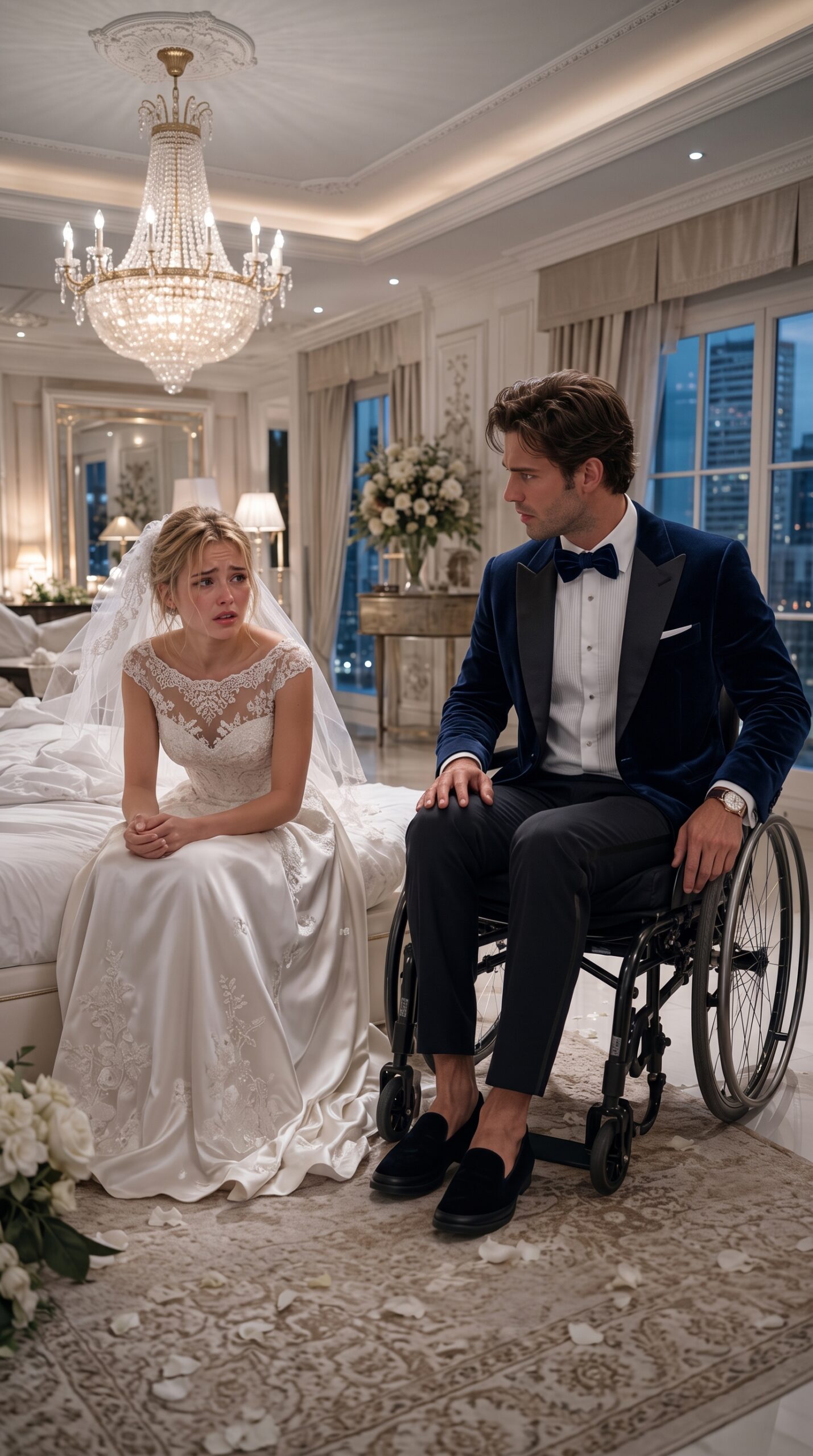
Camila Ríos's wedding night didn’t smell of flowers or champagne.
It smelled of fear.
From the window of a huge apartment in Santa Fe, the lights of Mexico City looked like jewels scattered on the asphalt. Outside, everything continued as normal: cars, sirens, people dining as if the world weren’t quietly fracturing.
Inside, Camila still wore her wedding dress.
The lace scratched her arms. The heels hurt her feet. The makeup had already smudged slightly beneath her eyes.
Before her stood Damián Salvatierra, owner of a medical software company, famous for his millions and for the accident that had left him in a wheelchair four years prior.
He was also the man her father had just married her off to in a desperate bid to save a textile factory in Naucalpan.
Damián didn’t approach.
He didn’t look at her as an owner.
He didn’t demand smiles, kisses, or “fulfilling the role of a wife.”
He simply placed his hands on the wheels of his chair and spoke with a rare calmness:
—The next room is ready for you. You can lock it. No one will disturb you here.
Camila lifted her face.
Those words hit harder than any scream.
For months, her father had repeated that she should be grateful. That Damián had bought the debts, that he had saved jobs, that a decent woman didn’t cause scandals when the family was at stake.
But no one asked her if she wanted to marry.
No one.
—I can’t —she whispered.
Damián paused before leaving.
—You can’t sleep there?
Camila gripped the wilted bouquet tightly between her fingers.
—I can’t be your real wife.
The silence grew heavy.
Damián observed her intently, not with hurt pride. There was something in Camila’s voice that didn’t sound like rejection.
It sounded like a door locked from the inside.
—Camila, you don’t have to explain anything to me tonight.
She let out a small, broken laugh.
—My dad said I did. He said you were an important man. That I couldn’t make a fool of myself in front of you.
Damián lowered his gaze for a second.
—I invested in your father’s company. I didn’t buy your body.
Camila froze.
As if no one had ever said something like that to her in years.
—You don’t understand —she said—. There are men who don’t need to buy. They just come and take.
Damián felt something cold creep up his spine.
—Who?
Camila opened her mouth, but the phone vibrated on the bed.
1 call.
Then another.
Then another.
The name lit up the screen like a threat.
MAURICIO.
Camila turned pale.
Damián caught a glimpse of it.
—Who is Mauricio?
She grabbed the phone with trembling hands, but before she could turn it off, a message came through.
“You look so pretty playing the wife. Tell the cripple to come down. I’m in reception.”
Damián looked toward the door.
Camila stepped back, almost holding her breath.
And just then, the intercom of the apartment started buzzing.
PART 2
Damián didn’t waste a second.
He grabbed his security tablet, opened the lobby camera, and saw a tall man in a dark blue suit, an expensive watch, and a politician’s campaign smile.
He held a bouquet of red roses.
He didn’t look like an intruder.
He looked like someone used to having all doors opened.
Camila covered her mouth.
—Don’t let him up. Please, don’t let him up.
—Is it him? —Damián asked.
Camila didn’t answer.
But her whole body had already screamed yes.
Mauricio Galván was the son of a former deputy from the State of Mexico, owner of several construction companies, and an expert at smiling while destroying lives.
He had been Camila’s boyfriend for almost three years.
At first, he sent her flowers, took her to dinner in Polanco, told her she was different, that he truly wanted to marry her.
Then he started checking her phone.
Next, her clothes.
Then her friends.
Then her schedule.
When Camila tried to leave him, Mauricio locked her in a house in Valle de Bravo for five hours until she apologized for wanting to go.
Damián called Mariana Lobo, his lawyer.
Then he called Efraín, the building’s head of security and a former police officer.
Then he called reception.
—Don’t let him up. Record everything. If he insists, call the police.
Below, Mauricio smiled at the guard.
—I’m here to congratulate the bride. I’ve known her since before that poor guy.
The guard hesitated.
Mauricio lowered his voice, but the camera captured it perfectly.
—Don’t get involved in problems that aren’t yours. That girl was mine before the cripple felt like a prince.
Camila heard the phrase through the tablet.
She froze.
Damián clenched his jaw but didn’t explode.
He simply said:
—You belong to no one.
She looked at him as if those four words were a new language.
Mauricio didn’t come up that night. Efraín arrived with two security personnel and escorted him out of the building while he threatened with surnames, calls, and favors.
But Camila didn’t sleep.
At 6:18 in the morning, she received 17 messages.
A photo of her father’s factory entrance.
A photo of the parish where her mom sold raffle tickets.
A photo of Damián’s adapted car leaving his office.
And one last image: the front of the art workshop that Camila had closed because of Mauricio.
The message read:
“I can touch everything you care about.”
Camila vomited in the bathroom.
Damián found her sitting on the floor, hugging her knees. He didn’t lift her. He didn’t touch her without permission.
He just stayed close.
—My dad knew —she said after a while.
Damián raised his gaze.
—What did he know?
—That Mauricio was stalking me. That he got into my apartment. That he threatened to destroy the factory if I spoke out. That once, he left me without keys and money because he saw me greeting a painting teacher.
Her voice cracked.
—My dad said not to make noise. That Mauricio had connections. That if I reported him, he’d sink us. Then you arrived with the investment… and my dad thought marrying you was the cleanest way to hide me.
Damián clenched his fingers around the wheel of his chair.
—He switched you to another cage.
Camila cried silently.
That same day, Mariana Lobo filed an urgent protection request. Efraín reviewed old footage, access logs, calls, messages, and reports that had never progressed because someone “lost” paperwork.
Two more women appeared.
A nurse from Querétaro.
A designer from Oaxaca.
Both had dated Mauricio.
Both had been threatened.
Both had accepted money to stay silent because they feared ending up worse.
But upon learning that Camila was going to testify, they spoke up.
For three weeks, the Santa Fe apartment stopped feeling like a rich suite and became a space of silent warfare.
Lawyers, therapists, police, and digital experts came and went.
Camila began to remember details she had buried to survive.
Damián accompanied her without invading her space.
At 7, he made coffee.
At 8, he joined meetings.
At 9, he left cut fruit, sweet bread, and scrambled eggs in the kitchen, as if routine could teach her body that she was no longer in danger.
One morning, Camila saw him struggling with a heavy door in the studio.
—Do you want help?
Damián gave a slight smile.
—Wanting, yes. Needing, not always.
She lowered her gaze.
—I’m sorry. I didn’t mean to…
—I know.
Camila stood by the table.
—People must treat you horribly.
—Sometimes. Some talk to me like I’m a child. Others think my chair made me a saint. Others believe my life ended on a highway.
She looked at him differently.
Damián continued:
—but no one is just one thing. Not a chair. Not a fear. Not an arranged wedding.
Camila swallowed hard.
For the first time since the ceremony, she didn’t want to run away.
The protection order arrived on a Friday.
Mauricio couldn’t come near Camila, the factory, the apartment, Damián, or any place she was.
Damián wanted to believe that was enough.
Camila knew that men like Mauricio didn’t fear the paper.
They feared losing control.
The proof arrived on a Tuesday at 8:44 PM.
Damián was in a presentation with investors on Reforma. Camila was left alone, drawing for the first time in months. She sketched a woman from behind, wearing a red dress, standing in front of an open door.
Then the intercom buzzed.
—Delivery for Mrs. Salvatierra —a voice said.
—I didn’t order anything.
—It’s flowers, ma’am. They’ve already been paid for.
Camila hung up.
Three minutes later, someone knocked on the door.
Not once.
Three soft knocks.
Like someone who already knows the house.
Camila called Damián.
He didn’t answer.
She called Efraín.
Neither did he.
Then she heard the most horrible sound.
A key entering the lock.
The door swung open.
Mauricio appeared with a white box in hand and a twisted smile.
—Enough of pretending to be protected.
Camila felt her legs go weak.
—How did you get in?
—In Mexico, everything is bought, darling. A uniform, a sad story, and 8,000 pesos for the new guard.
He dropped the box on the table.
Inside was a red dress, cut with scissors.
The air left Camila.
It was similar to the one she had worn the night she tried to end things with him.
—I told you that color wasn’t for you —Mauricio murmured.
Camila looked at her phone.
Mauricio did too.
—Don’t you dare.
She took a breath as the therapist had taught her.
4 seconds.
6 seconds.
Again.
—You’re violating a court order.
Mauricio laughed.
—Oh, now you talk like your catalog husband. Seriously, Camila, how embarrassing. What’s next? Are you going to push him in his chair at parties so everyone cries?
Something changed in her.
The word no longer made her small.
It made her burn.
—Don’t name him.
Mauricio stepped closer.
—You defend him? He didn’t save you. He bought you more expensively than I did.
Camila lifted her face.
—He was the first man who could demand something from me and chose to respect me.
Mauricio lost his smile.
He grabbed her arm tightly, right where he used to leave marks that she covered with sweaters even when it was hot.
For one second, Camila was that girl trapped in Valle de Bravo again, begging for someone to knock on the door.
But this time, she didn’t beg.
She twisted her wrist downward, as Efraín had taught her, and broke free.
She grabbed a heavy lamp from the table.
—Get out of my house.
Mauricio scoffed.
—You don’t have a house. You have an owner.
Camila threw the lamp to the floor in front of him.
The crash echoed like thunder. The glass shattered, and Mauricio recoiled, covering his face.
Camila ran toward the door.
But before she could reach it, the door swung open.
Damián burst in, pushing his chair with brutal force. Behind him came Efraín, two police officers, and Mariana recording on her phone.
Mauricio froze.
Damián saw Camila’s red arm.
The cut dress.
The shattered glass.
The white box.
And the fake key lying on the floor.
—Arrest him —he said.
Mauricio tried to adjust his jacket.
—She let me in. We’re sorting out couple issues.
Camila stepped forward.
Her mouth trembled, but not her voice.
—I asked him to leave my life. I begged him with tears, with fear, with reports, and with a court order. But I never asked him to come back.
No one spoke.
Not even Mauricio.
The police reviewed the order. Mariana showed the messages. Efraín handed over the lobby recording, where the guard accepted the bribe.
When they put the handcuffs on, Mauricio looked at Damián with hatred.
—Does that make you a man? Sending patrols because you can’t stand up?
Damián didn’t blink.
—No. Being a man is listening when a woman says no.
Mauricio was led away, handcuffed, shouting that his dad would get him out before breakfast.
But this time, he didn’t get out.
Old reports were reopened. The nurse from Querétaro testified. The designer from Oaxaca did too. The guard confessed the bribe. The building’s cameras showed the break-in.
And then came the blow Camila didn’t expect.
In the hearing, Mariana presented a chain of messages between Mauricio and Héctor Ríos, Camila’s father.
“Give her a chance until after the wedding.”
“Don’t make a scene at the factory.”
“She’ll calm down when she understands it’s for everyone’s good.”
Camila heard those phrases and felt the floor drop away.
Not because of Mauricio.
But because of her father.
The man who should have protected her had negotiated her fear as if it were another bank loan.
When they left the courthouse, Héctor tried to approach.
His eyes were red, his shirt wrinkled, his voice broken.
—Daughter, I wanted to save the family.
Camila looked at him with a sadness that no longer asked for permission.
—I was the family, Dad.
He opened his mouth.
He had nothing to say.
Mauricio received preventive detention and then a sentence for breaking and entering, violence, threats, violating a court order, and bribery.
It didn’t erase the years of fear.
Nothing wipes that away completely.
But for the first time, Camila saw that justice doesn’t always arrive like in the movies. Sometimes it comes weary, late, filled with paperwork, but it arrives when someone decides to no longer remain silent.
Months later, she reopened her workshop in Roma Norte.
She named it “The Red Door.”
It had wide ramps, tables at various heights, huge windows, and walls filled with paintings made by women who had survived what others called “couple problems.”
Damián paid for the accessibility adaptations but didn’t choose a single painting.
—Your space, your rules —he told her.
On the opening night, Camila wore a red dress.
Not to challenge Mauricio.
Not to prove anything to her dad.
She wore it because she liked to feel alive.
Damián watched her from the back, surrounded by businessmen trying to talk to him about contracts while he only watched her smile.
Mariana approached him and whispered:
—You look so cheesy.
Damián smiled.
—Oh well. It was about time.
When everyone left, Camila sat next to him in front of the open door of the workshop.
The city roared outside, with tacos, honking, laughter, and that chaotic life that never stops.
—Do you remember the wedding night? —she asked him.
—Yes.
—When I said I couldn’t be your wife, I thought I was talking about you. But I was talking about him. About his shadow. About how it filled every room until I ran out of air.
Damián took her hand.
—And now?
Camila looked at the white walls, the ramps, the paintings, the open red door to the street.
—Now I have places where his shadow no longer fits.
Damián closed his eyes for a moment.
She leaned in and kissed his forehead.
—And you were never less for being in that chair. You were the first who didn’t need to be big to make me feel safe.
That night, Camila didn’t ask for forgiveness for living.
She didn’t ask for permission to wear red.
She didn’t call her dad.
She didn’t check the door twenty times.
She just turned off the lights in the workshop, took Damián’s hand, and stepped out into the street with the certainty that some weddings begin as a sentence but can also become the first step to reclaiming an entire life.





