PART 1
At 6:00 PM, in a small chapel in Zapopan, Don Aurelio Mendoza’s coffin lay surrounded by cheap flowers, two candles, and a silence that hurt more than any cry. His wife, Doña Teresa, 69 years old, sat in the front pew, a gray shawl draped over her shoulders. She had been married to Aurelio for 44 years, the owner of a tortilla shop in Guadalajara that always smelled of boiled corn, lime, sweat, and early mornings.
But that day, their three children were not there. Fernanda, the eldest daughter, always elegant and proud, didn’t come. Óscar, the son who boasted about real estate deals in Puerta de Hierro, was absent too. Nor did Marisol, the youngest, who claimed her father was an outdated and stubborn man. All three had sent the same text message: “We’re not going to say goodbye to someone who left us a debt of 92 million pesos.”
The supposed debt surfaced two days before the wake in a blue folder, complete with seals, letterhead, and threats of seizure. It stated that Don Aurelio owed 92 million due to tax irregularities, overdue fines, and misreported properties. Fernanda was the first to explode: “Mom, Dad ruined us. Seriously, how embarrassing.” Óscar said he wouldn’t show his face to the family. Marisol, with fake tears, insisted it was best to keep their distance.
Doña Teresa did not argue. She just put away her phone and looked at her husband’s coffin. Aurelio had been tough and quiet, but never lazy. He had risen at 3 AM since he was young. With hands scorched by the griddle, he paid for private schools, graduation dresses, surgeries, weddings, and even down payments on his children’s homes. And yet, when he died, the only thing they saw was a debt.
At the end of the mass, only three people remained: Doña Teresa, a neighbor named Chabela, and Toño, a young man whom Aurelio had picked up from the street when he was 13 and taught to work the dough. Toño helped carry the coffin; his children did not. When they closed the grave, Toño approached Doña Teresa and spoke almost into her ear: “Don Aurelio asked me to tell you something if his children didn’t come. To check the old machine. The first tortilla maker. The one he never wanted to sell.”
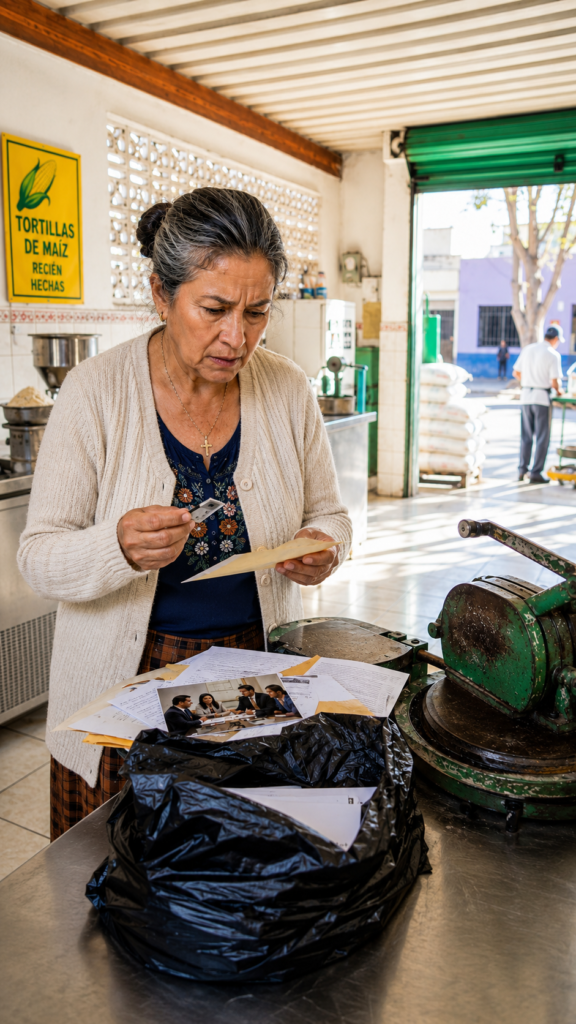
That machine had been collecting dust in the warehouse for years. Green, rusty, heavy. The children always called it “useless iron,” but Aurelio never allowed them to touch it. That very night, Doña Teresa went alone to the tortilla shop. The place was dark, filled with stacked sacks of corn and the smell of dry dough. At the back, covered with a tarp, was the old machine. Doña Teresa dusted it off, turned the crank, and noticed a loose plate. She opened it with a key. Inside was a black bag, a USB drive, and a yellow envelope with her name written by Aurelio’s hand.
Shaking, she opened it: “Teresa, if you’re reading this, our children chose to believe in a debt rather than in me. Don’t confront them yet. First, find out who signed the lie.” Doña Teresa pulled out some photos. In one of them, her three children sat in a luxurious office, next to Licenciado Bernardo Castañeda, the lawyer who had come to the wake to express his condolences for their “economic misfortune.” On the back of the photo, Aurelio had written: “They didn’t abandon me out of shame. They abandoned me because they thought they had already won.”
Then, the metal curtain of the tortilla shop began to rise. Doña Teresa hid the USB in her clothing. The door slowly lifted, and four shadows entered: her three children and the lawyer. No one in that tortilla shop could believe what was about to happen.
PART 2
Fernanda entered first, carrying an expensive bag and the expression of someone who came not to ask for permission but to give orders. Óscar walked behind, in a white shirt, a shiny watch, and a bossy look. Marisol wore dark glasses even though it was already night. And finally, Licenciado Bernardo Castañeda came in, immaculate, perfumed, with the same blue folder in hand.
—Mom —said Fernanda—, we knew you’d be here.
Doña Teresa didn’t respond. She just stood in front of the old tortilla maker, her hands cold and her heart pounding in her chest.
—We’re here to help you —said Óscar—. Before everything gets worse.
The lawyer smiled with an unpleasant calm.
—Doña Teresa, your husband’s debt is serious. If we don’t act today, the tax office can freeze accounts, seize the tortilla shop, and even your house in Tonalá.
Marisol sighed, as if tired of an old woman’s stubbornness.
—Just sign, Mom. It’s a temporary administration.
The lawyer placed the documents on the table where Aurelio kneaded dough every morning. Doña Teresa took the papers and read slowly. It wasn’t a temporary administration; it was a total transfer of rights. The tortilla shop, the warehouse, the house, and the small plot in Tlajomulco were to be under a commercial society whose only partners were Fernanda, Óscar, Marisol, and Bernardo Castañeda.
Doña Teresa looked up.
—Since when did you plan to take everything from me?
Marisol turned pale, and Óscar clenched his teeth. Fernanda let out a dry laugh.
—Oh, Mom, don’t start with the drama. You don’t understand business.
Those words hurt like a slap. Not because they were true, but because they came from the daughter to whom she made sandwiches at 5 in the morning before opening the business.
—I don’t understand business —said Doña Teresa—, but I do understand when a child comes to rob his mother.
The lawyer intervened quickly.
—She’s upset. It’s normal after a loss.
—I’m not upset. I’m awake —Doña Teresa replied with a firmness that surprised them.
Fernanda stepped closer, her voice even harder.
—Sign, Mom. Then we can sort it out as a family.
—Family? —she asked—. The same family that left the mass of your father alone?
No one responded. Óscar slammed his fist on the table in frustration.
—Dad left us a bomb. We’re just trying to save what’s left.
—No —said a voice from the back door—. You came to divide what wasn’t yours yet.
It was Toño. Fernanda looked at him with absolute contempt.
—You shut up. You’re nobody.
Toño lowered his gaze for a second, but then straightened up with pride.
—I’m nobody. But I was the only one who helped carry Don Aurelio.
That silence was worse than a scream. Doña Teresa took the pen the lawyer offered her. Her children relaxed, thinking they had won, but in a swift movement, she tore the papers in two.
Marisol screamed in horror.
—Mom, you’re crazy!
The lawyer lost his smile instantly.
—You just made a very costly mistake, ma’am.
Doña Teresa left the pieces on the table.
—The mistake was believing that an old woman in a shawl can’t read.
Óscar moved toward her in a threatening manner.
—You don’t know who you’re messing with.
At that precise moment, the back door burst open. Three agents entered with official identifications. A woman at the front showed her badge.
—State Prosecutor’s Office. Nobody moves.
The lawyer stepped back looking for an exit. Fernanda went pale, and Marisol began to cry, while Óscar glared at Toño as if he wanted to kill him. The agent pointed directly at the lawyer.
—Bernardo Castañeda, you are under arrest for falsification of documents, procedural fraud, criminal association, and attempted dispossession.
—This is ridiculous —he said, trying to hold his ground—. You have no proof of anything.
Toño pulled another USB drive from his pocket.
—Don Aurelio left a copy of everything.
Doña Teresa looked at him in surprise. Toño swallowed hard and explained.
—He told me you would guard yours as you guarded the money from the register, Doña Tere. He also told me that if they came tonight, I should call the authorities immediately.
The agent took the USB and looked at the lawyer.
—Here are audio recordings where you detail how to fabricate a false debt of 92 million to pressure the widow right after the funeral.
Fernanda fell to sit on a sack, completely disarmed. Óscar began to sweat cold. Marisol repeated through sobs:
—I didn’t know it was a crime… I didn’t know…
But they did know. Maybe they didn’t know the exact articles of the law, but they perfectly understood they were betraying their own mother. Doña Teresa felt her world shatter into a thousand pieces. The debt was false, the seals were false, the seizure was false, and the supposed love of her children was false too.
The agent explained that Aurelio had discovered the plan weeks before he died. Fernanda had requested copies of the deeds “for safety,” Óscar had brought hidden appraisers, and Marisol had signed as a witness in a shell company. The lawyer planned to sell the Tlajomulco land to a construction company and pocket most of the money. Aurelio, sick and silent, never confronted anyone in life. He prepared the complaint, kept the evidence, and set the trap inside the one thing his children always despised: the old machine.
When they took the lawyer away in handcuffs, Fernanda tried to take her mother’s hand. Doña Teresa pulled it away coldly.
—Mom, forgive us. We were manipulated —Fernanda pleaded.
—You were manipulated because you wanted to believe the lie to avoid feeling guilty —the mother stated.
Óscar lowered his head, ashamed.
—We were afraid of losing everything.
—You weren’t afraid of losing your father —she responded—. Nor afraid of losing me.
Marisol cried with a broken face.
—We’re your children, Mom.
Doña Teresa closed her eyes. That phrase had always been her weakness, but that night she did not break.
—Yes. You are my children. That’s why it hurts more. But being of my blood doesn’t give you the right to squeeze the life out of me.
Three days later, the will was read in a notary’s office in downtown Guadalajara. Her children arrived dressed in strict black. Now they came, but late, as always. Doña Teresa arrived accompanied by Toño. Fernanda looked at him with contained rage.
—Did you meddle in our affairs, and now you come for your cut? What’s he doing here?
The notary adjusted his glasses solemnly.
—Young Antonio Ramírez is explicitly mentioned in the will.
Óscar slammed his fist on the table.
—What? This is the last straw!
The notary proceeded to read the document. Aurelio left the house and the tortilla shop solely in Teresa’s name. The savings and the rest of the lands were protected in a blind trust for the widow’s support. As long as the Prosecutor’s investigation continued, her children would not be allowed to manage, touch, or sell anything.
But the final clause was what ultimately destroyed them morally. Forty percent of the future profits from the tortilla shop would be allocated monthly to a community kitchen for elderly people abandoned by their families.
Fernanda closed her eyes in frustration. Marisol covered her mouth to stifle a sob. Óscar muttered with anger:
—He’s humiliating us publicly from the grave.
Doña Teresa shook her head, profound sadness in her eyes.
—No, son. He’s not humiliating you. He’s portraying you just as you are.
The notary continued reading the last line:
—And names Antonio Ramírez as the operational manager with absolute power, for his loyalty, honest work, and for being present when others chose absence.
Óscar stood up furiously from his chair.
—That kid doesn’t even carry our last name! He’s a freeloader!
Toño, for the first time in his life, did not lower his gaze before them.
—I may not carry the last name. But I was with him until his last breath.
And that was enough. Because sometimes, the inheritance isn’t deserved by those who flaunt blood for interest, but by those who stay at the forefront when there’s nothing material to gain.
One month later, Doña Teresa reopened the tortilla shop. She didn’t change the original name, but she had a phrase painted under the main sign: “Founded with work. Defended with truth.” The old tortilla maker was completely restored and placed right in the center of the shop. Green, shiny, proud. People from the neighborhood came to see it as if it were a relic. Doña Chabela said that machine was miraculous, but Teresa knew it wasn’t a miracle; it was memory and justice.
As the weeks went by, the children began to seek her out. First with text messages, then with missed calls, and eventually with tears at the door. Fernanda arrived one afternoon without her designer bag or perfect makeup.
—Mom, please forgive me.
Teresa continued weighing the dough on the scale without looking at her.
—Forgiveness isn’t asked for when you get caught in the act, sweetie. It’s built day by day when no one is watching.
Óscar showed up days later offering “free help” with the business administration. She simply shook her head no. Marisol was the cleverest and brought the grandchildren. That did break the old woman’s heart. She hugged them tightly, gave them warm tortillas with salt, and kissed their foreheads. But when Marisol tried to take advantage of the moment to talk about the trust and the money, Teresa firmly pointed to the street door.
—Your children will always have a guaranteed meal here. You, to enter, will have to bring the truth upfront.
The community kitchen opened its doors on a Sunday. Solitary elderly people, widows forgotten by their families, and older men who no longer had anyone to serve them a hot meal arrived. There were beans from the pot, rice, salsa from the mortar, fresh cheese, and tortillas fresh out of the machine. Toño was by the griddle watching the fire. Doña Teresa was at the cash register. On the main wall hung a photo of Aurelio, serious, stubborn, with his hat, as if he were still watching over the heritage he worked so hard to build.
That same afternoon, Teresa found another envelope hidden in an old drawer in the office. It read: “For when you stop crying for me and start living for yourself.” Inside was a letter where Aurelio apologized for not telling her the truth from the beginning. He said he too was to blame for giving too much to his children and teaching them too little about the value of effort. He gave them houses, expensive education, and money, but he never set limits. In the end, he reminded her of something she often forgot:
“You counted every coin, Teresa. You cleaned the tables. You endured the heat of the griddle, the debts, the tiredness, and my long silences as a stubborn man. I only put the name on the sign, but you put in the whole life.”
Doña Teresa cried in silence, sitting on the same wooden bench where her husband drank coffee at 4 AM. But this time she didn’t cry as at the funeral. At the funeral, she cried because Aurelio was gone forever; that day she cried because she understood that, in leaving, he had left her perfectly standing and protected.
Six months later, her three children received a conviction for attempted fraud and falsification of official documents. Because they had no serious criminal records and returned the original papers, they didn’t spend much time behind bars, but they completely lost their reputation, their real estate businesses, their high-society friendships, and that unbearable comfort of thinking themselves untouchable by the law. Lawyer Bernardo Castañeda, on the other hand, ended up locked up in prison. The construction company that intended to buy the land in Tlajomulco was thoroughly investigated for other similar dispossessions of elderly people in the region.
The story went viral in local newspapers and on social media in Guadalajara. The tortilla shop became famous. People came from Tlaquepaque, Tonalá, Zapopan, and even tourists from Mexico City just to see the famous green machine where a dead man had hidden the truth to save his wife.
But the real justice happened one rainy morning. Doña Teresa opened the shop very early and found her three children standing outside, under the rain. They came without lawyers, without blue folders, and without demands for money. They held a bouquet of flowers in their hands, but they weren’t for her; they were for Aurelio’s altar.
Fernanda spoke first, her voice trembling.
—Mom… can we come in?
Teresa looked at them for a long moment in silence. For a brief second, the gray shawl seemed to weigh less, and she saw in their faces the little kids who used to run happily among the sacks of corn, their hands full of flour and their mouths stained with hot tortillas. She opened the iron curtain completely.
—You can come in. But let one thing be clear: no one enters here as the owner of anything. If you enter, you enter as workers from the ground up.
The three accepted, lowering their heads. That morning, for the first time in decades, Don Aurelio’s children cleaned tables, carried heavy sacks of corn, and served meals to the elderly in the community kitchen. They heard firsthand the stories of other parents forgotten by children who only showed up when there were wills involved. No one preached to them or demanded anything; true shame needs no explanation.
At noon, Fernanda slowly approached and touched the surface of the old machine.
—All our lives we saw it as a piece of old trash, Mom —she said with teary eyes.
Teresa stepped closer, took a freshly made, puffed, warm tortilla, and placed it directly in her hand.
—You saw it that way because you never really knew hunger, sweetie.
Fernanda broke down in uncontrollable tears. And this time, Doña Teresa did embrace her tightly. But she didn’t do it as a submissive mother who lets herself be trampled by the fear of being left alone in old age; she embraced her as the strong woman who had regained her dignity and her name.
Don Aurelio Mendoza did not leave them a debt of 92 million pesos. He left them a life lesson worth much more than any bank account or property in Puerta de Hierro: family is never measured by the blood that is flaunted at parties, but by the real presence and support demonstrated when there’s absolutely nothing material to gain.
Since then, every morning, when the first scent of hot corn completely fills the tortilla shop in Zapopan, Teresa looks tenderly at the green machine and whispers into the air:
—I’ve understood the lesson, you stubborn old man.
Then she calmly lights the griddle, opens the main door wide, and lets the entire neighborhood come in to eat freshly made justice.





