PART 1
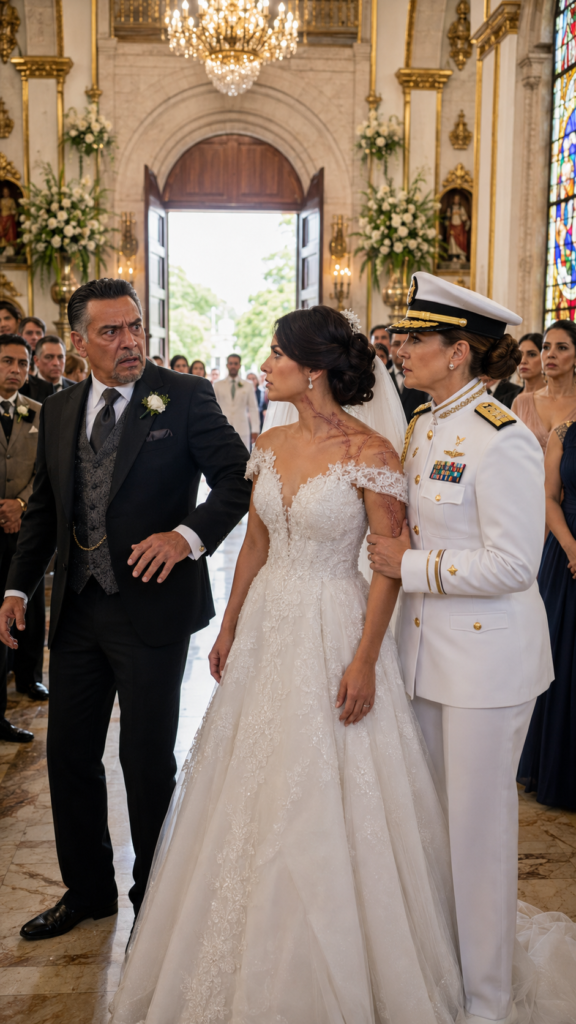
Three minutes before the wedding march began, Roberto Arriaga looked at his daughter’s neck and recoiled as if he had witnessed a tragedy.
The scars ran from Mariana’s jawline down to her left shoulder, thin in some places, deep in others, like paths of fire across her skin.
She stood there in her wedding dress, trembling bouquet clutched in her hands next to the door of an ancient chapel in Coyoacán.
Roberto adjusted his silver cufflinks, turned to the pews filled with businessmen, politicians, family from Guadalajara, and naval officers, and murmured with a coldness that shattered her soul:
—I will not give a marked woman away at the altar.
Mariana did not cry.
Not because it didn’t hurt.
But because she had learned to breathe while everything burned.
She survived an explosion on a naval vessel off the coast of Veracruz.
She had spent six months undergoing surgeries, rehabilitation, and sleepless nights.
She had learned once again to lift her left arm.
And now, the man who was supposed to take her arm to walk her down the aisle looked at her as if her wounds were a family disgrace.
—Dad… —she whispered.
—Don’t call me Dad right now —he replied—. This wedding will be in magazines, on websites, on social media. Do you know what they will say? Do you know how Grupo Arriaga will look next to… that?
That.
That’s what he called his daughter’s scars.
He didn’t care that Mariana was a Lieutenant Commander.
He didn’t care that she had saved four colleagues trapped in smoke and twisted metal.
He didn’t care that she had sent money for years to support the family business when it was on the brink of collapse.
To Roberto, Mariana was just a poorly cared-for photograph.
An awkward detail.
A stain on his perfect image.
His younger sister, Renata, appeared behind him in an emerald green dress with a face of feigned concern.
—Mari, seriously, Dad’s just nervous. We told you to wear the high-neck dress. No one had to see that.
Mariana lifted her gaze.
—That’s who I am.
Renata pressed her lips together.
—Don’t exaggerate. Just think a little about the family.
At that moment, Julián, Mariana’s fiancé, approached with a tense jaw.
—Mr. Arriaga, with all due respect, you have no right to speak to her like that.
Roberto let out a dry laugh.
—You keep out of this, boy. You’re not part of this family yet.
Mariana grabbed Julián’s hand to stop him.
—Not here.
Roberto believed he had won.
He stepped toward her and said more softly, but with more venom:
—You will walk alone. That way, everyone will understand that even your own father knows when something should not be shown.
Then the chapel doors opened.
The murmurs died abruptly.
All the officers stood up.
Admiral Teresa Castañeda walked down the aisle, one of the most respected women in the Mexican Navy.
Her white uniform seemed to illuminate the entire chapel.
Roberto lost all color.
He had spent two years trying to approach her because his construction company was seeking million-dollar contracts to modernize docks and shipyards.
The admiral walked straight to Mariana.
She saw the scars.
Then looked at Roberto with a calm that froze more than a scream.
—You may be ashamed of your daughter’s marks, Mr. Arriaga.
Then she offered her arm to Mariana.
—But I know exactly how she earned them.
The silence broke with applause.
First, the sailors.
Then the guests.
Julián had tears in his eyes.
Roberto stood frozen by the door, humiliated before everyone.
When they reached the altar, the admiral leaned toward Mariana and whispered:
—The file arrived this morning.
Mariana maintained her smile.
—Is it enough?
Teresa replied without looking at him:
—Enough to sink it all.
At the back of the chapel, Roberto understood that woman had not come merely to accompany the bride.
She had come for him.
PART 2
The ceremony continued as if nothing had happened.
The priest spoke of love, loyalty, and building a life together.
Mariana smiled.
Julián squeezed her hand.
The guests took photos.
But Roberto Arriaga no longer seemed the powerful businessman everyone knew.
He was sweating.
Checking his phone every twenty seconds.
Glaring at the admiral with the eyes of a cornered animal.
For eight months, Mariana had kept a secret that burned more than her own scars.
She hadn’t just survived a naval accident.
She had discovered who caused it.
It all began when she returned to the family home in Las Lomas to recover.
Her mother, Alicia, cared for her in silence, but Roberto barely entered to see her.
He claimed he had meetings.
That he couldn’t stand hospitals.
That the business was going through delicate moments.
One morning, Mariana went downstairs to get medication because the pain wouldn’t let her sleep.
Passing by the study, she heard her father’s voice on the phone.
—The certificates are already signed. No one will review those plates before installation.
Mariana froze.
—What if they fail? —asked another voice.
Roberto let out a laugh.
—Then they’ll blame the commander, the weather, or maintenance. We’ll have already cashed in.
Mariana felt the floor drop out from under her.
Grupo Arriaga manufactured metal components for naval support vessels.
And she knew full well what happened when a defective piece entered an engine room.
Fire would come.
Smoke would come.
Death would come.
That night she began to investigate.
Without making a scene. Without confronting anyone.
She copied emails.
Photographed contracts.
Reviewed invoices.
Found ghost companies in Querétaro, inflated accounts, bribes disguised as consultations, and monthly payments to former officials.
But the most brutal blow came three weeks later.
In a folder hidden behind a false bookshelf, she found the file on the vessel where she nearly died.
The thermal plate that failed in the explosion had come from a subsidiary of Grupo Arriaga.
The resistance tests had been altered.
And the final authorization had a signature.
Roberto Arriaga.
Her father.
The man who had just called her a “marked woman” had profited from the defective material that left her scarred forever.
Mariana didn’t scream when she discovered this.
She didn’t break anything.
She didn’t confront him.
She did something far more dangerous.
She gathered every piece of evidence and handed it to the Navy.
That’s why Admiral Teresa Castañeda was at her wedding.
Not by chance.
But for justice.
After the newlyweds’ kiss, the reception began in an elegant estate in the State of Mexico.
There was live music, glasses of champagne, arrangements of white flowers, and tables filled with people who pretended not to have seen Roberto’s disdain for his daughter.
But everyone had seen it.
And everyone was waiting for the next blow.
Roberto approached the admiral with a forced smile.
—Admiral Castañeda, what an honor to have you here.
She barely glanced at him.
—The honor is accompanying an officer who knows what it means to serve.
—Mariana has always been very intense —he said—. Since she was a child, she liked to call attention.
The admiral set her glass down on the table.
—Does calling attention mean entering a fire zone twice to rescue her comrades?
Roberto gulped.
—I didn’t mean that.
—Or are you referring to calling attention when a woman decides to denounce corruption even if the accused is her own father?
The sound of cutlery went silent.
Renata lifted her head.
Alicia, Mariana’s mother, turned pale.
Julián stepped closer to his wife.
Roberto tried to laugh it off.
—I don’t know what you’re talking about.
The admiral pulled out a thick envelope from a black folder.
—Then let’s remind you.
On a table, she laid out photographs, technical reports, bank statements, altered contracts, and copies of transfers.
Roberto looked at the documents.
His face fell apart.
—This is not valid.
—Yes, it is.
—They’re copies.
—We have the originals.
—That’s impossible.
The admiral leaned in slightly.
—The impossible thing was that your daughter came out alive from that explosion.
Roberto turned to Mariana.
Rage distorted his face.
—Did you do this?
Mariana did not look away.
—Yes.
—I’m your father!
—And I was your daughter when you saw me leave the hospital and the first thing you asked was whether the scars could be covered with makeup.
Renata intervened, nervous.
—Mariana, enough. You’re destroying the family.
Mariana looked at her sadly.
—No, Renata. The family was already destroyed. It’s just that you all called it prestige.
Roberto slammed his hand on the table.
—I did everything for you!
Alicia began to cry.
—No, Roberto. You did it for yourself.
The businessman looked at her, surprised.
His wife, who had endured humiliations, disdain, and screams for thirty-five years, finally raised her voice.
—You made your daughters compete for your approval as if they were employees. You called Mariana stubborn. You used Renata as a trophy. And you taught me to smile when life hurt.
Renata began to tremble.
—Mom…
Alicia wiped her tears.
—I will not be silent anymore.
At that moment, two federal agents entered the hall.
One showed an identification.
—Roberto Arriaga Medina, you are under arrest for fraud, bribery, falsification of technical documents, and presumed responsibility for damages derived from defective supply to naval facilities.
The music stopped.
The guests recoiled.
Just like Roberto had recoiled upon seeing Mariana’s scars.
He sought support among his partners.
No one approached.
Not the politicians.
Not the businessmen.
Not the lifelong friends.
Everyone looked at the floor.
Then the twist nobody expected happened.
Renata stood up crying.
—I have something too.
Roberto shot her a deadly glare.
—Sit down.
—No.
Her voice was broken, but firm.
—Dad asked me to delete emails from a computer five months ago. He told me they were tax problems. But I kept a copy because… because I no longer trusted him.
Mariana opened her eyes wide.
Renata pulled a USB drive from her bag.
—Here are the emails where Roberto ordered to change the resistance results of the plates. There are also messages where he asked to expedite delivery even though the batch was defective.
Roberto turned red.
—Ungrateful!
Renata cried with rage.
—I did everything you wanted my whole life. I dressed how you wanted. I spoke how you wanted. I criticized Mariana because you taught me to see her as a rival. But she almost died, Dad. And you were more concerned about the photos from her wedding than apologizing.
The hall fell silent.
Mariana didn’t expect this.
For years she thought Renata was her enemy.
But in reality, she had also been another daughter trying to survive Roberto’s conditional love.
The admiral took the memory stick.
—This will be added to the file.
Roberto lowered his head.
For the first time, he didn’t seem like a magnate.
He looked like an old man.
A 63-year-old man who had confused power with respect and fear with love.
The agents approached.
—You have the right to remain silent.
Roberto looked at Mariana.
For a moment, she thought he would insult her again.
But no.
His voice came out subdued.
—Did it hurt a lot?
Mariana felt a lump in her throat.
—What thing?
He pointed to her neck without touching her.
—That.
She took a deep breath.
—Yes.
—Were you scared?
—Very.
—Did you cry?
—Every night.
Roberto closed his eyes.
Tears streamed down his cheeks.
—I should have been there.
Mariana didn’t respond.
—I should have hugged you when you came back.
Alicia was crying silently.
Renata covered her mouth.
Julián held Mariana’s hand.
Roberto continued:
—I should have told you that you were still beautiful.
Mariana felt something inside her crack, but not from weakness.
From exhaustion.
From years of waiting for a phrase that came too late.
—Yes —she said—. You should have.
Roberto nodded.
—And I should have taken you to the altar.
Mariana looked at her dress, her scars, her bouquet, and the table filled with evidence.
Then she took a step toward him.
She didn’t embrace him like a happy daughter.
She embraced him like someone bidding farewell to a version of her life that no longer existed.
It was a brief hug.
Painful.
Human.
—I can’t save you from what you did —Mariana whispered—. But I won’t carry your shame either.
Roberto cried harder.
—Forgive me.
She closed her eyes.
—I don’t know if I can do it today.
She separated from him.
—But I do know that my scars were never this family’s shame. Your decisions were.
The agents escorted him out.
Before crossing the door, Roberto turned one last time.
—Mariana…
She looked at him.
—Thank you for being braver than me.
No one applauded.
No one celebrated.
Because this was not a clean victory.
It was justice, yes.
But it was also a broken family finally seeing the truth without makeup.
The admiral raised her glass.
—To Lieutenant Mariana Arriaga. To those who survive the fire and still have the courage to tell the truth.
Julián kissed his wife’s forehead.
Alicia embraced her two daughters.
Renata cried on Mariana’s shoulder, without asking for everything to be fixed immediately.
Because some wounds need time.
And some apologies do not erase the damage.
That night, Mariana touched the scar on her neck in front of everyone.
She no longer hid it.
She no longer covered it with her hair.
She no longer allowed anyone to call it a defect.
Because she understood that scars are not marks of shame.
They are proof that someone went through hell and chose not to stay there.
And perhaps that’s why the story went viral throughout Mexico.
Because many debated whether Mariana did the right thing by denouncing her own father on her wedding day.
But others said something simpler and stronger:
Blood makes you family.
But the truth decides who deserves to stay by your side.





