PART 1
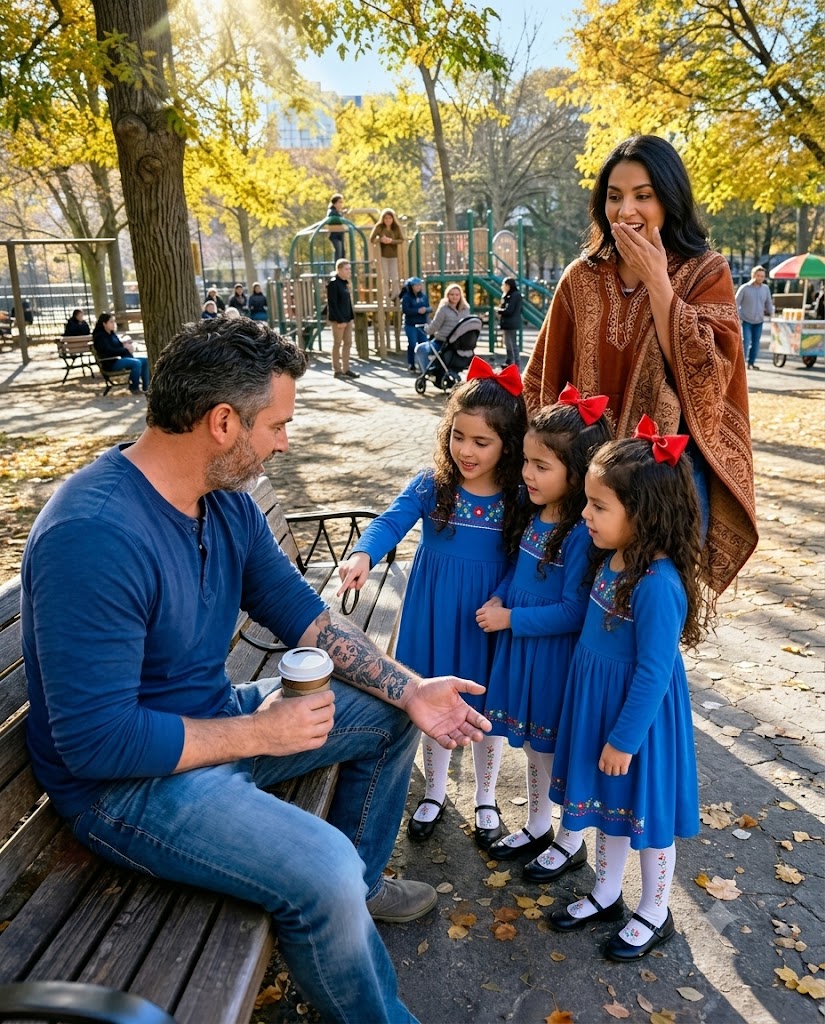
Diego Salvatierra sat on an old bench in Chapultepec Park, a watery coffee in hand, his mechanic uniform still stained with grease.
He had left the Portales shop early to clear his head before picking up his son, Mateo, from school.
At 36, Diego was no man of luxuries or dramas. A single father, hard-working, one of those who didn’t talk much because life had taught him that sometimes it was better to swallow the pain.
But that morning, three little girls dressed alike stopped in front of him and shattered his world with a single phrase.
—Sir, our mom has a tattoo exactly like yours.
Diego slowly lifted his gaze.
They were triplets. They had the same round little faces, the same enormous light brown eyes, and their hair tied up with white bows. Their beige dresses looked like they were bought in a boutique in Polanco, not from just any store.
The girl in the center pointed to his forearm.
There was the tattoo Diego rarely showed: a broken compass, with a crack running through the north and a small initial hidden among the lines.
A “C.”
—What did you say? —he asked, feeling his throat constrict.
The girl spoke with an innocence that hurt.
—My mom has one just like it. Only hers is here.
She touched her left shoulder.
Diego froze.
That tattoo wasn’t common. It was not a catalog design or a drunken trend. He had designed it himself on a napkin eight years ago, during a night in Mazatlán, when he still believed that getting lost could also feel beautiful.
The woman he had tattooed it with was named Camila.
Camila Robles.
An elegant, intense girl, with a dangerous laugh and eyes full of sadness. She appeared one night in a bar by the boardwalk, running from something she never wanted to tell.
They talked until dawn. They drank cheap mezcal, walked barefoot on the beach, and ended up in a hidden tattoo studio on a little street.
—A broken compass —Camila had said—. Because neither of us knows where the hell we’re going.
Diego had smiled that time.
And for the first time in a long time, he felt seen.
Then Camila disappeared.
No real number. No explanation. No goodbye.
She only left a folded note inside his jacket: “Forgive me. There are things one cannot escape.”
Since then, Diego tried to bury her in memory.
Until that moment.
—What’s your mom’s name? —he asked, lowering his voice.
The three girls looked at each other, as if they had just shared a forbidden secret.
One of them barely opened her mouth.
—Camila…
But she didn’t get to say more.
A woman in a gray uniform rushed towards them, her face pale with fear.
—Regina! Lucía! Valeria! What are you doing?
She grabbed the girls by the shoulders and pulled them away from Diego as if he were dangerous.
—I’m sorry, sir. They didn’t mean to bother you.
—I wasn’t bothered —Diego replied, standing up—. I just want to know who their mom is.
The woman swallowed hard.
—That’s none of your business.
Diego noticed she was shaking.
This wasn’t a nanny scolding mischievous kids. This was someone terrified.
—They said their mom has the same tattoo as mine.
The woman went even paler.
—Forget what you heard.
Then she glanced toward the avenue, where a black truck with tinted windows waited, engine running.
—If Mrs. Camila finds out that you talked to them, we’re going to be in big trouble.
Diego felt his heart pound against his ribs.
Camila.
This wasn’t a coincidence.
The nanny gently pushed the girls toward the truck. Diego took two steps after them.
—Wait. Camila Robles?
The woman paused for a second.
That silence was response enough.
Before getting in, one of the triplets turned back. The one in the center, Regina, pressed her little hand against the dark glass and moved her lips.
Diego couldn’t hear anything, but he could read it.
“Dad.”
The truck started and drove away.
And Diego stood on the sidewalk, coffee spilling over his fingers, understanding that what he had tried to forget for eight years had just returned to claim his whole life.
PART 2
Diego didn’t automatically pick up Mateo that afternoon. He arrived late to school, his head a mess, and the boy immediately noticed something was wrong.
—Did you get into a fight, Dad?
Diego tried to smile, but he couldn’t.
Mateo was ten and already knew his father’s sad faces too well. His mom had died when he was just three, and ever since then, Diego had raised him alone, through long shifts, hurried lunch packs, and nights where he pretended not to be tired.
—I saw someone from the past —Diego said.
—A bad person?
Diego stared out the bus window.
—I don’t know, son. I still don’t know.
That night, when Mateo fell asleep, Diego pulled out a metal box hidden in the closet. Inside were old papers, photos, receipts, and the yellowing napkin where he had first drawn the broken compass.
Also in there was Camila’s note.
“Forgive me. There are things one cannot escape.”
For years he had believed she left because she wanted to. Because she was rich, capricious, free. Because a mechanic without a fancy last name didn’t fit into her world.
But now there were three seven-year-old girls with the same look in their eyes.
And one of them had said “dad.”
Diego began searching the internet.
Camila Robles didn’t appear as Camila Robles.
She appeared as Camila Robles de Aranda, wife of Mauricio Aranda, a real estate businessman from Santa Fe, son of a powerful family, owner of towers, land, and political connections.
The photos took his breath away.
Camila was there, immaculate, smiling without a smile, with three identical girls by her side. Below, a social note read:
“The Aranda Robles heiresses celebrate their 7th birthday with an elegant private party.”
Diego clenched his fists.
The accounts didn’t fail.
Eight years ago, it had been Mazatlán. Nine months later, the girls were born.
The next day, he didn’t go to the shop. He borrowed money from a friend and followed the black truck from a distance to a private school in Las Lomas.
He waited outside for hours, feeling ridiculous, poor, and furious.
At noon, the same nanny went out alone to buy coffee at a nearby store. Diego reached her before she returned.
—I need to talk to Camila.
The woman almost dropped her cup.
—You don’t understand what you’re getting into.
—Then explain it to me.
She looked around, nervous.
—Not here.
They walked to a less busy corner. The woman said her name was Teresa. She had been taking care of the girls for six years.
—Mrs. Camila does know you —she whispered—. Sometimes, when she thinks no one is watching, she takes out an old photo of a man with that tattoo.
Diego felt a punch in the chest.
—Why didn’t she ever look for me?
Teresa looked down.
—Because they wouldn’t let her.
The story came out like an open wound.
Camila had returned from Mazatlán pregnant. Her father, Don Ernesto Robles, almost locked her up at home when he found out. The family already had an arrangement with the Arandas, an alliance of money, land, and power.
When Camila said she wanted to find Diego, they took her phone, erased contacts, and threatened to take the babies away as soon as they were born.
Mauricio agreed to marry her, but only if the girls were registered as Aranda.
—He knew they weren’t his —said Teresa—. Everyone in that house knew.
Diego felt sick.
—And Camila?
—She tried to escape when the girls were one year old. They found her at the bus station with three diaper bags and tickets to Guadalajara.
Teresa swallowed hard.
—Since then, they’ve been watching her.
Diego wanted to go straight to that mansion and break down the door, but Teresa stopped him.
—Don’t be foolish, sir. Those people don’t fight fair.
That same afternoon, Diego received a call from an unknown number.
—Diego? —said a trembling voice.
He closed his eyes.
It was Camila.
She didn’t sound like the free woman from Mazatlán. She sounded tired. Trapped. Broken.
—Are the girls mine? —he asked bluntly.
On the other end, there was a sob.
—Yes.
Diego had to lean against the wall.
All the rage he had carried mixed with something deeper: an old pain, the kind that doesn’t scream but shatters.
—Why didn’t you look for me?
—I did —she replied—. I went to your shop seven years ago.
Diego frowned.
—That’s not true.
—It is. Your mom opened the door for me.
The silence became brutal.
Diego’s mother, Doña Elvira, had died four years ago. A tough, proud woman who had never accepted any of her son’s partners because she said they all came to take advantage.
Camila continued.
—I told her I was pregnant. I asked for your number. I showed her the test. She told me you already had another life, that you didn’t want to know anything about me, and that if I really loved you, I should leave you in peace.
Diego felt his legs buckle.
It couldn’t be.
His own mother.
—She gave me money to leave —Camila said, crying—. I threw it on the floor. But when I left, my father’s men were already waiting for me.
Diego remembered his mother saying, years ago: “That woman would only bring you misfortune.”
He never imagined that phrase concealed three daughters.
The next day, Diego took Mateo to his aunt’s house and went to find Camila. Not alone. Teresa had given him copies of documents, printed messages, records with altered dates, and a DNA test that Camila had secretly done with a hair from Regina.
The result was clear.
Probability of paternity: 99.99%.
The confrontation happened during a charity event in a Santa Fe hall. The Aranda family was presenting a campaign about "family values" in front of businessmen, cameras, and ladies with pearls.
Camila was on stage, pale, with the triplets sitting in the front row.
Mauricio was speaking into the microphone.
—Family is built with honor, with last names, and with truth.
Then Diego entered.
He didn’t wear a suit. He wore a clean shirt, work boots, and his tattoo exposed.
The room began to murmur.
Mauricio recognized him instantly from the old photos he had surely seen. His smile disappeared.
—Who let this guy in?
Diego walked to the front.
—A father who came for the truth.
Camila covered her mouth.
The girls stood up simultaneously.
—It’s the tattoo guy! —Lucía shouted.
Regina ran first. Then Valeria. Then Lucía.
All three embraced Diego as if their hearts had recognized him before their memories did.
The entire hall froze.
Mauricio stepped down from the stage, furious.
—Let him go. That man is nobody.
Camila took the microphone with trembling hands.
—He is someone.
Her voice broke, but she didn’t let go of the microphone.
—He is the biological father of my daughters.
The scandal exploded.
Don Ernesto Robles tried to stand up, but Camila continued.
—My family forced me to marry. They hid me. They altered documents. And Mauricio accepted to raise the girls only to keep the business merger.
Mauricio tried to snatch the microphone from her.
—Shut up, Camila!
But Teresa, from the side, plugged a USB drive into the hall's screen.
A video appeared.
It was a recording from Mauricio’s office, where he was discussing with Don Ernesto.
“As long as the girls have my last name, Diego Salvatierra doesn’t exist. And if Camila opens her mouth, we declare her unstable.”
The murmurs turned into shouts.
Someone started recording with their phone.
Camila cried, but this time she didn’t lower her head.
Diego looked at Mauricio with a calm that was terrifying.
—You stole their right to know who they were.
Mauricio let out a bitter laugh.
—And what are you going to give them? A room in Portales? A greasy workshop? Give me a break. The girls have a chauffeur, a school, a future.
Diego clenched his jaw.
—I’m going to give them something you could never buy: a father who won’t use them as a business.
That phrase spread across social media before the night was over.
But the hardest blow didn’t come from Diego. It came from Regina, the girl who had called him “dad” from the truck.
She walked up to Mauricio and handed back a gold bracelet with his last name engraved on it.
—You always said that dad was the one in charge.
She looked at him with tears in her eyes.
—But he doesn’t even know us, and he already hugged us better than you.
Mauricio was left speechless.
For the first time, the man who used to boast power before everyone seemed small.
The legal battle lasted months.
There were threats, expensive lawyers, press coverage, and family members swearing that Camila was “exaggerating.” Don Ernesto tried to deny everything, but the documents, Teresa’s video, and the DNA test opened a door that no one could close.
Diego didn’t win a perfect family.
That doesn’t exist.
He won something much harder: the opportunity to start late.
The triplets met Mateo one Sunday in Chapultepec, on the same bench where it all began. At first, the four children looked at each other shyly, as if unsure of what to do with so much truth together.
Then Mateo pulled out a ball from his backpack.
—Want to play or what?
And the three girls ran after him laughing.
Camila sat next to Diego. She no longer wore gala dresses or borrowed smiles. She wore jeans, sneakers, and her shoulder was bare, showing the broken compass.
Diego looked at the tattoo.
—I thought that compass had lost us.
Camila shook her head slowly.
—No. It just took eight years to point the way.
Diego didn’t hug her right away. There was too much pain between them. Too many strangers’ lies. Too much time stolen.
But when the girls came running back and shouted “Dad!” without fear, something in him broke and healed at the same time.
Because sometimes blood doesn’t show up with scandals or important last names.
Sometimes it appears in the innocent voice of three girls who see a tattoo in a park and speak the truth that all the adults were too afraid to say.





