PART 1
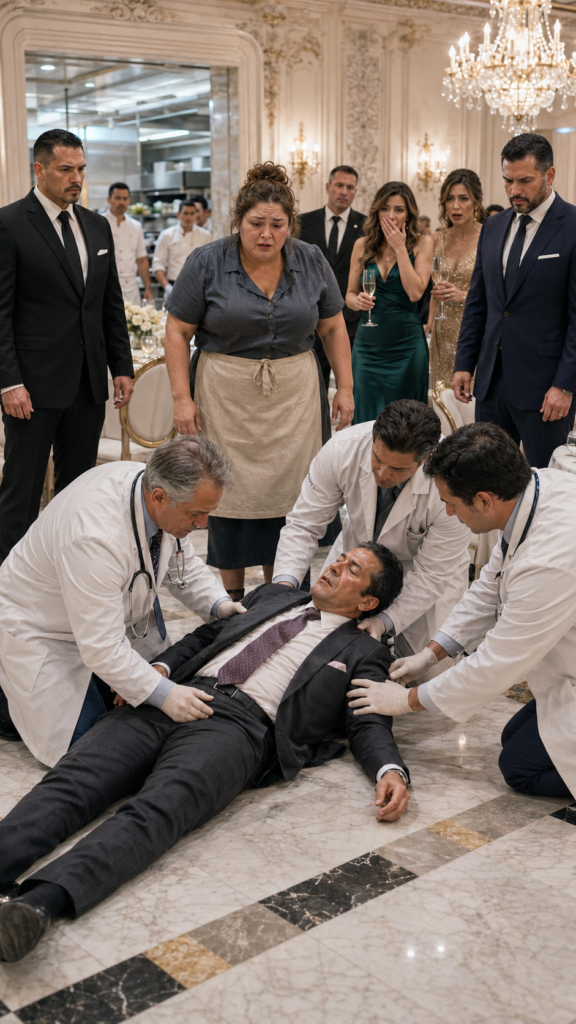
Don Rafael Cárdenas fell to the floor of the private room as if the strings holding him had been cut.
The impact shook the glasses, silenced the laughter, and froze the posh restaurant in Polanco. Outside, black SUVs continued to roll down Avenida Presidente Masaryk, but inside, no one dared to breathe.
The suited men jumped to their feet.
One pulled out a gun.
Another shouted for the private doctor.
And in the kitchen, beside the greasy sink, Nélida Herrera lifted her gaze.
Everyone knew her as Neli, the chubby dishwasher who arrived quietly, tied her apron, and endured heavy jokes without retorting. To the waiters, she was “the lady of the dishes,” even though she was only 39.
That night, while Marco, the chef, shouted for everyone to stay put, Neli saw something no one else did.
Don Rafael wasn’t having a heart attack.
His skin was gray, his lips moist, his pupils dilated, his pulse slow as if death were calmly pulling him in.
—Don’t move him! —she said from the door.
Everyone turned.
Damián, the youngest bodyguard, aimed his weapon at her.
—Get back to the kitchen, ma’am.
Neli didn’t flinch.
—If you lay him on his back, he’ll die right here.
The room went cold.
Don Rafael Cárdenas wasn’t just any businessman. In Mexico, everyone knew his name, though few dared to speak it aloud. He had legitimate businesses, foundations, restaurants, warehouses... and a dark reputation that trailed behind him like a shadow.
Neli crossed the dining room with her hands dripping with soap.
Marco murmured:
—No way, Neli...
She knelt beside the man half the country feared.
She took his wrist.
Counted.
Then brought her nose close to the glass of wine left on the table.
It didn’t smell only of alcohol.
There was something bitter, floral, hidden.
—He’s been poisoned —she said.
The word fell like a stone.
Old Victor, Rafael’s right-hand man, approached with a hardened face.
—What do you know about poisons?
Neli lifted her gaze.
—More than all of you combined.
Damián tightened his grip on the gun.
—Watch what you say.
Don Rafael barely opened his eyes.
—Let her... speak.
His voice was a thread.
Neli requested a pharmacy bag, sealed atropine, and clean water. She sent a waiter racing to the corner pharmacy. No one understood why a dishwasher was giving orders in a room full of dangerous men.
But something in her tone made them obey.
When the waiter returned, she took the medication and inhaled deeply.
—Before I do this, I need everyone to listen —she said—. My medical license is suspended. Legally, I shouldn’t touch anyone. If this goes wrong, you’ll say a dishwasher overstepped.
Victor eyed her with distrust.
—Medical license?
Neli didn’t answer.
She leaned toward Rafael.
—I need your permission.
Don Rafael, dying, looked at her as if he finally understood something.
—You have it.
—Say it clearly.
He gathered air from where there was almost none.
—Nélida Herrera has my permission to treat me.
Neli placed the medication under his tongue and held his wrist.
Seconds stretched into eternity.
His pulse continued to drop.
Damián cursed under his breath.
Marco began to pray.
Then Neli looked at Rafael and asked:
—What is Sofia’s favorite color?
Everyone exchanged glances.
Rafael blinked.
—Green.
—And what food did she like as a child?
—Peaches... with cream.
—When you survive, call her.
The eyes of the boss filled with something that wasn’t fear.
—She doesn’t answer me.
—Well, she better live to insist.
At 9:44, his pulse rose.
First 48.
Then 55.
Then 62.
The color returned to his lips.
Rafael Cárdenas breathed as if returning from a very dark place.
Neli exhaled.
—He’s going to live.
The room didn’t celebrate.
No one dared.
Only Rafael, pale and sweating, pointed at his glass with a trembling finger.
—Then... someone at this table wanted to kill me.
And everyone turned to the only person who had served that wine.
PART 2
The man who had poured the glass was named Ulises.
He had worked for Rafael Cárdenas for 22 years. He had carried Sofia when she was a child, accompanied funerals, baptisms, dirty deals, and Christmas dinners. In that family, Ulises wasn’t an employee. He was trust made flesh.
That’s why no one screamed.
That was the worst part.
Victor simply walked over to him and said quietly:
—Come outside with me.
Ulises went pale.
—Don Rafa, I...
Rafael didn’t raise his voice.
—Go with Victor.
Ulises looked at Neli as if she had condemned him with a single phrase. Then he exited through the private door.
Neli never saw him again.
And although she knew something terrible could happen to him, that night she didn’t have the strength to feel saintly. She had saved a man with a gun aimed at his chest. She had used knowledge the world had told her was worthless. She had heard her old title come from mouths that had once only called her “the fat one at the sink.”
The private doctor arrived 20 minutes later.
He entered wearing an expensive coat, a black briefcase, and an offended expression, as if Rafael had been rude for almost dying without notifying him.
He checked signs, listened to Neli’s summary, and pursed his lips.
—You did the right thing —he admitted begrudgingly.
Rafael, wrapped in a wool coat, didn’t take his eyes off her.
—Luck didn’t save me —he said—. It was because someone was watching.
Neli lowered her gaze.
It had been 4 years since anyone had seen her like this.
Then she returned to the kitchen.
The sink was still full.
The water was cold.
The dishes had dried sauce, stuck grease, and wine stains. Neli plunged her hands in and then started to tremble. She hadn’t trembled in front of the gun. She hadn’t trembled while counting the pulse. She trembled when she returned to the place where everyone thought she belonged.
Marco entered slowly.
—Neli... were you really a doctor?
—No.
He swallowed hard.
—But were you?
She turned off the tap forcefully.
—I was a clinical toxicologist. 14 years.
—And why didn’t you ever say anything?
Neli let out an ugly laugh.
—Were you going to pay me more for washing pots, dude?
Marco didn’t answer.
That morning, Neli walked to her rented room in the Doctores neighborhood. The building smelled of dampness, bleach, and street snacks from the corner. On a cardboard box, she had a diploma turned face down.
Nélida Herrera, Master’s in Clinical Toxicology.
She wiped it with her sleeve.
The woman on the diploma wasn’t dead.
She had simply been buried alive.
It all started with Caldera-Klein Laboratories, a powerful pharmaceutical that sold medication for chronic pain. Neli had detected a deadly interaction in certain patients. She reported it. Insisted. Testified.
And they destroyed her.
They bought experts, hid emails, pressured the hospital, and painted her as a resentful, exaggerated, conflictive woman.
Her husband, Julián, didn’t defend her.
On the last day, while packing his shirts into a suitcase, he told her:
—I hope one day you understand that being right isn’t always worth the cost.
She didn’t respond.
Because he had already left.
4 days later, a black SUV stopped in front of the restaurant.
Neli was sitting at the back entrance with a cold coffee in hand. She had 18 minutes until her shift began.
Rafael Cárdenas got out alone.
No visible bodyguards.
No boss’s hat.
Just a gray coat and that presence that made even stray dogs keep their distance.
—I have work for you —he said.
Neli stood up.
—I’m not going to work for a cartel.
—I already have enough criminals.
She almost smiled.
Rafael sat on the dirty step next to her. He didn’t call her into an office. He didn’t make her wait. He sat where she was.
—I need someone who understands substances, foods, medicines, imports, kitchens, wines, chemicals, supplements, and poisons. I don’t need them to have a medical license. I need them to have eyes.
Neli looked at the wet street.
—My eyes come with problems.
—My men come with records.
—That doesn’t reassure me.
—That wasn’t my intention.
He handed her a card with no name, just a number.
—Why me?
Rafael took a moment to answer.
—Because when I was dying, you didn’t ask about my money or my enemies. You asked about my daughter. You gave me something to hold on to.
The word daughter changed his voice.
—I haven’t spoken to Sofia in 6 years. Her mother died, and I turned the pain into a cage. Guards, rules, bodyguards, permissions. She left because she couldn’t breathe with me.
Neli remembered the weak pulse under her fingers.
—Call her again.
—I already did.
—And?
Rafael looked at the ground.
—She answered.
Neli clenched the card.
That was the first blow to the wall.
The second came 3 days later when she called the number.
A woman answered:
—Mr. Cárdenas’ office.
—I’m Nélida Herrera.
There was a pause.
—One moment, Dr. Herrera.
Doctor.
Neli had to sit on the edge of the bed.
She agreed to meet Rafael in a café in Narvarte, not in his office. She arrived in her usual black sweater and a cheap notebook.
—You said to set conditions —she said.
—I did.
—I need money; I’m not going to pretend I’m high-class. I owe rent, utilities, and my car sounds like a blender with rocks.
Rafael nodded.
—But it wasn’t the money they took from me.
—What did they take from you?
Neli looked him in the eye.
—My name.
Then she asked for the impossible: reopen the Caldera-Klein case, find the buried data, expose the bought experts, and publicly clear her license.
Rafael didn’t smile.
—That will be difficult.
—It was also hard to wash dishes while men who couldn’t even pronounce aconitine decided I was ignorant.
Rafael’s eyes shone with silent approval.
—I know lawyers.
—Sure.
—Not kind lawyers.
—I’m not looking for kindness.
And she added her last condition:
—I don’t manufacture harm. I don’t teach poisoning. I don’t help hurt the innocent. If I work with you, I prevent risks. Period.
Rafael placed both hands on the table.
—Accepted.
—Just like that?
—Just like that.
Neli knew he was serious.
The following months were a war without bullets, but just as brutal.
The lawyer Rafael introduced her to was named Mara Robles, a 56-year-old woman with red glasses and a calmness that was frightening. She had a firm on Reforma and a way of speaking that turned every sentence into a sentence.
—Caldera-Klein didn’t win —she told Neli in their first meeting—. They buried you in paperwork. It’s not the same.
For 6 months, Mara and her team uncovered what everyone had sworn didn’t exist.
Internal emails.
Disguised payments to “independent” experts.
Modified reports.
Minutes where executives referred to Neli as “the problematic fat girl from the hospital.”
But the real twist came in a 3-line memorandum.
“Ms. Herrera’s analysis is correct. The interaction confirms preventable toxicity. We recommend negotiating before public exposure.”
The date was 6 weeks before Neli’s original testimony.
They knew she was right.
They destroyed her anyway.
When Neli read that document, she entered the firm’s bathroom, closed the door, and covered her mouth with her fist. It wasn’t normal crying. It was rage emerging after 4 years trapped in her body.
The hearing took place in the same courtroom where she had been humiliated before.
Neli arrived in a navy blue suit, hair tied up, and hands steady.
In the hallway was Julián, her ex-husband.
He looked older.
—Neli —he said—. I heard they reopened the case.
—Yes.
—I also heard you’re working for Rafael Cárdenas.
—You heard right.
He lowered his voice.
—Be careful.
Neli almost laughed.
All her life, she had been told “be careful” when they really meant “shrink down.”
Be careful with your tone.
Be careful accusing a company.
Be careful embarrassing your husband.
Be careful thinking someone will hire you after this.
—I’ve always been careful —she replied—. That was never the problem.
Julián lowered his head.
—I should have believed you.
The phrase came too late.
But it didn’t come empty.
—Yes —she said—. You should have.
There was no hug.
There was no pretty reconciliation.
Sometimes regret isn’t enough to rebuild the house someone abandoned in flames.
In the chamber, the lawyers from Caldera-Klein no longer smiled.
Mara questioned Neli for 3 hours. This time, the documents supported every word. The internal data matched her original analysis. The experts were exposed as expensive theater.
When they asked for her conclusion, Neli approached the microphone.
—Caldera-Klein knew the risk was real. They knew patients could die. They had the data. They hid it. My original testimony was correct.
Her voice didn’t tremble.
At the back of the room sat Rafael Cárdenas.
He didn’t have to be there.
But he was.
Sitting in silence, with Victor beside him, watching her with the same intensity he had watched her from the floor of the restaurant.
When Neli stepped down from the stand, Rafael merely nodded.
And that gesture was worth more than applause.
The scandal exploded in the media.
The director of Caldera-Klein resigned “for family reasons,” which in Mexico always sounds like a fire in a tie. The medication was recalled. Lawsuits, investigations, and families finally got an explanation.
The medical board corrected Neli’s suspension.
They returned her license.
The hospital offered her reinstatement.
She said no.
Not because she didn’t want to be a doctor again. She had fought for that with nails, teeth, and soul.
But she learned something in the fall: institutions that abandon you for convenience don’t automatically deserve your return.
She opened Herrera Analytical Toxicology in a small office in Roma Sur.
On the first day she saw her name on the door, she stood still with a coffee in her hand.
It wasn’t a huge plaque.
It wasn’t luxury.
But it was hers.
Rafael sent flowers.
Not roses.
Purple aconite.
Neli called him immediately.
—Are you crazy?
—Good morning to you too, doctor.
—You sent me a poisonous plant.
—I thought you would appreciate the detail.
—It’s a botanical threat.
—It’s a precise homage.
Neli looked at the card.
“For the woman who knew what was killing me and refused to let me die.”
For the first time in years, Neli cried without feeling shame.
Rafael didn’t become a saint. This wasn’t a miracle novel. He remained a dangerous man, full of shadows and rooms where Neli didn’t enter.
But he kept his word.
His work prevented harm, it didn’t manufacture it.
The kitchens of his restaurants became safer than many hospitals. His men stopped buying counterfeit supplements. Wines were checked. Medications were registered. No one laughed when Doctor Herrera spoke.
And Rafael called Sofia.
That changed more than he admitted.
Months later, Sofia returned to Mexico City. She was an art restorer, 31 years old, with her father’s eyes and a sweetness that didn’t seem like weakness.
She met Neli in the same restaurant in Polanco.
Marco, the chef, came out to greet her.
—Doctor Herrera, your table is ready.
Neli could have humiliated him.
She could have reminded him of every mockery.
But she simply smiled.
—Thank you, Marco.
Sofia was waiting for her at the bar.
—You’re Neli.
—Yes.
Sofia looked at her for a long time, as if reconstructing a scene she hadn’t witnessed: a cold floor, a glass, a poison, a stranger holding her father’s wrist.
—He told me he asked about me.
—I needed to keep him conscious.
—He said you became his lifeline.
Neli swallowed hard.
—Sounds like something he would misinterpret.
Sofia smiled with tears in her eyes.
—He gets almost everything emotional wrong.
That night, the three of them dined at a normal table, not in the private room. Rafael complained about the music. Sofia teased him about his bodyguards. Neli personally supervised how they opened the wine, because healing didn’t mean becoming naive.
As she watched them bicker over dessert, Neli understood something.
Justice doesn’t always return what’s lost.
It doesn’t return the years, or the marriage, or the dead patients, or the version of oneself that trusted more easily.
But it can return one powerful thing: the truth spoken aloud.
Almost a year later, on a rainy afternoon, Rafael appeared at her office door with two coffees.
He never knocked like normal people. For him, doors were mere suggestions.
—You’re late —Neli said without looking up.
—We didn’t have an appointment.
—Still, you’re late.
He placed the coffee on the desk.
—Sofia got a workshop nearby. She’s staying in Mexico.
Neli smiled.
—That’s great.
—I’m worried about the parking.
—Of course. The national drama.
Rafael gazed at the wet glass.
—I wanted you to know that.
The simple trust of that phrase moved her more than she expected.
After a silence, he said:
—You saved more than my life that night.
Neli looked around her office, at the files, the plaque on the door, her name written where no one could hide it.
—I saved myself too.
Rafael nodded.
She thought about the sink. The apron. The gun. The bitter glass. About all those who had called her exaggerated, conflictive, useless, finished.
They had taken her job.
The marriage.
The license.
The reputation.
The name.
But they didn’t take her knowledge.
They didn’t take her steady hands.
They didn’t take that voice capable of commanding a room when everyone believes there’s no time left.
That night, Neli was supposed to stay in the kitchen.
That was what the world had left her.
A sink.
An apron.
A tiny silence.
But a man was dying on the floor, and she knew why.
So she stepped out.
Kneeled.
Took his pulse.
Asked about his daughter.
And while the most dangerous men in Mexico waited to know if their boss would live or die, Nélida Herrera remembered exactly who she was.





