PART 1
—Put another blanket on him and stop scaring everyone, Mariana. Seriously, it looks like you enjoy suffering.
That’s what Doña Rebeca said while she closed a beige suitcase in the living room of a house in Querétaro. On the table lay her passport, sunglasses, and two printed tickets to Cancun.
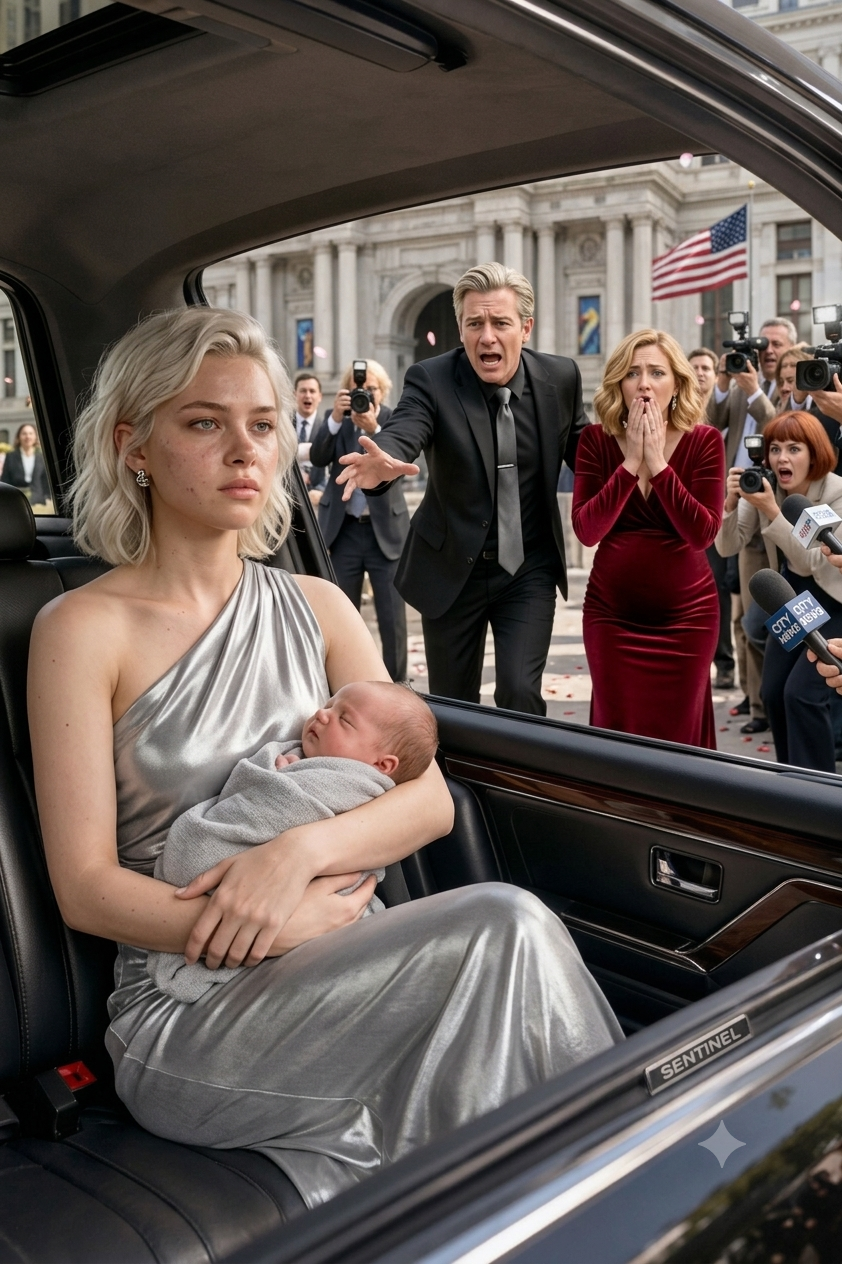
On the couch, Mariana held her four-day-old baby against her chest.
The boy was named Tomás.
He had been born by cesarean section on a Monday morning, after 18 hours of pain, fear, and prayers. When he cried for the first time, Andrés, her husband, broke down in front of everyone and promised he would never let anything happen to him.
But that morning, Tomás wasn’t crying.
He breathed as if something invisible were crushing his chest. His lips were purple, his fingers cold, and his skin had a bluish tone that sent chills through Mariana’s blood.
—Andrés, call 911 —she begged, her voice cracking—. Something’s wrong. Our son isn’t breathing well.
Andrés was checking his phone, confirming transportation to the airport.
He didn’t even approach her immediately.
—Mariana, please. Not again with your panic attacks.
Doña Rebeca let out a dry laugh.
—I raised three children without running to the hospital for every little thing. The girls nowadays think Google knows more than a mother.
Mariana tried to get up, but the cesarean wound burned like fire. Still, she walked toward her bag to search for her phone.
Doña Rebeca was quicker.
She grabbed it, turned it off, and stuffed it into her sweater pocket.
—No numbers —she said—. You’re going to lie down, calm yourself, and when we get back, we’ll talk.
—When you get back? —Mariana looked at her, confused—. Where are you going?
Andrés sighed, annoyed.
—to Cancun. It was already paid for. My mom needs a break and so do I. It’s been an exhausting few days.
Mariana looked at him as if she didn’t recognize the man in front of her.
—You’re going on vacation while your son is turning blue?
—My son needs a stable mom —he replied—, not a woman inventing tragedies every five minutes.
Then he opened Mariana’s bag, took her credit card, and slipped it into his wallet.
—I’ll use it, and then we’ll see. I don’t have time to argue right now.
Doña Rebeca, before leaving, dropped one last phrase:
—I also hid the charger. That way, you won’t spend all day searching for illnesses online.
The door closed.
The house fell silent.
Only Tomás’s labored breathing could be heard.
Mariana, barefoot, bleeding, and with the baby pressed to her chest, understood they hadn’t left her alone by accident.
They had locked her in her own emergency.
And no one in that house could imagine what was about to happen.
PART 2
Mariana searched for her phone in desperation.
She found it inside the diaper pail, wrapped in a damp towel, turned off and out of battery. She pressed it against her chest as if she could breathe life back into it with pure rage.
She checked drawers, suitcases, the kitchen, the bathroom, the baby’s room.
The charger wasn’t there.
Tomás made a sound so weak that Mariana felt the world shatter inside her. It no longer sounded like crying. It was barely a choked gasp.
She stumbled outside as best she could.
She wasn’t walking well. Every step opened the wound. Her gown was stained, her hair stuck to her face, and fear was buried deep in her bones.
—Help! My baby isn’t breathing well! Please, help me!
Doña Lupita, the neighbor from across the street, came out with a bag of tortillas in her hand. Upon seeing the baby, the bag fell to the ground.
—Holy Virgin...
She pulled out her phone and called 911.
Then she hugged Mariana to keep her from collapsing.
When the ambulance arrived, Tomás’s lips were nearly violet.
In the hospital, everything was quick, white, and brutal. A nurse took the baby, a doctor called for oxygen, another shouted low saturation. Mariana sat in a wheelchair, trembling, repeating a single phrase:
—I wanted to call earlier… they took my phone.
A social worker stopped writing and looked up.
—Who took it?
Mariana looked through the glass where they were trying to save her son.
—My husband and my mother-in-law.
Hours later, a pediatric cardiologist explained what no one in that house wanted to hear: Tomás had a critical congenital heart defect. He needed urgent care. Every minute lost weighed too heavily.
The baby survived that night.
He also survived the next.
While Mariana slept sitting next to neonatal intensive care, Andrés uploaded a photo from Cancun.
He appeared in a white shirt, dark glasses, and a drink in his hand. Doña Rebeca was beside him, smiling in front of the sea.
The caption read:
“Finally, a breath after so much drama.”
Mariana took a screenshot.
Then she saw another post from Doña Rebeca: boutique bags on a hotel bed.
“There are women who are born to make families and others to invent problems.”
She took another screenshot.
She didn’t cry.
She couldn’t anymore.
The pain had turned cold, precise, useful.
She requested copies of everything: ambulance report, admission time, medical notes, social work report, call record from Doña Lupita, and the cardiologist’s diagnosis.
Then she called from the hospital phone to Sofía, an old college friend who was now a family lawyer.
—I need to preserve evidence today —Mariana said.
—Against whom?
—Against my husband, my mother-in-law, the bank, the airline, the hotel, the rideshare taxi, the phone company, and the neighborhood cameras.
Sofía paused for a few seconds.
—What did they do?
Mariana looked at Tomás, connected to tubes too large for such a tiny body.
—They went to Cancun with my card while my son was dying.
Sofía took a deep breath.
—Then let’s make every minute count.
On the third day, Tomás got worse.
On the fourth, the doctors spoke of renal failure and damage from lack of oxygen. Mariana signed documents with hands that no longer seemed to be hers.
Andrés didn’t answer calls.
He only replied to an email when Tomás had been dead for six hours.
“Enough of manipulating us. When I get back, we’ll talk.”
Mariana didn’t respond.
She sent it to Sofía.
Then she returned home.
The crib was still set up. The green blanket was folded over the rocking chair. On the wall still hung a handmade sign with Tomás’s name, crafted by a work friend.
Mariana turned on Andrés’s computer.
He had never put a password on it.
She found messages.
Doña Rebeca had written:
“Take away her phone. If she calls emergency, she’ll ruin the trip.”
Andrés replied:
“Yes. I’m also going to use her card. Let her pay something after all that show.”
Mariana printed everything.
She also found hotel receipts, purchase confirmations, restaurant charges, and a bank authorization made with her card 22 minutes after she asked to call 911.
Five days later, a taxi stopped in front of the house.
Andrés and Doña Rebeca entered, laughing.
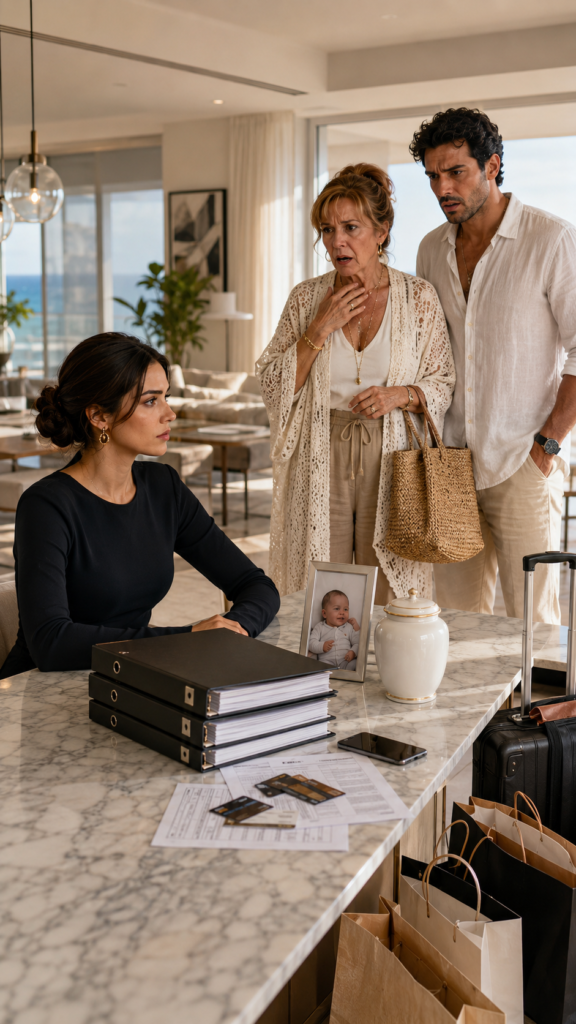
They were sun-kissed, with new suitcases and expensive store bags. Doña Rebeca wore a huge hat and bracelets that jingled every time she moved her hand.
Their laughter died upon seeing the living room.
Mariana sat at the dining table, dressed in black.
In front of her were four folders and a small urn covered with a white handkerchief.
Andrés dropped the suitcase.
—What is this?
Doña Rebeca looked at the urn and frowned.
—Mariana, seriously, what theater are you putting on now?
Mariana didn’t respond immediately.
She looked at her husband.
She searched for the man who had cried at the birth, the one who kissed Tomás’s forehead, the one who promised to be a father before being his mother’s son.
But she only saw the man who closed a door while their baby was running out of air.
—Tomás died Thursday morning —she said.
Andrés turned pale.
—No.
—Yes.
—Don’t say that.
—I say it because it’s true.
Doña Rebeca stepped forward.
—Diego… I mean, Andrés, don’t believe everything she says. She probably left the baby with someone to punish you. You know how she gets.
Mariana pushed the first folder forward.
—Medical report. Admission time. Ambulance report. Diagnosis. Social work report. Statement from Doña Lupita, the neighbor who called because you left me without a phone.
Andrés didn’t touch the papers.
Mariana pushed the second folder.
—Bank charges. Tickets, hotel, meals, purchases, and taxis paid with my card without authorization while Tomás was in intensive care.
Doña Rebeca raised her chin.
—That card belonged to the family.
—No. It was mine. And you took it while I bled in the living room with a newborn who couldn’t breathe.
Then she pushed the third folder.
—Messages. Yours, Andrés. Your mother’s. Her telling you to take away my phone. You agreeing. Her saying I’d ruin the trip. You replying that I should pay for all that show.
Andrés took a sheet with trembling hands.
He read.
His face changed from anger to confusion, from confusion to horror, and from horror to a shame so deep he couldn’t hold the gaze.
—I didn’t know it was that serious —he mumbled.
Mariana looked at him without blinking.
—You didn’t want to know.
—My mom said it was normal.
—You were his father, Andrés. Not a child waiting for permission to think.
That phrase crumpled him.
He fell into a chair, covering his face.
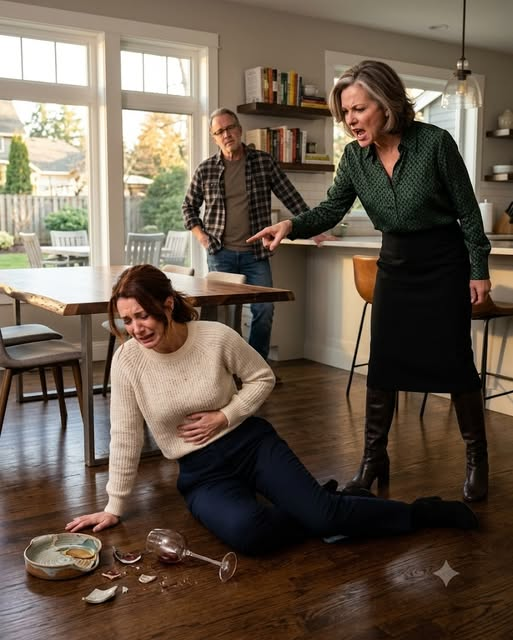
Doña Rebeca slammed the table.
—This is a trap! She always wanted to separate my son from me! She’s using the baby’s death to destroy us!
At that moment, there were three sharp knocks on the door.
Mariana stood up and opened.
Outside were two investigative police officers and Sofía, her lawyer, with a thicker folder than all the others.
—Mrs. Mariana Ríos —said one of the officers—, we are here to take your detailed statement and notify measures related to the investigation.
Sofía entered and looked at Andrés and Doña Rebeca.
—You are being investigated for possible omission of assistance, deprivation of means of communication, unauthorized use of a bank card, and interference with urgent medical care.
Doña Rebeca placed a hand over her chest.
—I was just trying to take care of my daughter-in-law. She was hysterical.
Sofía opened her folder.
—The messages show you knew Mariana wanted to call emergency and still hid the phone and charger. The neighborhood cameras show you leaving with suitcases while she remained in the living room with the baby in her arms. The bank confirmed purchases made with a card that didn’t belong to you. The rideshare taxi provided route and time.
Andrés whispered:
—I thought that...
Mariana interrupted him.
—You thought about Cancun. You thought about resting. You thought about not contradicting your mom. You thought about everything but your son.
Andrés fell to his knees.
—Forgive me. Please. I loved him.
Mariana felt something inside her break again.
For endless nights, she had imagined this moment. She thought seeing him destroyed would bring her peace.
But she felt no victory.
Only exhaustion.
—You’re going to live with that —she said—. And maybe that’s the only sentence you can’t appeal.
The following months weren’t like in the movies.
Justice moved forward with stamps, interviews, reports, expert assessments, and endless nights. Doña Lupita testified that she saw Mariana emerge bleeding, with Tomás nearly purple in her arms. The social worker confirmed that Mariana reported from the first minute that they had taken her phone. The cardiologist explained that earlier care could have increased the chances of intervention.
The airline delivered schedules.
The hotel provided expenditures.
The bank handed over charges.
The Cancun posts stopped looking like family photos and became evidence.
Doña Rebeca tried to present herself as a confused grandmother from another generation who didn’t know about medicine.
But her messages sunk her.
She didn’t say, “Let’s check the baby.”
She said, “Take away her phone.”
She didn’t say, “Let’s wait for a doctor.”
She said, “She’s going to ruin the trip.”
Andrés said he thought Mariana had postpartum anxiety. The experts were clear: nobody needed to be a doctor to call 911 when a newborn had purple lips and difficulty breathing.
You just needed to be an adult.
There were consequences.
Andrés lost his job when the case went public. Doña Rebeca had to sell a family plot to pay lawyers and debts. The family that once defended everything with, “That’s just how she is” stopped answering her calls.
Mariana signed the divorce without trembling.
When Andrés asked if they could talk, she replied just once:
—The day I needed to talk, you closed the door.
A year later, Mariana returned to the children’s hospital.
She didn’t enter through the emergency room.
She walked in, wearing a light blue dress and holding a small box in her hands. In the yard, they had planted a young jacaranda. At the foot of the tree, there was a simple plaque:
Tomás Ríos. 4 days of life. A small voice that taught many mothers to listen.
With part of the recovered money, Mariana and Sofía created a program for postpartum women without support networks: emergency phones charged, with balance, handed out upon leaving the hospital.
They also organized workshops for nurses and social workers on signs of family control.
Because not all prisons have bars.
Some have a mother-in-law saying, “I know more than you” and a husband repeating, “You’re exaggerating.”
That day, a nurse approached Mariana with a photo.
In the image was a young woman crying next to an incubator. Her baby had oxygen but was alive.
—She got there on time thanks to one of the phones —said the nurse—. Her family told her to wait until morning. She called.
Mariana touched the photo with her fingers.
She didn’t smile.
But she breathed differently.
For a long time, she thought justice would be seeing Andrés and Doña Rebeca fall.
And yes, they fell.
They lost money, reputation, comfort, and that mask of decent family they had flaunted.
But the deeper justice didn’t sound like a sentence.
It sounded like a phone lighting up in the hands of a scared mother.
Like an operator saying: “The ambulance is on its way.”
Like a nurse believing before judging.
Like a baby breathing.
Mariana rested her hand on the jacaranda and closed her eyes.
The pain was still there.
It would always be there.
But it was no longer a fire.
It was memory.
It was love.
It was a promise with Tomás’s name.
And if anyone asked her what she had learned after losing her son because of those who should have protected him, she would respond the same:
When a mother says something is wrong, listen to her.
Because sometimes believing her in time can make the difference between an empty crib and a whole life ahead.