PART 1
—When my wife falls asleep again, remove her uterus. I don’t want her to ever get pregnant again.
Lucía Barrera stood by the operating room door, her gown open, bare feet cold against the floor, her body still trembling from the loss of her baby.
The voice was Rodrigo Montes, her husband.
The same man who, seven years ago, had promised her, in front of the Virgin of Guadalupe in a church in Puebla, that he would never leave her alone.
The doctor didn’t respond immediately.
Rodrigo lowered his voice, but Lucía heard it all.
—Put whatever you need in the medical record. Tumors, cancer, mortal risk. But do it today. Lucía must never be a mother again.
She held onto the wall.
She didn’t scream.
She didn’t faint.
She only felt something inside her extinguish before the scalpel touched her body.
Then Paola Iriarte appeared, the image director of Montes Publicidad, Rodrigo’s family business.
She was dressed as if for a red carpet: beige dress, perfect lips, dark glasses, a hand gently caressing her barely rounded belly.
Rodrigo embraced her with a tenderness that Lucía had been missing for months.
—Get her the best gynecologist —he ordered—. That baby will carry my last name.
Lucía understood everything.
The nighttime meetings.
The sudden trips to Monterrey.
The cellphone face down.
The times Rodrigo returned smelling of expensive perfume, telling her he was tired.
She dragged her feet back to her room.
On the table was a bouquet of white calla lilies with a card.
“My love, we will get through this together.”
Lucía crumpled the card in her grip.
A smiling nurse entered, unaware she was facing a woman who had just heard her own death sentence.
—Mrs. Lucía, how blessed you are with your husband. He rented the entire floor for you. When you lost the baby, he cried so hard. Honestly, almost no one loves like that.
Lucía looked out the window.
Outside, Mexico City was alive, noisy, indifferent.
Inside, her marriage smelled of bleach, blood, and lies.
Minutes later, Rodrigo rushed in.
—Where have you been? I was so worried.
He hugged her.
And the worst part was that his fear seemed real.
He had a small cup with dark medicine.
—Take this, love. It’ll calm you down. We can try again later.
Lucía felt the word “try” as a cruel mockery.
—No.
Rodrigo blinked.
—Lucía, don’t be stubborn. You always wanted to give me a child.
She snatched the cup and smashed it against the wall.
The liquid fell like a black stain on the white floor.
—I said no.
For one second, Rodrigo stopped being a husband.
He looked like an owner.
He glanced at the nurse.
—Leave us alone.
Lucía tried to sit up, but felt a sting in her arm.
The room began to spin.
Rodrigo’s face blurred.
The last thing she saw was his hand stroking her forehead while her eyes were already looking towards the door.
When she woke up, it was morning.
The pain in her abdomen was different.
Deeper.
More final.
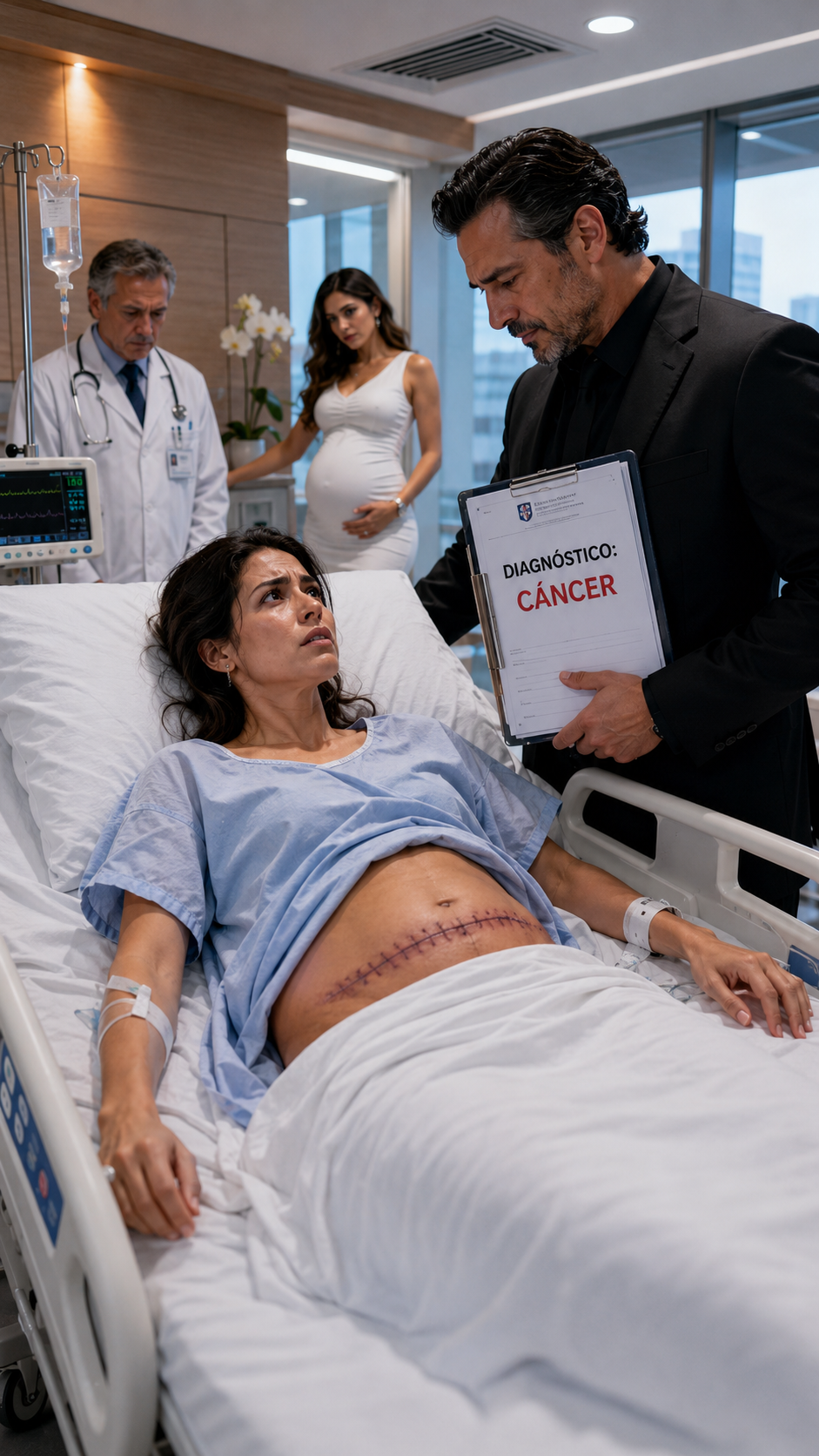
She lifted the sheet with trembling hands and saw a new scar running across her abdomen.
Rodrigo was sitting beside her, red-eyed, a medical folder on his lap.
—Love, there were complications. They found cancerous cells. I had to authorize the surgery to save you.
Lucía didn’t cry.
Because she had already heard the truth.
At that moment, the door opened.
Paola entered with a fruit basket, smiling as if visiting a beloved aunt.
—I’m sorry to interrupt. I came to see how Mrs. Montes is doing.
Rodrigo didn’t remove her.
He just squeezed Lucía’s hand.
And under the sheet, while pretending to comfort his wife, his fingers trembled from touching the woman who was expecting his child.
Lucía smiled faintly, slid her hand under the pillow, and touched the legal letter her lawyer had sent days before, unaware that this document would ignite the entire Montes family.
PART 2
That afternoon, Lucía pretended to sleep.
She had a fever, pain, and a cold rage that cleared her mind.
Rodrigo stayed by her bedside, stroking her hair like a devoted husband.
Paola sat across, crossed her legs, and placed the fruit basket on the table.
The apples shone too brightly.
Like everything about that visit.
Too clean.
Too false.
Lucía glanced at her reflection in the window.
There she saw what she shouldn’t have seen.
Paola was rubbing Rodrigo’s shoe under the table.
At first, it was an accident.
Then it was shameless.
Rodrigo looked at Lucía’s unmoving face and squeezed Paola’s knee.
Not to stop her.
But to ask for patience.
When they both left for the hallway, Lucía got up, her body breaking inside.
She followed them to an emergency exit.
—I told you not to come like this —Rodrigo complained.
Paola let out a giggle.
—Like what? Pregnant? Tough luck, my king, your child can’t be hidden forever.
—Lower your voice.
—No. Tomorrow you announce you’re divorcing or I’ll tell Lucía everything myself.
Rodrigo fell silent.
That silence was crueler than any confession.
Lucía returned to bed before she was discovered.
At midnight, Paola entered alone.
No longer smiling.
She closed the door and stood in front of her.
—You know, right?
Lucía didn’t answer.
—Rodrigo loves me. I’m expecting his heir. And you, sorry, but you’re no good to him anymore.
Lucía breathed slowly.
—Since when?
Paola raised three fingers.
—Three years. It started at a dinner in Polanco. The day you lost the baby, he wasn’t in a meeting either. He was with me in Santa Fe.
Lucía remembered her hemorrhage.
The unanswered calls.
Rodrigo arriving at the hospital on his knees, crying, swearing he hated himself for not being there.
Paola leaned in.
—Tomorrow you sign the divorce. No scandal. No drama. He’s going to marry me in church, and my child will get everything.
—That’s what you think.
Paola smiled disdainfully.
—Look at you. No baby, no uterus, and no family. Do you really think you can go against the Montes?
When Paola left, Lucía pulled out the letter from under the pillow.
It wasn’t just a divorce petition.
It was an urgent request for her complete medical record, to review signatures, hospital videos, and bills paid by Rodrigo.
It had been prepared by Tomás Arriaga, a lawyer who had been a friend of her mother.
Lucía signed it with trembling hands.
At dawn, Rodrigo found the documents on the bed.
—What is this?
—The only honest thing left between us.
Rodrigo opened the folder and paled.
—Lucía, you’re medicated. You don’t know what you’re doing.
—For the first time, I know exactly what I’m doing.
The door swung open.
Tomás Arriaga entered with a notary and two police officers.
Rodrigo stood up.
—Who let you in?
Tomás placed a folder on the table.
—Mrs. Lucía requested a certified copy of her medical record. There’s a problem: the cancer diagnosis was signed by a specialist who was giving a conference in Guadalajara that day.
Rodrigo said nothing.
Tomás continued.
—We also checked the hospital payments. The surgery was authorized before any studies existed.
Paola entered just then, still wearing her victorious face.
Tomás looked at her.
—And since you’re here, Miss Iriarte, there’s another detail. The preliminary genetic test of your pregnancy doesn’t match Rodrigo Montes.
Paola froze.
Rodrigo turned to her.
—What did you do?
Paola touched her belly, now without pride.
—I did the same thing you did, Rodrigo. Lie to survive.
Silence fell heavily.
Then Lucía’s phone vibrated.
It was a message from an unknown number.
It contained an old photo of her mother, Teresa Barrera, standing in front of a blue house in Coyoacán.
Underneath it said:
“Your baby didn’t die. Look at Casa Alba before Rodrigo erases everything.”
Lucía felt the world stop.
Tomás carefully took the phone from her and read the message twice.
—We have to get you out of here.
That same night, Lucía left the hospital through a service door.
There were no goodbyes.
No tears.
Only the sound of her weak footsteps and a truth growing like a wildfire.
The house in Coyoacán had belonged to her grandmother.
It had peeling walls, dried bougainvilleas, and an old wood smell that seemed to guard secrets.
Lucía hadn’t returned there since her mother died.
They rummaged through boxes, drawers, albums, and books.
At dawn, they found a loose tile under the desk.
Underneath was a metal box.
Inside were letters from Teresa Barrera.
There were also notarial acts, a USB drive, and documents from Montes Publicidad.
Tomás read first.
His face changed.
—Lucía… your mother wasn’t an employee of the Montes.
She took a sheet.
Teresa Barrera had been a founding partner of the company.
She held 50% of the shares.
After her death, her signature was forged to erase her from all records.
But the worst came in a video.
On the screen appeared Teresa, younger, with swollen eyes.
—Daughter, if you ever see this, don’t trust the Montes. They don’t just steal companies. They buy doctors, buy judges, buy silence. If you have a child, protect him. To them, blood is business.
Lucía covered her mouth.
Her belly ached.
But the pain of thinking about her living child was worse.
Tomás investigated Casa Alba.
It was a private foundation in Querétaro, funded by Montes Publicidad.
It supposedly helped abandoned children.
In reality, several complaints linked it to irregular adoptions.
Before leaving, Paola arrived at the house.
No makeup.
With dark glasses.
And a bruise on her neck.
Lucía wanted to close the door.
—I’m not here to ask for forgiveness —Paola said—. I’m here because Rodrigo knows the baby isn’t his. He tried to choke me.
—And now you want me to save you?
Paola swallowed hard.
—I want to sell you the truth.
Tomás let her in.
Paola confessed through tears that Rodrigo had been sterile since he was 17, after a car accident.
He hid it his whole life.
That’s why he needed a false heir.
That’s why he hated that Lucía had gotten pregnant.
—Your child was born —Paola whispered—. Doctor Salcedo took him. Rodrigo said that if you woke up thinking he had died, you would never look for him.
Lucía jumped up, though the pain almost doubled her over.
—Where is he?
Paola looked down.
—Casa Alba.
They traveled to Querétaro that same afternoon.
Tomás obtained a provisional order with the medical documents, the audios, and Teresa's papers.
The director of the foundation tried to refuse.
But when she saw the police officers, she began to tremble.
She led them to an inner courtyard.
Several children were playing under a jacaranda tree.
Then Lucía saw him.
A four-year-old boy was sitting with a red cart in his hands.
He had a small scar on his eyebrow.
And her eyes.
Not similar.
The same.
Lucía stepped forward, breathless.
—Hello.
The boy looked up.
—Are you Lucía?
She lost her voice.
—Yes. Who told you my name?
The boy hugged his cart.
—A lady came to see me and said my mom’s name was Lucía. That one day I would find her.
Lucía fell to her knees.
—What’s your name?
—Emiliano.
That name shattered her soul.
Because Emiliano was the name she had chosen for her baby before losing him.
She hugged him carefully.
The boy didn’t cry.
He just rested his head on her shoulder and said:
—You took too long.
Lucía felt that phrase break her ribs.
Rodrigo had stolen four years.
Four birthdays.
Four Christmases.
Four years of first steps, fevers, fears, and lullabies.
But he wasn’t going to steal one more day.
The scandal exploded the next day.
Rodrigo tried to control the press.
He leaked that Lucía was unstable, that she had gone mad after a necessary surgery, that she wanted to destroy him out of jealousy.
But Tomás delivered the audios to the Prosecutor’s Office.
An investigative journalist published the case with a brutal headline:
“Lucía’s uterus wasn’t sick: it was proof of the crime.”
In hours, all of Mexico was talking about her.
Women from Guadalajara, Mérida, Tijuana, and Monterrey began sharing stories of false diagnoses, surgeries without consent, and families that remained silent for money.
The audience filled with cameras.
Lucía entered dressed in white, walking slowly, holding Emiliano’s hand.
Paola entered behind her, pale but determined to testify.
Rodrigo was impeccable.
Blue suit.
Perfect beard.
The look of a man used to winning.
But when he saw Emiliano, the mask fell away.
That second was enough.
Tomás presented everything: the false record, the payments to Doctor Salcedo, the surgery authorized without consent, the forgery against Teresa Barrera, the transfers to Casa Alba, and the records where Emiliano appeared under another name.
Paola testified for two hours.
She admitted her relationship with Rodrigo.
She admitted her pregnancy wasn’t his.
She admitted that at first, she wanted to take Lucía’s place.
Then she cried.
—But when I knew they had stolen a child from her, I understood that Rodrigo loved no one. He only wanted to possess.
Rodrigo stood up furiously.
—Everyone is lying!
The judge demanded silence.
Then they played the final audio.
Rodrigo’s voice filled the room.
—If Lucía wakes up, it will be too late. Without a uterus, she can’t claim anything. The child stays hidden until it serves us. And if Teresa left papers, we’ll burn them.
No one moved.
Lucía closed her eyes.
Hearing that phrase destroyed her.
But it also liberated her.
It was no longer her word against a powerful surname.
It was Rodrigo’s voice digging his own grave.
Doctor Salcedo was arrested that afternoon.
The director of Casa Alba confessed to the network of illegal adoptions.
The notary who forged Teresa’s documents tried to flee to Chiapas, but was arrested before crossing the border.
Rodrigo Montes was charged with obstetric violence, forgery of documents, child abduction, fraud, threats, and organized crime.
Months later, he received a historic sentence.
He lost his freedom.
He lost the company.
He lost the surname as a shield.
Teresa’s shares were returned to Lucía.
With that money, she opened a foundation for women victims of medical and domestic abuse.
Paola also paid.
She lost contracts, followers, and the luxurious life she flaunted.
She didn’t become friends with Lucía.
But she testified to everything she knew.
And sometimes justice needs even those who were once part of the wound.
Emiliano took time to call her mom.
He slept with the light on.
He kept sweet bread under the pillow “in case there wasn’t any tomorrow.”
Every gesture reminded Lucía of how much they had taken from her.
One day, in the garden of Coyoacán, they planted a new jacaranda.
Emiliano dug his hands into the earth and asked:
—Are you really going to stay?
Lucía knelt before him.
—For all my life.
The boy looked at her seriously, as if needing to verify that this promise wasn’t another adult lie.
Then he hugged her.
—Then I can finally call you mom.
Lucía cried against his hair.
Not out of defeat.
But out of return.
The scar on her belly remained.
She didn’t hide it.
She turned it into memory.
Because Lucía had a organ taken from her, a child stolen, and they tried to erase her mother.
But they made a huge mistake.
They left alive the woman who could tell the story.





