PART 1
Marisa Herrera walked out of the Santa Martha women’s prison with a black bag, an official apology, and a check she didn’t even want to touch.
They told her it had been "a system error."
Just like that.
As if six years locked away for the death of a child could be erased with a signature.
In the San Miguel Teotongo neighborhood in Iztapalapa, everyone knew her as “the woman from the case.”
The big one.
The serious one.
The one who, according to the gossip, was capable of harming a child.
Marisa rented an old space next to a tortilla shop and hung up a hand-painted sign:
COMMUNITY DINER.
Every day she cooked rice, beans, noodle soup, and huge stews.
But no one came in.
People walked by, lowered their voices, and pulled their children close as if Marisa were a disease.
For three weeks, she cooked for the flies.
Until one afternoon, a scrawny girl appeared, with broken sneakers and hair tied back with an old hair tie.
—Are you Mrs. Marisa? —she asked.
Marisa put the ladle down onto the pot.
—And who are you, kid?
—I’m Danna. My mom says you’re not bad. That you would never shut the door on a hungry child.
Marisa froze.
No one had spoken to her like that since before prison.
No one had looked at her without fear.
She served her a big plate.
The girl ate so fast that Marisa had to put her hand over the glass.
—Slow down, honey. The food isn’t going anywhere.
—It’s just that I didn’t have dinner last night —Danna said, mouth full—. And my little brother didn’t either.
The next day, she returned with a smaller boy.
On the third day, their mother came, a thin woman with dark circles under her eyes, clutching a shopping bag tightly against her chest.
—I’m Graciela… but they call me Chela —she murmured—. Sorry for sending the girl.
Marisa looked her up and down.
—You don’t say sorry with an empty belly. Sit down.
Chela lowered her gaze and obeyed.
As days passed, the diner began to fill up.
First, five children came.
Then twelve.
After that, the neighbors who used to murmur started leaving bags of vegetables at the door.
Chela was the one who helped the most. She washed dishes, peeled potatoes, and cleaned tables.
But every time someone mentioned Marisa's trial, she turned pale and hid in the kitchen.
One afternoon, a woman brought old newspapers to wrap rolls.
One fell open on the table.
There was Marisa’s photo, the headline of the case, and the name of the dead boy.
Chela dropped a plate.
The noise made everyone look.
Marisa saw her face.
And then she remembered.
That woman had been in court.
That woman had testified against her.
That woman was the witness who sent her to prison for six years.
And worst of all, Danna, the girl who ate in her diner, was the sister of the boy for whose death Marisa had lost half her life.
She couldn’t believe what was about to happen.
PART 2
That night, Marisa didn’t lock up the diner.
When everyone was gone, she turned off the stove, pulled down half the padlock, and walked to the little room at the back, where she kept a cardboard box wrapped in brown tape.
That box held the papers she swore she would never look at again.
The sentence.
The photos.
The names of the witnesses.
The life they had stolen from her packed into yellow folders.
She pulled out sheet after sheet until she found it.
Graciela Robles Salazar.
The photo was blurry, but it was her.
Chela.
The same woman who had peeled potatoes in her diner for weeks.
The same one who smiled at Danna when the girl asked for double tortillas.
Marisa felt the air leave her chest.
The statement said that Chela had seen her near the tenement on the day the boy died.
It said that Marisa had a "violent character."
It said her presence scared everyone.
Just words that the judge swallowed as if they were true.
The next day, Chela arrived early, with a bag of zucchini and a pack of napkins.
—Good morning, Mrs. Marisa —she said, trying to smile.
Marisa didn’t respond.
She carefully took her by the arm, without making a scene in front of the children, and led her to the back.
She placed the old newspaper on the table.
Then she put the file sheet on top.
Chela didn’t ask anything.
She just stared at her own name.
—Why? —Marisa asked.
Chela pressed her lips together.
—I was desperate.
—Desperate? —Marisa let out a dry laugh—. You took six years from me, Chela. Six years. Does that seem like desperation to you?
Chela began to tremble.
—My son died in the tub.
—I know that already.
—But it wasn’t like I said.
Marisa felt her legs go weak.
Chela covered her face.
—Beto had a seizure. He’d been having convulsions since he was little. I left him alone for five minutes because I went to get milk from the store. When I came back, he wasn’t breathing anymore.
Silence fell heavily, like a tin roof in a storm.
Marisa closed her eyes.
She knew Beto.
Of course, she knew him.
Before going to prison, Marisa had a little eatery with three tables near the market.
Beto would come every afternoon, huge for his ten years, with clumsy hands and a laugh that filled the sidewalk.
He would sit by the griddle and steal hot tortillas.
When he had a seizure, Marisa knew what to do: she would lay him on his side, move the chairs aside, and speak softly until he came to.
—Don’t leave him alone in the water —she had once told Chela—. Not even for a minute, you hear me? If he has a seizure there, he’s gone.
Chela knew that.
And still, she left him.
—When I saw him like that… —Chela whispered— I thought they were going to take Danna from me too. I thought they would call me a bad mother. I didn’t want to lose both my children on the same day.
Marisa slammed her palm on the table.
—So you blamed me!
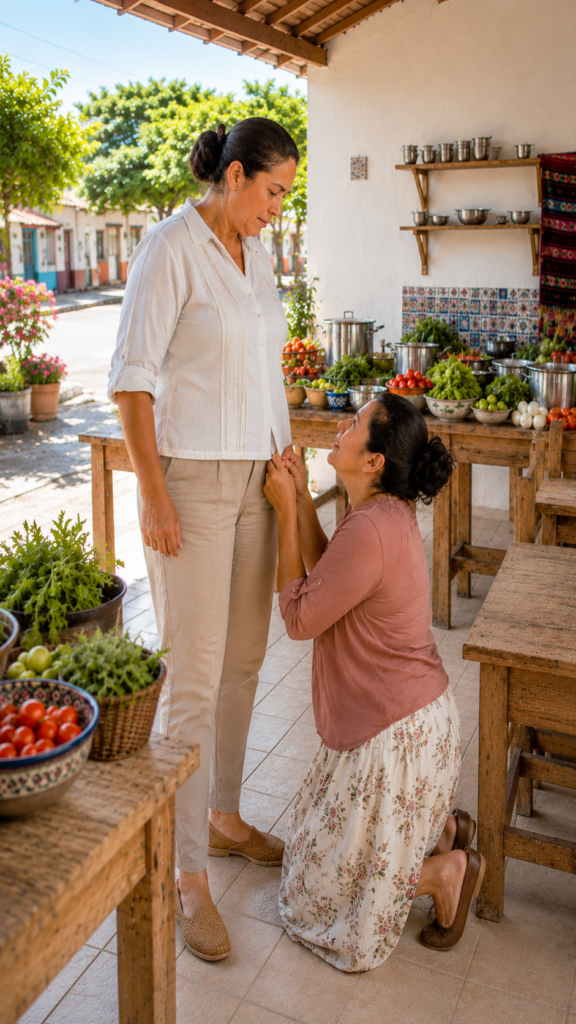
Chela knelt down.
—Yes.
She didn’t try to defend herself.
She didn’t make anything up.
She just knelt as if her body could no longer bear another lie.
—People already looked at you funny —she said—. You were big, strong, with a heavy character. Everyone was afraid of you even though you had never done anything to them. It was easier for them to believe me.
Marisa looked at her with a rage that burned even her teeth.
—Get out.
Chela lifted her face.
—Kill me if you want. Yell at me. Report me. Do whatever you have to do. But don’t close the diner for Danna.
—Don’t use your daughter to save yourself.
—I’m not using her for me —Chela said, and coughed so hard she had to hold onto the sink.
The cough wouldn’t stop.
Chela doubled over.
She brought her hand to her mouth.
When she pulled it away, there was blood.
Marisa froze.
The woman she hated was on the floor, bleeding, and even then the first thing she thought of wasn’t revenge.
It was Danna.
—What’s wrong? —she asked.
Chela tried to clean herself with her sleeve.
—Nothing.
—Don’t give me that look, Chela.
The woman breathed with difficulty.
—Stomach cancer. They told me eight months ago. There’s not much that can be done.
Marisa felt the anger choking her throat.
Chela hadn’t come to the diner just from hunger.
She hadn’t sent Danna by chance.
She had sought out Marisa because she knew she was dying.
—Is that why you came? —Marisa asked.
Chela nodded, crying silently.
—Danna has no one. Her dad left who knows with what woman years ago. My mom is sick. My siblings won’t even look at her. And in this whole neighborhood, the only person who feeds a child without asking where they come from…
She didn’t finish the sentence.
It wasn’t necessary.
Marisa sat down in front of her.
For six years, she had imagined this moment.
She had dreamed of finding the person who had sunk her.
She thought she would scream, break things, demand jail time, reclaim her name with rage.
But the truth was crueler than revenge.
Chela wasn’t a cold monster.
She was a mother who had lost a child because of a five-minute lapse.
A cowardly woman, yes.
A liar, too.
But a woman who had been dying inside since then.
—Does Danna know? —Marisa asked.
—No. She thinks Beto died in his sleep. She believes you were in prison for something else.
Marisa squeezed her eyes shut.
—You better hope she never finds out about this from your mouth.
Chela lifted her gaze, surprised.
—So…?
—So you’re going to keep coming as long as you can. You’re going to eat. You’re going to let Danna eat. And when you can’t get up anymore, someone will bring her here.
Chela began to cry like a child.
—I don’t deserve that.
—No —Marisa said—. You don’t. She does.
For the following days, Chela continued to help, but she was getting thinner.
The neighbors began to notice that things were falling from her hands.
Danna looked at her with concern, but Chela always said the same thing:
—I’m just tired, my love. Your mom is just feeling down.
One night, after closing, Marisa took the box from the trial out again.
She wanted to burn it.
She no longer wanted to live shackled to the file, to the headlines, to the dirty looks of the neighborhood.
She lit the griddle, took the sheets, and started bringing them close to the fire.
The first was the newspaper article.
Then a copy of the sentence.
After that, a photo of the courtroom.
But at the bottom of the box, she found an envelope she had never opened.
It was the same one they had handed her the day she left prison.
The one with the official apology.
The one with the check.
Marisa had thrown it in there without looking, because at that moment any money felt like a mockery.
She opened it with trembling hands.
Inside was the check.
But there were also letters.
Many.
More than thirty.
All written in a crooked, cramped handwriting of someone who had barely finished elementary school.
They were from Chela.
Marisa read the first one.
It was dated three months after she was locked up.
In that letter, Chela confessed she had lied.
She said Marisa was innocent.
She said Beto had died from a seizure in the tub.
She asked for the case to be reviewed.
She asked to be jailed instead if necessary, but to release Marisa.
There was another letter to the judge.
Another to the prosecutor.
Another to a public defender.
Another to Human Rights.
Another to a journalist.
Year after year, Chela had written the same thing.
That the guilt was hers.
That Marisa had never touched Beto.
That the woman everyone called dangerous had been the only one who ever cared for the child as if he were her own.
Marisa sat down on the floor.
The woman who had put her in prison had also spent six years trying to get her out.
Not out of courage, perhaps.
Not from the start.
But yes out of guilt.
Out of love for Beto.
Out of a truth that weighed so much it ended up breaking her body.
Marisa ran to the Seguro hospital the next day.
Chela was in a bed, with Danna asleep in a chair next to her.
Her skin was yellow and her lips dry.
When she saw Marisa, she tried to sit up.
—I read the letters —Marisa said.
Chela closed her eyes.
—Forgive me.
Marisa approached slowly.
—I don’t know if a lifetime is enough to forgive something like this.
Chela cried.
—I know.
Marisa looked at Danna, asleep with her head tilted and one hand clutching her mother’s blanket.
—But Beto loved you. And Danna needs you to be pure in her memory.
Chela opened her eyes, confused.
—What do you mean?
—That she won’t know. Not from me.
Chela covered her mouth to stifle her sobs.
—Will you take care of her?
Marisa swallowed hard.
—She will eat first. Always.
Chela died that Saturday morning.
There was no big wake.
There were seven people, two cheap wreaths, and a girl who didn’t understand why her mom no longer squeezed her hand.
The neighborhood talked, of course.
It always does.
Some said Marisa was crazy for taking care of the daughter of the woman who had sunk her.
Others said she was a saint.
Others, the nosy ones, said there must be something more to it.
Marisa didn’t respond to anyone.
She just opened the diner on Monday at seven.
Danna arrived with her backpack on and puffy eyes.
—Can I sit wherever I want? —she asked.
Marisa pointed to the table by the stove.
—That one’s yours.
—Why that one?
Marisa looked at the spot where Beto used to sit years ago, stealing tortillas and laughing as if the world couldn’t break him.
—Because that’s where those who come hungry sit and stay home.
Danna sat down.
Marisa served her first, even though there was a line outside.
Since then, the diner’s door never fully closed again.
Not at night.
Not when it rained.
Not when the neighbors murmured.
Because Marisa understood something that burns many to accept: sometimes justice doesn’t come with punishment, it comes with an impossible decision.
The decision not to repeat the harm.
The decision not to pass down hate to a child.
The decision to look at the daughter of the one who destroyed you and still put a warm plate in front of her.
And that’s why, every time someone asks if Marisa forgave Chela, she just responds:
—I don’t know if I forgave, dude. All I know is that no child goes hungry while I’m alive.





