PART 1
That night, the rain fell on Mexico City as if the sky wanted to shatter the glass of Polanco.
Ricardo Arizmendi was alone in his apartment on the 34th floor, gazing at Reforma from a space too elegant and too empty.
At 46, he had 3 companies, a fortune that graced business magazines, and a reputation as a cold, precise man, nearly impossible to touch.
He also carried a buried word since his youth.
Infertile.
They told him at 23, in a private fertility clinic, when he was still a debt-ridden student pretending not to be scared.
Since then, Ricardo had built his life upward, not sideways.
No children.
No drawings on the refrigerator.
No toys scattered around.
No small voices asking why.
His marriage to Valeria had been brief. She loved his last name, his connections, and the dinners in Las Lomas, but she couldn’t bear the idea of a home without heirs.
That night, Ricardo was reviewing a contract when the doorbell rang.
He froze.
No one came to his floor without authorization. There was surveillance, a private elevator, and 2 security filters.
The doorbell rang again.
Ricardo opened the camera.
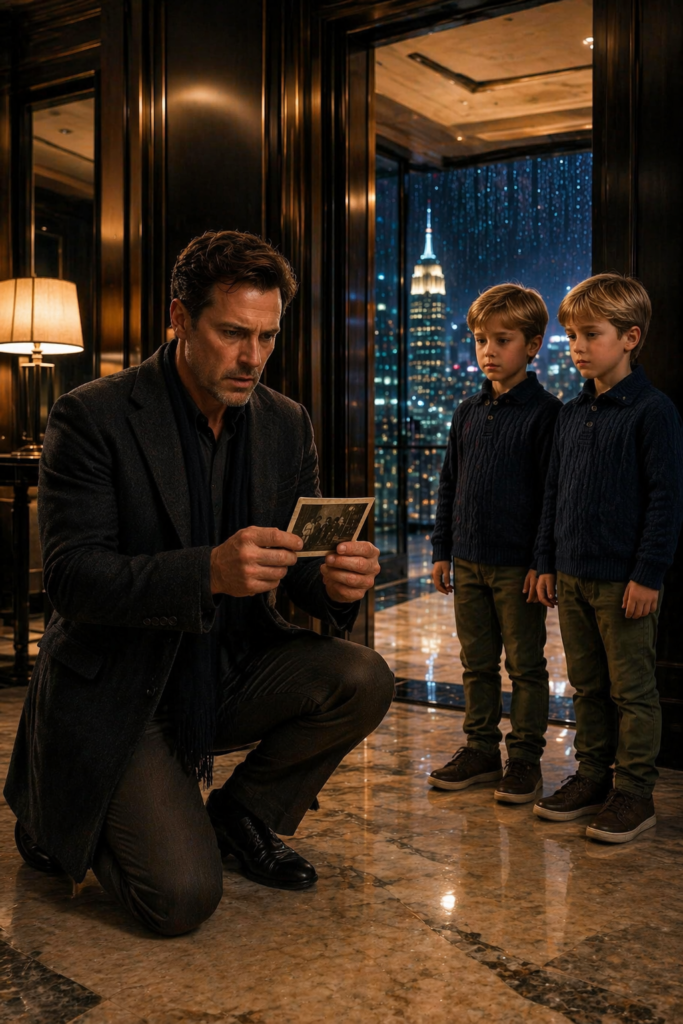
On the screen appeared 2 soaked children.
They were identical, about 8 years old, wearing thin jackets, old sneakers, and hair plastered to their foreheads.
But what took his breath away were their eyes.
Gray.
Not just any gray.
The same strange shade Ricardo saw every morning in the mirror.
He opened the door before thinking.
The cold rushed in with them.
—Are you Ricardo Arizmendi? —one asked, shivering.
—Yes. Who are you?
—I’m Mateo —said the more serious one—. This is Leo.
The other child lifted a plastic bag as if carrying something sacred.
—Our mom is very sick. We don’t have money for a good doctor. And we found this.
Ricardo took the bag.
Inside was an old photo, protected with clear tape.
It was him.
Younger, thinner, standing in front of the Vida Nueva Clinic in 2003.
He remembered that day like a kick to the chest.
He had donated samples after they told him he would never have children naturally. They paid him little, but at that moment he needed money to finish college.
He convinced himself it was a formality.
An anonymous help.
An act without consequences.
But now he had 2 children in front of him with his same gaze.
—Did your mom give you this? —he asked.
Mateo shook his head.
—She doesn’t know we came.
Leo spoke almost in secret:
—She said our dad was a student who helped us be born.
Ricardo felt the floor drop out from beneath him.
—Where is your mom?
The children looked at each other, as if communicating without words.
Then Mateo said the phrase that changed the entire night:
—In Iztapalapa. She’s dying. And before she goes, she asked us never to be separated.
PART 2
Ricardo didn’t call his lawyers.
He didn’t call security.
He didn’t even ask if this was a trap, although a part of him wanted to.
He just grabbed his coat, requested the SUV, and went down with the 2 kids as the storm battered the city.
The driver made his way through Periférico amid puddles, honks, and half-flooded streets.
Mateo was glued to the window.
Leo clutched the bag with the photo against his chest.
Ricardo watched them in the rearview mirror. They didn’t talk much, but they cared for each other with a precision no 8-year-old should know.
—How long has your mom been sick? —he asked.
—Almost 2 years —Mateo said—. But this month she got worse.
—She couldn’t work at the library anymore —Leo added—. Sometimes she doesn’t get up.
Ricardo watched the city change.
The luxury towers fell behind.
Narrow streets appeared, stalls closed with wet tarps, dogs seeking shelter under awnings, and neighbors watching the rain from tin doors.
They arrived at an old building near Ermita.
There was no lobby.
No doorman.
Only a damp staircase and a flickering light.
The children climbed 3 flights.
In front of apartment 3C was a flower pot in a can of chiles, a little image of the Virgin of Guadalupe, and a handmade sign:
“Please knock softly. Mom is resting.”
Leo knocked twice, waited, and opened the door.
—Mom… we brought help.
The apartment was small but clean.
Books were piled, homework taped up, school uniforms hung by a window, and a bed set up in the living room.
On that bed lay Marisol Reyes.
Thin, pale, with deep shadows under her eyes, but with a gaze so firm that Ricardo understood immediately who had kept those children alive.
When she saw him, her face changed.
Not surprise.
Fear.
—Mateo. Leo —she said weakly—. What have you done?
—They came looking for me —Ricardo replied.
Marisol closed her eyes.
—I never wanted to ask you for anything.
—Well, they came to my door in the middle of a storm.
She breathed with difficulty.
—I used a sample from the Vida Nueva Clinic. They gave me basic information about the donor, not his name. Later, when I got sick, I searched for more… not for money.
She held his gaze.
—I needed to know if my children had someone in the world when I was no longer here.
Ricardo felt those words weighing more than any contract.
Marisol had advanced liver cancer.
She had spent months between public appointments, expensive medications, neighborhood raffles, and silences to avoid scaring her children.
Ricardo took out his cellphone.
In less than 40 minutes, what had been impossible for Marisol for months began to move.
An oncologist from Médica Sur agreed to see her.
An ambulance arrived.
A room was prepared.
Mateo and Leo watched as their mom was lifted onto the stretcher, without crying, as if they had already learned that crying wasted time.
Before leaving, Marisol grabbed Ricardo's sleeve.
—Promise me you won’t separate them.
Ricardo looked at the children.
Then he looked at the cold hand of that woman who, without knowing him, was handing him the most sacred part of her life.
—I won’t separate them.
The promise came out before fear could take hold.
That night, the twins slept in the Polanco apartment.
Well, they tried to sleep.
Ricardo showed them a huge room, with a king-size bed, marble bathroom, and windows overlooking the city.
The children stayed by the door, holding their backpacks.
—We can sleep on the floor if you want —Mateo said.
Ricardo froze.
—the bed is for you.
—We won’t mess it up —Leo whispered.
Something broke inside Ricardo.
For years he had thought that the absence of children was an old wound. But that night he understood he had also lived without knowing how a child’s fear of being a burden looked.
The next day, he ordered a DNA test.
Not to deny.
But because his entire life had been built on a medical certainty that was now crumbling.
The result arrived 4 days later.
Probability of paternity: 99.999%.
Mateo and Leo were his biological children.
Ricardo read the paper 6 times.
He hadn’t known about them.
He hadn’t abandoned them on purpose.
But that didn’t lessen the blow.
For 8 years, his children had lived in the same city, doing homework, caring for their mother, learning not to ask for too much.
He, meanwhile, spoke of expansion, investments, and legacy at conferences in expensive suits.
The legacy had been in Iztapalapa, wearing worn sneakers.
The following months were a brutal learning experience.
Ricardo came to know that the children needed not just tuition, clothes, and doctors.
They needed someone to ask how their day went.
They needed someone to arrive on time.
They needed someone to know that Mateo loved circuits and dismantled remotes to understand them.
That Leo drew entire streets from memory and noticed when an adult was sad even if they smiled.
They also needed not to feel that their mom was being replaced.
Ricardo turned a cold meditation room into a study.
He put in 2 desks.
Bought books, colors, robotics kits, warm lamps, and even a rug that Mrs. Chayo, his longtime employee, chose because "this house looks like a clinic, boss, for real."
The children thanked everything.
But their backpacks remained by the door.
Ready.
As if any day someone could tell them they had already disturbed enough.
One stormy night, the power went out.
The generator took time to turn on.
Ricardo heard a sob.
He found Mateo and Leo hiding in the closet, covered with a blanket.
—Thunder sounds like when everything breaks —Leo said.
Ricardo, who knew how to run meetings worth 40 million dollars, didn’t know how to comfort 2 scared children.
So he sat on the floor with them.
—My grandfather taught me to count between the lightning and the thunder —he said—. That way you know if the storm is coming or going.
A flash of lightning lit the room.
—1… 2… 3…
Thunder rumbled.
Mateo lifted his face.
—It’s close.
—Yes. But it’s moving away.
They started counting again.
The thunder came later.
Leo breathed easier.
For 20 minutes, fear became a number.
The number became a game.
And the game became refuge.
The next morning, Ricardo noticed something.
The backpacks were no longer by the door.
They were inside the closet.
He said nothing.
He learned that some victories aren’t celebrated loudly, because they can scare those just beginning to trust.
But Ricardo failed.
And badly.
One Thursday, he had a meeting with investors, Mateo’s math contest, and Leo’s drawing exhibition.
He believed he could do it all.
He could not.
He arrived at Mateo’s contest.
He saw him win 2nd place.
Mateo smiled as if he had received the entire sky.
But when they returned home, Leo was sitting in the living room, with his drawing folder on his lap.
—Did you see my exhibition? —he asked.
Ricardo was left speechless.
He had forgotten it.
Leo nodded slowly, as if confirming something he already feared, and went to his room.
That night, Ricardo locked himself in the office.
The next day, too.
He returned to being efficient, distant, busy.
Mrs. Chayo confronted him in the kitchen.
—With all due respect, sir, those kids don’t need another nice hospital. They need you to be there.
Ricardo wanted to respond.
He could not.
That same afternoon, the hospital called.
Marisol had worsened.
Ricardo arrived and found her weak, with dry lips and still awake eyes.
—You’re avoiding them —she said.
—I have urgent matters.
—They think they did something wrong.
Ricardo lowered his gaze.
—Leo thinks that because he needs you, you got tired. Mateo thinks it was his fault for asking to go to the contest.
That hurt more than any lawsuit.
Marisol breathed heavily.
—Ricardo, blood isn’t enough. You can pay for everything and still leave them orphans in another way.
That night, Ricardo returned home and found the twins packing.
Mateo was putting clothes in the backpack.
Leo was storing the photo from the clinic.
—We didn’t want to bother you anymore —Mateo said.
Ricardo felt shame.
He sat on the floor, suit and all.
—I was wrong.
The children didn’t speak.
—I treated you like a problem to manage. Doctors, school, schedules, paperwork. But you are not a formality.
His voice cracked.
—You are my children.
Leo lifted his tear-filled eyes.
—Because of the test?
—No. The test explains biology. Family is made by staying.
Mateo tightened the backpack.
—And are you going to stay?
Ricardo swallowed.
—Every day they let me learn.
The next day, he changed his life.
He delegated the daily operation of his companies.
Canceled trips.
Blocked his afternoons for his children.
At school, he prioritized exhibitions, tournaments, meetings with psychologists, and parent-teacher meetings.
When a partner told him it was crazy, Ricardo replied:
—The madness was believing that a company was more urgent than 2 children calling me dad.
Then Valeria returned.
She arrived at the apartment in heels, expensive perfume, and an inheritance lawyer named Darío Montes.
She looked at the toys, the drawings on the wall, and the children’s books on the table.
—How sweet —she said—. Ricardo Arizmendi playing family.
He didn’t smile.
—What do you want?
—To protect you. Those children appeared just when their mother is dying. Doesn’t that seem convenient?
—There’s DNA proof.
The lawyer intervened:
—When there’s wealth involved, it’s wise to review custody, inheritance, emotional manipulation…
That’s when Ricardo understood.
They didn’t care about the children.
They cared about the money.
The real blow came 3 days later.
A portal published:
“Mexican magnate in a fight for secret twins and a millionaire inheritance.”
The article insinuated that Marisol had planned everything, that the children were instruments, and that Ricardo was being manipulated.
Mateo got into a fight at school because a classmate called them “pity heirs.”
Leo stopped eating and hid cookies in his backpack.
Ricardo investigated.
The twist was worse.
The leak came from Darío’s office.
And Valeria had consulted, 2 weeks before, if the twins could reduce their share in a trust signed during the divorce.
She didn’t want justice.
She wanted to keep privileges.
Marisol died on a Thursday morning.
Mateo and Leo were by her side.
Ricardo was too.
She whispered something to each child.
Then she looked at Ricardo.
—They’re worth everything —she whispered.
—I know.
—No —she said, barely breathing—. He’s still learning.
Ricardo cried without hiding.
—Yes. But I won’t stop learning.
Marisol smiled.
And she left.
The funeral was small.
Yellow roses, because she liked them.
Soft Juan Gabriel songs, because Leo said his mom played them while cooking.
Neighbors, librarians, teachers, and Mrs. Chayo cried like family.
Valeria arrived dressed in black, with dark glasses and legal papers.
Ricardo stood in front of the children.
—Not today.
—The court doesn’t stop for sentimentalism —she said.
—No —Ricardo replied—. But decent people do.
On Monday they went to a family hearing.
Valeria argued that Ricardo was too busy, too cold, too new in the children’s lives.
Ricardo's lawyer presented evidence: DNA, school reports, psychological evaluations, work changes, witnesses, messages from Marisol, and documents showing Valeria’s economic interests.
The judge requested to hear from the twins.
Mateo spoke first.
—He’s our dad. The DNA proves one part, but not the important one.
—What’s the important one? —the judge asked.
Leo replied:
—When I cry for my mom, he doesn’t tell me to be strong. He sits with me. Sometimes he doesn’t know what to say, but he stays.
Mateo added:
—And when there was a storm, he taught us to count. Now thunder doesn’t get the best of us so easily.
Ricardo lowered his head.
The judge granted Ricardo full custody and paved the way for full adoption.
She also noted Valeria's economic conduct and the leak to the media.
Outside the courthouse, Leo passed by her and looked at her with that sensitivity that made adults uncomfortable.
—You’re sad —he said—. But not because of us.
Valeria didn’t respond.
For the first time, she had no elegant phrase.
Months later, Ricardo created the Marisol Reyes Foundation.
He allocated 50 million pesos to single mothers and fathers with terminal illnesses.
Medical support.
Legal advice.
Tutoring.
Therapy for children.
Custody plans.
Temporary rentals.
Everything Marisol needed before her children crossed half the city in the rain.
Years later, Ricardo sold the cold Polanco apartment and bought a house in Coyoacán with a patio.
Mateo built robots under a jacaranda tree.
Leo painted murals on a wall that Ricardo vowed never to have cleaned.
Family dinners became sacred.
Meetings could wait.
A drawing could not.
A science fair neither.
A voice saying “dad, come here” became the most important priority on his agenda.
One night, another storm fell over the city.
Ricardo was by the window when a lightning bolt illuminated the patio.
—1… 2… 3…
Two teenage voices joined from the stairs.
—4… 5…
The thunder sounded far away.
Mateo smiled.
—It’s moving away.
Leo hugged Ricardo from one side.
—Just like that night.
Ricardo looked at his children.
They had his eyes.
But the heart belonged to Marisol.
And he understood that fatherhood hadn’t come through perfection, nor through money, nor even through blood.
It came because 2 children knocked on his door with a wet photo, a dying mother, and an impossible hope.
And because, for the first time in his life, Ricardo Arizmendi didn’t close the door.





