PART 1
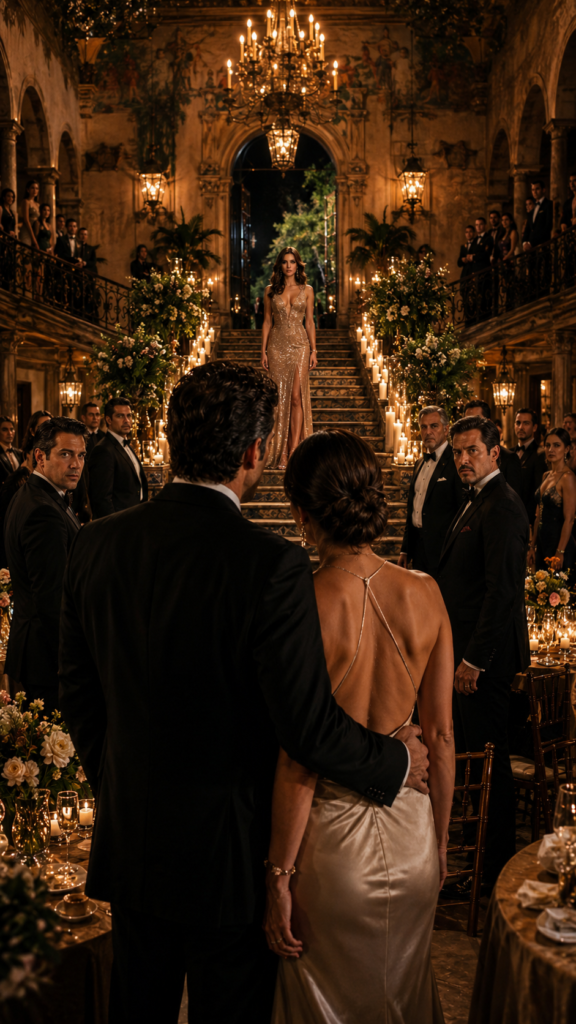
When Julián Montero stepped into the Imperial Hall of an old palace in the Historical Center of Mexico City with another woman on his arm, the air sliced like a knife.
It wasn’t just because Valeria Santillán was beautiful, though she was. She wore a silver dress, perfect hair, and a smile that suggested she had just won a war.
The problem wasn’t her.
The problem was Julián hadn’t come with Clara Montero.
His wife.
The woman everyone expected to see at his side.
Julián paused at the top of the marble staircase, convinced that the silence was admiration. He was 39, clad in a tailored black suit, radiating the arrogance of a man raised among bodyguards, wealth, and political favors.
His father had built the Montero family from transportation contracts in Veracruz to private security, warehouses, routes, and agreements that were never put in writing.
Julián inherited the name.
But he confused fear with respect.
Below, the hall was set. Glasses filled, expensive flowers, waiters with white gloves, and a long table reserved for the heads of seven families.
But no one sat.
No one raised a glass.
No one smiled.
Valeria tightened her grip on his arm.
—Julián… why is everyone looking at us like this?
He smiled without lowering his voice.
—Because the old men can’t stand to see the future.
Valeria lifted her chin, believing she would be introduced that night as Julián’s new significant other.
For eighteen months, she had listened to him complain about Clara. How she was cold. How she rarely spoke. How she was always tied up with calls, old agreements, and loyalties that he deemed boring.
Valeria made him feel alive.
Clara, according to him, only knew how to remain silent.
That’s why he wanted to teach her a lesson that night.
He didn’t ask her not to come.
He sent his assistant, Mauricio Rivas, to deliver a curt message:
“Mrs. Montero is not needed at tonight's event.”
Then he arrived with Valeria.
The first to approach was Don Esteban Arriaga, a broad-shouldered man from Jalisco, with tired eyes and a calm voice.
—Julián.
—Don Esteban. Good to see you.
The old man glanced at Valeria for barely a second. Then he asked:
—Where is Clara?
Julián maintained his smile.
—At home.
Don Esteban waited.
—I made some changes to how the Montero family will be represented —Julián added.
Valeria smiled wider.
Don Esteban simply said:
—I see.
And he walked away.
Then Don Emilio Barragán, from Monterrey, asked the same.
Afterwards, Doña Ruth Cárdenas from Tijuana closed her folder and left her glass untouched.
—Is Mrs. Clara not attending?
—No —Julián replied, already annoyed.
Ruth pushed her chair back.
—Then we wait.
—For whom?
—For her.
The word spread throughout the hall.
We wait.
At 8:52 p.m., dinner was supposed to start.
By 9:17 p.m., no one had sat down.
Julián searched for the event coordinator near the service door.
—What’s going on?
The man was sweating.
—The heads are waiting, Mr. Montero.
—Waiting for what?
—For Mrs. Clara.
Julián felt a stab of rage.
He walked towards Don Samuel De la Garza, 78 years old, a legend from the north. He was short, gray-haired, and spoke with a calmness that was more frightening than a scream.
—Samuel, we need to start.
—Yes —the old man said—. We need.
—Then why is everyone standing like they’re at a funeral?
Don Samuel turned slowly.
—Where is Clara?
Julián exhaled through his nose.
—I’ve answered that five times already.
—Answer it one more time.
—She’s not coming.
—Did she decide not to come?
—That’s none of your business.
—Tonight it is.
Julián stepped forward.
—This is my gala. My family called this council together.
Don Samuel didn’t blink.
—Your family called it. Clara made it possible for everyone to agree to come.
The phrase fell heavy.
Julián didn’t understand it at first.
—Clara is my wife. She’s not the boss.
—No —Don Samuel said—. She’s something much rarer.
—What are you talking about?
The old man looked at the empty table.
—No one is signing a single document in this building without Clara Montero in the room.
Julián felt his pride stick in his throat.
Valeria, from the bar, stopped smiling.
And in that silence, for the first time, Julián understood that perhaps he hadn’t brought his mistress to humiliate Clara.
Perhaps he had brought his mistress to humiliate himself in front of everyone.
PART 2
The next half hour was a slow humiliation.
No one sat.
No one touched the documents.
No one looked at Valeria as the future Mrs. of anything.
Julián ended up cornering Don Esteban near the bar.
—Tell me what Clara did to make everyone act like she’s indispensable.
Don Esteban looked at him with disappointment.
—Eight years ago, my people and Barragán’s were three days away from killing each other. Burned trucks, two missing men, crossed threats. Your father was ill, and you were playing untouchable.
Julián clenched his jaw.
—Clara called me —Don Esteban continued—. Not as your wife. She called me as Clara. She knew the numbers, the grievances, the prides. She gathered us in the basement of a church in Guadalajara. By dawn, no one wanted war.
Julián froze.
—She never told me.
—Did you ask her?
The question struck harder than an insult.
Don Esteban lowered his voice.
—You inherited fear. Clara built trust. They’re not the same currency, son.
Julián searched for Valeria. She was alone, pale, with a glass she hadn’t touched.
When he returned to her, Valeria whispered:
—You have to call her.
—No.
—Julián…
—I said no.
She looked down.
—I didn’t know.
—Didn’t know what?
—What she was.
Julián looked at the empty chairs, the closed folders, and the most dangerous men in the country waiting for his wife.
—I didn’t either —he murmured.
At 9:46 p.m., the main doors opened.
There was no announcement.
Clara Montero simply walked in.
She wasn’t wearing a gala dress. She was in a charcoal suit, cream blouse, low shoes, and her hair pulled back. No diamonds. No sparkle. No seeking attention.
And yet, the entire hall turned to her.
Don Esteban was the first to approach.
Then Don Samuel.
Then Ruth.
Then Barragán.
One by one, the heads greeted the woman Julián had left at home.
Clara listened more than she spoke. She asked little, but every question landed where it had to.
When she looked at Julián, she held his gaze for barely two seconds.
There was no pain on her face.
That was worse.
Pain would have meant she still expected something from him.
Then Clara looked at Valeria. Not with jealousy. Not with anger. Just as someone sees an object out of place.
Then Ruth approached and whispered something.
Clara’s face barely changed.
But all the important people noticed.
Clara opened a folder.
—Who else received the revised package?
Don Esteban frowned.
—Revised?
Julián approached.
—What package?
Clara didn’t look at him.
—The one someone wanted them to sign tonight.
In minutes, humiliation turned into an emergency.
Clara led the heads to a private room. Julián followed, though no one invited him. That detail hurt.
All his life, doors opened by his last name.
That night, they opened again.
But not for him.
Ruth placed a folder on the table.
—We intercepted copies an hour ago. These are not the negotiated terms.
Clara reviewed the sheets calmly.
—They altered the distribution clauses, access to the port, and the penalties.
Barragán leaned in.
—For what?
—So in thirty days, several families would accuse each other of treason —Clara said—. This wasn’t an agreement. It was a bomb with an elegant signature.
Don Samuel looked at Julián.
—Who handled the final documents?
Julián took too long to answer.
—My office.
Clara raised her eyes.
—Your office is compromised.
The phrase emptied the room.
A man from Veracruz pulled out a letter.
—A representative said he came with Montero’s authorization.
Julián took the sheet.
It was his signature.
Perfect.
Every curve seemed made by his hand.
—I didn’t sign this.
—I know —Clara said.
Those two words frightened him more than a scream.
—You know?
—I suspected a false channel. I didn’t know they were already forging your signature.
—Who?
But Julián already knew.
Mauricio Rivas.
His assistant.
He had access to his schedule, routes, emails, messaging, guests, and documents. He had been with him for eight years. Julián treated him like part of the furniture.
And he never checked the foundations until the building started to crumble.
—You should have told me —Julián said.
Clara looked at him with a dry sadness.
—I tried.
He stood still.
—Eighteen months ago, I entered your study with a report. Mauricio was there. I told you there was external pressure on the council. You silenced me in front of three men and said that professional matters should be handled by professionals.
Julián remembered.
Remembered the folder.
Remembered his own voice.
Remembered Mauricio hiding a smile.
Clara returned to the table.
—I continued without your permission. Like many times.
Then another blow came.
Ruth showed a sheet with codes, schedules, and addresses around the hall.
Don Samuel stood up.
—Those aren’t routes.
Clara folded the sheet.
—They’re positions.
Julián took half a second to understand.
—Men outside?
—At a minimum —Clara said—. If the document plan failed, there was a second option.
—Violence?
—Elimination.
No one spoke.
—Of whom? —Julián asked.
Clara looked at him.
—Of everyone who matters.
The hall moved in silence. Arriaga closed hallways. Ruth sent people to check exits. Barragán sent men to the rooftop. Don Samuel made two calls and blocked nearby streets.
Julián watched his wife coordinate the survival of 43 people with the same calmness he had called "coldness" for eleven years.
At 10:03 p.m., they found the first device.
At 10:13 p.m., the second.
At 10:14 p.m., the third.
Clara turned to Julián.
—I need to evacuate the hall.
—Do it.
—If I order it, they’ll argue. If you order it, they’ll obey.
It was the first time that night she needed him.
Not as a husband.
As a last name.
And that made him feel smaller than any mockery.
Julián climbed on stage and took the microphone.
—There is a security threat. Heads and immediate staff, exit through the east corridor. Do not collect coats. Do not argue. Move.
For one second, no one reacted.
Then Don Samuel stood up.
—Listen to him.
The hall obeyed.
Valeria remained by the bar, trembling.
—Leave with Barragán’s people —Julián told her.
—Is this my fault?
—No.
But they both knew it wasn’t entirely true.
She hadn’t forged documents.
Hadn’t planted devices.
But she had been useful.
Julián had made her useful.
—I thought this was just about us —Valeria whispered.
Julián looked toward where Clara was.
—I thought so too.
Then Clara asked:
—Where is Mauricio?
No one answered.
Julián felt a horrible chill.
—He left at 7. He was going to deliver some ceremonial copies.
Clara turned.
—What copies?
Julián understood his mistake.
Only four people knew about those copies.
He.
Clara.
Mauricio.
And Valeria.
They found Valeria on the stairs, staring at a phone that wasn’t hers.
—I didn’t know —she cried—. Mauricio gave it to me. He said if anyone contacted me, to obey. I thought it made me important.
Clara took the phone.
On the screen, it said:
“Tell the girl from Montero to stay. Mauricio is going for the last file.”
They followed the signal to a room on the second floor.
There was Héctor Cruz, a financier from Monterrey who had been wanting to enter the council for years. Blue suit, cold smile, and two armed men behind him.
—Clara —he said, as if he knew her too well.
Julián hated that confidence.
—Héctor —she replied.
Cruz smiled.
—You were quicker than expected.
—You gave me too much time.
Cruz looked at Julián.
—Did you understand what your wife is? I did. I saw her avoid wars over the phone. I saw older men change plans because she asked the right question. And you brought a mistress to replace her as if she were a chair.
Julián didn’t respond.
Because it was true.
Clara stepped forward.
—You used Mauricio for the documents. Valeria to confirm my absence. You altered agreements to break the council. And when that failed, you activated your network.
—You make it sound vulgar.
—It was vulgar.
Cruz’s smile cracked.
—I would have made you visible, Clara.
She looked at him as if offered a gilded cage.
—You didn’t want to acknowledge my worth. You wanted to decide it.
Then the door opened.
Don Esteban entered with eight men.
Cruz’s guards lowered their weapons.
Clara didn’t blink.
—I told you I’d come in. I didn’t say I’d come in alone.
Before they took him away, Cruz looked at Julián.
—Everything you saved tonight, she saved it.
Julián held his gaze.
—Yes. She saved it.
But the worst was still to come.
Three gunshots rang out below.
Clara ran.
In the main hall, Mauricio stood with a gun in his hand. A woman from Clara’s team lay unconscious, blood oozing from her temple.
—Mauricio —Clara said.
He was crying.
—Cruz had my family. Photos. Addresses. I had no choice.
—You had choices for eight years —Clara said—. Some were horrible. That doesn’t mean they weren’t choices.
Mauricio trembled.
—I didn’t know I would kill everyone.
—I believe you —Clara said—. But you helped build the door.
She approached.
—Put the gun down. Not for forgiveness. For the only decent decision you can still make.
The gun fell to the marble.
At 12:08 a.m., the heads returned to the table.
The food was cold. The candles nearly extinguished.
Clara explained everything: the forged signature, the altered clauses, Cruz, Mauricio, Valeria, and the devices.
She didn’t exaggerate.
She didn’t humiliate Julián.
She simply told the truth with such clarity that no one could hide.
One by one, the heads signed the corrected agreements.
Not for Julián.
Not for the Montero name.
They signed because Clara had made the truth hold the table once more.
At 1:40 a.m., Julián found her by a window.
—I need to say something.
—Then say it.
He looked at his reflection.
—I told myself a story about you. That you were quiet because you had nothing to say. That you were prudent because you were afraid. That you were with me because my world was bigger than yours.
His voice cracked.
—I was wrong about everything.
Clara didn’t move.
—I know.
—I brought Valeria to replace you in public.
—Yes.
—I gave Cruz the opportunity.
—Yes.
He accepted every word.
—I’m sorry. Not because I was humiliated. I’m sorry because you spent years holding up a world I thought was mine, and I never asked how much it cost you.
Clara looked at him wearily.
—Living alongside someone who doesn’t see the truth is exhausting.
—I know.
—No. You’re just beginning to know.
Then she said what he already feared.
—I’m going to leave the marriage.
It hurt Julián, but he didn’t argue.
—That’s fine.
Clara took a deep breath.
—The council will create an independent chair for mediation. I will occupy it for twelve months. After that, I will decide what I want.
—What do you want?
The question surprised her.
Maybe because she should have been asked it eleven years earlier.
—I want a house where no one sends me messages through assistants. I want to sleep. I want to know who I am when I’m not solving problems for men who think they’re powerful.
Julián swallowed hard.
—You deserve that.
—I know.
There was no cruelty.
Just certainty.
At the door, Clara took her coat. Julián didn’t try to help her.
He was learning that too.
Before getting into the car, she looked at him clearly.
—I hope one day you become better than the man who walked in tonight.
Julián’s voice came out broken.
—I hope so too.
Clara left.
Julián stood alone on the sidewalk as dawn broke over Mexico City.
Inside, the waiters cleaned glasses and removed flowers. By noon, the hall would seem intact.
Powerful people know how to hide the rubble.
But Julián understood that some rubble must remain visible.
That night, he didn’t just lose his wife.
He lost the lie that kept him comfortable.
And for the first time, without Clara, without applause, and without a room accommodating his power, Julián Montero had to ask himself who he really was.





