PART 1
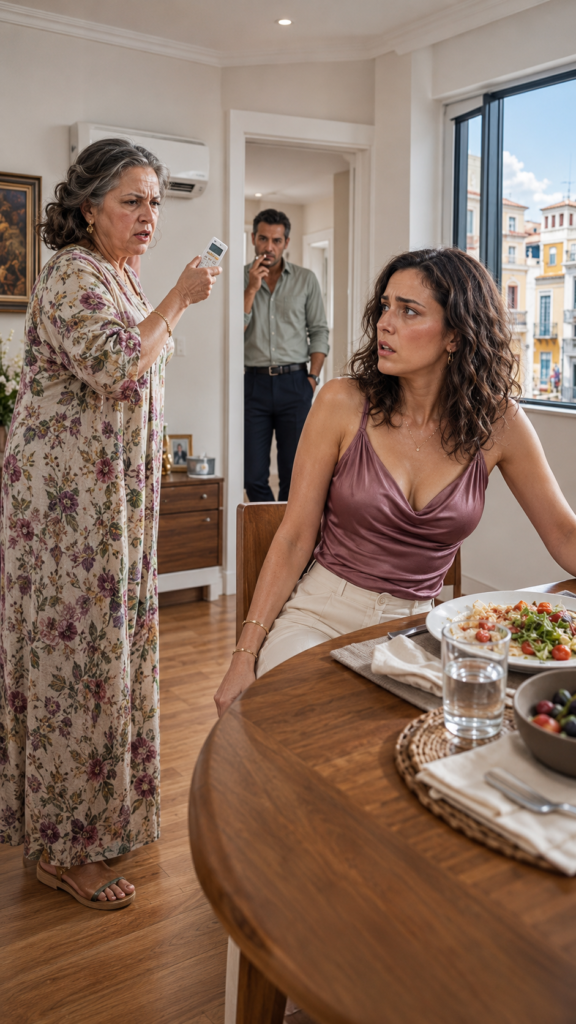
—In this house, lazy women who arrive late and still want air conditioning are not rewarded.
That’s what Doña Elvira spat out, her voice unwavering, as Renata Márquez had barely been sitting on the bed for 10 minutes, her shirt clinging to her body from sweat, her head thumping like a drum.
Renata was 32, working as the administrative director at a construction materials company in Mexico City.
That Sunday, she had rushed out because a wrongly authorized payment could jeopardize a million-dollar contract. Since 7 AM, all she had consumed was coffee and a cold vending machine pastry.
She texted her husband, Bruno:
“Eat without me. I’ll be late, but I’ll be back and clean everything up.”
Bruno read it.
He didn’t respond.
When Renata arrived at their home in the Portales neighborhood, heat radiated from the pavement like steam from a griddle. From the entrance, she smelled tlalpeño soup, red rice, and freshly made tortillas.
At the table sat Doña Elvira and Bruno, finishing their meal.
Renata’s plate sat in a corner: brothless soup, dry chicken, and clumped rice.
“Look how lovely,” Doña Elvira said, banging the table with her spoon. “An old woman like me cooking while the lady arrives like a movie executive.”
“I had an emergency at work,” Renata replied, exhausted. “I told Bruno. I’ll just change and wash the dishes in a bit.”
Renata glanced at her husband.
She hoped for one word.
Just one.
But Bruno kept staring at his phone, as if the fight wasn’t his to engage in.
“Work, work, work,” Doña Elvira mocked. “Honestly, who do you think you are? A woman earns her place by attending to her husband, not bragging about an office.”
Renata didn’t reply.
What hurt the most wasn’t the insult.
It was seeing Bruno comfortable, silent, letting his mother crush her little by little.
She entered the bedroom. It was stifling.
That air conditioner, she had bought it two years ago when she remodeled the house. She had also paid for the kitchen, the plumbing, the refrigerator, the washing machine, the curtains, and even the table where they had just humiliated her.
She took off her shoes, turned on the air, and closed her eyes.
She just wanted to breathe.
Not even ten minutes passed when the air abruptly shut off.
Renata stepped into the hallway.
The television was still on.
The living room fan too.
It wasn’t a blackout.
Doña Elvira stood by the circuit breaker, arms crossed and a dry smile on her face.
“What did you do?” Renata asked.
“I turned off the waste,” she said. “You arrive late, you’re useless, you don’t wash, don’t attend, and you still want to waste electricity. This house doesn’t support leeches.”
Renata felt something inside her shatter.
“I pay the electricity, Doña Elvira.”
Bruno emerged from the living room.
“Renata, don’t start. My mom is old. Help her first and then you can rest.”
She stared at him intently.
“Did you read my message?”
“Yes, but that doesn’t mean my mom has to treat you like a queen.”
Then Renata understood everything.
It wasn’t about the air.
It wasn’t about the cold plate.
It was about her living on tiptoes in a house sustained by her money, while others felt entitled to her peace.
She entered the bedroom, pulled out a black suitcase, and began packing clothes, documents, cards, deeds, and a photo of her father.
Bruno peeked in, annoyed.
“Are you really going to throw a fit over a light switch?”
Doña Elvira appeared behind him.
“Go ahead, sweetheart. Let’s see how long you last without a roof and without my son’s last name.”
Renata zipped the suitcase.
She took her phone and called Lawyer Martín Ibarra.
“Lawyer, prepare the papers. I want to reclaim my house in Portales. I won’t allow Bruno and his mother to keep living off me any longer.”
Bruno went pale.
“Your house? What are you talking about?”
Renata looked at Doña Elvira without lowering her head.
“Don’t worry. I’m leaving. But before I go, I’m going to leave the house just as you think a leech should be: without air, without television, without water, and without a woman to stomp on.”
And she walked straight to the main switch.
PART 2
Renata flipped the switch down.
The house fell silent.
The television died in the middle of a soap opera. The fan stopped spinning. The water pump made a dry sound and then went silent.
Silence descended heavily, as if the house finally understood who sustained it.
“You’re crazy!” Doña Elvira shouted. “Turn that back on right now!”
Renata didn’t respond.
She locked the circuit breaker, stepped into the patio, and turned off the water valve. Then she returned for her suitcase.
Bruno stood in the middle of the living room, sweating, eyes wide.
“This house is mine,” he said, though his voice no longer sounded so fierce. “What right do you have to do this?”
“With the right of the one who pays for the electricity, the water, the repairs, the furniture, and the deed.”
Doña Elvira let out a fake laugh.
“Oh please. My son bought this house. He told me.”
Renata turned to Bruno.
“Tell her.”
Bruno looked down.
No more was needed.
Doña Elvira’s face changed. The arrogance washed away like makeup in the rain.
“Bruno?”
He didn’t answer.
Renata took her purse.
“You have 7 days to leave. Starting today, I’m not paying another cent for services, food, debts, or whims.”
Bruno tried to grab her hand.
“Renata, we’re married. We can fix this.”
She pulled away.
“You had 4 years to fix it. You chose to remain silent every time your mother humiliated me.”
She stepped out to the street and called a taxi.
Bruno didn’t run after her.
Maybe he thought Renata would return like other times, after crying silently and swallowing her anger.
But that night, she didn’t come back.
She stayed in a small hotel near Insurgentes. She showered, ordered hot soup, and when the waiter placed it in front of her with a kind smile, Renata cried.
Not for the broth.
But because a warm plate served with respect felt like a luxury.
That same night, Lawyer Ibarra confirmed what she already knew: the house was her father’s inheritance, received before the marriage. Bruno had no claim to it.
“We can also initiate divorce proceedings,” the lawyer said.
Renata closed her eyes.
“Do it.”
The word hurt, but it also cleansed.
The next day, she reviewed their shared account. She had opened it. Bruno had an additional card.
That’s where the real hell began.
There were charges for restaurants in Polanco, boutique hotels, jewelry stores, and strange deposits. One bill left her frozen: a diamond ring costing nearly 180,000 pesos, picked up by a woman named Daniela Ríos.
Renata recognized that name.
She had seen it appear late at night on Bruno’s phone.
He always said:
“She’s an intense client, you know how they are.”
But on an old tablet Bruno had left synced, a message popped up that took her breath away:
“Did you get rid of Renata? Your mom said that when she leaves, I can move into the house.”
Renata read that sentence several times.
They not only wanted her out.
They were already planning to bring another woman into her own home.
She printed everything.
When the lawyer reviewed the transactions, he found more things. It wasn’t just money for Daniela. There were also transfers to Bruno’s younger brother, Toño, in small repeated amounts.
They summed over 250,000 pesos.
Toño owed money for sports gambling.
Doña Elvira withdrew cash claiming it was for medicine, groceries, or urgent repairs. But that money ended up covering her younger son’s debts.
That afternoon, Renata received an unknown call.
“Tell Antonio he has 3 days. If he doesn’t pay, we’re coming to collect at the house.”
Renata hung up without trembling.
For the first time, her rage didn’t destroy her.
It ordered her.
The final twist came on Wednesday.
Renata discovered that the construction company where Bruno worked was desperately seeking a contract with Grupo Márquez Norte, the company her father had left her.
Bruno didn’t know that Renata was the president of the board.
She had always worked from a subsidiary, without flaunting her name. Her father used to tell her:
“Money attracts false hugs. First, see who respects you when they think you have nothing.”
Renata thought Bruno respected her.
She was wrong.
On Thursday, she entered the boardroom in a cream suit, hair tied back, and a folder under her arm.
She wasn’t going as a wounded wife.
She was going as the owner of the decision that could change Bruno’s life.
Engineer Calderón, the group auditor, was waiting for her with several documents.
“Mrs. Renata, the proposal from Construcciones Ledesma has serious irregularities,” he said. “Overpricing, unverified expenses, and disguised commissions. All signed by Bruno Ledesma.”
Renata opened the folder.
There was Bruno’s signature again and again.
Steel 18% above market. Duplicated transport. “Client” meals that looked like weddings. Corporate gifts without receipts.
“Bring him in,” she said.
Bruno entered with two colleagues.
He looked nervous but tried to smile like a confident executive.
The smile froze when he saw Renata sitting at the head of the table.
“Renata?”
“Good morning, Mr. Ledesma,” she replied. “Take a seat. We are going to review your proposal.”
His colleagues exchanged uncomfortable glances.
The engineer opened the session.
“The review will be led by Mrs. Renata Márquez, president of the board of Grupo Márquez Norte.”
Bruno’s forehead began to sweat.
For an hour, Renata dismantled his proposal point by point.
She didn’t mention the cold plate.
She didn’t mention Doña Elvira.
She didn’t say anything about the air conditioning.
She just put numbers on the table.
“Here they report representation expenses of 420,000 pesos,” she said. “Where are the receipts?”
“We’re gathering them,” Bruno stammered.
“Then you presented unverified costs.”
She moved to the next page.
“There are also 11 transactions linked to personal accounts related to your management. Can you explain this?”
Bruno gulped.
“It must be an administrative error.”
“Administrative errors don’t repeat 11 times with your signature.”
His colleagues stopped defending him.
The proposal was suspended and sent for independent audit.
Bruno stood up desperately.
“Renata, please. Let’s talk as family.”
She looked at him with a calmness he had never seen before.
“In this room, we talk business. You left family in your mother’s hands every time she insulted me while you shrank away.”
As she left, Renata leaned in slightly.
“Go home, Bruno. Check your papers. And watch the water. You’ve seen how expensive everything is.”
That afternoon, Bruno arrived in Portales furious.
He found Doña Elvira fanning herself with an old folder, without television, without fan, and with the gas delivery man demanding payment for three overdue cylinders.
“Pay him, son,” she said. “That man comes as if we were beggars.”
Bruno paid with the last bills in his wallet.
The dark house no longer seemed like a reward.
It felt like a debt.
“Your wife is terrible,” Doña Elvira complained. “Just because I turned off a little device, she put on a show.”
Bruno tossed his briefcase on the table.
“That device she bought! The house is hers! And the contract that could save my job also depended on her!”
Doña Elvira tried to hold her face.
“A wife should support her husband.”
“Support? She paid for everything while you called her a leech.”
At that moment, Toño entered, pale and with a wrinkled shirt.
He wanted to leave upon seeing Bruno.
“You’re staying,” he commanded. “How much do you owe?”
Toño shook his head.
“Nothing, dude. It’s a misunderstanding.”
Doña Elvira’s phone rang. She quickly turned it off.
Then Toño’s rang.
Bruno snatched it and put it on speaker.
“You have 3 days,” a cold voice said. “Either you pay the 250,000, or we’re coming to the house.”
The silence was brutal.
“Were they using Renata’s money to pay for bets?” Bruno asked.
Doña Elvira began to cry.
“He’s your brother. A mother helps her children.”
Cornered, Toño let the worst slip.
“Don’t play dumb, Bruno. You also bought a ring for Daniela. And Mom knew you were going to bring her here when Renata left.”
Bruno lost his breath.
Doña Elvira looked at the floor.
That night, everything fell apart: the lie, the mistress, the perfect family, and the pride they flaunted at Sunday dinners.
The next day, the lawyer's letter arrived.
They had 7 days to vacate.
But Doña Elvira still didn’t understand.
Three days later, at a business dinner in a hotel in Santa Fe, Bruno tried to approach group partners to salvage something.
Renata attended in a dark blue dress, without flashy jewelry, just her father’s watch.
She didn’t seek spectacle.
Doña Elvira did.
She entered on Bruno’s arm, in a black dress, gold necklace, and heavy makeup. Upon seeing Renata in the reserved area, she walked straight to her.
“Look at this,” she said loudly. “The ungrateful daughter-in-law also enters these places. Who paid for your dress? Did you find another man to support your tastes?”
Several people turned.
Bruno tightened his grip on her arm.
“Mom, shut up already.”
But she continued.
“A woman who cuts off light and water from an older lady deserves no respect.”
Renata set her glass down on the table.
“Good evening, Doña Elvira.”
“Don’t call me that. You’re no longer my daughter-in-law.”
“We agree on that.”
A murmur swept through the hall.
Doña Elvira flushed.
“Money doesn’t buy class.”
Renata looked her in the eye.
“You’re right. That’s why, although you lived in my house for 4 years, you never learned to behave with dignity.”
At that moment, Engineer Calderón arrived with two assistants.
“Mrs. Renata, the board is waiting for you. The presentation is about to begin.”
Doña Elvira opened her mouth.
Nothing came out.
Bruno whispered:
“Mrs. Renata?”
The engineer looked at him seriously.
“Mrs. Renata Márquez is the president of the board of Grupo Márquez Norte.”
The hall seemed to lose air.
Renata ascended the stage amid applause.
She took the microphone.
“My father taught me that in business, you can lose money, but never integrity. He also taught me that a person is best known when they think the one in front of them can’t defend themselves.”
She didn’t mention names.
It wasn’t necessary.
She announced audits, suspension of irregular contracts, and new transparency rules.
Honest companies applauded.
Bruno hung his head.
Afterward, he waited for her in the hallway.
“Why did you hide who you were?” he asked, his voice broken.
“I didn’t do it to deceive you. I did it to know if you wanted Renata or the Márquez name.”
“I did love you.”
“No, Bruno. You wanted the house, the account, the comfort, and the image of a successful husband. But you left me eating cold food, asking for permission to rest, and enduring insults for 10 minutes of air.”
His eyes were red.
“My mom filled my head with nonsense.”
“Your mom spoke. You chose to remain silent.”
Then Daniela appeared.
Elegant, nervous, with her phone in hand.
“Is it true?” she asked Bruno. “You don’t have a house? You don’t have a contract?”
Bruno didn’t answer.
Daniela looked at Renata, then at him, and left without saying goodbye.
Renata felt no jealousy.
She felt pity.
A week later, Bruno, Doña Elvira, and Toño left the house in Portales with cardboard boxes and old furniture.
There were no genuine apologies.
Just neighbors watching from their windows.
Doña Elvira tried to speak at the door.
“Renata, I didn’t know the house was yours.”
Renata took a deep breath.
“I didn’t need to know to be treated like a person.”
The woman had nothing more to say.
Months later, Bruno signed the divorce. He lost his job after the audit. Toño had to face his debts without other people's money. Doña Elvira moved in with a sister in Neza and stopped flaunting successful children at family gatherings.
Renata returned to her house on a Saturday morning.
She changed the locks, opened the windows, painted the kitchen white, and donated the table where she had been served cold food so many times.
That night, she served herself hot soup, turned on the air conditioning without guilt, and sat alone.
But she didn’t feel lonely.
She felt at peace.
Because sometimes the family one loses isn’t home; it’s a cage with a beautiful roof.
And no woman should ever forget this: a house doesn’t become a home for having light, water, or expensive walls; it becomes home when no one needs to turn off your peace to feel powerful.





