PART 1
—If my son had the kindness to pick you up from where you came from, the least you can do is teach your daughter from a young age what her place is.
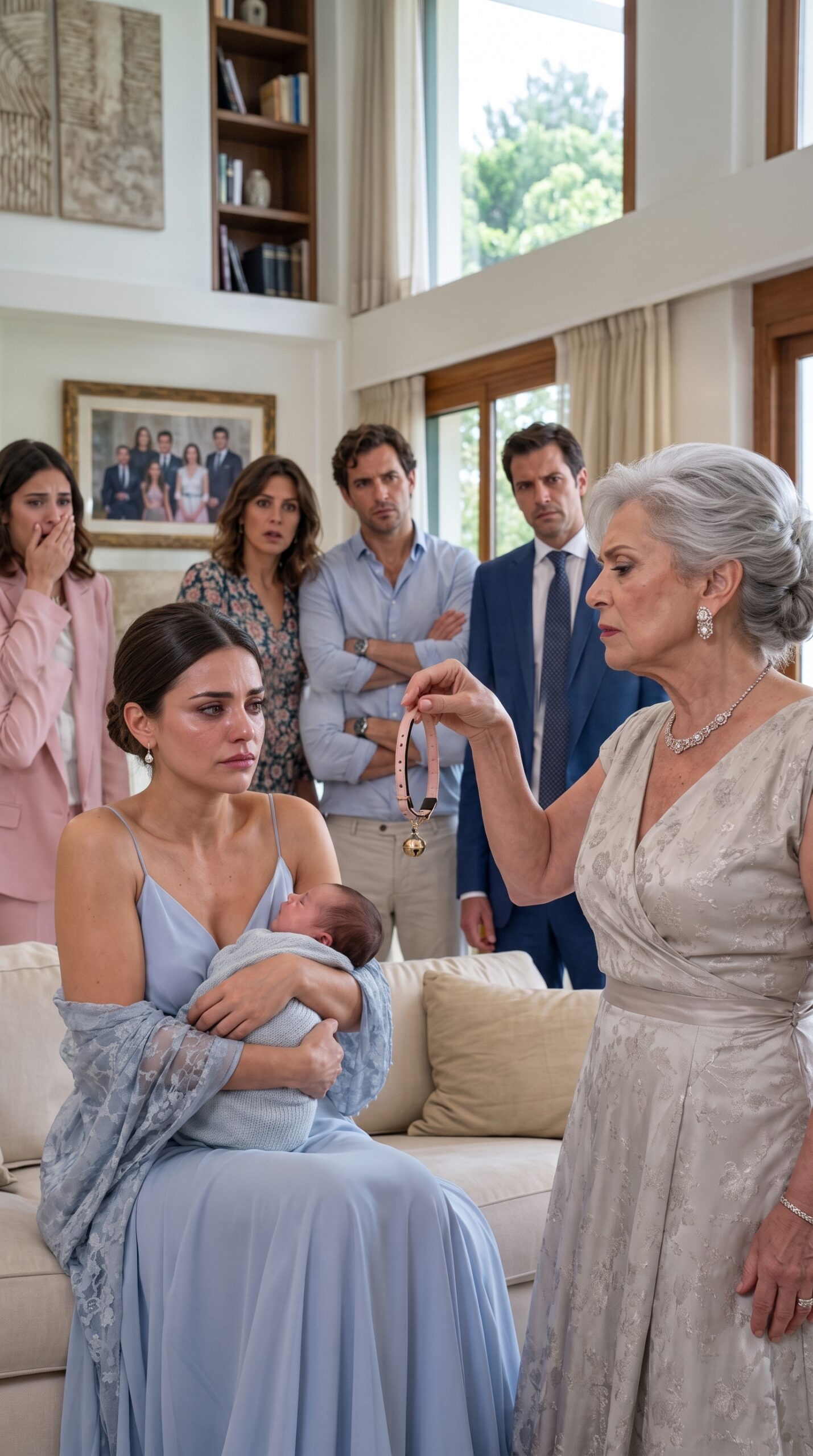
That’s what Graciela Salcedo said during the welcome of Renata, her granddaughter, barely 1 month old, in front of over 60 guests in a huge house in Lomas de Chapultepec.
Then she opened a blue velvet box and pulled out a red dog collar, with a golden tag that said: "Obey."
For 2 seconds, no one breathed.
Then the laughter started.
It wasn't awkward laughter. It was clean, cruel cackles, the kind that sounds worse because everyone understands the humiliation and still decides to revel in it.
Camila Montes was by the dessert table, with Renata sleeping against her chest. The baby smelled of milk, talcum powder, and that innocent warmth that newborns have when they still don’t know the world can be miserable too.
The party looked like it was straight out of a magazine: perfect garden, soft mariachi music in the background, peony arrangements, waiters in white gloves, tiny canapés, and ladies with bags more expensive than a used car.
But nothing shone as brightly as the contempt in Graciela's eyes.
Camila was a pediatrician at a hospital in Doctores. She had grown up in Nezahualcóyotl, in a tin-roofed house built on effort, the daughter of a mechanic and a seamstress. She never hid her origins. She never felt ashamed to say she studied on scholarships, sleepless nights, and packed buses.
But for Graciela, that was a stain that not even the Salcedo surname could wash away.
Ever since Camila married Joaquín, the only son in the family, her mother-in-law treated her like an invader. She never yelled. She never directly insulted. She did it worse: with refined smiles, disguised comments, and that elegant lady's voice that could cut like a knife.
—Camila has a very rags-to-riches story —she would say at family meals, dragging out the word as if it were a disease.
Or also:
—There are women who know how to seize an opportunity when it arises.
Joaquín always asked for calm.
—My mom is heavy, Cami. But she doesn’t mean any harm.
That Sunday it became clear that she did.
Graciela walked towards her in a champagne-colored dress, her hair immaculate, and that smile she wore when she wanted to destroy without getting her hands dirty.
—I brought a very special gift for the girl —she said.
Camila, out of courtesy, opened the box.
Upon seeing the collar, she felt the blood drain from her feet.
—What is this? —she barely managed to ask.
Graciela lifted it for everyone to see.
—A symbol. So Renata doesn’t forget that she entered a family with rules. We wouldn’t want her to turn out as rebellious as her mother.
A cousin of Joaquín burst into laughter. An uncle murmured:
—Oh, Graciela, you’re really something.
Camila hugged her baby tighter.
—Don’t come near her with that.
But Graciela took another step.
—Don’t be dramatic. It’s a fine joke, not something from the neighborhood.
Renata woke up crying just as Grandma tried to bring the collar close to her neck.
That cry shattered something inside Camila.
She saw her defenseless daughter. She saw her mother-in-law smiling. She saw the guests enjoying the spectacle as if a mother’s dignity were mere entertainment.
Then she understood that if she stayed silent, Renata would grow up learning that money gave permission to humiliate.
With a trembling hand, she took out her phone. She pretended to check a message but activated the camera. She recorded the collar. She recorded the laughter. She recorded Graciela’s hand trying to touch her baby.
Then she put the phone away, grabbed the diaper bag, and walked toward the door.
—This is how upwardly mobile people are —Graciela said behind her—. You give them a surname and they still get offended.
Camila didn’t turn back.
She walked out with Renata crying against her chest, without shouting, without insulting, without making a scene.
Because as she crossed the gate of that mansion, she already knew that Graciela had just gifted her the beginning of her own downfall.
PART 2
Camila arrived at the apartment in Del Valle with weak legs and broken breath. Renata remained restless, as if the fear from that room had stuck to her little body. She carried her, breastfed her, and waited until the baby fell asleep again.
Then she opened her laptop.
She didn’t cry first. She didn’t call anyone. She didn’t complain in the family chat. She did something colder and more powerful: she saved the video in 4 different places.
She uploaded it to the cloud, sent it to her email, copied it onto a flash drive, and placed it in a private folder where she had been storing evidence of everything Graciela had done to her for months.
There were messages where her mother-in-law asked if Joaquín was sure Renata was his. Audios where she said that a woman "from a public hospital" didn’t have the class to raise a Salcedo. Screenshots of a chat where they called her "the neighborhood doctor." Photos from Christmas, when she was seated next to the employees because "there were no seats at the main table."
Camila had saved everything without knowing exactly why.
Maybe out of fear. Maybe out of instinct. Maybe because a part of her knew that one day she would need to prove that pain also leaves evidence.
Joaquín arrived almost at midnight. He came from Monterrey, having closed a deal for the family group. He entered tired, with a loose tie and a smile that died the moment he saw Camila’s face.
—What happened?
She didn’t answer. She just turned the laptop and played the video.
Joaquín saw his mother holding the collar. He saw his daughter crying. He saw his cousins laughing. He saw Graciela approaching Renata’s neck with the tag "Obey" shining under the light.
When the video ended, he didn’t say anything.
He played it again.
Then a third time.
—Tell me she didn’t get to touch her —he murmured.
—I didn’t let her.
He brought his hands to his face.
—Why didn’t you call me?
Camila felt more rage from that question than from all the previous taunts.
—Because every time I called you for smaller things, you asked me to understand your mom.
Joaquín looked down.
Then Camila opened the folder. She showed him every message, every audio, every screenshot, every date. She didn’t exaggerate. She didn’t embellish. She just let the truth speak.
In the end, Joaquín looked like a different person. Paler. More serious. More embarrassed.
—Tomorrow we’re going to see my dad —he said.
Don Ernesto Salcedo was the founder of the family group: construction companies, restaurants, land in Querétaro, and boutique hotels in San Miguel de Allende. He was tough, reserved, one of those men who didn’t hug much but observed everything.
He was never affectionate with Camila, but he never humiliated her either.
The next day he received them in his office in Santa Fe. He watched the complete video without interrupting. He listened to 3 audios. He read 6 screenshots. Then he closed the laptop with a calm that was frightening.
—This isn’t a joke —he said—. It’s a moral disease.
He called his assistant.
—Gather the family today at 5:00. Main room. Nobody misses it.
At 5:00, the meeting room was full. Graciela arrived last, perfumed, immaculate, annoyed to be summoned as if she were an employee.
—Ernesto, what’s this nonsense?
He didn’t answer. He just connected the laptop to the screen.
When the video appeared, Graciela’s smile vanished.
The entire room heard their own laughter again.
That was the first blow.
The second came when Ernesto handed out a folder to each guest. Inside were the messages, the screenshots, and the audios. Each page was a mirror. Each piece of evidence showed that the cruelty hadn’t been an accident but a full-blown campaign.
An aunt tried to speak.
—Oh, Ernesto, we all know Graciela has a heavy sense of humor...
—No —he cut in—. A heavy sense of humor is a bad joke. This is classism, abuse, and cowardice.
Graciela stood up abruptly.
—Because that woman doesn’t belong to this family!
The phrase exploded in the room.
No one could pretend anymore that it was all a misunderstanding.
Joaquín stood up, red-eyed.
—Thank you, Mom.
Graciela looked at him, confused.
—Thank you for what?
—For finally telling the truth without makeup. You were never bothered by anything Camila did. You were bothered that I loved someone who didn’t come from your circle. You were bothered that my daughter is also the granddaughter of a mechanic and a seamstress. But those grandparents have more decency than all those who laughed at a baby.
Camila felt her chest loosen for the first time in months.
Not because the pain disappeared.
But because someone was finally naming it.
Graciela tried to cry, but her tears seemed like disguised rage.
—I just wanted to protect you from an opportunist.
—No —Joaquín replied—. You wanted to keep controlling my life.
Then Ernesto pulled out a beige envelope and placed it in front of his wife.
—And I’m going to stop obeying you too.
Graciela opened it with trembling hands.
Inside were the divorce papers.
The room froze.
—Are you crazy? —she whispered.
—No. I think for the first time in 32 years, I’m seeing clearly.
—Are you going to leave me for this girl?
Ernesto shook his head slowly.
—I’m not leaving you for Camila. I’m leaving you for what you did with a newborn in your arms. I’m leaving you for all the times you used the surname as a weapon. I’m leaving you because you confused elegance with cruelty and money with human value.
Graciela looked around, seeking support.
No one stood up.
No one defended her.
Because the video was still there, frozen on the screen, showing the golden bell like a sentence.
Ernesto continued:
—From today, you are out of the family council. Your accounts will enter the corresponding legal process. The house in Cuernavaca will be available while everything is resolved. And until a judge or Renata’s parents decide otherwise, you will not have contact with the girl.
Graciela put a hand to her chest.
—Are you going to take my granddaughter away?
Camila took a deep breath. Her legs trembled, but she spoke.
—You didn’t lose Renata today. You started losing her the day you saw her as a way to humiliate me.
For the first time, Graciela looked at her with fear.
She was no longer facing the daughter-in-law who endured comments at meals.
She was facing a mother.
—You don’t know what you’re provoking —Graciela murmured.
—Yes, she does —Joaquín said, taking Camila’s hand—. She’s protecting our daughter.
The meeting ended without hugs, without coffee, and without apologies. Some relatives tried to approach Camila. A cousin said she hadn’t laughed, although her cackle was clearly audible in the video. An uncle wanted to say everything had gotten out of hand.
Camila didn’t answer.
There are apologies that only come when shame has an audience.
That night, Joaquín and Camila returned to the apartment in silence. Renata was sleeping in her seat, oblivious to everything, with a little hand closed next to her cheek.
Joaquín turned off the car and took several seconds to speak.
—I’m sorry.
Camila looked out the window. She had waited for that word for months: after the awkward meals, the hurtful messages, the poisonous jokes, the times he asked her for patience.
But when it finally came, it didn’t sound like a happy ending.
It sounded like the beginning of a debt.
—Sorry isn’t enough —she said.
—I know.
—Never ask me for calm again when someone hurts our daughter.
—Never again.
Camila wanted to believe him. Not because everything was fixed, but because that day Joaquín had chosen a side.
Theirs.
Eight months went by.
Ernesto and Graciela’s divorce became gossip at dinner tables all over Mexico City. Some said Camila had destroyed a powerful family. Others insisted that “the daughters-in-law nowadays can’t take any nonsense.” There were also ladies defending Graciela, saying it had all been a joke.
But no one could erase the video.
And that changed everything.
Graciela stopped attending events, resigned from 2 boards, and moved to Cuernavaca. At first, she sent furious messages to Joaquín. She said Camila had him bewitched, that Renata would grow up without “her true level,” that one day everyone would apologize to her.
Joaquín didn’t reply.
Then the messages changed.
They became shorter. Then sadder. Until a letter addressed to Camila arrived.
She didn’t open the first one.
Not the second one either.
The third arrived on a Saturday morning, when Renata was already crawling around the living room chasing a yellow ball. Camila left it on the table for hours.
In the end, she read it.
Graciela said she had been in therapy for months. That she had to talk about her fear of losing control, her obsession with appearances, how she was taught to measure people by their cradle and not by their heart.
But one phrase made her cry.
“Camila, that day I didn’t humiliate Renata because she was a baby. I humiliated her because she was yours. And that obligates me to change before asking for any place in her life.”
She didn’t demand to see the girl.
She didn’t ask to erase the past.
She only said:
“Forgive me for treating your origins as shameful, when the real shame was mine.”
Camila folded the letter slowly.
She didn’t know if it was forgiveness. She didn’t know if it was justice. She didn’t know if one day Renata would meet that grandmother without fear.
But she did know one thing.
Dignity doesn’t always scream.
Sometimes it carries a baby, crosses a door with cold hands, and saves a video while everyone thinks cruelty has won.
Today, Renata is 9 months old. Her maternal grandmother sews little dresses for her from scraps of fabric. Her mechanical grandfather takes her for walks in the park as if he were carrying a treasure. Ernesto arrives on Sundays with sweet bread and sits on the floor even though his knees hurt.
Joaquín and Camila keep rebuilding.
Slower.
More honestly.
In their house, no one calls humiliation a "joke." No one uses money to trample another. No one touches Renata if her mother says no.
Recently, Camila found the red collar in an forgotten bag. The tag that said "Obey" hit the table and for a second she felt the coldness of that Sunday again.
Joaquín wanted to throw it away.
She stopped him.
—No. I’m going to keep it.
—For what?
Camila looked at Renata sleeping, with her little mouth slightly open and a peace that still deserved to be protected.
—So one day she knows that someone wanted to put a leash on her… and ended up freeing us.
Because that collar didn’t mark Renata.
It marked the end of her mother’s silence.
And if one day the girl asks why an entire family broke apart after her welcome, Camila will tell her the truth: that a house isn’t destroyed by defending a baby’s dignity.
It’s destroyed when everyone laughs while someone tries to take it away.