PART 1
Alejandro Montes arrived at the lake house in Valle de Bravo with a singular purpose: to close the door on the past.
Almost two years had passed since the death of Elisa, his wife, and he was still living as if the air weighed a ton.
He owned hotels, subdivisions, and shopping centers across half the country. He had a driver, bodyguards, lawyers, and a huge house in Las Lomas where everything glittered, except for him.
But that afternoon, he drove alone.
He wanted to say goodbye to the cabin where Elisa had been happy.
As he stepped out of the truck, the wind carried the scent of pine, wet earth, and stale bread.
Then he saw them.
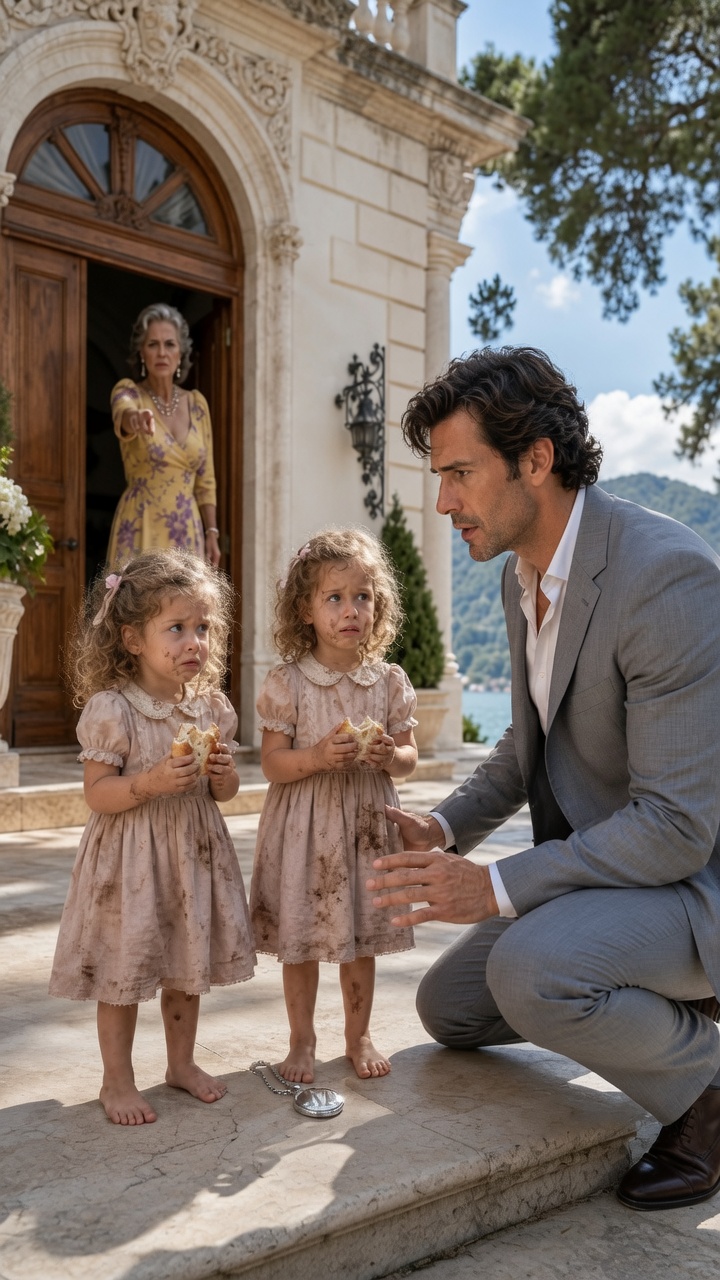
Two identical little girls sat by the door, barefoot, their feet covered in dust and their dresses stained. One clutched a hard roll against her chest. The other stared at the lake as if she had been waiting for someone to return for hours.
Alejandro froze.
They must have been three years old.
They had light brown hair, big eyes, and a seriousness that did not belong to a child.
“What are you doing here, little ones?” he asked, crouching down slowly.
The bravest one looked at him without blinking.
“I’m Lucía.”
Then she pointed to her sister.
“She’s Estrella.”
The other girl clutched the roll tighter.
“Where’s your mom?” Alejandro asked.
Lucía looked down.
Estrella whispered:
“She’s asleep.”
Alejandro’s throat tightened.
He called the municipal police, the child welfare services, and even a contact in Civil Protection. They all responded with pretty phrases and solutions for later.
“File a report.”
“We’ll send someone on Monday.”
“Don’t move them too much.”
Monday.
As if hunger, fear, and abandonment had office hours.
Alejandro took them inside the house.
He warmed milk, made them beans with eggs, and rummaged through old boxes for clothes. He dressed them in two of his t-shirts that nearly reached their ankles.
They ate in silence.
They didn’t devour the food.
They cared for it.
As if someone had taught them that eating too fast was a sin.
Estrella didn’t let go of the roll.
When Alejandro tried to take it from her to give her a fresh one, the girl recoiled in fright.
“That one’s not for you,” Lucía said. “That’s from mom.”
Alejandro didn’t insist.
That night, they slept together in the guest bed, embraced as if the world were a storm.
He remained in the hallway, unable to close his eyes.
In that house, Elisa had imagined a child’s room.
She had bought a lamp with moons, yellow blankets, and children’s books that never arrived.
Cancer took her in six months.
And with her, the dream of becoming parents disappeared.
The next day, just as Alejandro was beginning to understand what he would do, his mother arrived.
Doña Carmen stepped out of a black SUV with a driver. She was accompanied by her younger son, Rodrigo, and his wife, Natalia.
No one had invited them.
They entered as if the house still belonged to them.
“What does this mean?” Carmen asked upon seeing the girls in the living room.
Lucía hid behind Alejandro.
Estrella held the roll with both hands.
“I found them yesterday at the door,” he said. “They were alone.”
Natalia wrinkled her nose.
“Oh, no, Alejandro. Seriously, you have to think a little. No one leaves two little girls at the door of a millionaire just like that.”
Rodrigo let out a dry laugh.
“They’re trying to get money from you, brother. Or get you into legal trouble.”
Alejandro glared at them with contained rage.
“They’re children. They’re not a threat.”
Doña Carmen stepped forward.
“Your wife is dead. You can’t keep filling voids with every tragedy that crosses your path.”
The phrase landed heavily.
Alejandro clenched his jaw.
“Don’t talk about Elisa like that.”
Then Natalia pointed at the roll.
“Well, check that. Maybe that’s where the trap is.”
Before Alejandro could stop her, Natalia snatched it from Estrella’s hands.
The girl screamed as if someone were tearing her mother away from her again.
The roll broke against the floor.
And from the dry crumb fell a small, golden medallion.
Tiny.
Old.
With an engraved letter E on the back.
Doña Carmen lost her color.
Rodrigo stopped smiling.
Alejandro picked it up with trembling fingers and recognized the medallion that Elisa swore she had lost before she died.
In that instant, he understood that those girls hadn’t arrived by chance.
And the worst was about to shatter his life.
PART 2
The living room fell silent.
Only Estrella’s soft, tight cries could be heard, as if she had learned to cry without disturbing anyone.
Alejandro held the medallion in his palm.
He had seen it hundreds of times hanging around Elisa’s neck. It was a tiny Virgin Mary, with the initial E engraved on the back. She used to say it was her talisman, but never told him who had given it to her.
“Where did this come from?” Alejandro asked, looking at his mother.
Doña Carmen composed herself too quickly.
“And how would I know? It’s just any old medallion.”
“It’s not just any old medallion.”
Rodrigo tried to take it.
“Let me see it.”
Alejandro closed his hand.
“Don’t you dare.”
Lucía stepped closer.
“It was mom’s, Rosa,” she said.
Alejandro felt another blow.
“Mom Rosa?”
Estrella, with red eyes, pointed at the medallion.
“Mom Rosa said the bad lady shouldn’t see it.”
Doña Carmen tensed.
Natalia looked at the floor.
Rodrigo murmured:
“Let’s go, mom.”
But Alejandro didn’t move.
“What bad lady?”
Lucía lifted a tiny finger and pointed at Carmen.
The old woman let out a fake laugh.
“What a barbarity. Now it turns out that a filthy little girl is going to accuse me.”
Alejandro stood up.
“Don’t you ever talk to them like that again.”
Doña Carmen looked at him with that coldness she had used all her life to dominate everyone.
“You’re sick with grief, son. Those girls need to leave before they destroy you.”
“Destroy me?” Alejandro asked. “Or destroy you?”
No one answered.
That night, Alejandro locked the door with a double key.
He tucked the girls into the guest room and stayed until their breaths evened out. Then he went down to Elisa’s study.
He hadn’t entered since the funeral.
Everything remained intact: her recipe books, her photos of the lake, a cracked mug, the highlighters she used to mark novels.
Alejandro opened drawers, boxes, and folders.
He found medical receipts, letters from friends, a photo of their wedding in Cuernavaca.
Nothing.
Until he saw a loose piece of wood behind the bookshelf.
He moved it.
Inside was a blue notebook, wrapped in a scarf.
On the first page was Elisa’s handwriting.
“If Alejandro finds this, it means I could no longer protect the truth.”
Alejandro felt his hands go numb.
He continued reading.
Elisa spoke of her illness, her fear of dying, and something he never knew: before starting chemotherapy, she had frozen her eggs.
She wanted to leave a hope open.
Not out of whim.
Not out of selfishness.
Because she knew Alejandro dreamed of being a father, and she refused to let cancer take everything from them.
In the following pages, names appeared.
“Santa Clara Clinic.”
“Rosa Elena Méndez.”
“Surrogate gestation.”
“Private contract.”
“Rodrigo heard the call.”
“Carmen threatened me.”
Alejandro read that last line three times.
Then came the sentence that shattered his chest.
“If the girls are born and I’m no longer here, Alejandro must know they are his daughters.”
The notebook fell onto his knees.
Above, a door creaked.
Alejandro ran upstairs and found Rodrigo in the hallway, in front of the room where the twins were sleeping.
“What are you doing here?” he growled.
Rodrigo jumped.
“I came to talk to you, dude. Mom’s worried.”
“At two in the morning?”
Rodrigo saw the notebook in Alejandro’s hand.
His face changed.
“Give me that.”
“What do you know?”
“Don’t make this bigger.”
Alejandro took a step towards him.
“Bigger than hiding my daughters?”
Rodrigo swallowed hard.
He didn’t deny it.
That silence was a confession.
Alejandro pushed him out of the house and immediately called his lawyer, Julián Herrera. He asked him to arrive before dawn. He also called a private doctor and a trusted social worker.
By 8 a.m., the lake house was filled with tension.
Doña Carmen returned, this time accompanied by two municipal police officers and a DIF worker named Teresa.
“We received a report that there are two minors at risk,” Teresa said.
Alejandro looked at his mother.
“What a coincidence.”
Carmen lifted her chin.
“My son hasn’t been well since he became a widower. He invents signs where none exist.”
Lucía hugged Estrella.
The girls no longer cried.
That hurt even more.
Julián arrived with a briefcase and a hard expression.
“Before anyone removes the minors, you need to review this,” he said.
He placed Elisa’s notebook on the table.
Then he showed on his cell phone a photograph obtained from an old clinic file.
In the image, Elisa was seen leaving the Santa Clara Clinic, pale but smiling. Next to her walked a pregnant woman. Behind, clear as day, was Rodrigo.
Alejandro felt rage rise to his throat.
“Speak,” he told his brother.
Rodrigo sank into a chair.
He seemed like a broken man.
“I didn’t want it to happen like this.”
“Speak.”
Carmen slammed her hand on the table.
“Don’t say a word.”
But Rodrigo was already crying.
“Elisa wanted to make it legal. Rosa Elena agreed to gestate the girls because she needed money to care for her sick mother. At first, everything was fine. But mom found out.”
“How?” Alejandro asked.
Rodrigo wiped his face.
“She was reviewing Elisa’s accounts. She said a dying woman shouldn’t handle family money.”
Alejandro looked at Carmen with disgust.
“That was her money too.”
“It was your future,” she replied coldly. “That woman was dragging you to her grave.”
Teresa’s eyes widened.
Julián began to record.
Carmen didn’t hold back.
“What did you want? To be a widower with two babies born from a rented womb? To ruin the Montes name over the whim of a sick woman?”
Alejandro slammed his hand on the table.
“Don’t ever call my wife’s love a whim.”
Rodrigo continued, his voice broken.
“When Elisa died, mom paid to make the file disappear. The clinic later closed due to reports of false adoptions and altered documents. Rosa had the girls in a private house in Toluca. Mom sent her money every month so she would never show up.”
“And you?” Alejandro asked.
Rodrigo lowered his gaze.
“I signed as a witness on a document. I thought it was temporary. I thought when you were better, we would tell you.”
“Almost two years passed.”
“I know.”
Natalia, who had remained silent by the door, broke down in tears.
“I told him it was madness. I told Rodrigo it was a sin, that those girls were not to blame. But your mom said that if they showed up, she would change the inheritance, the shares, everything.”
The truth sliced through the air like a knife.
They hadn’t hidden the girls out of compassion.
They hid them for money.
For control.
For surname.
For ambition.
Then Estrella, who sat on the couch with the medallion between her fingers, spoke.
“Mom Rosa said when she went to heaven, we had to come to the man by the lake.”
Alejandro knelt in front of her.
“Where is Rosa, my love?”
Lucía pulled out of her t-shirt pocket a crumpled, dirty napkin, almost torn.
“Mom Rosa said not to lose it.”
Alejandro opened it carefully.
The handwriting was shaky.
“Don Alejandro: forgive me. I was paid to be silent, but Elisa always wanted you to know. The girls are yours. Mrs. Carmen threatened me. I can no longer care for them. I’m sick and have no family. If anything happens to me, let Lucía and Estrella come to the lake house. Elisa said that there you could feel they were yours before seeing papers. Don’t let them take them.”
A name was written below.
Rosa Elena Méndez.
And a phone number that no longer answered.
Teresa asked to read the note.
The officers exchanged glances.
Carmen finally lost her composure.
“That proves nothing. A poor woman can write anything for money.”
Alejandro stood up slowly.
“You bought her silence and now you want to call her a liar.”
“I protected you.”
“No. You robbed me.”
The word hung in the air.
Robbed.
She robbed her son of parenthood.
She robbed Elisa of her last will.
She robbed two girls of their name, their home, and their father.
Julián spoke firmly.
“We will request urgent DNA testing, protective measures, and an investigation for concealment of identity, alteration of documents, and possible trafficking of files.”
Carmen tried to approach the girls.
Alejandro stepped in front.
“Not one step closer.”
Teresa made a decision right there.
“The minors will not be removed. They will remain under the provisional custody of Mr. Montes while the information is verified. There will be supervision and evaluation, but they will not be moved today.”
Carmen screamed.
She said she knew judges.
That the press would destroy them.
That no one would believe a dead woman, a poor woman, and two barefoot girls.
But every word sunk her deeper.
The DNA test arrived nine days later.
99.99%.
Lucía and Estrella were biological daughters of Alejandro Montes and Elisa Robles.
Alejandro received the result in the parking lot of a laboratory in Toluca. The girls slept in the back seat, each with a new doll.
He read the numbers.
He didn’t shout.
He didn’t smile.
He simply walked over to a jacaranda tree, leaned against the trunk, and broke down.
He cried for Elisa.
For Rosa.
For the three years his daughters spent without him.
For all the nights he thought life had taken everything from him, not knowing that two pieces of his love were still breathing somewhere.
The legal process was hell.
Carmen tried to present herself as a concerned mother. She said Alejandro was depressed, that Elisa had acted behind his back, that everything was too confusing.
But deposits appeared.
Deleted messages.
Calls to the clinic.
Testimonies from a nurse.
And Rodrigo’s complete confession.
Carmen lost the right to approach the girls. She was put under investigation, and her name, that surname she defended so much, ended up in the headlines she always wanted to avoid.
Rodrigo lost his brother.
Alejandro couldn’t forgive him, not truly.
Natalia separated from him months later, tired of living with a guilt that wasn’t hers.
The Montes family, elegant, powerful, and so concerned about appearances, shattered before all of Mexico.
And Alejandro, for the first time, didn’t try to piece the fragments back together.
He sold the mansion in Las Lomas.
He didn’t want to raise his daughters in a house filled with cold hallways and rotten secrets.
He stayed in Valle de Bravo.
He fixed the garden.
He painted the room that Elisa had imagined.
One wall was filled with silver moons.
The other, with yellow suns over green mountains.
Lucía asked for dinosaur sheets.
Estrella wanted flower curtains.
Nothing matched.
And still, Alejandro thought it was the most beautiful room in the world.
A month later, they found a box of Elisa’s behind some old suitcases.
Inside were letters.
One for Alejandro.
Another for “my girls, if they ever come home.”
He took two days to open his.
He read it on the porch, right where he had found the twins with the hard roll.
“Love: if you’re reading this, you may already know the truth. Forgive me for being silent. I didn’t want to leave you a hope that could kill you again. But if our daughters reach you, don’t think that I arrived too late. Think that I found a way to return.”
Alejandro cried in silence.
On the grass, Lucía chased a ball.
Estrella wore the clean medallion on a new chain.
When it fell, Lucía picked it up.
And they kept running.
As if life could still be good.
The first birthday they celebrated together had no businessmen, politicians, or awkward relatives. There was vanilla cake, a star piñata, neighbors, Teresa, Julián, and a photo of Elisa next to a bouquet of white flowers.
They also placed flowers on Rosa Elena’s grave.
The plaque read:
“Thank you for bringing them home.”
That night, Lucía asked:
“Dad, does mom Elisa see us from heaven?”
Alejandro looked at the dark lake, the distant lights, and the sky full of clouds.
“Yes, my love. I believe she does.”
Estrella touched her medallion.
“And does mom Rosa see us too?”
Alejandro picked her up.
“Yes. She took great care of you.”
Lucía thought for a few seconds.
“Then we have many moms looking after us.”
Alejandro smiled with tears in his eyes.
“Yes. And they all paved the way for you to arrive with me.”
Sometimes, the family that boasts the most love is the one that hides the most harm.
Sometimes, blood doesn’t guarantee goodness.
And sometimes, a truth appears in the humblest place: inside a hard roll, in the dirty hands of two girls who knew nothing of inheritances, lawyers, or surnames.
They only knew one thing.
That they had knocked on the right door.
Because what is destined to save you, even if it is buried, even if it is denied, even if it is bought with money, sooner or later finds a way to come home.





