PART 1
—If you don’t sign for my mom to live in your apartment, then you never understood what it means to be a wife —Diego said in front of his whole family.
Valeria didn’t respond right away.
They were seated in the dining room of her in-laws’ house, in a gated community in Querétaro, with plates of mole, glasses of wine, and a tension so thick that even the ceiling fan couldn't stir it.
Valeria was 34 years old, an architect who had bought her apartment in Milenio III before getting married.
No one gave it to her as a gift.
It wasn’t luck.
It was years of blueprints, late-night deliveries, working under the sun, debt paid off peso by peso, and weekends spent working while others rested.
But for Diego’s family, that apartment was just “a wasted space.”
Doña Carmen, her mother-in-law, touched her chest as if she were about to faint.
—I can’t handle the stairs in this house anymore. The doctor said I need peace. And you, Valeria, have 2 empty bedrooms. A grateful daughter-in-law doesn’t deny a roof to her husband’s mother.
Don Ernesto, her father-in-law, added without a hint of shame:
—Moreover, Diego already has too many expenses. It would only be fair for you to contribute 20,000 pesos a month for Carmen’s medicine and food.
Valeria looked at Diego.
She waited for him to say something.
A word.
A “don’t exaggerate.”
A “that apartment is yours.”
But Diego just lowered his gaze and kept moving his fork, as if they were discussing her but without her.
—No —Valeria finally said.
The dining room froze.
—What do you mean no? —Doña Carmen asked, her smile hardening.
—I’m not going to give up my apartment. I’m not signing anything. And I’m not paying a monthly fee to support decisions you made without asking me.
Diego slammed the silverware down.
—You’re humiliating me in front of my family.
—No, Diego. You brought me here to pressure me in front of them.
Doña Carmen’s expression changed.
She no longer looked sick.
She looked furious.
—Look at how arrogant she is. That's why women nowadays don’t stay married. They want to control everything.
Valeria took a deep breath.
—My house isn’t up for discussion.
Diego stood up.
—If you don’t give your house to my mom, then you were never part of this family.
He grabbed a glass of wine.
Valeria barely had time to turn her face when the glass hit her brow.
The impact was dry.
The wine ran down her cheek, mingled with blood.
No one moved.
Not her brother-in-law, not her father-in-law, not Doña Carmen.
Only Lucía, Diego’s brother’s wife, covered her mouth with both hands.
—Oh, Valeria —Doña Carmen murmured—. Don’t be dramatic. You provoked it.
In that moment, Valeria understood everything.
This wasn’t a family dinner.
It was an ambush.
She stood up trembling, took out her cell phone, and dialed 911.
Diego turned pale.
—Hang up, you’re exaggerating.
Valeria looked at him with blood running down her face.
—No, Diego. It’s over.
When the operator answered, Valeria spoke with a calmness that terrified everyone:
—I need a patrol car and an ambulance. My husband just assaulted me in front of his whole family.
And while Doña Carmen screamed that it was all an accident, no one imagined that the worst was just beginning that night.
PART 2
When the patrol arrived, the Mendoza house ceased to look like an elegant residence.
Suddenly, the dining room with fine china, expensive paintings, and scented candles turned into a room full of people trying to tell the same lie.
A paramedic sat Valeria near the entrance.
He carefully cleaned her wound, but the sting shot up to her eye. The bleeding wasn’t as bad now, although her light blouse was still stained with red wine.
One police officer separated Diego.
Another asked for names.
—Who saw what happened?
No one spoke.
That silence was crueller than the blow.
Doña Carmen stepped forward with a trembling voice, pretending to be fragile.
—Officer, it was an accident. My daughter-in-law got intense. They argued, Diego moved his hand, and the glass fell.
—The glass didn’t fall —Valeria said—. He threw it at me.
Diego tried to approach.
—Vale, don’t do this. We’re married. We can sort this out at home.
Valeria let out a bitter laugh.
—We were also married when you threatened me to give up my apartment.
The police officer looked at her more attentively.
—Do you have proof of threats?
Valeria pulled out her cell phone. The screen had a wine stain, but it still worked.
She opened the messages.
One read:
“If you contradict my mom again, I can’t promise what will happen.”
Another:
“That apartment will serve my family sooner or later.”
And another, sent 2 days prior:
“Sign nicely, Valeria. Don’t make me pressure you in front of everyone.”
The officer read in silence.
—Do you wish to file charges?
Diego shook his head, almost pleading.
—No, please. My love, come on, don’t ruin our life over a silly thing.
Valeria looked at him as if she finally saw a stranger.
—Yes. I want to file charges.
They took her to the hospital to stitch her brow. The only one who got in the ambulance with her was Lucía, her sister-in-law.
Throughout the ride, Lucía kept crying.
—I’m sorry —she repeated.
Valeria didn’t understand why.
She thought it was guilt.
She thought it was fear.
But she didn’t ask. She was too tired to hold another truth.
The next day, with 4 stitches in her brow and her body sore, Valeria went to the office of Renata Solís, her university friend and family lawyer.
She brought messages, pictures of old bruises, receipts for contributions Diego had asked for “for emergencies,” and the original deeds to her apartment.
Renata read everything with her jaw clenched.
—This wasn’t a spur of the moment; this was planned.
—Planned?
—Yes. They wanted to make you feel guilty until you signed something.
That same afternoon, they went to Valeria’s apartment.
The first thing was to change the locks.
Then they checked documents, drawers, and folders.
Everything seemed normal until Renata opened a closet where Diego kept some old boxes with tools.
At the back was a black folder.
On the cover, it said:
“Department Milenio III.”
Valeria felt a horrible chill in her stomach.
Inside were copies of her deeds, a recent appraisal, rental calculations, potential buyers, and a handwritten note from Doña Carmen.
The note read:
“If Valeria refuses, Diego must make her feel like a bad wife. Let her think she’ll destroy the family. He has to get her to sign before she consults a lawyer.”
Valeria couldn’t breathe.
Renata lifted the sheet carefully.
—This isn’t just domestic violence anymore. This looks like an attempt to dispossess.
Valeria sat on the floor.
For years, she had thought Doña Carmen was just meddlesome, annoying, bossy.
But that sheet wasn’t an opinion.
It was a plan.
That night, when she thought nothing could surprise her anymore, Lucía appeared at Renata’s office.
She came with red eyes, a swollen face, and an old cell phone wrapped in a napkin.
—I have something —she said in a broken voice—. If I hand it over, Martín will hate me forever.
Martín was Diego’s older brother.
The same one who said nothing when the glass hit Valeria.
Renata closed the door.
Lucía placed the cell phone on the desk.
—The whole dinner is recorded.
Valeria felt her heart stop.
—Recorded by whom?
Lucía swallowed hard.
—By my husband. Martín always records when money is discussed. Don Ernesto asks him to ensure no one claims they didn’t agree to terms later.
Renata connected the phone to her computer.
The image was somewhat blurry but enough.
There was the dining room.
There was Valeria.
There was Diego.
There was Doña Carmen pretending to be in pain while she spoke about the apartment as if it were already hers.
They heard her voice:
—Valeria must understand that when a woman gets married, she also marries the needs of her husband.
Then Don Ernesto said:
—If it’s sold later, it’s shared among family, and everyone profits.
Valeria felt nauseous.
They didn’t want to live there.
They wanted to seize the apartment.
The recording continued.
Diego’s voice came through:
—Don’t make me look like a freeloader in front of my family.
Then Valeria’s voice, firm even though she was trembling inside:
—My apartment is not for lending, not for selling, and not for buying my place in this family.
Then came the blow.
The glass slipped from Diego’s hand.
Valeria’s body leaned to one side.
They heard the glass shatter.
The gasping breath.
The chair scraping the floor.
And then Doña Carmen’s voice:
—See what you provoke.
Renata paused the video.
Lucía broke down in tears.
—I knew they wanted to pressure you, but I didn’t think Diego was capable of doing that to you.
Valeria looked at her, hurt.
—And why are you helping me now?
Lucía lowered her head.
—Because I have an 8-year-old daughter. And when I saw you bleeding, I understood that I don’t want her to learn that a woman must stay silent for a family to appear decent.
That sentence broke something in Valeria.
Because for years she believed her marriage was complicated but normal.
That Diego had a strong character.
That her mother-in-law was intense.
That Mexican families sometimes got too involved, but “that’s how they were.”
No.
That wasn’t family.
It was a machinery of obedience.
A house where abuse was disguised as tradition and violence was made up to look like an accident.
Renata wasted no time. The video was added to the complaint along with the messages, the black folder, appraisals, and Doña Carmen’s note.
They also requested protective measures because Diego began writing from new emails.
One read:
“You’re going to end up alone. No one believes a self-interested woman.”
Another:
“All this theater over an apartment. What a terrible wife you’ve been.”
The third arrived at 2:17 AM:
“You’re still in time to fix it.”
Valeria wanted to reply.
She wanted to scream at him.
She wanted to tell him he was a coward.
But Renata stopped her.
—Don’t give them a fight where they know how to manipulate. You’re going to respond where the evidence weighs.
And so started the hardest stage.
Because filing charges wasn’t like in the movies.
There was no immediate justice.
There were procedures, statements, exhaustion, fear of opening the door, fear of checking the mail, fear of running into Diego outside the office.
The wound on her brow healed before the shame did.
Valeria felt embarrassed for her colleagues to see the stitches.
She felt ashamed to say her husband had hit her.
She felt ashamed for having endured so much.
Until her psychologist told her something that left her speechless:
—The shame isn’t yours. They left it for you to carry.
That night, Valeria returned to her apartment, locked the new locks, and sat on the floor crying.
But she cried differently.
Not like someone defeated.
She cried like someone finally releasing a burden she should never have carried.
Diego’s family tried to clean up their image.
First, they called Valeria’s parents in San Luis Potosí.
Doña Carmen said Valeria was “upset,” that she exaggerated a discussion and that it was best to convince her to withdraw the complaint.
Valeria’s mother heard everything.
Then she responded:
—My daughter wasn’t born for you to educate her with blows.
Then came the rumors.
They said Valeria was cold.
That she never loved Diego.
That she was just interested in keeping everything.
That she surely had another man.
That a normal woman wouldn’t call the police over a glass.
When Renata told her, Valeria clenched her fists.
—I want to respond.
—No —said Renata—. Every lie they tell will serve to show how they try to intimidate you. Your file already speaks for you.
And it spoke.
At the first hearing, Diego arrived in a white shirt and a rehearsed remorseful face.
Doña Carmen sat in the back with a rosary in her hands, as if praying could erase her handwriting on that sheet.
Don Ernesto didn’t look at anyone.
When the judge asked what happened, Diego lowered his voice.
—It was a moment of tension. My wife became verbally aggressive. I lost control for a second, but I never intended to hurt her.
Valeria felt the scar burning.
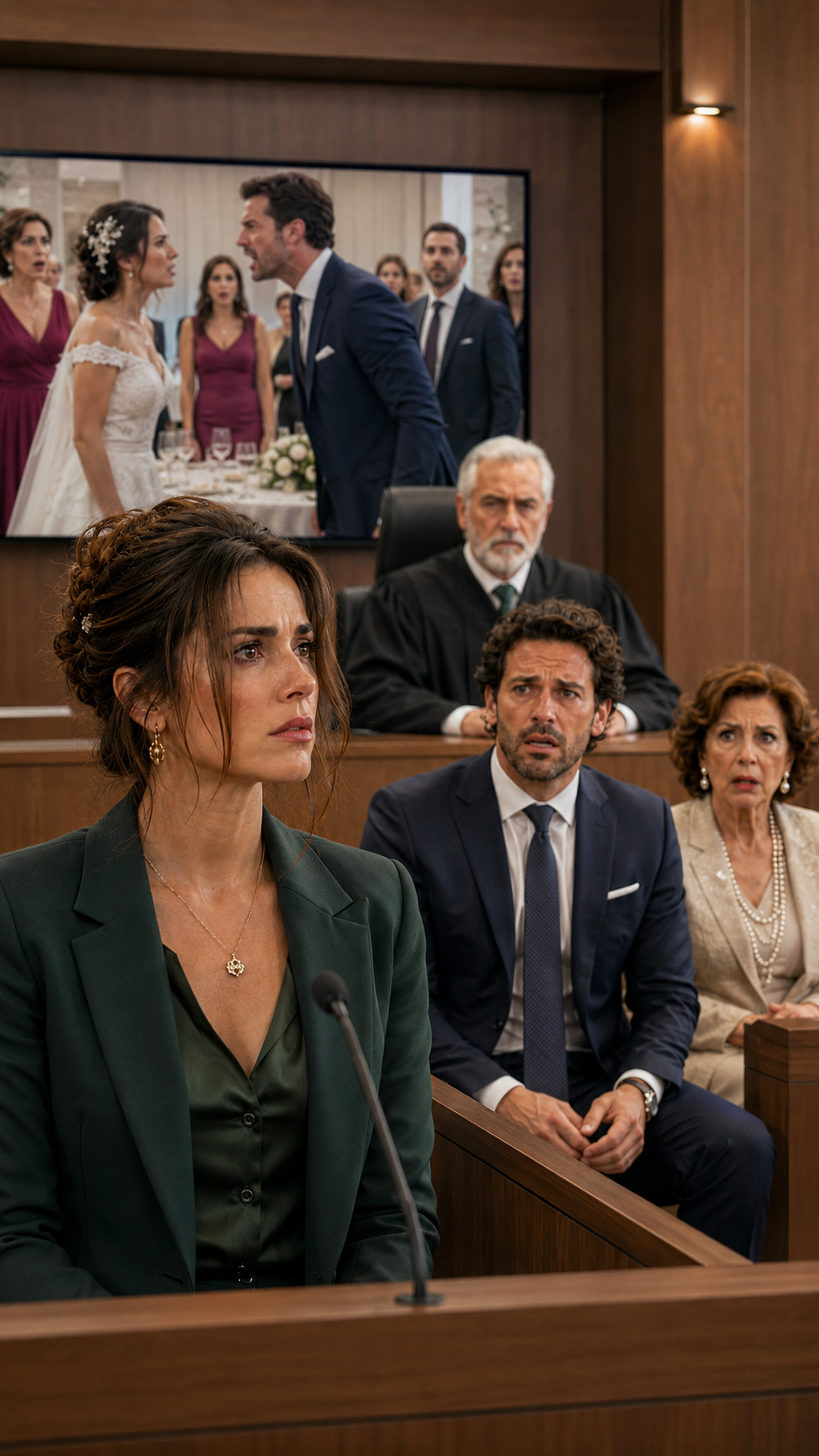
Renata requested to play the video.
The room fell silent.
They heard Doña Carmen talk about the apartment.
Don Ernesto mention that everyone would win if it was sold.
Diego say Valeria left him looking like a freeloader.
Valeria say no.
And then the blow.
No one could say it was an accident.
No one could say the glass fell.
No one could pretend she was exaggerating.
What hurt the most wasn’t the sound of the glass.
It was hearing Doña Carmen again:
—See what you provoke.
The judge asked to pause the video.
She stared at Diego for several seconds.
—Was that also an accident?
Diego didn’t respond.
Doña Carmen stopped moving the rosary.
Don Ernesto sank into the chair.
For the first time, they didn’t look like a powerful family.
They looked like exposed people.
When Valeria spoke, her voice trembled, but didn’t break.
—For years, I believed that being a good wife meant enduring. Enduring comments, demands, screams, humiliations. I thought defending my home made me selfish. But that night I understood that my apartment wasn’t the problem. My “no” was the problem. They didn’t want family. They wanted obedience.
She took a deep breath.
—I didn’t file charges over a glass. I filed charges because that glass was the visible part of everything that had been happening in silence.
Months later, Diego was prosecuted for injuries and domestic violence.
The restraining order remained in place.
He had to pay medical expenses, part of the psychological therapy, and compensation for damages.
The divorce was finalized under separation of assets.
No alimony for him.
No rights over the apartment.
No negotiation.
But the final blow came when the asset investigation revealed something else.
Diego had enormous debts.
He had borrowed money from acquaintances claiming he would soon have access to a “family” property in Milenio III.
He even showed copies of Valeria’s deeds as if they were collateral.
Don Ernesto denied any involvement.
Until messages of his emerged:
“Tighten the screws before she consults a lawyer.”
And another:
“If she signs something simple at home, we’ll formalize it later.”
Doña Carmen tried to play the victim.
She said she was a sick woman attacked by an ungrateful daughter-in-law.
But her own note caught up with her.
It wasn’t enough to punish her for everything she tried to do, but it was enough to clarify that she wasn’t a concerned mother-in-law.
She was part of the plan.
Lucía also paid dearly.
Martín called her a traitor.
He told her she destroyed the family.
She left 2 months later with her daughter and 2 suitcases.
She rented a small apartment close to her daughter’s school.
One afternoon she called Valeria and said:
—I don’t have a living room, or dining room, or hardly any furniture. But my daughter sleeps peacefully.
Valeria cried upon hearing her.
Not because everything was perfect.
But because finally, something was starting to be right.
A year after that dinner, Valeria organized a meal in her apartment.
There was no wine.
She still struggled to smell it.
She bought sweet bread, white flowers, and mineral water.
At the table were her mom, Renata, Lucía, and 2 work friends.
It wasn’t an elegant dinner.
There were quesadillas, salad, conchas, and a peace that felt new.
Her mom raised her glass.
—To Valeria. Because she said no when everyone wanted to see her on her knees.
Valeria smiled with tears in her eyes.
—The truth is I was scared.
Renata took her hand.
—Being scared doesn’t mean you’re not brave.
Lucía added:
—It means you did it even though you trembled.
That night, when everyone left, Valeria closed the door and stood in the middle of the living room.
Her living room.
Her walls.
Her balcony.
Her keys.
For a long time, she believed that love had to hurt a little to be real.
That all families had secrets.
That all mothers-in-law demanded.
That all husbands yelled when pressured.
That a mature woman didn’t make scenes.
Now she knew it didn’t.
Love doesn’t demand a house as proof of loyalty.
Family doesn’t charge you obedience to give you a place.
A husband doesn’t protect you only when you do what his mother wants.
And a home isn’t a home if you have to shrink yourself to make others feel big.
Sometimes Valeria still dreamed of the blow from the glass.
She would wake up touching her brow, searching for blood that was no longer there.
But then she would see her blueprints on the desk, her plants by the window, and her keys on the table.
Then she remembered she survived.
Not because someone rescued her.
But because one night, in front of a table full of cowards, she rescued herself.
And every time someone asked if it was worth “breaking a family” for defending an apartment, Valeria responded the same:
—I didn’t break a family. I broke a cage they decorated as home.
Because sometimes a woman doesn’t need to take revenge.
She just needs to say no, hold it until the end, and let the truth make the noise she’s already tired of shouting.





