PART 1
"You’re going to say you slipped, Valeria. And you better say it right."
That was the last thing Valeria Méndez heard before crashing to the kitchen floor.
The impact dimmed her world.
When she opened her eyes again, she didn’t see her home in Lomas Verdes or the broken lamp on the table. She saw white lights, a moving ceiling, and the blurry face of her husband leaning over her.
"My love, it’s okay," Tomás Arriaga said in a soft, false, almost tender voice. "We’re at the hospital now."
Then he turned to a nurse.
"She fell in the shower. She hurt herself badly. My wife is so clumsy, always distracted."
Valeria wanted to speak.
She couldn’t.
Her mouth was dry, her lip split, a terrible pain shot through her ribs, and a pressure on her neck made her breathe as if Tomás’s hands were still around it.
He stroked her hair in front of the medical staff.
"Poor thing," he murmured. "She’s been very anxious lately."
No one in the ER knew that this elegant man, dressed in a white shirt and an expensive watch, was the same one who had dragged her through the kitchen 40 minutes earlier, demanding the password to her laptop.
To the world, Tomás Arriaga was a successful businessman from Mexico City. Owner of Arriaga Capital, sponsor of foundations, invited to events in Santa Fe, a model husband on social media.
He posted pictures with Valeria at restaurants in Polanco, wrote phrases about love and family, hugged her in public as if she were his treasure.
But at home, he was different.
He checked her phone.
He blocked her credit cards.
He told her which friends were a "bad influence."
He hid the car keys whenever she mentioned visiting her mom in Toluca.
The first time he pushed her, he cried and brought her roses.
The second time, he blamed stress.
The third, he said she provoked him.
After that, he didn’t even apologize.
What Tomás never imagined was that Valeria was not an naive woman.
Before they married, she had been a forensic auditor. She knew how to trace dirty money, detect shell companies, find fake invoices, and read contracts like others read text messages.
When Tomás met her, his company was drowning in debt. Valeria organized accounts, negotiated with banks, cleaned up balances, and convinced investors.
Tomás slapped his name on the facade.
Valeria hid her power in documents he signed without reading.
Through a trust created by her father, she held 51% of the voting rights.
For six months, Valeria prepared her escape.
She photographed her injuries.
She saved audio recordings.
She copied suspicious transfers.
She scanned contracts with suppliers from Puebla, Querétaro, and Monterrey that stank of fraud from a distance.
Everything was uploaded to an encrypted cloud shared only with her older brother, Santiago Méndez.
Santiago was the chief of emergency at Santa Lucía Hospital.
And that night, he was on duty.
Tomás didn’t know.
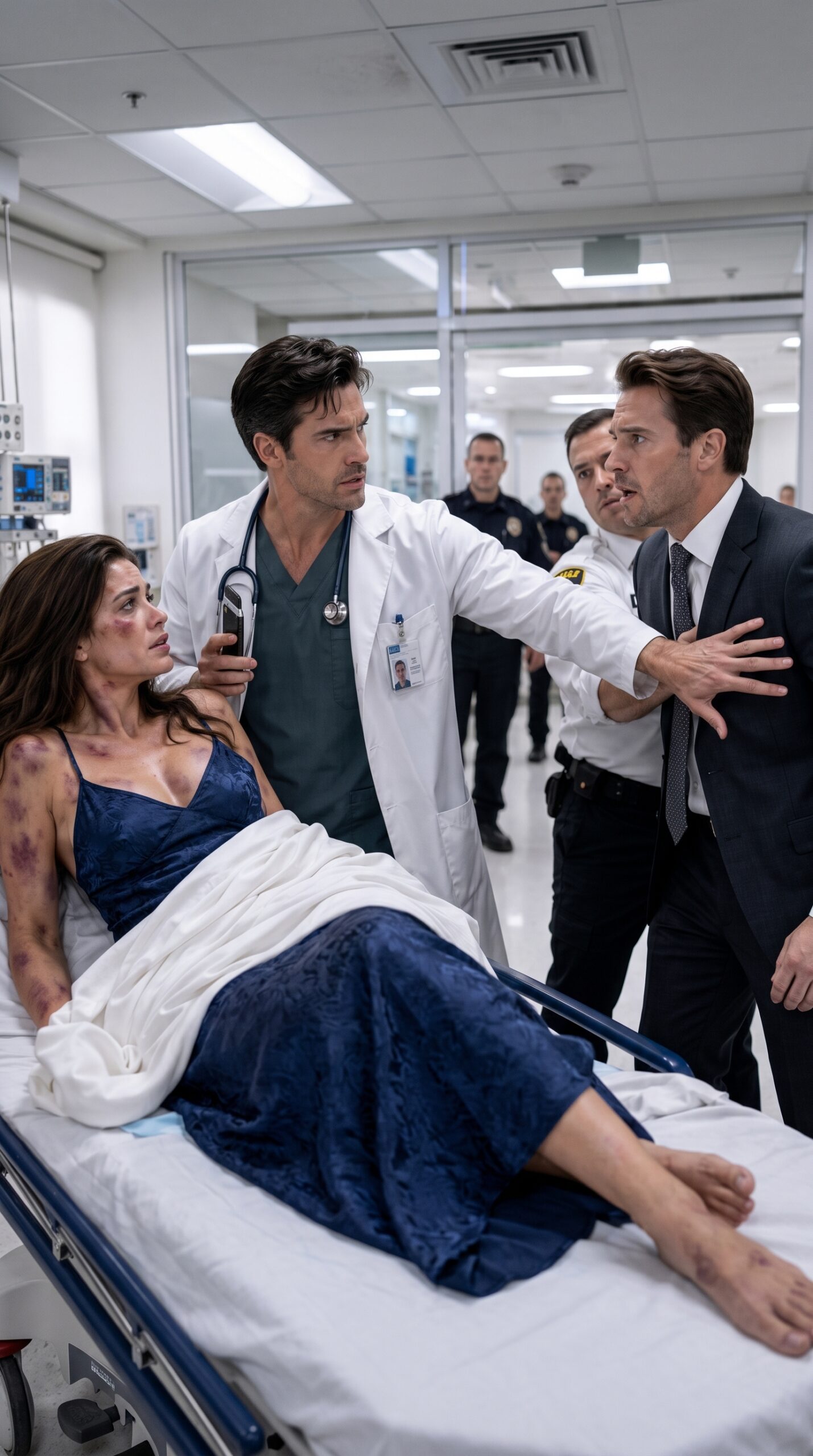
When the automatic doors opened, Santiago walked in, reviewing the patient file. Upon reading Valeria’s name, he looked up.
He froze.
He saw her split lip.
The purple mark on her neck.
The old bruises peeking from under her sleeve.
Tomás smiled, not recognizing him.
"Doctor, thank you. My wife fell in the shower."
Santiago approached the gurney and took Valeria’s hand.
She barely opened her eyes.
"Santi…"
Tomás’s smile vanished.
Santiago turned to him, his voice low but firm.
"She didn’t fall."
Tomás stepped back.
"Who are you?"
Santiago grabbed the phone from the wall.
"I’m her brother. Close this area and call security, the Public Ministry, and the police."
And for the first time in years, Tomás Arriaga understood that the woman he thought was alone had arrived at the only place where his lie wouldn’t survive.
PART 2
Tomás let out a dry, nervous laugh, the kind used by men accustomed to everyone believing them.
"This is ridiculous," he said, raising his hands. "I understand you’re worried about your sister, doctor, but you’re mixing personal issues with medicine."
Santiago didn’t budge.
"Medicine is documenting injuries. And what Valeria has doesn’t correspond to a fall."
"She hurts herself," Tomás replied instantly. "She has episodes. She gets upset. Sometimes she makes things up when under pressure."
Valeria closed her eyes.
There was the other prison.
It wasn’t just the blows.
It was the narrative Tomás had built around her: that she was unstable, jealous, exaggerated, ungrateful. That she had anxiety attacks. That she confused normal discussions with violence. That she needed to rest and not make important decisions.
For months, he had repeated this at dinners, family gatherings, and company events.
Each comment was a seed.
Now he wanted to harvest them in a hospital.
A social worker entered with two police officers and an agent from the Public Ministry. The nurse closed the curtain. A guard positioned himself by the door.
Tomás changed his tone.
"Officer, this is really getting out of hand. My wife needs medical attention, not a show. I brought her here because I love her."
Valeria struggled to breathe.
Pain coursed through her chest, but she managed to move her lips.
"Ask him… about the smoke detector."
Tomás turned so fast that even the officers noticed.
"What did you say?"
Santiago leaned in.
"Valeria, repeat it."
She swallowed hard.
"The camera is in the smoke detector in the kitchen."
Tomás’s face drained of color.
Three weeks prior, after threatening to declare her incapacitated if she sought a divorce, Valeria had bought a security camera with automatic backup. She installed it in the kitchen, inside a new smoke detector.
Every time it detected shouting or sudden movements, the video uploaded to the cloud.
Tomás had found the audit.
He found the fake folder she left on the desk.
He found two empty USB drives.
But he never found the actual camera.
Santiago took out his phone.
"I have access to the backup," he said.
"Valeria, shut up," Tomás ordered.
It was so natural, so cold, so him, that no one looked at him as a worried husband again.
He tried to approach the gurney, but the guard stopped him.
"You can’t pass."
"She’s my wife!"
The agent looked up.
"She’s not your property."
Tomás gritted his teeth.
"You don’t know who I am."
Santiago stepped forward.
"That’s why we’re calling those who can investigate you."
As the doctors examined Valeria, the clinical report began to outline the truth: two fractured ribs, a concussion, pressure marks on her neck, old injuries on her arms and back, bruises in various stages of healing.
It wasn’t a fall.
It was a pattern.
The agent requested to separate Tomás from the patient. The police took him to the hallway. He was still trying to talk on the phone, demanding calls, asking for names, threatening lawsuits.
But the hospital was no longer his home.
He couldn’t close doors there.
He couldn’t take away phones.
He couldn’t silence Valeria’s voice.
At 11:48 PM, Rebeca Ibarra, Valeria’s lawyer, arrived. She had a black briefcase, glasses on her head, and a no-nonsense face that made Tomás stop shouting for three seconds.
"Good evening," Rebeca said. "I’m here as legal representative of Mrs. Valeria Méndez."
Tomás burst into laughter.
"Did you plan this too?"
Valeria looked at him from the gurney, pale, with her neck immobilized.
"I didn’t plan for you to hit me," she said. "I planned for you not to be able to erase it."
Rebeca opened the briefcase on a table.
"Mr. Arriaga, your wife had already initiated a procedure for patrimonial and personal protection. She also left signed instructions to activate emergency measures if she suffered physical aggression."
Tomás blinked.
"It’s not valid."
"Yes, it is," Rebeca replied. "And you signed it without reading."
Santiago nearly smiled but contained himself.
Rebeca pulled out three folders.
The first contained the prenuptial agreement.
The second, the documents for the Méndez trust.
The third, a preliminary audit of Arriaga Capital.
"Valeria holds 51% of the voting control of the company. Furthermore, the corporate regulations allow for the immediate removal of any executive investigated for violence, fraud, or use of corporate resources to cover up crimes."
Tomás looked at Valeria as if he were seeing her for the first time.
"You wouldn’t dare."
She didn’t raise her voice.
"I already did."
The aggression hadn’t started from jealousy.
That was the pretty lie to justify the unjustifiable.
Tomás hit her because he discovered that Valeria had requested an independent audit. The night of the attack, she had found payments to four non-existent suppliers, triangulated transfers, and inflated invoices for work that was never done.
The money hadn’t disappeared.
It had been hidden.
There was an apartment in Santa Fe under the name of a cousin of Tomás.
A vacation home in Valle de Bravo paid with "external consulting."
Watches, jewelry, and trucks billed as operational expenses.
And behind several transactions appeared the name of his mother: Doña Eugenia Arriaga.
Total traced up to that night: 92 million pesos.
Valeria had emails.
Bank statements.
Messages.
Screenshots of forged authorizations with her electronic signature.
And a recording where Tomás said:
"If you open your mouth, I’ll make everyone believe you’re crazy."
When the agent heard that phrase, she looked at the police.
"Proceed."
Tomás was handcuffed in the emergency hallway.
The scene would have seemed impossible just days before: the great businessman, the magazine man, the guy of donations and family speeches, sitting in a metal chair while a nurse passed by him unafraid.
At 12:36, Rebeca sent the file to the Arriaga Capital board.
At 1:10, the board suspended Tomás as CEO.
At 1:22, the bank froze corporate accounts under investigation.
At 1:41, the prosecutor’s office requested to secure his phone and laptop.
At 2:03, Doña Eugenia arrived at the hospital wrapped in an expensive coat, wearing dark glasses even though it was the middle of the night.
She didn’t ask about Valeria.
She didn’t ask if she was still alive.
She stormed in, screaming.
"That woman is destroying my son! She’s always been a climber!"
Santiago stepped into the hallway.
"Your daughter-in-law has two fractured ribs."
Doña Eugenia didn’t blink.
"Decent wives fix things at home."
Valeria heard that from the bed and felt a cold deeper than the pain.
For years, she had tried to win that woman’s affection. She brought her flowers, invited her to lunch, spoke to her with respect. But Eugenia always looked at her like an intruder.
Now she understood why.
Rebeca came out with a sheet of paper in hand.
"Mrs. Eugenia, this transfer of six million came from a shell company to an account linked to you. And these earrings you’re wearing were paid for with a fake remodeling invoice."
Eugenia instinctively touched her ears.
That small movement betrayed her more than any scream.
The police escorted her to a separate room to testify.
Tomás watched her pass.
For the first time, he didn’t look angry.
He looked scared.
The dawn advanced amidst declarations, signatures, medical reports, and videos that no one could erase anymore. Santiago stayed by Valeria’s side the whole time, not as a doctor, but as a brother.
When she trembled after recounting the first assault, he held her hand.
When she broke down describing how Tomás took money from her so she couldn’t leave, he brought her water.
When the agent asked if she wanted to continue, Valeria took a deep breath.
"Yes," she said. "Please write it all down."
That was the beginning of Tomás’s true downfall.
Not with a scandal on social media.
Not with an impulsive revenge.
But with each piece of evidence he thought was small.
The kitchen video showed how he cornered her by the sink, how he demanded the password, how he hit her when she refused, how he ordered her to repeat the shower version before lifting her off the floor.
The prior medical reports demonstrated that Valeria had visited different clinics five times with "accidental" injuries.
The audios proved threats.
The emails proved fraud.
The bank statements proved money laundering.
Eugenia tried to say it was all her son’s doing.
Tomás tried to say it was all his mother’s doing.
Neither understood that when a lie depends on many people, it takes just one to be afraid for everything to collapse.
At the initial hearing, Valeria appeared with a neck brace, her face still swollen and her gaze steady. Tomás didn’t want to see her. Neither did Eugenia.
The prosecutor’s office presented the video, the medical reports, the transfers, and the protection orders.
The defense tried to talk about "marital conflict."
The judge interrupted.
"This isn’t a couple’s dispute. This is violence, threats, and possible illicit financial operation."
Months later, Tomás accepted to plead guilty to aggravated family violence, threats, document forgery, fraudulent management, and operations with illicit resources.
He received 14 years in prison.
Eugenia received 5 years for complicity and money laundering.
The house in Valle de Bravo, the apartment, the jewelry, and three trucks were secured to repair part of the damage.
Valeria retained the company but removed the Arriaga name from the entrance.
She renamed it Grupo Méndez Raíz.
She also created a fund for women who needed legal assistance, shelter, and psychological support to escape homes where everyone said: "endure, he’s your husband."
A year later, Valeria lived in a bright apartment in the Del Valle neighborhood. It wasn’t a mansion, but it had something her old house never did: silence without fear.
One morning, Santiago arrived with coffee and sweet bread.
He found her on the balcony, watching the city wake up among tamale stands, honking horns, and sunlight over the buildings.
"Did you sleep well?" he asked.
Valeria smiled faintly.
"I still wake up sometimes. But I no longer wake up locked in."
Santiago squeezed her shoulder.
"Freedom also takes time to heal."
She looked at her scars, now clearer, and thought of all the women who still lied in hospitals, saying they fell, that they bumped into something, that nothing happened.
That’s why, when someone asked her how she managed to escape, Valeria never talked about luck.
She said something that made many uncomfortable, but saved others:
"A woman doesn’t need to be believed until it’s too late. She needs to be heard while she’s still alive."





