PART 1
When Andrés returned home to Tlaquepaque after seven months of service, he imagined his wife would run into his arms.
He had counted the days in a little notebook, one of those he kept in his uniform pocket. Every night he thought of Mariana, her laughter, the smell of coffee from the kitchen, and the bougainvilleas in the yard.
But when he opened the door, he found no welcome.
He found silence.
Mariana stood by the refrigerator, wearing an oversized beige sweater, far too warm for Jalisco. Her hair was carelessly tied back, her lips chapped, and her hands hidden deep within her sleeves.
When she saw him, she didn’t smile.
She stepped back.
Just half a step, but Andrés noticed. He had seen fear many times in places where people learned to speak softly to survive. And what he saw in his wife’s eyes was not surprise.
It was terror.
—Hello, Andrés —she murmured.
Not “my love.”
Not “you’re back.”
Not “thank God.”
Just his name, cold, as if she were saying it in front of someone watching her.
Then his younger brother, Bruno, appeared.
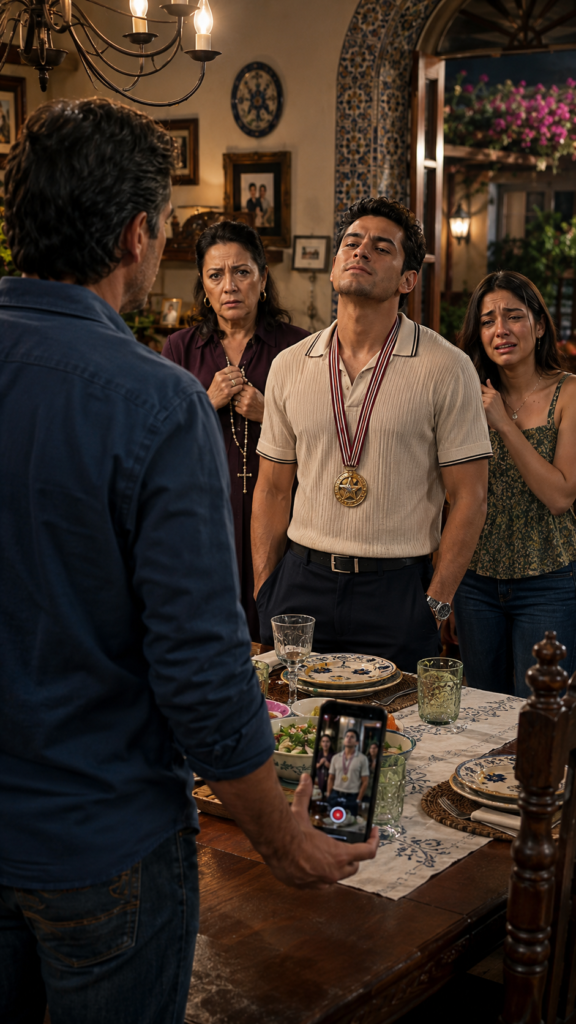
He was wearing Andrés’s military jacket. On his wrist, he wore his watch. And hanging from his chest shone the medal Andrés had earned years ago.
Bruno smiled as if he had finally taken the place he had always envied.
—Don’t approach her as if you still have any right —he said.
Andrés felt the blood rush to his head.
That was his kitchen.
His house.
His wife.
But their mother, Doña Eugenia, entered from the dining room with a rosary between her fingers, pretending to maintain a calm demeanor like that of a church.
—Don’t make a scene, son. Mariana has been very fragile since you left.
Bruno let out a dry laugh.
—Fragile? No, Mom. Useless. She couldn’t handle the house or the business.
Mariana looked down.
Andrés scanned the living room. Everything seemed the same and yet foreign. The portrait of his father still hung on the wall, but the bar was filled with expensive bottles. There were new furniture pieces, papers piled up in the study, and contracts on the desk that he used to occupy alone.
—What did you do while I was gone? —he asked.
Doña Eugenia smiled without showing her teeth.
—Your brother saved what you abandoned.
Bruno approached Mariana and adjusted the collar of her sweater. She tensed up as if that gesture was a prelude to a blow.
—Things have changed here, brother —he said—. While you played the hero, someone had to take charge.
Andrés wanted to punch him in the face.
But Mariana barely lifted her gaze.
Her eyes silently pleaded for something.
Not here.
That night, when they were finally alone in the bedroom, Andrés understood that something was rotten to the core.
Mariana lay at the edge of the bed, covered up to her neck. Between them was a distance that had never existed before.
—Mari, I’m here now —he said softly.
She squeezed her eyes shut.
Andrés barely touched her shoulder, and she flinched as if expecting a hit.
He pulled his hand back immediately.
—What did they do to you?
Mariana didn’t answer. She just breathed quickly, staring at the door as if the walls had ears.
The next morning, Andrés found a notebook hidden in a box of gauze. It contained copies of deeds, nearly empty accounts, signed loans, appointments with a notary in Zapopan, and the name of an unknown company: Grupo Norte Patrimonial.
Administrator: Bruno Salazar.
There were also signatures from Mariana.
And signatures from Andrés.
But Andrés had signed nothing.
That afternoon, Doña Eugenia organized a dinner. She called it “the new order of the family.”
She set a white tablecloth, pulled out the good china, and lit candles in front of the Sacred Heart as if God could bless a betrayal.
Bruno arrived wearing Andrés’s military jacket and the medal on his chest.
Mariana sat next to him, pale, with her hands hidden.
—Let’s toast —said Doña Eugenia— to those who stayed to take care of what’s ours.
Andrés raised his glass but didn’t drink.
Under the table, he turned on the camera on his phone.
Mariana saw him.
And her eyes filled with tears.
Bruno leaned toward her.
—Tell him, sister-in-law. Tell Andrés who’s in charge now.
Andrés kept the phone recording.
—Enough —he said.
Bruno smiled.
—You don’t get it, man. The house changed. The business changed. And so did she.
He pointed at Mariana with his chin.
—She doesn’t belong to you anymore.
Doña Eugenia didn’t correct him.
She just looked at her glass.
As if she had heard that phrase many times before.
PART 2
Andrés stood up slowly.
—Mariana, come with me.
Bruno immediately stood up.
—No.
The word fell like a slap.
The younger brother was telling him “no” in his own house, wearing his jacket, with his medal, and with his wife trembling behind him.
Andrés didn’t shout. He didn’t hit. He just looked at Mariana.
—Please.
She stood up, frightened. Bruno tried to grab her arm, but Andrés stepped forward, and he stopped.
They went upstairs to the bedroom. Andrés locked the door. Mariana started crying silently, as if even her tears had to ask for permission.
—Look at me —he pleaded—. I really need to know what happened.
She shook her head.
Carefully, Andrés lifted the hem of her sweater just a bit.
He didn’t find infidelity.
He found bruises.
On her arms.
On her ribs.
A recent mark near her shoulder.
The world crashed down on him.
—Who did this to you?
Mariana covered her mouth.
—Your mom and Bruno forced me to sign. They said that if I talked, they would report you for fraud. That they would say you hit me. That no one would believe a nervous wife.
From downstairs, Bruno’s laughter echoed.
They were toasting.
Andrés covered Mariana with the sweater and didn’t hug her until she leaned in first.
When she did, she broke against his chest as if she had been waiting for permission to breathe for seven months.
—There’s something else —she whispered.
Andrés felt a strange chill.
—What?
Mariana pointed to the bookshelf.
Between a wedding photo and a clay figure from Tlaquepaque was a modern black watch.
—Bruno put a camera there to watch me. He wanted to know if I called you or spoke with a lawyer.
Andrés clenched his teeth.
—And can you access it?
Mariana swallowed hard.
—He used my email. He thought I was too stupid to check the cloud.
She wasn’t stupid.
She was terrified.
They opened the app from Mariana’s phone. There were videos sorted by date. Dinners, shouting, Bruno entering the bedroom without knocking, Doña Eugenia praying and then counting money at the same table.
Then the file appeared.
The night of the signing.
Mariana was sitting in the study wearing a blue shirt. Doña Eugenia had a notary folder. Bruno walked behind her, wearing Andrés’s watch.
—Sign —Doña Eugenia said in the video—. Andrés won’t return the same. And if he does, he won’t be worth anything. The company needs a man with a head.
Mariana was crying.
—I can’t sign for him.
Bruno slammed the table.
—We already have his scanned signature. All that’s left is for you to renounce the marital administration.
Mariana pushed the paper away.
—No.
Doña Eugenia sighed as if a child were tiring her.
—Then tomorrow I’ll go to the barracks with a report. I’ll say that Andrés stole money before he left. I’ll say you know about it. I’ll say he hit you.
—That’s a lie —Mariana said.
Bruno leaned over her.
—The truth doesn’t matter, sister-in-law. What matters is who signs first.
Then he twisted her arm.
Mariana screamed.
Doña Eugenia was unbothered. She just held the pen and said:
—Don’t leave marks on her face. Andrés has always been very observant.
Andrés stopped the video. If he kept watching, he would go down and do exactly what they wanted to use against him.
Mariana touched his wrist.
—Don’t do it.
He took a deep breath.
—I’m not going to hit them. I’m going to sink them with evidence.
They copied everything. There were more files: Bruno selling Mariana’s truck with a false power of attorney, Doña Eugenia changing beneficiaries on a life insurance policy, a notary in Zapopan receiving a brown envelope and saying that “with a properly done ratification, no one asks too many questions.”
There was also an audio of Bruno speaking with someone from Grupo Norte Patrimonial.
—The deeds have to move before Andrés returns. If Mariana goes crazy, we’ll institutionalize her. My mom has prescriptions and a psychiatrist friend.
Mariana covered her mouth.
—They took me to that doctor. They wanted me to sign that I couldn’t manage assets.
Andrés understood the complete plan.
They didn’t just want the business.
They wanted the house.
The accounts.
The insurance.
And they wanted Mariana turned into a woman without a voice, without credibility, and without a way out.
That dawn, they left through the back door. They took no luggage. Just phones, copies of deeds, the notebook, and a memory stick Mariana had hidden inside a box of sanitary towels, the only place Bruno never checked because his machismo disgusted him.
They walked through Tlaquepaque while the town continued to pulse in the distance, with muted music, the smell of birria, and warm lights in El Parián.
Andrés didn’t take Mariana’s hand until she reached for him.
Then she clung to him as if she were crossing a river.
First, they went to Captain Robles, a trusted superior of Andrés in Guadalajara. She watched the videos without interruption.
When she finished, she simply said:
—This gets reported today. And she needs protection now.
They went to the Women’s Justice Center. Mariana entered trembling, believing no one would believe her. A doctor examined her injuries. A psychologist listened without blaming her.
—You didn’t allow this —she said—. You survived.
Mariana cried like she hadn’t been able to in seven months.
Then came the Prosecutor’s Office.
The report wasn’t just a sheet.
It was an avalanche.
Domestic violence.
Injuries.
Extortion.
Forgery.
Fraud.
Dispossession.
Threats.
Identity theft.
Captain Robles requested official documents to prove that Andrés was on service when he supposedly signed papers in Jalisco. His logs, permits, and locations began to dismantle the lie.
Meanwhile, a lawyer named Valeria reviewed the contracts.
The house was in Andrés and Mariana’s names. The family business had shares inherited from their father. But Bruno had created Grupo Norte Patrimonial to invent debts and absorb assets for “noncompliance.”
—There was patrimonial violence here —Valeria said—. They wanted to leave Mariana without money, without a home, and without a voice.
Andrés placed the notebook on the table.
—And my mom helped.
Valeria looked at him without softening anything.
—Your mom directed.
That phrase hurt him more than any blow.
At 8 o’clock in the morning, Doña Eugenia did what she always did when she wanted to win: she called for family.
Aunts, cousins, neighbors from the rosary, and people who just wanted gossip arrived. She served coffee from a pot and sweet bread, crying in front of the Sacred Heart.
—Andrés returned changed —she said—. The military made him aggressive. Bruno was just trying to protect us.
A cousin sent the video to Andrés.
Minutes later, the police walked in.
There was no heroic music.
No movie screams.
They entered with a warrant.
Bruno tried to hide in the study. They found him with a backpack full of documents, Mariana’s cards, Andrés’s passport, policies, scanned signatures, and an external memory.
Doña Eugenia sat down, crossed herself, and said:
—God knows I did it for my children.
An officer asked:
—For which one?
She didn’t answer.
Because everyone knew the answer.
To her, there was only one son.
Bruno.
When he was taken out, he still wore the military jacket. An officer asked him to take it off.
—It’s mine —Bruno said.
Andrés arrived with Captain Robles.
—Take it off.
Bruno smiled, but now without strength.
—Or what?
The captain spoke firmly.
—Or we add resistance and theft of insignia charges.
Bruno slowly took off the jacket. Then he ripped the medal from his neck and threw it on the floor.
Mariana bent down before Andrés. She picked it up, cleaned it with her sleeve, and placed it in his hand.
—This is yours —she said.
In the hearing, the defense tried to paint Mariana as unstable. They showed prescriptions, messages, consultations with the psychiatrist. They said she exaggerated, that she fell on her own, that she was confused.
Then Valeria requested to play the videos.
The atmosphere in the room changed.
Doña Eugenia appeared telling them not to leave marks on her face.
Bruno twisting Mariana’s arm.
The notary accepting money.
Bruno practicing Andrés’s signature with his pen.
Mariana closed her eyes.
Andrés stared at the full screen.
Not for morbid reasons.
For her.
Because someone had to see fully what they had done to her.
The judge ordered protective measures, a prohibition to approach, securing the house, freezing accounts, and a formal investigation against Grupo Norte Patrimonial.
Doña Eugenia screamed:
—That house is mine!
Valeria opened a folder.
—No, ma’am. Legally, the house belongs to Andrés Salazar and Mariana Torres.
Bruno spat in rage:
—She was already with me.
Mariana stood up. Her legs trembled, but she spoke clearly.
—I was never with you. I was locked up with you.
Bruno dropped his last mask.
The following months were slow and painful. Mariana started therapy. Not because she was broken, but because someone had taught her to live hidden in her own home.
Andrés also went to therapy. He learned that protecting didn’t mean deciding for her. He learned to ask before touching. He learned to wait.
One Sunday, they returned to Tlaquepaque. They walked through El Parián, amidst tourists, music, and the smell of food. Mariana bought a blue mug at a clay stand.
—For the house —she said.
It was the first time she referred to their home as “the house” since Andrés’s return.
The financial investigation finished them off. Grupo Norte Patrimonial was a shell. The money from Mariana’s truck had gone into Bruno’s account. Part of the insurance policy where Doña Eugenia tried to make herself the beneficiary was linked to payments to the notary.
But the final blow came from the past.
Among the recovered documents was a letter from Andrés’s father, kept with his accountant.
“If Andrés returns and Eugenia tries to take away what is his, give him this.”
Inside was an old act.
Doña Eugenia was never the owner of the business.
The main shares belonged to Andrés. And there was a clear clause: any heir that falsified, coerced, or attempted to dispossess another beneficiary lost all future economic rights.
All of it.
Bruno and Doña Eugenia had disinherited themselves.
But there was something more.
A sealed envelope contained a DNA test.
Bruno was not the son of Andrés’s father.
Doña Eugenia had lied for over thirty years.
The man who believed he owned the company, the house, and even Mariana had not a drop of the blood he used as an excuse to destroy them.
The evidence was presented in civil court because Bruno continued to claim familial rights.
When he found out in front of the judge, he looked at Doña Eugenia.
—Is this a lie?
She clutched the rosary.
She said nothing.
That silence shattered him more than any sentence.
Bruno was convicted of domestic violence, fraud, forgery, and extortion. Doña Eugenia for coercion, concealment, fraud, and patrimonial violence. The notary lost his license and ended up being investigated for other cases.
The day they took Bruno away in handcuffs, he looked at Andrés.
—I stole everything from you, and yet you came back.
Andrés replied without raising his voice:
—I didn’t come back for things. I came back for my wife.
Bruno looked at Mariana.
—She’s not the same anymore.
Mariana stepped forward.
—You’re right. That’s why you’ll never give me orders again.
Doña Eugenia started praying out loud.
Mariana interrupted her.
—Don’t use God to cover up blows, ma’am.
For the first time, Doña Eugenia had no response.
Months later, the house smelled of coffee and bougainvillea again. There were no hidden cameras, no foreign footsteps, no candles used to feign holiness.
Andrés placed his medal in a frame in the study.
Not to show it off.
To remember that courage doesn’t always lie in fighting. Sometimes it lies in recording silently, slipping out the back door, and believing the woman who trembles.
Mariana approached and rested her head on his shoulder.
—When you came back, I thought you wouldn’t recognize me.
Andrés waited for her to open her arms first. Then he embraced her.
—I recognized you from the fear —he said—. And now I recognize you from strength.
Bruno said that Mariana didn’t belong to Andrés anymore.
He was right about one thing.
Mariana didn’t belong to anyone.
She had never belonged to Andrés.
But she didn’t belong to them either.
And when they tried to turn her into a signature, insurance, deed, and silence, she became proof, judgment, and memory.
The woman they thought weak ended up leaving them without a home, without a business, without a clean surname, and without forgiveness.