PART 1
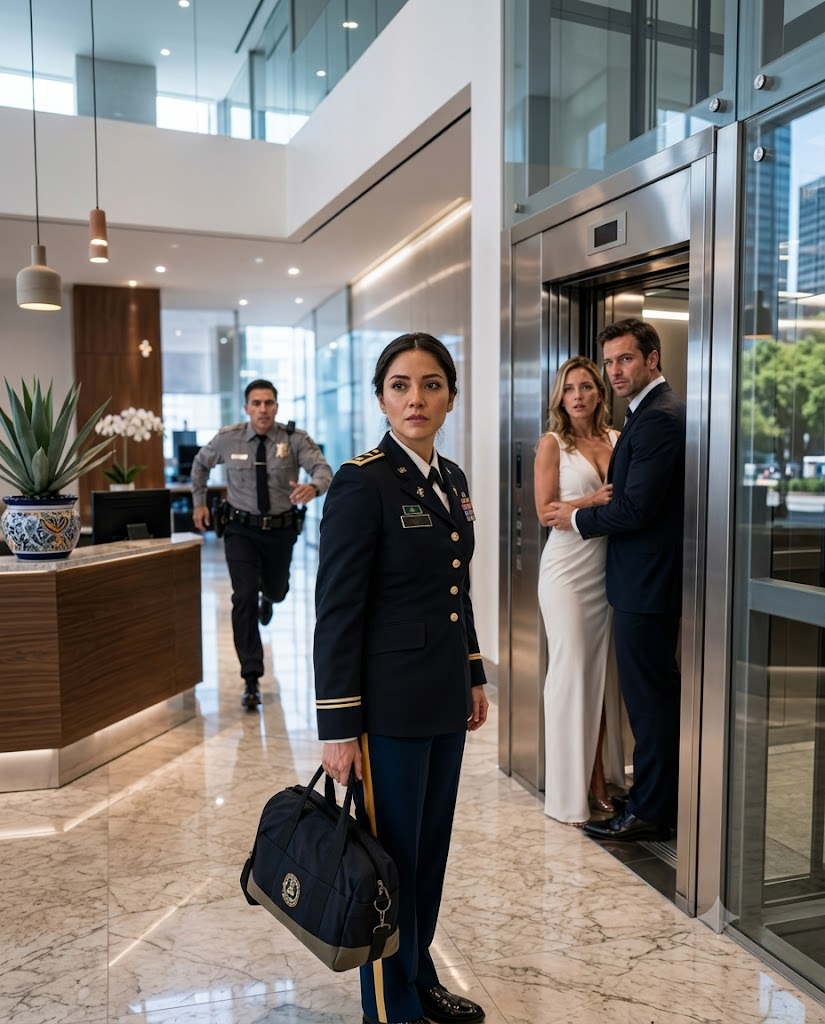
Claudia Montero arrived in Santa Fe, her dress uniform perfectly pressed, medals aligned on her chest, and a black suitcase in hand.
She had driven nearly three hours from Puebla to Mexico City to surprise Arturo Salcedo, her husband of twenty-nine years.
No notice.
No message.
She wanted to see the look on his face when she appeared at his workplace, after months of military commission in the north of the country. She wanted to believe that after so many missed anniversaries, so many cut-off calls, and so many ‘I’ll be home soon’ messages, there was still a place waiting for her.
The lobby of Salcedo National Logistics gleamed with marble, glass, and the scent of expensive coffee. On the walls hung photos of Arturo with businesspeople, politicians, and support foundations for military families.
Claudia felt a silent pride.
That business had flourished while she served the country. Many times, she had sent money, signed documents from a distance, and accepted her absences so that Arturo could build his dream.
She approached the front desk.
“Good morning. I’m here to see Mr. Arturo Salcedo.”
The guard looked up and smiled politely.
“Do you have an appointment, ma’am?”
“No. I’m Claudia Montero de Salcedo. His wife.”
The young man froze.
That word seemed to unsettle him.
He checked the screen, looked at Claudia again, and swallowed hard.
“Ma’am… Mr. Salcedo already has his wife upstairs.”
Claudia didn’t understand at first.
“Excuse me?”
The guard lowered his voice, as if fearing someone else would hear.
“Mrs. Salcedo is on the 18th floor. She comes almost daily.”
The air grew heavy.
Claudia didn’t scream. She didn’t pound on the counter. She had learned to breathe under pressure in places where a mistake cost lives. But no mission had prepared her for a stranger to deny her own marriage.
“I am Arturo’s wife,” she said, her calm frigid.
The guard looked as if he wished to disappear.
“Yes, ma’am, but…”
He didn’t finish.
The executive elevator opened.
A woman stepped down slowly, dressed in an ivory suit, fine heels, and perfectly styled brown hair. She walked with the confidence of one who knows everyone will step aside.
Two employees straightened up.
“Good morning, Mrs. Salcedo.”
The woman smiled as if the title had belonged to her forever.
Claudia felt something burn in her chest.
It wasn’t the elegant suit.
It wasn’t the way everyone looked at her with respect.
It was the medal that woman wore around her neck.
A small, old silver star, with an almost invisible mark on the edge. Arturo had gifted it to Claudia when she was promoted to Colonel, one night when she cried, saying he had never felt so proud of anyone.
That woman wore her medal.
Her story.
Her place.
The stranger glanced at Claudia for barely a second. She didn’t seem confused. Nor frightened.
She recognized her.
And kept walking.
Claudia remained frozen until the woman exited the building and a white SUV picked her up in front of the entrance.
Then she grabbed her suitcase, turned around, and left without saying a word.
Outside, the gray afternoon in Mexico City seemed to swallow all the noises. Claudia sat on a bench facing the avenue, watching cars pass by as if the world hadn’t just shattered in two.
Her cell phone vibrated.
It was Arturo.
“I miss you, my love. It won’t be long until you’re back.”
Claudia stared at the message until the letters blurred together.
Arturo believed she was still on commission for one more month. Or at least that’s what he had wanted her to believe.
That night, she registered at a hotel under her maiden name: Claudia Montero.
She went up to the room, closed the curtains, and opened her laptop.
She searched for the company’s website.
In the public photos, Arturo appeared smiling alongside mayors, businessmen, and foundation leaders. And in almost every image, there was the same woman.
Renata Robles.
In one post, she was called “Renata Salcedo, wife of the founder.”
In another, she appeared in the living room of Claudia’s house, next to the clay birth that Claudia had bought in Tlaquepaque.
In another, she wore Claudia’s pearl earrings.
And in the last one, during a dinner honoring veterans, Renata smiled with the silver star hanging from her neck.
Claudia closed the laptop with a calm that scared her.
Then the phone rang.
It was Ximena, her thirty-year-old daughter.
“Mom… are you back in Mexico?”
Claudia stood up slowly.
“Why do you ask that?”
On the other end, Ximena breathed heavily.
“Dad just called me. He told me to let him know immediately if you were looking for him.”
Claudia looked toward the dark window.
Arturo already knew she had returned.
And in that moment, she understood that this wasn’t just infidelity: someone had been preparing for years to erase her completely.
PART 2
Claudia asked Ximena not to answer any more calls from her father.
She didn’t want to put her daughter in the middle. Ximena lived in Querétaro with her two small children, and for years she had borne the absence of a military mother who always promised to return soon.
But that night, the lie had already entered every room of the family.
“Mom, tell me what’s going on,” Ximena pleaded.
Claudia closed her eyes.
“I still don’t know everything. But I need time.”
Then she called Lucía Rivas, her lifelong friend, a former military investigator, and a woman who never sugarcoated the truth.
Lucía listened without interrupting.
When Claudia finished, she simply said:
“Don’t confront him yet.”
“I wasn’t planning to.”
“Good. Arturo wants to control the story before you understand the size of the mess. Don’t give him that privilege.”
The next day, Claudia rented a gray car, put on simple clothes, a cap, and dark sunglasses. For five days, she parked in front of the Santa Fe building.
Renata arrived every morning in a white SUV.
An assistant opened the door for her.
A director brought her coffee.
Arturo came down to greet her at noon, touched her waist, and guided her to the private elevator as if they had been doing this for years.
Because they had been doing this for years.
Lucía arrived in the city with an empty folder, two new cell phones, and a bag of sweet bread.
“You haven’t eaten,” she said.
“I’m not hungry.”
“That’s exactly why I brought you conchas. You’re not going to faint before taking that guy down.”
Together, they built a timeline. Public photos. Events. Press notes. Properties. Foundations. Contracts.
Renata Robles had entered the company four years earlier as an image consultant. Then she appeared as the coordinator of a foundation for military families. Afterward, she began accompanying Arturo to meetings, dinners, and interviews.
Two years later, the press was already calling her Mrs. Salcedo.
Claudia called Teresa, her younger sister.
“Do you know Renata Robles?”
The silence was a confession.
“Claudia… Arturo told us you were separated.”
Claudia’s blood ran cold.
“What else did he say?”
“That you didn’t want to make it public so it wouldn’t affect your career. That you were emotionally unwell. That Renata was helping him hold the company and the house together.”
“And you believed him?”
Teresa began to cry.
“He cried too. He asked us not to pressure you.”
Unstable.
Claudia had commanded operations, comforted families of fallen soldiers, and slept in cold bases without breaking in front of anyone. But her husband had painted her as a broken woman so that no one would ask too many questions.
Then she called Doña Mercedes, the neighbor from the house in Lomas de Chapultepec where Claudia and Arturo had lived for twenty-two years.
“Oh, dear,” said the neighbor. “I thought you no longer lived there.”
Claudia tightened her grip on the phone.
“Since when has Renata been in my house?”
Doña Mercedes lowered her voice.
“Almost two years.”
That night, Claudia drove to Lomas.
The house was lit.
The garden that she had tended before her last commission was still blooming. Through the window, she could see her dining room, her dishes, her crystal lamp.
At 8:40, Arturo arrived.
Renata opened the door before he knocked.
She kissed him.
Then she adjusted his tie with a domestic tenderness that pierced Claudia more than any insult.
Lucía, sitting beside her in the car, murmured:
“This isn’t an affair.”
Claudia didn’t take her eyes off.
“No. It’s a replacement.”
Renata stepped out to the porch for a moment, talking on the phone. Claudia caught a glimpse of something in her hand.
It wasn’t just the star.
It was her anniversary ring.
The same one Arturo swore he had kept safe so it wouldn’t get lost during his commission.
Claudia felt rage rising like fire. She wanted to get out of the car, knock on the door, and break everything. But Lucía placed a hand on her arm.
“To destroy a lie like that, pain isn’t enough.”
Claudia looked at the house where another woman was sleeping in her bed.
“Then let’s find proof.”
The lawyer’s name was Mariana Treviño, and she had a sober office in Polanco. She listened to Claudia for forty minutes and didn’t ask if she wanted a divorce.
She asked something worse.
“Colonel, do you know who manages your investments, properties, and shares within the company?”
Claudia felt shame before answering.
“Arturo.”
Mariana nodded.
“Then this isn’t just a marital issue.”
They called Ernesto Olvera, a thin, silent forensic accountant, the kind who found hidden tragedies among numbers.
Three days later, he arrived with four folders.
Consultancy payments to companies related to Renata. Rent paid by the company for an apartment she used before moving to Claudia’s house. Image contracts with no results. Donations from the military foundation diverted to nonexistent suppliers.
“How much?” Claudia asked.
Ernesto looked at Mariana.
“Between seventy and ninety-five million pesos, according to the preliminary records.”
The number didn’t make her cry.
The betrayal did.
This wasn’t passion or a mistake. It was a structure. It needed signatures, accounts, meetings, accomplices, and bought silences.
The cruelest blow came from Ximena.
Her daughter showed up at the hotel with red eyes.
“Dad told me you chose the Army over me.”
Claudia gasped.
“What?”
“When Mateo was born and you couldn’t come, he told me to stop waiting for you. That you didn’t know how to be a mom or a grandmother.”
Claudia remembered that night. She recalled calling Arturo, crying, asking him to tell Ximena that she loved her, that she was devastated for not being there.
Arturo then replied: “She knows.”
But he hadn’t told her anything.
He used her absence as poison.
Ximena broke down.
“I thought you didn’t care.”
Claudia hugged her with desperate strength.
“I cared every day. Every single day.”
Mother and daughter cried until they ran out of words. Then Claudia showed her photos, contracts, transfers, and records.
Ximena wiped her face.
“There’s something you need to know. Dad is throwing a gala on Friday. Thirty years of Salcedo Logistics. He invited partners, press, politicians, clients, and the whole family.”
Mariana looked up.
“And Renata?”
Ximena swallowed hard.
“She appears as the official host.”
Lucía let out a dry laugh.
“How considerate. He brought everyone together.”
Mariana noted that they could proceed legally without a scandal.
Claudia looked at a photo of Renata wearing her medal under a Mexican flag.
“He wanted an audience. An audience he will have.”
The gala was held in a hotel in Reforma, with chandeliers, white flowers, and over three hundred guests. Arturo took the stage in a black tuxedo and a smile of a world owner. Renata was beside him, dressed in dark blue.
Around her neck hung the silver star.
Claudia waited in the hallway with Ximena, Lucía, Mariana, and Ernesto.
She wore her dress uniform.
Every medal was in its place.
“You can still change your mind,” Mariana said.
Claudia took a deep breath.
“I changed my mind four years too late. Not today.”
The doors opened.
At first, no one understood. Then the room began to hush. Some retired military stood up out of reflex. A camera turned toward her.
Claudia walked until she was in front of the stage.
Arturo saw her.
His smile died.
Renata touched the medal as if she could hide it.
“Hello, Arturo,” Claudia said.
He stepped down a step.
“Claudia, this isn’t the place.”
“For years you said I didn’t have a place.”
A murmur spread through the room.
Claudia turned to everyone.
“My name is Claudia Montero de Salcedo. I am a Colonel in the Mexican Army and have been married to Arturo Salcedo for twenty-nine years.”
The silence was absolute.
Renata paled.
A partner asked:
“Arturo, what does this mean?”
Mariana stepped forward with a folder.
“It means there is relevant information for partners, auditors, the board of directors, and tax authorities.”
Arturo attempted to grab Claudia by the arm.
Ximena interposed herself.
“Don’t you ever touch her to silence her.”
That broke the last wall.
Mariana distributed copies. Ernesto explained dates, payments, ghost companies, transfers, foundations, and contracts linked to Renata.
There were no shouts.
No insults.
Just documents.
And every document weighed more than a slap.
Fifteen minutes later, Renata attempted to leave.
Lucía appeared in front of her.
“Leaving so soon, Mrs. Salcedo?”
Renata looked at Arturo.
Arturo didn’t look back.
Claudia then understood that this relationship hadn’t been love. It had been ambition with expensive perfume.
A reporter raised his voice:
“Colonel, do you accuse your husband of publicly presenting another woman as his wife while you served the country?”
Claudia held Arturo’s gaze.
“I accuse him of handing over my house, my name, my story, and my daughter’s love to a lie. The rest will be told by the documents.”
That night, the board suspended Arturo. Days later, Renata was removed from all positions. The foundation was placed under investigation. Several accounts were frozen.
Arturo called fifty-eight times.
Claudia didn’t answer.
The divorce took almost a year. Arturo lost control of the company, part of his assets, and almost all his reputation. Renata disappeared when the money stopped protecting her.
The house in Lomas was sold. Claudia went alone on the last day. She walked through the empty rooms and touched the wall where she once hung a picture of little Ximena.
For years she believed that Renata had taken her life.
But she understood the truth.
Renata had merely donned someone else’s pieces: the name, the medal, the jewels, the bed, the table.
But she could never be her.
Before leaving, Claudia uprooted a small rosebush from the garden and planted it in front of a simple house in Querétaro, near Ximena and her grandchildren.
Sundays became sacred. They ate enchiladas, watched the children run around the yard, and slowly, the stolen years stopped hurting like a knife and began to hurt like a scar.
One day, Mateo found the silver star in a box.
“Is this yours, Grandma?”
Claudia smiled.
“It always was mine.”
“And why was someone else wearing it?”
Ximena wanted to intervene, but Claudia gently shook her head.
“Because there are people who think they can take what shines, even if they don’t know what it cost to earn it.”
Mateo looked at her seriously.
“And did you take it back?”
Claudia kissed his forehead.
“No, my love. I just remembered it never stopped belonging to me.”
That spring, the rosebush bloomed with unexpected strength.
The true justice wasn’t seeing Arturo fall in public.
It was hearing Ximena laugh without guilt.
It was sleeping without feeling someone was writing her story in secret.
Because a woman doesn’t disappear when a man betrays her.
She only disappears when she accepts others to tell her life for her.
And Claudia Montero returned ahead of time to remind everyone that the truth doesn’t need permission.





