PART 1
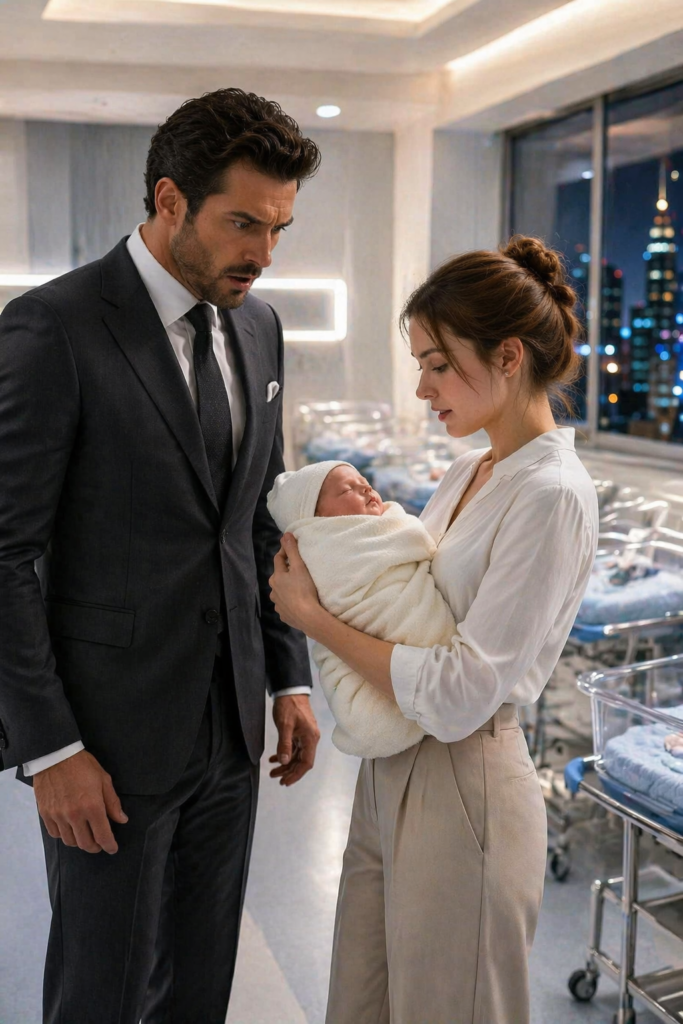
Santiago Arriaga had buried many men without blinking, but that morning, at the Santa Lucía Hospital in Mexico City, he stood paralyzed in front of an empty crib.
The doctor told him that his son had been born lifeless.
He didn’t even look him in the eye.
He just lowered his voice, shuffled some papers, and repeated that nothing could be done. That the baby didn’t survive. That his wife, Camila, hadn’t survived the hemorrhage either.
Santiago didn’t scream.
That was what scared everyone the most.
His men, dressed in black, waited in the hallway. No one dared to breathe too loudly. The most feared man in the capital stood there with a shirt stained with blood, staring at a folded white sheet on a gurney.
But in the basement of the hospital, where the smell of bleach, burnt coffee, and exhaustion lingered, Marisol Reyes heard something no one else wanted to hear.
A whimper.
It was weak, almost impossible.
Marisol was 22 years old, working nights cleaning operating rooms and assisting when staff was short. She had no degree, no connections, no important last name. She lived in a rented room in Iztapalapa, studying with used photocopies and eating cold tortas on the hospital stairs.
That night she had been ordered to take an unplugged incubator to the medical waste area.
But when she lifted the blanket, she saw the baby.
He was purple, cold, with tiny fists clenched.
And he was breathing.
Marisol felt her blood freeze.
She shouted for help, but the on-duty nurse told her not to interfere. That there was already an order. That the baby “was not supposed to come out alive.”
So Marisol did the only thing she could do.
She ran.
She shoved the incubator down the hallway, kicked open an emergency door, and burst into the neonatal area as if the devil were chasing her. A young doctor tried to stop her, but Marisol showed her the child.
—He’s still breathing —she said, her voice broken—. If you let him die, I’ll scream it in the street myself.
In less than 3 minutes, the entire floor descended into chaos.
The baby was intubated. They provided warmth, oxygen, saline. A resident cried while compressing the tiny chest. Marisol held a lamp with both hands, trembling, softly praying a song her mother used to sing when she was a child.
When Santiago arrived in the area, no one moved.
He saw the boy connected to tubes.
He saw Marisol in her gray uniform covered in blood, her hair stuck to her forehead, and her eyes red from exhaustion.
—Who found him? —he asked.
No one answered.
Marisol raised her hand.
Santiago walked toward her. He was tall, serious, with the gaze of a man used to being obeyed.
—Why did you do it?
Marisol swallowed hard.
—Because he was alive.
The baby let out a small, hoarse, almost furious cry.
Santiago broke down right there, in front of everyone.
He didn’t fall to the ground. He didn’t scream. He just closed his eyes and brought a hand to his mouth as if that sound had pierced his chest.
But when the doctor who had signed the false death certificate tried to leave the hospital, two of Santiago’s men stopped him at the door.
And Marisol watched in terror as that baby not only survived.
He had just opened a war that no one would be able to stop.
PART 2
They named the boy Mateo.
Santiago chose that name because Camila had written it in a notebook before she died. Among prescriptions, medical appointments, and clumsy drawings of a crib, there was an underlined phrase: “If it’s a boy, Mateo. May his name mean gift.”
The gift fought for 19 days in neonatal therapy.
Marisol shouldn’t have still been there. Her shift ended at 7 AM and her contract was for cleaning, not nursing. But every night she returned to the neonatal glass with the pretext of mopping the hallway.
Santiago was always there.
Sometimes sitting, with a wrinkled jacket and a scruffy beard. Sometimes standing, immobile, watching the baby as if he feared that if he blinked, they would take him away again.
The first time Marisol sang to Mateo, she did it without realizing.
The baby was crying, and no nurse could calm him down. Santiago was desperate, awkward, holding him as if he were made of glass.
Marisol approached, sought permission with her gaze, and began to hum an old song.
—Whose song is that? —Santiago asked.
—My mother’s.
—Did she sing a lot?
Marisol didn’t take her eyes off the baby.
—Until she could no longer.
The room fell silent.
Santiago didn’t ask any more questions.
That was the first thing that surprised her about him. He didn’t force people to speak when it hurt. He didn’t demand gratitude. He didn’t behave like the men who thought money could buy even the silence of a wound.
In the following weeks, Marisol saw pieces of Santiago that didn’t match the rumors.
She saw him thank a nurse with respect.
She saw him cancel meetings because Mateo had a fever.
She saw him spend the entire night next to the incubator, with swollen eyes, repeating that no one else would care for his son while he could be there.
But she also saw the other side.
The armed men outside.
The whispers on the phone.
The sealed envelopes.
The doctors’ fear when Santiago walked down a hallway.
Marisol knew who he was. All of Mexico knew who Santiago Arriaga was: a façade businessman, owner of warehouses, transportation, and restaurants, but with a shadow too long over the south of the city.
She had to stay away.
But Mateo clung to her finger every time she got close.
And one day, Santiago looked at her as if she were the only person capable of telling him the truth.
—Come to the house —he said—. Mateo needs someone who isn’t afraid of him.
—I’m afraid of you.
Santiago lowered his gaze.
—Then come because you care about him.
Marisol wanted to say no.
But she thought of Mateo. She thought of her cold room, of her debts, of the school she had left because she couldn’t afford it. She thought of her brother Samuel, who died at 9, and the promise she made as a child: one day she would save lives.
She accepted.
Santiago’s house was in Lomas de Chapultepec, behind black gates and well-tended bougainvilleas. Everything smelled of expensive wood, freshly brewed coffee, and old secrets.
Marisol arrived with one backpack, three biology books, and the certainty that she was committing madness.
The first days were strange.
Santiago didn’t know how to change a diaper without struggling with the tapes. He didn’t know how to prepare formula without spilling half of it. One morning, Marisol found him in the kitchen, staring at a pan full of burnt eggs as if it were a crime scene.
—That looks terrible —she said.
He looked up.
—Can you cook?
—I survive.
Santiago glanced at the blackened eggs, then back at her.
—Teach me.
Marisol almost laughed. Almost.
The man who made half the world tremble couldn’t fry two eggs.
At first, their breakfasts were a disaster. Toast burned to charcoal. Watery coffee. Shells in the pan. Once, he almost set off the smoke alarm, and Mateo started to cry as if he were also voicing his opinion.
—This is humiliating —Santiago murmured.
—It should be.
He looked at her, offended.
—You’re enjoying this.
—A little.
But he kept trying.
And because he kept trying, something changed.
Not suddenly. Not like in novels. It changed in painful centimeters.
Santiago learned that Mateo calmed down if rocked in short circles, not long ones. He learned that Marisol checked the windows twice before sleeping. He learned that she never left food on her plate, even if she was dead tired.
He also discovered she had an interview to join a bridging medical program at UNAM.
Marisol hadn’t told him because she expected mockery.
He just said:
—You’re going to go.
—I can’t afford that.
—Now you can.
—I’m not accepting your money.
Santiago leaned against the counter.
—It’s not charity.
—Then what is it?
It took him a while to respond.
—A debt.
Marisol wanted to retort harshly, but something in his face stopped her.
He wasn’t flirting. He wasn’t buying her.
He was trying to repair something he couldn’t even name.
So she went.
Days turned into weeks. Weeks turned into months.
Marisol studied on the Metrobús, in the kitchen, beside Mateo’s crib. She read anatomy while the child slept. Santiago left coffee next to her books without saying a word.
Sometimes he watched her from the doorway with an expression she couldn’t decipher.
It wasn’t desire.
Not yet.
It was something more dangerous.
Hope.
Then one night, everything broke.
Marisol entered the office to look for a folder of medical expenses. Santiago had told her it was in the bottom drawer.
The drawer was locked, but the key was still in.
Inside were documents, photos, names, accounts. And among it all, a yellowed folder with a handwritten label:
“Reyes, Martín.”
Marisol’s breath caught.
That was her father’s name.
She opened the folder with frozen fingers.
Martín Reyes. Accountant. Possible leak. Risk to the operation. Family present in residence. Execute without noise.
Below was a signature.
S. Arriaga.
Marisol felt the room tilt.
She was seven again. She heard the banging on her front door in Nezahualcóyotl again. She saw her mother lying by the dining room table, her father trying to cover her, her brother Samuel hiding under the table.
Samuel, her little brother, dying in her arms as she sang her mother’s song to keep him from being afraid.
The office door opened.
Santiago froze when he saw her with the folder in her hands.
Neither spoke for several seconds.
Until Marisol whispered:
—My dad.
Santiago’s face changed.
She stepped back as if struck.
—You ordered my family killed.
—Marisol…
—No. Say it right. Did you sign or not sign the order that killed Martín Reyes, Clara Reyes, and Samuel Reyes?
Santiago’s jaw tightened.
For the first time, he looked old.
—Yes.
The word fell like another gunshot.
Marisol let out a dry, broken laugh.
—I saved your son.
Santiago closed his eyes.
—I know.
—I carried your baby when everyone thought he was dead. And you… you took my brother from me.
—I was told your father was selling information to my enemies. I was told he was a threat. I believed the man who brought the file.
—Who?
Santiago didn’t answer.
But Marisol already knew the answer.
—Ramiro.
Ramiro Salgado, Santiago’s right-hand man. The man who was always behind him. The man who smiled little and listened too much.
Marisol clutched the folder to her chest.
—Did you know my last name?
—Not until I saw your papers in the hospital. I swear.
—But now you do.
—Yes.
—And you still expect me to stay here?
Santiago slowly shook his head.
—No.
That honesty hurt more than any lie.
He took a step forward but stopped.
—I’m not going to apologize.
—Good, because I wouldn’t give it to you.
—I know.
Marisol had tears filling her eyes, but she didn’t want to cry in front of him.
—Samuel died in my arms because of you.
Santiago received the phrase as if struck.
—If I could change my life for his, I would.
—Don’t dare say that as if it mattered.
Marisol threw the folder on the desk.
—The dead don’t come back because the murderer regrets it.
That same night, she left.
She didn’t return to the street. She rented a room above a laundromat in the Portales neighborhood and buried herself in school until exhaustion hurt less than memory.
Santiago didn’t follow her.
That also hurt.
But he did something Marisol didn’t expect.
He let her go.
He closed several warehouses. Cut dirty routes. Sold businesses where blood was hidden. Pulled his men from corners where they once felt like owners of other people’s lives.
Ramiro Salgado, on the other hand, began to move.
He said Santiago had softened. That a poor girl and a sick baby had made him useless. That the empire needed someone with an iron fist.
Three months later, Mateo fell ill again.
Marisol received the call at 2:14 AM.
Santiago didn’t even try to sound calm.
—He won’t stop vomiting. He’s cold. He’s not responding well. Marisol, please.
She should have hung up.
She didn’t.
She arrived before dawn.
Mateo was pale, limp, with dry lips and half-open eyes. Marisol checked his pulse, temperature, and the medications on the table.
Then she looked at Santiago with fury.
—This isn’t a normal infection. Who gave him this bottle?
Santiago froze.
The label said children’s vitamins, but the smell was strange, metallic.
Marisol took the bottle, put it in a bag, and called a trusted doctor.
Mateo was taken to the hospital in silence, without flashy escorts. For six hours, Marisol fought with doctors, checked analyses, and stayed by the bed until the child began to stabilize.
When the danger passed, Santiago found her in the hallway.
His face was shattered.
—Ramiro —he said.
Marisol didn’t ask how he knew.
He showed her a security recording from the kitchen. Ramiro entering without permission. Ramiro swapping the bottle. Ramiro looking at the crib with a coldness that seemed inhuman.
But the hardest blow came after.
Santiago pulled out another file.
—I never told you the whole truth.
Marisol looked at him with exhaustion and rage.
—Is there still more?
—Ramiro framed your father. Martín wasn’t a traitor. He was an accountant and found transfers Ramiro was making with people from another group. Your father was going to report him. Ramiro brought me false evidence, and I signed.
Marisol felt her legs give way.
—When did you find out?
—Years later. When I could no longer repair anything.
—And you let him live?
Santiago lowered his head.
That was the answer.
Marisol took two steps back.
—So you didn’t just kill my family. You also protected the man who condemned them.
Santiago didn’t defend himself.
—Yes.
That night, Ramiro was detained by the prosecutor’s office, but not by Santiago. Marisol handed over the bottle, the recording, and copies of the Reyes file to an agent who had investigated Santiago’s circle for years.
It was the first time Santiago didn’t use his influence to hide the truth.
On the contrary.
He testified.
Gave names.
Gave accounts.
Gave properties.
His own men called him a traitor. Some wanted to make him disappear. Others fled. The press exploded with headlines about the criminal empire crumbling from within.
But Marisol didn’t celebrate.
A week later, she went to the cemetery where she hadn’t been in 15 years.
She brought white flowers for her mother, unsweetened coffee for her father, and a blue toy truck for Samuel.
She knelt before the three graves.
For the first time, she spoke aloud.
She told them she was still alive. That she had entered medical school. That she had saved a baby who wasn’t guilty of his father’s blood. That she hated Santiago. That she had also seen his fear, his shame, and his clumsy attempt to become someone different.
She cried until she had no strength left.
Then she whispered:
—I don’t forgive him because he deserves it.
She squeezed the blue truck in her hands.
—I forgive him because I deserve to stop dying with you every night.
Behind her, a stone crunched.
Santiago was several meters away, without escorts, without a jacket, with red eyes.
He didn’t approach.
He didn’t speak.
He just waited.
Marisol stood up slowly.
—I will never justify what you did.
—I know.
—I will never erase Samuel.
—I know.
—And if you lie to me again, even out of fear, you won’t see me again.
Santiago took a deep breath.
—Fair.
She looked at him for a long time.
She didn’t hug him.
She didn’t kiss him.
She just walked past him and said:
—Mateo is asking for you.
That was the beginning of something that didn’t seem like love, but an impossible reconstruction.
Santiago faced trials, lost businesses, surrendered properties, and accepted living under watch. He wasn’t a saint. No one turned him into a hero. There was too much pain behind his name.
But for the first time, he paid without hiding.
Marisol finished medical school with honors. She became a pediatrician and worked in a public clinic where she attended children without insurance, single mothers, tired grandmothers, and families who arrived in fear of not being able to pay.
Mateo grew up healthy, stubborn, and cheerful. He called Marisol “Mom Sol” before anyone could correct him.
One winter afternoon, Santiago found Marisol in the kitchen, just like years ago, staring at a pan.
The eggs had burned.
He smiled slightly.
—That looks terrible.
Marisol let out a laugh that seemed both broken and new at the same time.
—Shut up, dude.
It was the first time he heard her laugh without guilt in the middle.
Time later, during a night shift, Marisol found a 10-year-old girl asleep outside the emergency room. She was dirty, skinny, and hugged a torn backpack as if it were a shield.
Marisol sat beside her with hot milk and a torta.
She didn’t ask painful questions.
She just waited.
The girl ate as if she hadn’t tasted anything for days.
—What’s your name? —Marisol asked.
—Lupita.
Marisol saw in those eyes the same fear she had at seven.
That night, she took her home with legal help, without shortcuts, without dark favors.
Mateo ran to the door and shouted that he had a sister now.
Santiago looked at Marisol with that silent gratitude that no longer tried to buy anything.
And when Lupita crossed the threshold, Marisol finally understood what her mother sang in that old song.
The past never disappears.
But one wound can turn into an outstretched hand.
And sometimes, true justice isn’t about forgetting what the guilty did, but about preventing the pain from breeding more victims.





