PART 1
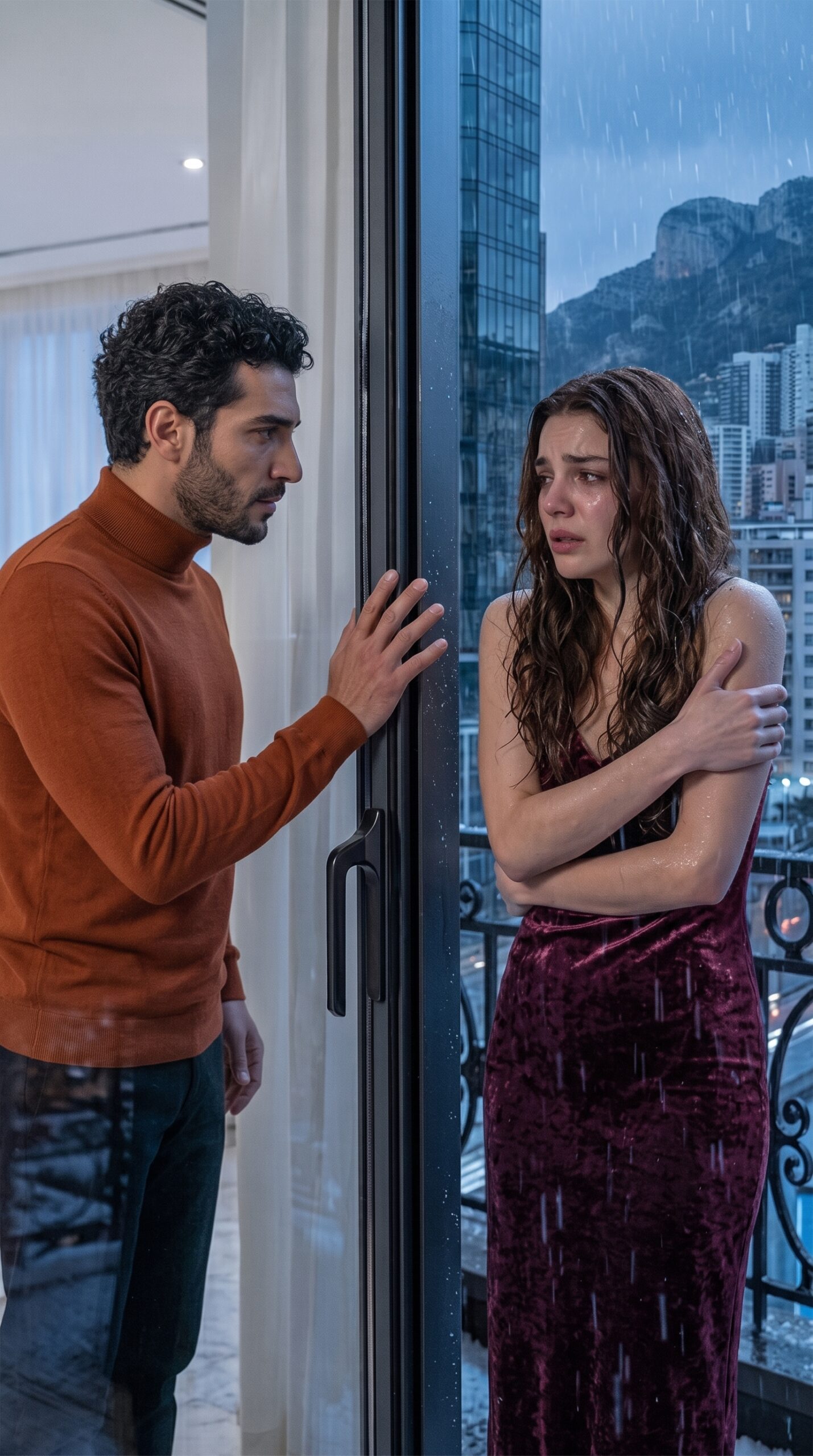
—If you love hiding money so much, stay outside and think about the shame you bring to this family.
That was the last thing Rodrigo said to Marisol before he slammed the glass door of the balcony shut and turned the lock.
They lived in a small apartment in Zapopan, on the third floor of a building where everyone greeted each other in the morning but also overheard each other’s fights through the open windows.
That November night had an unusual chill, the kind that sneaks into your bones in Jalisco without warning.
It all started during dinner.
Elvira, Rodrigo's older sister, arrived from Jocotepec with fresh cheese, warm tortillas, and a bag of charales, as if she were bringing gifts, but also authority.
Since their mother died, Elvira had acted as if she owned Rodrigo’s life. She commented on his clothes, his job, his friends, and especially on Marisol.
Marisol spent all afternoon cooking. She prepared a shrimp broth with guajillo pepper, red rice, and hibiscus water. She set the table beautifully, lit a candle, and even bought sweet bread because she knew Elvira loved conchas.
But nothing seemed right.
—Oh, Marisol, what a sad broth —Elvira said, putting down the spoon—. At my house, this actually tastes like food. Here it’s like colored water, honestly.
Marisol lowered her gaze.
Rodrigo saw how his wife pressed her lips together, but he said nothing. He always said Elvira was “like that,” that she shouldn’t be taken seriously.
After dinner, Marisol went to wash the dishes. Elvira waited for the sound of running water and leaned toward her brother.
—Open your eyes, Rodrigo. Your little woman is robbing you.
He let out a dry laugh.
—Don’t start with your nonsense.
—It’s not nonsense. I heard her on the phone. She said, “Mom, I’ve saved up a bit more, just hold on a little longer.” Where do you think she gets that money?
Rodrigo froze.
That night, as Marisol slept, he checked the banking app. He found 3 transfers: 2 of 2,500 pesos and 1 of 3,000.
In total, it was 8,000 pesos sent to an account he didn’t recognize.
The next morning, he wanted to speak calmly.
—Marisol, who did you send money to?
She turned pale.
—Why did you check that?
That question hit Rodrigo like a confession.
—Who did you send 8,000 pesos to? —he repeated, his voice now harsh.
Marisol opened her mouth but didn’t answer. Tears filled her eyes.
Elvira appeared in the hallway as if she’d been waiting for the exact moment.
—See? I told you. These women pretend to be saints, but first, they take care of their family and leave their husband looking like a fool.
—Rodrigo, let me explain —Marisol begged.
But he was already poisoned by doubt.
—I don’t want half-hearted explanations. Go out on the balcony. When you want to tell the truth, you come in.
Marisol looked at him as if she had just seen a stranger.
Then she walked toward the balcony.
Rodrigo closed the door.
And locked it.
At 3 AM, he woke with a terrible anxiety. He reached out and touched the cold pillow where Marisol had been. Then he remembered everything.
He jumped up to let her in.
But before he could touch the lock, he saw something on the floor.
From the entrance of the apartment to the balcony, there was a wet trail, as if someone had come in soaked and walked straight to her.
Rodrigo opened the door with trembling hands.
The balcony was empty.
Only Marisol’s ring remained on a flower pot, a footprint marked in the railing, and a folded note that read:
“Forgive me. I didn’t steal anything. I was just afraid to tell you the truth.”
Rodrigo looked down and saw a white lump next to the tree by the sidewalk.
In that second, he understood he had closed the door to his home, but perhaps also to his life.
PART 2
Rodrigo ran down the stairs barefoot, hitting his feet against the steps, while Elvira shouted from above not to make a scene.
In the street, neighbors were already gathered. A woman was praying softly. A young man held a cellphone in his hand, unsure whether to record or call for help.
Rodrigo pushed his way through them and recognized Marisol’s white nightgown.
He fell to his knees.
—Marisol! My love, answer me!
But when he touched her, he discovered something that shattered his heart.
Marisol was alive.
She was barely breathing, her lips purple, one hand clutching another piece of paper, her body cold from the chill.
—An ambulance! —Rodrigo shouted—. Please, call an ambulance!
They took her to the Civil Hospital in Guadalajara. Rodrigo spent hours in a white room, hands dirty, eyes red, and guilt lodged in his throat.
Elvira sat next to him, but she wasn’t crying. She just kept repeating:
—She brought this on herself by hiding things.
Rodrigo didn’t reply.
When the doctor came out, her face was serious.
—We managed to stabilize her, but she arrived with severe intoxication.
Rodrigo felt the floor shift beneath him.
—Intoxication? What are you talking about?
—We found sedatives in her blood and traces of a substance used in agricultural products. It wasn’t a single dose. Her body has been accumulating it for days.
Elvira stopped moving her leg.
Rodrigo glanced at her.
—Days? —he asked, breathless.
The doctor nodded.
—Someone may have been giving her something mixed in food or drinks.
At that moment, Rodrigo remembered the herbal infusions Elvira brought “for stress.” She said they were good village herbs, that Marisol looked very tired and needed to “cleanse her body.”
Marisol took them to avoid being rude.
Elvira never tried them.
Rodrigo returned to the apartment like a ruined man. He searched the kitchen, the mugs, the jars of herbs, and the trash.
On the balcony, he found a cigarette butt hidden behind a flower pot. He also found a small, golden earring that wasn’t Marisol’s.
Neither he nor his wife smoked.
Elvira always said she hated cigarettes.
He bagged everything and called César, a friend who worked in the municipal police.
They met near La Minerva. Rodrigo told him everything: the transfers, the balcony, the wet trail, the note, the intoxication.
César listened without interrupting.
—This is no longer a couple’s fight, dude —he said at the end—. This is a crime.
Hours later, César confirmed something worse.
The cigarette butt had saliva from a woman named Renata Larios. The earring also had partial prints of her.
Rodrigo frowned.
—I don’t know her.
César looked at him seriously.
—but your sister does. They were friends in high school. And Renata works at a distributor of agrochemicals in El Salto.
Rodrigo felt nauseous.
When he returned to the apartment, Elvira was frantically cleaning the kitchen.
—What are you doing? —he asked.
She startled.
—Cleaning. This place is a mess.
Rodrigo snatched the cloth from her.
—You’re not cleaning. You’re erasing.
Elvira turned pale.
—Don’t start, Rodrigo.
—Who is Renata Larios?
The name fell in the kitchen like a shattered plate.
Elvira leaned against the counter.
—I don’t know.
—Don’t lie. They found her cigarette butt on my balcony. Also an earring. What was she doing here the night Marisol almost died?
Elvira began to cry, but those tears no longer seemed innocent.
—I didn’t know this would happen.
Rodrigo felt something inside him dim.
—What thing didn’t you know?
—Renata told me Marisol was using you. That those transfers were proof. That a woman who hides money is capable of anything.
—And you believed her?
—I wanted to protect you.
Rodrigo let out a bitter laugh.
—Protect me by poisoning my wife?
Elvira covered her face.
—She told me the herbs would only make her weak, tired, nervous. That this way she would confess. I didn’t know they had chemicals. I swear to God, I didn’t know about the sedatives.
Rodrigo thought of Marisol locked on the balcony, cold, crying silently, believing her husband saw her as a thief.
Then he took out the note she had left.
He read it again.
“My mom needs surgery. I didn’t want to worry you because you’ve been saying for months that money is tight. I didn’t steal. I was just afraid to ask for help.”
The 8,000 pesos were for Doña Socorro, Marisol's mother, hospitalized in Tepic for a tumor that needed surgery soon.
Rodrigo sank into a chair.
—She was saving her mom —he said, his voice broken—. And we treated her like a thief.
Elvira cried harder.
—I didn’t know.
—You didn’t want to know —he replied—. And neither did I.
César arrived that same afternoon with 2 officers. Elvira was taken in for questioning. Not handcuffed, but with the lost look of someone who just realized a rumor could become a tragedy.
Renata was arrested at her job. In her apartment, they found hidden jars, deleted messages, and a notebook with dates.
The dates matched Elvira's visits to the apartment.
But the real twist came with Renata’s confession.
Years earlier, Marisol had worked at an avocado packing house near Ciudad Guzmán. An old machine malfunctioned and trapped a worker named Iván Larios.
Iván was Renata’s brother.
Marisol tried to save him. She got between the gears, cut her arm, and screamed until her voice was gone for them to turn off the machine.
But the company blamed it on “human error,” and Iván’s family needed someone to hate.
Renata chose Marisol.
For 3 years, she believed Marisol caused her brother’s death.
When Elvira told her Marisol was sending money secretly, Renata saw the perfect opportunity.
—That woman has already destroyed a family —she told her—. Now she’s destroying yours.
Elvira, blinded by fear and that twisted love that believes controlling is caring, believed her.
The night on the balcony, Renata entered the building with a key Elvira had left her “for emergencies.” She went up when Rodrigo had already locked Marisol in.
She wanted to see her suffer.
She wanted to force her to confess a guilt that never existed.
But she found Marisol nearly fainted. Marisol had taken sedatives to sleep, not to die. She only wanted to turn off the pain of hearing her husband call her a liar for a few hours.
Renata panicked. She tried to move her, spilled a glass of water, and walked to the balcony. That’s why there was a wet trail.
Marisol lost strength, hit the railing, and fell toward the tree below. Renata could have called for help.
But she fled.
A neighbor who went out for bread at 4 AM found her and called for help.
That call saved her life.
When Rodrigo heard everything, he felt no relief. He felt shame.
Because Renata had planned the revenge.
Elvira had fed the suspicion.
But he had closed the door.
He had chosen to believe his sister over listening to his wife.
He had confused tears with guilt.
On the fourth day, Marisol woke up completely. Rodrigo entered the room with a bouquet of flowers, but seeing her pale, bruised arms, and tired gaze, he understood the absurdity of the gesture.
No flower could cover a humiliation.
—Marisol —he whispered.
She looked toward the window.
—I know everything now —he said—. About your mom. About Renata. About her brother.
Marisol closed her eyes.
—I tried to save him.
—I know.
—No one believed me.
Rodrigo lowered his head.
—Neither did I.
She looked at him then. There was no hatred in her eyes. There was something worse: exhaustion.
—That’s what hurt the most —she said—. That the man who slept beside me needed to see me almost dead to believe me.
Rodrigo didn’t try to touch her.
—I’m going to declare everything. What Renata did, what Elvira did, and what I did. Because even if the law doesn’t punish me the same way, I know I was part of it too.
Marisol swallowed hard.
—My mom needs surgery.
—it’s already paid for —he replied—. I spoke with the hospital. Not to buy your forgiveness. Just because I should have been with you from the beginning.
Marisol cried silently.
Rodrigo did too.
They didn’t hug.
There was no pretty reconciliation or background music. Just two broken people understanding that some doors, when closed with cruelty, take years to reopen.
Renata was prosecuted for attempted poisoning and serious injuries. Her defense talked about pain, grief, and a destroyed family.
But the judge was clear: suffering doesn’t give the right to destroy another.
Elvira didn’t go to jail due to lack of direct evidence about the dose but lost what she boasted the most: her place in Rodrigo’s life.
Before returning to Jocotepec, she went to the hospital. She stood at the door of the room, too afraid to enter.
—Marisol —she said with a broken voice—. I don’t ask for forgiveness. I just wanted to tell you that I’m ashamed.
Marisol looked at her from the bed.
—Shame doesn’t give me back the night I spent believing my husband hated me.
Elvira clutched her chest.
—I know.
—Then live with that —Marisol said—. I’m going to try to live with mine.
Elvira left crying.
When Marisol left the hospital, she returned to the apartment only to collect her things. She stood in front of the balcony for a long time.
The glass was clean. The flower pot was still there. But everything smelled of fear to her.
—I can’t live here —she said without turning—. Every time I see that lock, I feel like you pulled me out of your life.
Rodrigo left a box on the floor.
—We’re leaving.
—Don’t do it out of guilt.
—It’s not out of guilt —he replied—. It’s because this house has stopped being home for you.
They moved to a small house in Tlaquepaque, near a street where in the mornings it smelled of coffee, fresh bread, and wet clay after the rain.
Marisol brought her plants. Rodrigo sold almost everything else.
For months they lived slowly.
There were good days: quiet breakfasts, walks through the Parián, calls from Doña Socorro after a successful surgery.
And there were bad days: Marisol would stare at the door for hours, Rodrigo woke up at 3 AM to check if she was still by his side.
One night, while it rained, Marisol made chamomile tea. They sat in the patio without speaking.
—Rodrigo —she finally said—. I don’t know if I’ll ever be able to forgive you like before.
He nodded.
—I understand.
—But I don’t want to live hating you either.
Rodrigo felt a knot in his throat.
Marisol looked at the rain falling on the pots.
—What happened taught me something horrible. That a woman can sleep next to her husband and still be alone.
He closed his eyes.
—I don’t want you to feel alone with me again.
—That can’t be promised —she replied—. It has to be shown.
From then on, Rodrigo learned to ask before accusing. He learned that family doesn’t always protect; sometimes it invades, judges, and destroys in the name of love.
He also learned that a woman’s silence isn’t always guilt.
Sometimes it’s fear.
Sometimes it’s exhaustion.
Sometimes it’s a desperate way to carry alone what no one took the time to notice.
A year later, Elvira sent a letter.
“I’m not asking you to return to your life. I just want you to know that every Sunday I light a candle for Marisol. I learned late that loving someone doesn’t mean deciding for them.”
Rodrigo showed it to Marisol.
She read it, folded it, and put it in a drawer.
—not yet —she said.
Rodrigo didn’t insist.
That was another lesson: forgiveness has no calendar.
It cannot be demanded.
It’s not used to clean the conscience of those who hurt.
Sometimes it comes.
Sometimes it doesn’t.
And it must be respected.
Time later, Rodrigo passed by the old building in Zapopan. He looked at the third-floor balcony. It already had new curtains and other plants.
Another family lived there, perhaps dining, laughing, or fighting over trivial things, unaware that in that place a woman had felt the world expel her.
Marisol was waiting for him in the car.
—Are you okay? —she asked.
Rodrigo got in and took the wheel.
—Yes —he replied—. I just remembered how fragile a house can be when we fill it with suspicion.
Marisol said nothing.
But she placed her hand over his.





