PART 1
"Your wife didn’t wait for you, son. She ran off with another man."
That was the first thing Alejandro Montes heard when he opened his eyes after seven months in a coma.
The hospital room smelled of bleach, medicine, and wilted flowers. The harsh white light hurt his eyes. His lips were chapped, his throat dry, and his body so weak that even breathing felt painful.
In front of him stood his mother, Doña Elvira, dressed in black as if she were still at a funeral that never ended. Beside her, his sister Patricia wiped tears that never fell.
"Where is Mariana?" Alejandro asked, his voice rasping.
Elvira gripped the rosary tightly between her fingers.
"You have to be strong. Mariana changed when she thought you weren't coming back. She took money, some jewelry, and ran off with a man. They saw her in Querétaro, living it up."
Alejandro closed his eyes.
Not because he believed it.
But because that lie hurt more than the scars.
Mariana would never do something like that. Not the woman who sold cream bread and coffee outside the San Juan market to help him pay for his first plans. Not the woman who held him when the banks slammed their doors.
For nine years of marriage, she was his home before he could buy one.
When they had nothing, they lived in a small apartment in the Doctores neighborhood. He sketched projects on a wobbly table, and she kneaded dough with flour even in her eyelashes.
"One day you will build big buildings, the kind that are in magazines," she told him.
"And you will have a beautiful bakery, with display cases and a bright sign."
She laughed.
"I just want a kitchen big enough for a table that fits everyone."
But "everyone" never arrived.
The doctors said they were both healthy, that sometimes life just took its time. For Doña Elvira, however, guilt always had a name: Mariana.
"A wife who doesn’t give children leaves the house empty," she would say at every family meal.
Alejandro always defended her.
"My family is Mariana. Everything else, if it comes, will be a blessing."
That love burned in Elvira. It also burned in Patricia, who hated that a “market woman” had entered a family with a name, a business, and properties.
Everything changed when Alejandro won the biggest contract for his construction company: a private complex in Monterrey.
On the morning of the trip, Mariana woke up at four to bake her orange conchas with cinnamon. She didn’t need to sell bread anymore, but she wanted to send it off like before.
"I’ll be back in three days," he told her, biting into a warm concha. "And when I return, we’ll go to the clinic together. Whatever it is, we’ll face it together."
Mariana hugged him tightly.
"Don’t take too long."
The small plane never reached Monterrey.
There was smoke, fire, twisted wreckage, and a passenger list where his name appeared as deceased.
The next day, Doña Elvira entered the house with Patricia, two lawyers, and an icy expression.
Mariana hadn’t slept for 24 hours.
"Pack your things," Elvira ordered. "This house belonged to my son."
"Alejandro is not confirmed dead."
"Don’t make a scene. You didn’t give him children; you don’t belong here."
They took her phone, her cards, her keys, and even her personal documents. Patricia rummaged through drawers as if searching for proof of some invented shame.
Only Carmen, the girl who worked in the house, dared to speak.
"Mrs. Mariana has rights."
They fired her that same day.
Mariana left with a suitcase, her recipe notebook, and the old apron from when they were poor. She didn’t cry in front of them. She cried in a taxi, with the city passing by as if nothing had happened.
Weeks later, with some hidden savings, she bought a used cart and returned to selling bread outside a market in Coyoacán.
One Tuesday, while serving coffee, a dizziness doubled her over.
The doctor at the health center looked at the tests and smiled.
"Congratulations. You’re pregnant."
Mariana covered her mouth.
"After nine years?"
"And it’s not one baby. It’s three."
She cried on her knees in the health center bathroom. The miracle had come when the man who was supposed to hear it was, according to everyone, underground.
But Alejandro was not dead.
And when he returned to life, his own mother had already prepared the lie that could destroy everything.
PART 2
For seven months, Alejandro remained in a private hospital in Monterrey registered as an unknown patient. The explosion had burned his documents, his face was scarred, and no one could connect him to the businessman everyone mourned in Mexico City.
When he woke up, his memory returned in fragments.
He remembered the smell of Mariana's bread. The kitchen ablaze before dawn. The promise to come back in three days. Her voice saying, "Don’t take too long."
And then he heard his mother say she had left with another.
Doña Elvira brought him back to the house in Las Lomas as if he were a resurrected saint. She made him soups, arranged his pillows, and spoke of betrayal every time she saw him silent.
"I warned you, son. That woman was never one of us."
Patricia added poison with a soft voice.
"I saw her take things. She was in a hurry. She didn’t even cry; she looked free."
Alejandro listened.
But he wouldn’t swallow it.
He had known Mariana when no one called him "Engineer Montes," when he was just a stubborn kid with plans under his arm and worn-out shoes. He had seen her break the last bolillo to give him the bigger half. He had seen her sleep sitting up after selling bread all day.
A woman like that wouldn’t run off with jewels.
That night, locked in his study, he called Raúl Santillán, his partner and only true friend.
"I need you to find Mariana," he said. "Without my mother knowing."
Raúl fell silent for a few seconds.
"Do you think they lied to you?"
Alejandro looked at an old photo: he and Mariana next to a coffee cart, sweaty, poor, and happy.
"I don’t think so. I know so."
The investigation began the next day.
Raúl searched for fired employees, spoke with neighbors, reviewed bank movements, and old security cameras. After four days, he found Carmen, the worker Doña Elvira had fired for defending Mariana.
They met in a discreet café in the Del Valle neighborhood.
When Carmen saw Alejandro alive, she brought her hands to her chest.
"Holy Virgin… Mr. Alejandro."
"Tell me what happened to my wife."
Carmen broke into tears before speaking.
"They threw her out like trash. Your mother came with lawyers. Mrs. Mariana begged to stay because you weren’t confirmed dead, but they wouldn’t let her. They took everything from her. They even tried to hide her ID."
Alejandro felt his blood drain to his feet.
"And now where is she?"
"I don’t know where she lives. But I heard she went back to selling bread in Coyoacán. Someone recognized her conchas."
That phrase pierced his chest.
Her conchas.
The next day, Alejandro pretended to accept a meeting near downtown. Raúl accompanied him. When it ended, they passed through a street filled with stalls, the air thick with the scents: tamales, flowers, cut fruit, boiling coffee.
Raúl bought two pastries from a nearby cart.
"They say they’re delicious. Eat something; you look terrible."
Alejandro bit into a concha without enthusiasm.
And the world stopped.
Orange.
Cinnamon.
Butter.
A hint of toasted almond that only Mariana knew how to balance.
It wasn’t similar. It was her.
"Where did you buy this?" he asked, pale.
Raúl pointed to the corner.
Alejandro walked as if following a bell. Amid the market noise, the shouts of the vendors, and the steam of the coffee, he saw her.
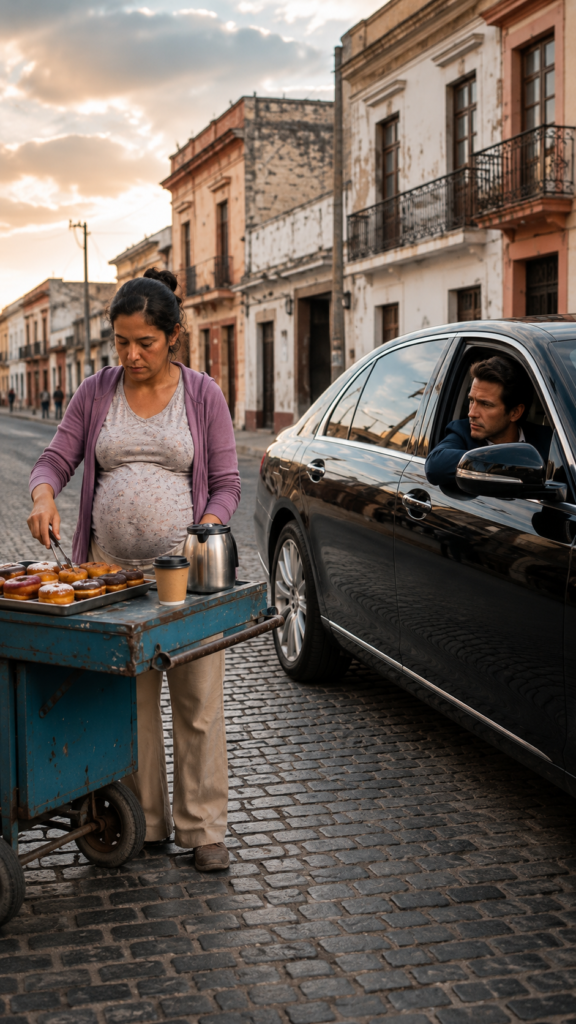
Mariana was behind a wooden cart, her hair tied up, wearing a simple dress and a clean apron. Her large belly was visible beneath the fabric. She was serving bread to an elderly lady and smiled wearily.
Alejandro stood still.
She was alive.
She was pregnant.
And she was alone.
Raúl whispered:
"Let’s go."
Alejandro shook his head, tears filling his eyes.
"Not yet. If I go in now, my mother will invent something else. First, I’ll protect her."
That day, he got everything.
Carmen testified. The security guard confirmed that Mariana had been expelled. A lawyer, pressured by Alejandro, admitted that Doña Elvira and Patricia blocked accounts, forged authorizations, and moved properties to control the company while he was missing.
But something was missing.
Alejandro discovered a document that left him frozen: Patricia had attempted to initiate a process to declare Mariana an "abandoning spouse" and strip her of any rights. The file contained a supposed letter signed by Mariana where she renounced everything.
The signature was fake.
And the date was impossible: that day, Mariana was in the emergency room for a threatened miscarriage.
Alejandro didn’t shout.
He simply folded the paper, put it away, and said:
"Now it’s time."
That afternoon, he returned to the market.
Mariana was packing trays. Her feet were swollen, her face weary, and her hands covered in flour. She felt someone stop in front of the cart.
"Good afternoon, what can I get you?"
No one answered.
She looked up.
The tray fell to the ground.
"No… it can’t be."
Alejandro stood before her, thinner, with scars on his cheek and a broken gaze.
"Mariana."
She stepped back, bringing a hand to her belly.
"You’re dead."
"That’s what they made me half-believe. I woke up not long ago. They told me you had left with another."
Mariana let out a bitter laugh mixed with sobs.
"With another? They threw me out of my house. Your mother left me without a phone, without money, without keys. I waited for you until I had nowhere to sleep."
Alejandro stepped forward slowly.
"I know the truth."
She trembled.
"I thought you would never meet them."
He looked down at her belly.
"Meet them?"
Mariana cried, but this time she didn’t hide.
"There are three. Your children, Alejandro. The children we waited nine years for."
He fell to his knees on the sidewalk. The market crowd stared. Some stopped buying. An elderly woman crossed herself.
Alejandro rested his forehead on Mariana’s belly and cried like a child.
"Forgive me. Forgive me for not being there."
Mariana placed a hand on his head.
"You were fighting to live. The ones who were here chose to destroy me."
That phrase hurt him more than any wound.
That same night, Alejandro took Mariana back to the house in Las Lomas.
She didn’t go alone.
They entered with Raúl, Carmen, the security guard, the lawyer, and a folder full of evidence.
Doña Elvira was in the living room, drinking tea as if the house still belonged to her. Patricia was on the phone, laughing about something.
When they saw Mariana pregnant, silence shattered.
"What is she doing here?" Patricia said.
Alejandro placed the folder on the table.
"She’s here to take her place."
Elvira tried to get up with dignity.
"Son, don’t let yourself be manipulated. That woman…"
"That woman is my wife," he interrupted her. "And you kicked her out pregnant, even though you didn’t know it. You stole documents, blocked accounts, and forged her signature."
Patricia paled.
"That’s an exaggeration."
Raúl pulled out copies, audio recordings, and statements.
Carmen spoke with a trembling voice but firm.
"I was there. Mrs. Mariana begged. Doña Elvira said that a woman without children had no rights."
Mariana lowered her gaze. Not out of shame, but to not break down in front of those who had humiliated her.
Doña Elvira began to cry.
"I just wanted to protect your inheritance. I thought she would take everything."
Mariana looked at her with a sadness heavier than hatred.
"I already had everything when I had your son. I never needed your houses."
Patricia exploded.
"Oh, please! Now it turns out the baker is a saint. It’s convenient that she appeared pregnant just when it suited her."
Alejandro turned slowly.
"Be careful with what you say."
"And what if they aren’t even yours?"
The blow wasn’t physical, but the whole room felt it.
Mariana went pale.
Alejandro walked up to Patricia and spoke without raising his voice.
"Tomorrow, tests will be done, no matter what. Not because I doubt Mariana, but to silence you forever."
The tests arrived days later.
The three babies were Alejandro's.
But the result brought another discovery: Mariana had faced complications due to severe stress during the early months of her pregnancy. The doctor was clear.
"If she had received stable care from the start, the risk would have been lower. What she lived through could have cost her life and the babies’ lives."
Alejandro felt rage. But Mariana asked for something unexpected.
"I don’t want blind revenge. I want justice."
And justice came.
Patricia was removed from the company and reported for forgery and breach of trust. She lost the position she flaunted at family meals and had to face the partners who once greeted her for convenience.
Doña Elvira was not abandoned. Alejandro assured her a pension and a small house in Cuernavaca but forbade her from entering his home or participating in any family decisions.
"You are my mother," he said, "but you stopped behaving like family when you touched Mariana."
Elvira cried.
Maybe out of regret.
Maybe out of broken pride.
No one knew.
Mariana took time to sleep peacefully again. Sometimes she would wake up thinking someone would take the keys away again. Alejandro would get up with her, make her tea, and sit in silence until her fear subsided.
He didn’t try to fix everything with gifts.
He learned to accompany her.
He went to every doctor’s appointment. He massaged her swollen feet. He burned more than one coffee trying to make it like she did. And when Mariana returned to baking, he didn’t let her do it out of necessity.
"Only if it makes you happy," he would say.
She kneaded slowly, with her large belly and calmer eyes.
Months later, two boys and a girl were born: Emiliano, Gael, and Sofía.
When the nurse placed the three babies next to Mariana, Alejandro could not speak. He only cried, with a tiny hand squeezing his finger.
Mariana looked at him tired but smiling.
"They arrived late, like their dad."
He let out a broken laugh.
"But they arrived."
One Sunday, back home, the kitchen began to smell of orange and cinnamon again. On a shelf were the old recipe notebook, the apron from the hard times, and a photo of the Coyoacán cart.
Mariana pulled out a tray of conchas.
Alejandro tasted one and closed his eyes.
"This flavor found me when everyone wanted to lose me."
She looked at him tenderly.
"No. You found me because you never believed the lie.
In the living room, their three children slept huddled together under blankets. The house no longer felt like a cold mansion or a trophy of a name. It finally felt like a home.
Alejandro understood that a family is not protected by driving away those who come without money or defending names as if they were crowns.
A family is proven when everything falls apart.
And Mariana proved that true love doesn’t always shout, doesn’t always accuse, doesn’t always take revenge.
Sometimes it stands on a sidewalk, with flour on its hands, three miracles in its belly, and a heart ablaze, waiting for the truth to find its way back.





