PART 1
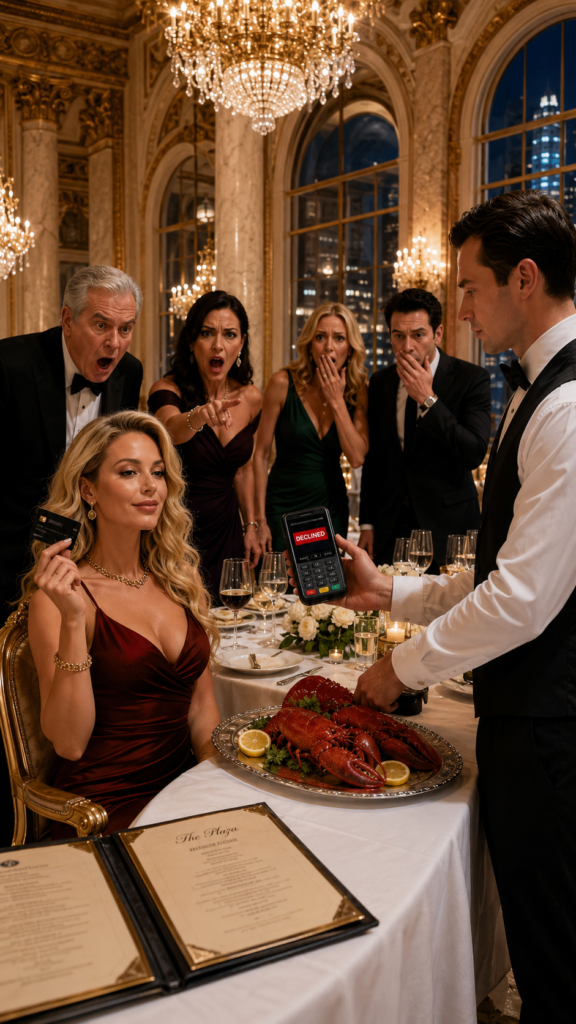
The waiter set the black bill holder right in the middle of the table.
No one breathed.
In the restaurant El Mirador del Ángel, located in the most upscale area of Polanco, the glasses still sparkled under the warm light, the seafood plates still smelled of butter and lemon, and the soft music seemed to mock the awkward silence that had just fallen.
Don Ernesto, Mariana's father, pushed the bill holder toward her with two fingers.
He smiled like a man who already had the fight won.
— C'mon, daughter. You'll take care of it, right?
Mariana slowly lifted her gaze.
Around her were 16 people.
Her mother, Doña Teresa, elegantly adorned with her fake pearl necklace as if she were at a wedding.
Her brother Rodrigo, a wine glass in hand and a smile that ignited anger.
Her aunt Graciela, who hadn't stopped whispering since Mariana arrived.
And several cousins who, just three years ago, had stopped talking to her as if she had committed a crime.
That night, they all looked at her.
But not with affection.
They watched her expecting her to obey.
The table was an expensive mess.
Opened lobsters.
Oysters on ice.
Gigantic shrimp.
Ribeye steaks.
Desserts with edible gold.
Bottles of wine that no one in that family would have ordered at a small eatery, but that night they ordered as if they were lifelong millionaires.
Mariana had chosen nothing.
Not the lobster.
Not the wine.
Not the private room.
She had only accepted a dinner with her parents.
Or at least, that's what they told her.
Three days prior, Doña Teresa had sent her a message after three years of silence.
“Your dad and I want to talk to you. Enough with the fights. Let’s have dinner, just the three of us.”
Mariana read that message about 20 times.
For three years, she had tried not to expect anything from them.
Since her grandmother Consuelo died, the family had split in two.
The grandmother had left Mariana a little house in Valle de Bravo and an investment account she had built over decades by selling food, sewing uniforms, and taking care of other people's children.
It wasn't a fortune.
But for Mariana, it was a hug from beyond.
Her grandmother had raised her when her parents were busy fighting, working, or bragging about things they didn't have.
Don Ernesto swore the will was wrong.
Rodrigo said Mariana had manipulated the grandmother.
Doña Teresa cried, saying a “decent” daughter would share everything.
Mariana refused.
Not out of greed.
But because she knew something no one wanted to accept: Grandmother Consuelo had left a letter explaining why she trusted Mariana and not the rest.
Since then, they called her selfish.
Ungrateful.
Opportunistic.
They erased her from gatherings, birthdays, and Christmases.
And now, suddenly, they wanted to see her.
When Mariana walked into the restaurant, her stomach tightened.
It wasn't just her parents there.
The whole family was present.
There were exaggerated hugs.
Kisses on the cheek.
Phrases like “you've lost weight” and “you don't even remember us anymore.”
For two hours, they talked about old memories, illnesses, gossip, weddings, and children.
No one mentioned the grandmother.
No one apologized.
Then they started ordering nonstop.
— A platter of seafood to start.
— Better make it two.
— Is the lobster fresh?
— Bring us the biggest one.
— And another bottle, young man. This gathering deserves it.
Mariana only ordered mineral water and a salad.
Rodrigo laughed.
— No way, Mariana. Don’t be so serious. Today we’re celebrating that the family is back together.
Don Ernesto raised his glass.
— And that some did really well thanks to the inheritance.
Several giggles escaped around the table.
Mariana swallowed hard.
She didn't respond.
She had learned that not every provocation deserved an answer.
But when the bill arrived, she understood everything.
Don Ernesto pushed the bill holder toward her again.
— After all, you're the one with the house, the investments, and that job in Santa Fe. It won’t hurt you.
Rodrigo let out a laugh.
— Seriously, sister, think of it as a way to compensate just a little for what you took.
Doña Teresa touched her hand.
— Do it for the peace of the family, sweetie.
Mariana opened the bill holder.
$4,386.72.
The number seemed to burn on the paper.
Her cousins stopped pretending to look at their phones.
They all wanted to see her face.
Mariana calmly closed the bill holder.
She raised her hand and called the waiter over.
When the young man approached, she leaned in and whispered something.
The waiter nodded, serious.
Don Ernesto frowned.
— What did you say?
Mariana took her glass of water.
— Nothing that shouldn't have been said from the beginning.
Then the waiter walked away toward the manager's office, and for the first time all night, her father's smile began to crack.
PART 2
For a few minutes, no one spoke about the bill.
It was as if everyone had decided to pretend that bomb wasn't in the middle of the table.
Aunt Graciela took her glass and smiled too loudly.
— Well, the important thing is that we’re together again, right?
Rodrigo settled back in his chair.
— Yeah, besides, Mariana isn’t going to get heavy over a bill. I mean, with all due respect.
Mariana looked at him.
She said nothing.
That made Rodrigo more uncomfortable than any shout.
Don Ernesto began tapping the table with his index finger.
Tap.
Tap.
Tap.
His patience was wearing thin.
— Mariana, don’t make a scene. We’re not in a bar here.
She took a deep breath.
Around her, the restaurant continued to function as if nothing was wrong.
Couples toasting.
Waiters walking by with perfect plates.
A man in a suit closing a deal in a low voice.
And there was her family, trying to turn a dinner into a trap.
The same family that for three years had called her a thief for accepting the last wishes of a woman who truly loved her.
Doña Teresa leaned toward her.
— Sweetie, please. Don’t embarrass your dad.
Mariana let out a small laugh.
It wasn’t mockery.
It was exhaustion.
— How curious, mom. No one was worried about embarrassing me when they brought me here under false pretenses.
Doña Teresa looked away.
That gesture confirmed something painful for Mariana.
Her mom did know.
It hadn’t been a surprise for her.
It hadn’t been a reconciliation dinner.
It had been a theatre.
A theatre with lobster, expensive wine, and family onlookers.
Rodrigo chimed in again.
— Oh, here you go again with your drama. You always play the victim.
— No —Mariana replied calmly—. You need me to be the villain so you don’t have to face what you did.
Silence returned.
Heavier.
More uncomfortable.
At that moment, the manager appeared.
He was a man in his 50s, dark suit, kind expression, and a tablet in hand.
The waiter followed behind.
The manager stopped by the table and spoke politely.
— Good evening. Sorry to interrupt. We need to confirm a detail about the reservation and the payment.
Don Ernesto raised his hand, desperate.
— Yes, of course. My daughter will pay. She already accepted.
Mariana barely turned her head.
— I didn’t accept anything.
Don Ernesto clenched his jaw.
— Don’t start.
The manager checked the tablet.
— Mr. Ernesto Valdivia, the reservation was made under your name. With your phone number. Your email. And your bank card registered as a guarantee.
Don Ernesto’s face changed.
First surprise.
Then rage.
Then fear.
— That doesn’t mean I’m going to pay. I just reserved the table.
The manager maintained a professional tone.
— I understand. But our policy indicates that when no prior signed agreement exists among diners, the initial responsible party is the one who made the reservation and authorized special orders.
Rodrigo placed his glass down on the table.
— What special orders?
The manager swiped the screen and read.
— 2 premium seafood platters. 6 seasonal lobsters. 4 bottles of imported wine. Private service. Special desserts. And a written request: “Charge everything to a single bill at the end of dinner.”
Mariana felt several eyes boring into her father.
Don Ernesto coughed.
— That’s normal in any fancy restaurant.
— There’s also an additional note —said the manager.
Doña Teresa turned pale.
— There’s no need to read that.
But it was too late.
The manager looked at Mariana, as if asking for permission to continue.
She nodded.
— The note states: “The guest Mariana Valdivia will cover the entire bill as a family gesture. Do not split the bills even if requested.”
The table froze.
Even Rodrigo lost his smile.
Mariana felt a blow to her chest.
Not because she was surprised by the trap.
But because seeing it in writing made it more cruel.
Her father not only expected her to pay.
He had planned it.
He had given instructions to close off any exit for her.
Don Ernesto exploded.
— I wrote that because it was the right thing to do! After what she did with the inheritance, the least she could do was show a gesture toward her family.
Mariana set her glass down on the table.
— A gesture? You tricked me, ordered the most expensive things, and expected me to pay to prove I deserve to be forgiven?
Aunt Graciela murmured:
— Well, it’s not that big of a deal...
Mariana turned to her.
— Aunt, you took my grandmother's jewelry before the novena was over.
The woman opened her mouth.
Nothing came out.
Rodrigo slammed his hand on the table.
— Enough! You always bring that up. Grandma was old. She didn’t even know what she was signing.
Mariana stared at him closely.
— She did know.
— No.
— Yes, Rodrigo. And you know it too.
He stood still.
There it was, the first crack.
The small second in which someone understands that the secret can come to light.
Doña Teresa whispered:
— Mariana, no.
But Mariana had already spent too many years staying silent to avoid breaking her family.
The family had broken itself.
She was just going to stop carrying the pieces.
She pulled a thin folder from her bag.
Rodrigo turned red.
Don Ernesto pointed at it.
— What’s that?
— The reason why the grandmother didn’t leave you the house.
The manager stepped back, uncomfortable, but didn’t leave.
Maybe because the bill still hadn’t been paid.
Maybe because everyone at that table was too tense to act normal.
Mariana opened the folder.
— For two years, Grandma Consuelo paid loans she didn’t request. Credit cards she didn’t use. Purchases she didn’t recognize. She thought it was a bank error until she found hidden statements in a shoebox.
Rodrigo half rose.
— You’re crazy.
— No, dude. I’m tired.
The word fell flat.
Mexican.
Wounded.
True.
Mariana pulled out three copies.
— Grandma discovered that someone had used her signature to request credits. And when she went to the bank with the help of a neighbor, she found something worse.
She looked at her father.
— The account where her deposits fell had monthly transfers in Rodrigo's name. And several authorizations signed by you, dad.
Don Ernesto turned pale.
Doña Teresa began to cry, but not as a victim.
She cried like someone who already knew the story and hoped it would never come out.
Rodrigo mocked, though his voice trembled.
— That doesn’t prove anything.
Mariana pulled out another sheet.
— There’s also the grandmother's letter.
The whole table shifted.
Everyone had heard about that letter.
No one had read it.
Mariana didn’t raise her voice.
She didn’t need to.
— She wrote that she didn’t leave me the house to make me rich. She left it to me because it was the only thing she had left after you all drained half her life. She said the house wasn’t a prize. It was protection.
Don Ernesto clutched the tablecloth.
— Your grandmother exaggerated.
— My grandmother died worried because her own son left her in debt.
That phrase broke something.
It wasn’t heard.
But everyone felt it.
Doña Teresa cried louder.
— I told her to stop, Mariana. I told your dad it was too much, but Rodrigo owed money. They threatened us. We didn’t know what to do.
Rodrigo turned furiously.
— Mom!
Then came the twist no one expected.
Mariana looked at her brother.
— You owed money for gambling, right?
Rodrigo pressed his lips together.
— That has nothing to do with it.
— Yes, it does.
Mariana pulled out one last sheet.
— Because Grandma didn’t just change the will. She also left a prepared complaint. She didn’t file it because she didn’t want to see her son in prison. But she left instructions: if you tried to take the house from me or pressure me, I could deliver it.
Don Ernesto sank into his chair.
Aunt Graciela crossed herself.
One of the cousins stopped recording with his phone when Mariana looked directly at him.
— Record well —she told him—. So you won’t tell another version.
The manager coughed discreetly.
— Gentlemen, I apologize for interrupting, but we need to settle the payment.
Don Ernesto reacted as if cold water had been thrown on him.
— I’m not going to pay $4,386.72. It’s an abuse.
The manager replied:
— The registered card will be charged according to the conditions accepted when confirming the reservation.
— I’ll sue you!
— You have that right, sir.
Mariana closed the folder.
— Don’t worry, dad. This time you are going to pay for something you ordered.
Rodrigo pointed at her.
— You’re a disgrace.
Mariana stood up slowly.
— No. I’m the granddaughter of the woman you all used until she could no longer defend herself.
Doña Teresa tried to take her hand.
— Sweetie, forgive me.
Mariana didn’t pull away violently.
She just withdrew her hand sadly.
— I spent three years waiting for you to reach out to tell me the truth. Not to set another trap.
Her mother covered her mouth.
— I wanted to see you.
— Then you should have invited me yourself. Without an audience. Without a bill. Without lies.
Mariana looked at everyone.
At the cousins who ate without asking.
At the aunt who judged knowing too much.
At the brother who lost more than money.
At the father who confused authority with the right to destroy.
— Grandma used to say that family isn’t measured by blood, but by what one does when no one is watching. And you, when no one was watching, took from an elderly woman the little she had.
No one replied.
Because some truths aren’t up for discussion.
They just weigh.
The manager discreetly informed that the charge had been processed.
Don Ernesto closed his eyes.
Rodrigo cursed under his breath.
Aunt Graciela asked if they could split her share, but no one paid her any mind.
Mariana took her bag.
Before leaving, she left a copy of her grandmother Consuelo’s letter on the table.
Not to humiliate them.
But so they would finally read what they never wanted to hear.
As she passed by her mother, she stopped.
— I’m not going to turn in the complaint today.
Doña Teresa looked up with hope.
Mariana continued:
— But if you ever knock on my door to threaten me, to defame me, or to use my grandmother’s name, I’ll deliver it tomorrow.
Then she left the restaurant.
Outside, the night in Mexico City was still alive.
There was traffic, vendors, couples walking, a man playing boleros on the corner.
Mariana breathed as if she had finally escaped from a burning house.
Inside, her family remained seated in front of empty plates and a bill paid by the man who wanted to turn her into punishment.
The lobster was gone.
The wine too.
But the shame was just beginning.
And that night many understood something that in Mexico is still hard to accept: not everything called family deserves a seat at your table.





