PART 1
Aurelio Robles was 50 years old and owned a dairy ranch on the outskirts of Tepatitlán, Jalisco, where the church bells rang louder than the secrets… but the gossip spread faster than any truck.
His ranch, El Encino, had been in his family for three generations. Over 80 hectares of pastures, cows, corrals, a small shop selling artisanal cheeses by the roadside, and a big house with red tiles that, for the past three years, seemed to breathe pure sadness.
Once, that house smelled of freshly brewed coffee.
Of sweet bread.
Of Clara’s laughter, his wife.
Clara had been much more than the woman Aurelio married at 28. She managed the accounts, talked to suppliers, scolded workers when they left tools lying around, and turned that indebted ranch into a respected business.
Then sickness arrived.
For nearly a year, Aurelio watched Clara fade away, but even then she would ask him if he had eaten. When she died, he didn’t cry in front of anyone. The next day, he woke up at five, put on his muddy boots, and went out to milk cows as if the work could fill the gaping hole in his chest.
The room where Clara managed the accounts remained closed.
Her cup still sat on the shelf.
Her shawl hung behind the chair.
Aurelio touched nothing. Not out of bravery, but because opening that door meant accepting she would never return.
The only person who frequently crossed the dirt path between the neighboring ranch and El Encino was Mariana Salcedo.
Mariana was 25, had studied agricultural management in Guadalajara, and returned to the town to revive her family's 25 hectares. She had dairy goats, organic vegetables, and sold jams online.
She was no lost girl.
She drove a tractor, fixed fences, negotiated prices, and could silence any man who looked down on her.
Two weeks after Clara’s funeral, Mariana arrived at Aurelio’s doorstep with a pot of caldo tlalpeño.
“I made too much,” she said. “Help me finish it.”
Aurelio understood immediately that it was an excuse for him to eat.
“You didn’t have to come.”
“I know.”
From then on, almost every Tuesday she showed up with something: corn bread, coffee, fruit, fresh cheese, or just a few minutes of companionship. Aurelio always said it wasn’t necessary. Mariana always replied the same:
“I know.”
Over time, Tuesdays became part of ranch life. Aurelio never asked if she would come, but he brewed two cups of coffee and wrapped up chores near the house early.
Mariana talked about her greenhouses, online orders, her mischievous goats. Sometimes she fell silent, staring at the hills, and that silence didn’t weigh him down.
Aurelio placed her safely in his mind.
The good neighbor.
The smart young woman.
The daughter of a decent family.
Someone he owed respect and distance.
Until that October morning.
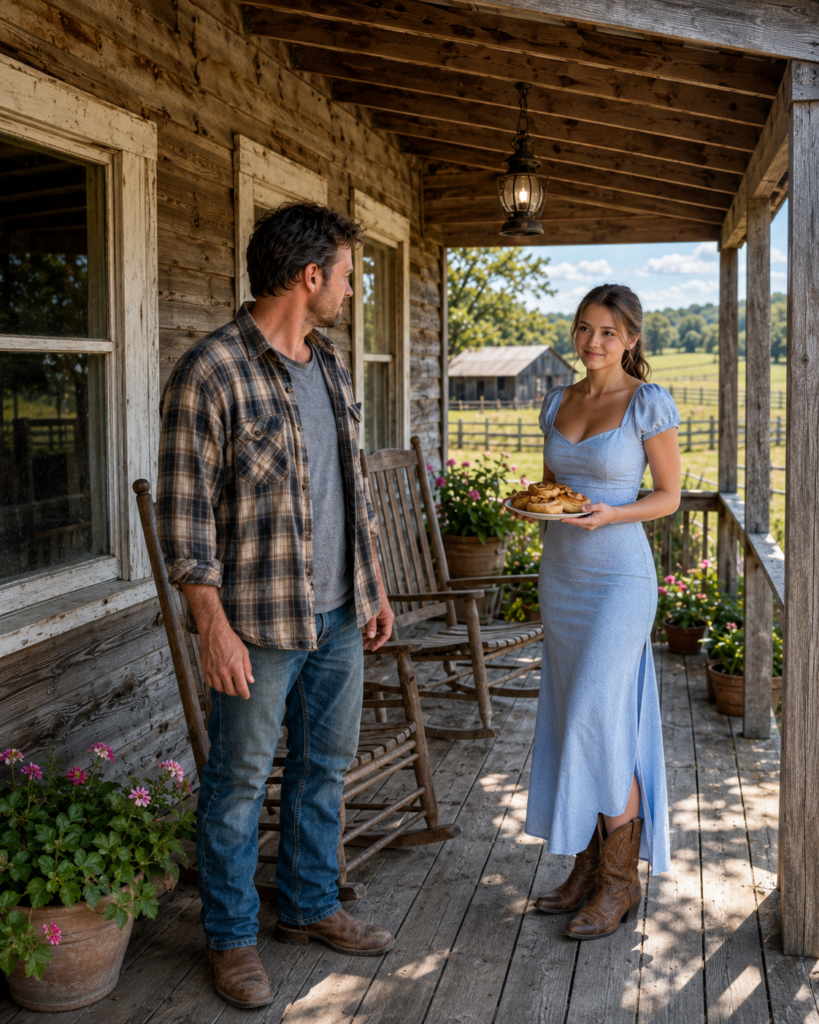
Mariana arrived with a freshly baked guava pie. She wore jeans, a white shirt, brown boots, and had a smudge of flour on her cheek. The sweet aroma filled the porch.
Aurelio looked at her and smiled without thinking.
“If I were 20 years younger… I’d even marry you.”
He expected Mariana to laugh, to say, “Oh, Mr. Aurelio, don’t joke,” or to change the subject.
But she didn’t laugh.
She looked him straight in the eye, with a calm that disarmed him.
“That doesn’t matter to me.”
Aurelio felt the air catch in his throat.
“What did you say?”
Mariana lowered her gaze to the pie, took a deep breath, and stepped back.
“I need to check the irrigation.”
She walked away down the dirt path, leaving him with the pie on the table and a burning phrase in his chest.
That afternoon, while checking cows, delivering cheeses, and repairing a pump, Aurelio tried to convince himself it meant nothing.
But of course, it meant everything.
Mariana didn’t cross that field out of pity.
And he didn’t look forward to Tuesdays just out of habit.
For two weeks, he didn’t dare seek her out. He repeated to himself that she was 25, he was 50, and the town would tear them apart. That Mariana deserved a young man, unburdened, with a house free of ghosts.
And the town seemed to think the same.
Bruno Alcalá, 29, son of the wealthiest agricultural distributor in the area, had been pursuing Mariana for months. New truck, pressed shirt, model smile. He sent her flowers, offered contacts, and even talked to her mother as if he were already part of the family.
One Friday, Aurelio overheard two men in the town shop.
“Bruno is going to invite Mariana to the fair,” one said. “I hope she accepts, because that girl shouldn’t be wasting her time with an old widower.”
Aurelio pretended to check some sacks of feed, but he felt those words shatter something inside him.
That night, he remembered a phrase from Clara, said when the sickness had her already tired.
“When I’m gone, don’t turn your life into a penance, Aurelio.”
He had gotten angry.
“Don’t talk like that.”
Clara squeezed his hand.
“You’re going to keep living. But one thing is to live, and another is just to breathe.”
The next day, Aurelio walked over to Mariana’s greenhouses.
She was adjusting a hose.
“Mariana.”
“Tell me.”
“I’ve been thinking about what you said.”
She straightened up.
“So have I.”
“I’m 50.”
“I know.”
“You’re 25.”
“I know that too.”
“That’s not nothing.”
Mariana placed the tool on a box.
“I don’t want a younger version of you. I didn’t fall in love with a number. I fell in love with the man who cared for his wife until the last day, the one who helps without showing off, the one who doesn’t know how to ask for help but always arrives when someone needs him.”
Aurelio swallowed hard.
“I don’t know if I can give you what you deserve.”
“You haven’t even asked me what I deserve.”
He didn’t know how to respond.
“Don’t decide for me,” she said. “Don’t reject me as if I were a girl who doesn’t know what she feels.”
Aurelio’s gaze dropped.
And just then, from the path, a black truck stopped in front of the greenhouse.
It was Bruno.
He got out with a huge bouquet of roses and an awkward smile. He looked at Aurelio, then at Mariana, and understood far too quickly.
“So it was true,” he said, with contempt. “Really, Mariana… for him?”
PART 2
Mariana didn’t move.
Aurelio felt he should leave, but his feet wouldn’t respond.
Bruno placed the roses on a table as if they were trash.
“The whole town said it, and I didn’t want to believe it. Are you really going to throw away your future for a man who could be your father?”
“Watch what you say,” Mariana replied, firm.
“No, you watch yourself. Because one thing is to help a widower, and another is to step into his house as if you’re going to take the place of the dead.”
Aurelio stepped forward.
“Don’t talk about Clara.”
Bruno let out a bitter laugh.
“And what about you, Mr. Aurelio? Aren’t you ashamed? Aren’t you embarrassed to be getting a 25-year-old woman’s hopes up when you’ve already lived your life?”
Mariana stood between the two.
“No one is getting my hopes up here. I make my own decisions.”
“Then decide better,” Bruno spat. “Because my dad isn’t going to keep buying your production if you keep making a fool of yourself.”
That was the real blow.
Mariana understood that the flowers, the invitations, and the favors weren’t love. They were control.
“Are you threatening me?”
“I’m waking you up. Without our distributor, your cheeses and jams won’t leave this town.”
Aurelio clenched his jaw.
“Then El Encino will sell them.”
Bruno looked at him mockingly.
“You? With your roadside shop?”
“With my shop, my customers, and my word.”
Bruno picked up the roses, threw them to the ground, and drove off in a cloud of dust.
After that, the town exploded.
Before the day ended, everyone was talking about Mariana and Aurelio. In the butcher shop, in the church, in the market, even in the groups of gossip.
“She wants to take the ranch.”
“He’s old and confused.”
“Poor Clara, they don’t even let her rest in peace.”
The worst came from Clara’s family.
Luz, Clara’s sister, showed up one afternoon at El Encino with eyes full of rage.
“Is what they’re saying true?”
Aurelio didn’t pretend.
“I don’t know what they’re saying, but Mariana matters to me.”
Luz let out a dry laugh.
“How quickly you forget my sister.”
That phrase hurt more than all the gossip combined.
“Clara will never be forgotten.”
“Well, you’re doing a good job of pretending. That girl comes to sit where Clara used to sit, to cook for you, to move into this house. And you, like a foolish old man, don’t even realize it.”
Aurelio didn’t respond.
Because deep down, that was his fear.
Not that Mariana wanted him.
But that wanting her would mean betraying Clara.
The following Tuesdays, Mariana didn’t show up.
There was no shared coffee.
No pie.
No good silence.
Aurelio kept preparing two cups out of habit until one morning he left the second cup untouched and understood he wasn’t protecting anyone. He was losing the only living thing that had entered his house in three years.
Meanwhile, Bruno fulfilled his threat.
He canceled orders.
Convinced several merchants to stop buying from Mariana.
He even spread the rumor that she approached Aurelio out of interest because El Encino was worth a fortune.
Mariana didn’t cry in front of anyone. She worked harder, increased online sales, and sought new clients in Guadalajara. But at night, when she turned off the greenhouse lights, she would stare at the path toward the ranch.
She was also tired of waiting for a man who loved her but was afraid to accept it.
One afternoon, Aurelio did what he had been avoiding for three years.
He opened Clara’s room.
Dust covered the desk. Notebooks were piled up. The shawl was still on the chair. Aurelio sat down and for the first time didn’t flee to the barn.
He cried.
He cried for Clara, for the good years, for the illness, for the things he didn’t say, for the guilt he had confused with loyalty.
Then he opened an old notebook.
Among accounts, recipes, and supplier lists, he found a folded sheet with his name on it.
“Aurelio.”
He recognized Clara’s handwriting and felt his heart stop.
The letter said:
“If you’re reading this, you’re probably still being stubborn, locked in this room as if my memory needed dust to survive.
I know you. You’re going to believe that suffering for me is a way to love me. It’s not.
I don’t want a tomb living inside my house. I want you to open the windows, to laugh again, to let good people in.
And if one day someone looks at you without fear, don’t punish her for arriving after me.
Love doesn’t erase when another is born. It just changes rooms inside the heart.”
Aurelio pressed the letter against his chest.
That was the twist he never expected: Clara wasn’t holding him back from memory. He himself had put chains on using her name.
The next day, before dawn, he crossed over to Mariana’s greenhouses.
She was loading boxes into an old truck. She had dark circles under her eyes, muddy boots, and her hair tied back carelessly.
“I’ve come to apologize,” Aurelio said.
She didn’t put down the box.
“For what? There are several.”
He accepted the blow.
“For treating you as if you didn’t know how to choose. For hiding behind Clara. For letting the town speak louder than I did.”
Mariana set down the box.
“People are still talking.”
“Let them talk.”
“Bruno is trying to sink my business.”
“Then let’s lift it higher.”
She looked at him suspiciously.
“Let’s?”
Aurelio took out Clara’s letter but didn’t hand it to her.
“Last night I understood something. I thought that loving again would mean disrespecting my wife. But Clara knew me better than I knew myself. She didn’t want me to stay alone. She wanted me to live.”
Mariana didn’t say anything.
“I can’t give you youth. I can’t give you a life without comments or problems. I can’t promise that in 25 years I will have the same strength. But I can promise you that I will never love you in secret again, nor push you toward another man out of cowardice.”
Mariana’s eyes filled with tears, but her voice came out firm.
“I don’t want you to rescue me, Aurelio.”
“I didn’t come to rescue you. I came to walk with you.”
That same week, El Encino began selling Mariana's products in the shop. Aurelio used his contacts, Mariana managed the social media, and several clients from Guadalajara started ordering combined packages of cheese, jams, and preserves.
Bruno laughed at first.
Then he stopped laughing when his own customers began to ask about Mariana’s brand.
The town fair arrived with more poison than music.
Bruno, furious, showed up in front of Mariana's stand and said in front of everyone:
“Let’s see how long this little act lasts. She wants a ranch, and he wants a young girl.”
The silence fell heavily.
Mariana was about to respond, but Aurelio took the microphone from the booth where they announced raffles.
“Since everyone is so curious about my life, listen closely.”
People gathered.
Luz, Clara’s sister, was there too.
Aurelio took a deep breath.
“I loved Clara with all that I was. I cared for her until the last day, and I will honor her until the last day of my life. But honoring a good woman doesn’t mean I have to die with her.”
No one blinked.
“Mariana didn’t come to take anyone’s place. She came when this house was empty and never asked for anything in return. If anyone wants to call her selfish, they better have the courage to wake up at five, work their land, pay wages, and save their business while a coward tries to close doors because she said no.”
Bruno turned red.
Mariana stood frozen.
Then Luz stepped forward.
Aurelio thought she would attack him again, but she had tears in her eyes.
“Clara told me something before she died,” she confessed. “She asked me not to let you sink. I was the first to fail her because I confused your pain with loyalty.”
She looked at Mariana.
“Forgive me, girl. My sister wouldn’t have wanted this cruelty.”
That day, the town changed the subject, as towns always do when they discover they were wrong.
But Mariana didn’t forget.
Not out of resentment, but because she understood who truly respected her and who only accepted her as long as she obeyed.
Almost a year later, a strong storm destroyed part of her greenhouses. Before she could ask for help, Aurelio arrived with workers, wood, tools, and hot coffee.
They worked until nightfall. Mariana, soaked and covered in mud, watched him from the entrance of the greenhouse.
“You showed up again without being called.”
“I’ve made it a habit.”
“That’s why I love you.”
That night, Aurelio took her to El Encino.
On the table was a guava pie. It was crooked, with a burnt edge and a sunken center.
Mariana looked at it.
“You made this?”
“I tried.”
“It shows, huh?”
Aurelio pulled out a simple silver ring.
Mariana stopped smiling.
“A while ago, you brought me a pie, and I made a joke because I was afraid to tell the truth,” he said. “I thought 20 years made me insufficient for you. But I understood that the problem was never the age. It was my cowardice.”
He knelt down.
“Mariana Salcedo, will you build a life with me that doesn’t ask fear for permission?”
She began to cry and laugh at the same time.
“You’re proposing to me with a burnt pie.”
“I can buy a nice one.”
“Don’t you dare. I want this one.”
Then she nodded.
“Yes, Aurelio. Yes, I do.”
They married in the autumn, right on the strip of land between the two ranches. Before the wedding, Aurelio went to Clara’s grave with white flowers. He thanked her. He promised that he would never forget her, but he would finally stop using her memory as a prison.
Years later, on a Tuesday morning, Aurelio was repairing the southern fence when he saw Mariana crossing the field, holding their small son in one arm and a guava pie in the other.
“Another pie?” he asked.
“And this time it’s not burnt.”
Aurelio smiled, looking at his wife, his son, and the house he once thought was condemned to silence.
“If I were 20 years younger…” he said, no longer hiding.
Mariana approached and touched his arm.
“20 years wouldn’t change anything. I didn’t need a younger version of you. I needed you alive, brave, and willing to choose me without shame.”
Aurelio kissed her in front of the path, unafraid of anyone seeing them.
Because in the end, the true scandal wasn’t that a 25-year-old woman loved a 50-year-old man.
The true scandal was that an entire town believed it had more right than she did over her own heart.





