PART 1
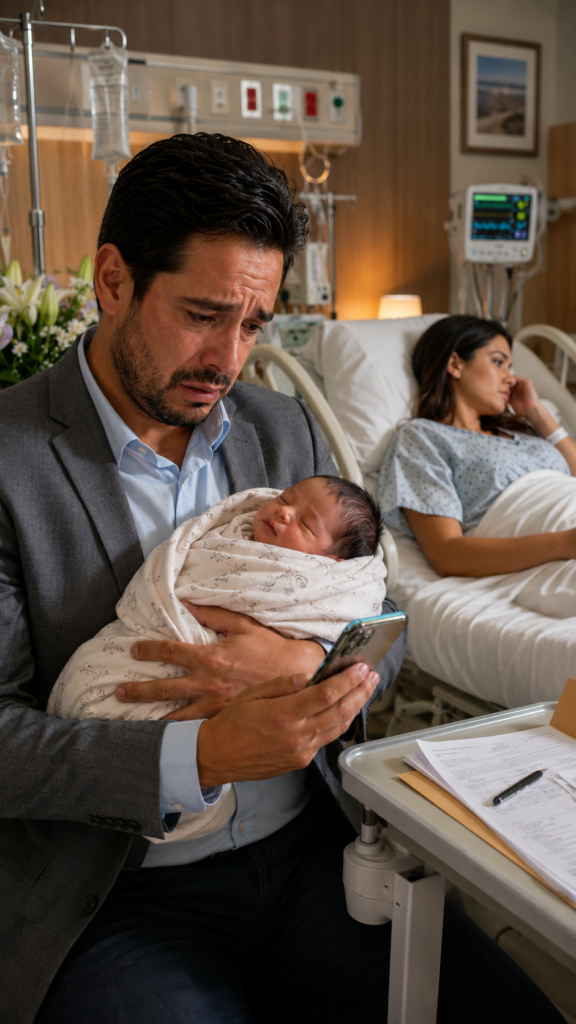
The nurse placed the baby in Raúl Méndez's arms, and for one fleeting second, he believed life was finally giving him what he had longed for.
But he didn't smile.
He didn't cry with happiness.
He froze.
That newborn child had none of his eyes, nor his nose, nor his mouth. It had a brown spot under the left eyelid, a dimple in the chin, and a slightly divided eyebrow.
Exactly like Diego, his partner.
The same Diego who months earlier had told him, while sipping tequila on a terrace in Guadalajara:
—Raúl, don’t be a fool. If Valeria is pregnant, give her everything before someone else beats you to it.
In that moment, Raúl thought his friend was giving him advice.
Now he understood that he had been mocked to his face.
For eight years, Raúl had been married to Lucía, a calm, decent woman, one of those who don’t cause scandals but remember every wound. They lived in Providencia, in a nice house that looked perfect from the outside but had turned cold inside.
They had not been able to have children.
Or so Raúl said.
Each negative test was, for him, another excuse to look at Lucía with reproach. Each medical appointment ended with a heavy silence in the car. And over time, that silence morphed into cruel phrases.
—Maybe the problem is you, Lucía.
She didn’t respond.
She just lowered her gaze, as if swallowing the pain was part of being married.
Then Valeria Torres appeared at an architecture convention in CDMX. She was young, confident, with expensive heels, a strong perfume, and that way of looking that made any insecure man feel important.
Raúl fell hard and fast.
Four months later, Valeria told him she was pregnant.
He almost went crazy with excitement.
That baby was, in his mind, the child that Lucía could never give him. So he decided to leave his wife, but just then, his father suffered a heart attack. The cardiologist warned that a strong shock could kill him.
Raúl used that as the perfect excuse.
He continued to pretend his marriage was intact while paying for Valeria’s private consultations, a chauffeur, maternity clothing, and a five-million-peso apartment in Santa Fe.
Lucía knew.
Of course she knew.
One night, while Raúl was putting on cologne in front of the mirror, she asked him:
—Are you sure that baby is yours?
He looked at her with disdain.
—Don’t you dare. You’re just bitter because you couldn’t give me one.
Lucía didn’t cry.
She simply responded:
—Sometimes God doesn’t punish quickly, Raúl. He punishes perfectly.
On the day of the delivery, Valeria screamed for ten hours. Raúl was there, holding her hand, kissing her forehead, promising everything would be okay.
When the baby cried, he felt the world forgive him.
Until he held him in his arms.
Until he saw that brown spot.
Until Valeria turned her face without surprise.
And just when the nurse asked for a signature, his phone vibrated.
It was a message from Lucía.
“Congratulations, Raúl. I also received my results today.”
Below was a photo.
A positive pregnancy test.
PART 2
Raúl read the message with the baby still in his arms.
For a moment, he didn’t understand.
Or he didn’t want to understand.
The nurse asked if he was okay. He nodded like an idiot, but the child began to weigh on him like a sentence. Small, fragile, innocent, and yet Raúl felt himself sinking to the depths of the hospital.
Valeria, lying in bed, closed her eyes.
—Give him to me —she said.
Her voice didn’t sound excited.
It didn’t sound like a happy mother.
It sounded like a woman who knew her lie had just shattered.
Raúl looked at the baby again.
The brown spot.
The dimple.
The divided eyebrow.
Diego.
His partner.
His friend.
The man who had gone with him to choose the truck for Valeria. The man who called him “brother” while sipping his best tequila. The man who encouraged him to spend money, to sign papers, to leave Lucía “with dignity.”
—Is it Diego’s? —Raúl asked, almost voiceless.
Valeria didn’t answer.
It wasn’t necessary.
The nurse took the child carefully and took him for examination. Raúl stood frozen in the middle of the room, empty-handed, as if something had been ripped from him that wasn’t even his.
The phone vibrated again.
Lucía again.
“The results are clear. The problem was never me.”
Below was another image.
It wasn’t just a pregnancy test. It was a complete medical file, with studies, dates, and observations. Lucía could indeed get pregnant. Her results had been normal for years.
Then came another message.
“I also received yours.”
Raúl opened the image with trembling fingers.
There it was, his name.
Raúl Méndez.
Severe male factor.
Extremely low natural probability.
He gripped the bed railing.
For eight years, he had made Lucía feel defective. For eight years, he had seen her take vitamins, pray silently, leave appointments alone, give up coffee, give up wine, even give up hope.
And the problem was him.
Not her.
Valeria tried to sit up.
—Raúl…
He looked at her with a mix of hatred and shame.
—Since when?
—Don’t do this here.
—Since when have you been sleeping with Diego?
—I just gave birth.
Raúl let out a dry, ugly laugh.
—And I just became an idiot.
In that moment, the door opened.
Diego entered with a bouquet of sunflowers and a smile that faded the moment he saw Raúl’s face.
—Brother… did he arrive?
Raúl took one step toward him.
—He has your spot.
The room went cold.
Valeria began to cry. Diego looked toward the crib where the baby was already back, wrapped in a blue blanket.
He didn’t deny it.
That was the worst part.
He didn’t deny the child.
He only denied Raúl with his silence.
—We can talk —Diego said.
Raúl hit him.
He didn’t think. He didn’t measure. His fist struck Diego’s mouth, and he fell against the wall, scattering the sunflowers to the floor. The nurse screamed. The baby cried. Valeria pleaded for him to calm down.
But Raúl stopped when he saw himself reflected in the glass.
Disheveled.
Crying.
With his shirt wrinkled.
And he understood something even more humiliating: he wasn’t a clean victim. He had built that disaster himself with lies, arrogance, money, and Lucía’s pain.
He left the hospital before security arrived.
Outside, Guadalajara smelled of rain and gasoline. Cars passed by Avenida Patria as if the world hadn’t just slapped him.
He called Lucía.
She didn’t answer.
He texted:
“I need to see you.”
She replied minutes later:
“No. You needed to see me years ago.”
Raúl sat in the parking lot, crying like a child. Not for Valeria. Not for Diego. Not even for the baby.
He cried for Lucía.
For every hot dinner left on the table. For every shirt she ironed while he perfumed himself for another woman. For every time she swallowed tears to avoid making a scene.
When he returned to the room, Diego was already gone.
Valeria held the child.
—You’re not going to make a scene, are you? —she asked.
Raúl looked at her incredulously.
—I bought you a five-million-peso apartment thinking it was for my son.
—You wanted to.
—Because you lied to me.
Valeria wiped her tears with anger.
—You lied too. You had a wife, Raúl. Don’t come now pretending to be the betrayed man.
The statement hit him because it was true.
—I gave you the story you wanted to buy —she added—. You didn’t want a woman. You wanted a child to feel like a man.
Raúl looked at the baby.
He slept peacefully.
He was guilty of nothing.
That enraged him even more because he couldn’t even hate him.
—Did Diego know?
Valeria looked down.
—He always knew.
—Then why did he push me toward you?
She took a deep breath.
—Because I needed to get you out of the company.
That was the second bill.
The first was the baby.
The second was everything else.
Raúl remembered the documents he had signed without reading, the powers of attorney, the transfers, the companies created to “protect assets” before the supposed divorce. Diego had told him it was all just paperwork.
And he, busy playing the future dad, had stopped being a businessman.
That same night he went to his office in Puerta de Hierro. The building was almost empty. He went up to his office, turned on the computer, and found altered folders, signed contracts, open credits, forwarded emails, and transactions he didn’t recognize.
Diego hadn’t just stolen the mistress from him.
He had stolen the business.
At three in the morning, Octavio, his lawyer, arrived with his shirt half-tucked and a hardened face.
He reviewed documents for almost an hour.
—They drained you, Raúl.
—How much?
Octavio remained silent.
His face said it all.
—We can fight —he explained—, but many signatures are yours.
—I was deceived.
—No. You were buying silence, not reading contracts.
Raúl didn’t respond.
Sometimes the truth doesn’t shout.
It just sits in front of you with papers.
At dawn, he went to Lucía’s house. He knocked several times until Tomás, her brother, opened the door.
—She doesn’t want to see you.
—I need to talk to her.
—She needed you to accompany her to appointments. You didn’t.
Behind Tomás, Lucía appeared.
She wore a gray robe, her hair tied up, and one hand over her belly. She didn’t yet show, but Raúl saw her as if she carried a miracle that no longer belonged to him.
—Lucía…
—Don’t come in.
—Is it mine?
The question came out miserable.
She looked at him with a calm that hurt more than any scream.
—Yes.
Raúl shattered inside.
The child he had longed for for eight years was there. In the woman he humiliated. In the wife he abandoned without leaving. In the only person who never tried to sell him a lie.
—I want to take responsibility —he said.
Lucía nodded slowly.
—Start by signing the divorce.
Raúl felt a door slam in his face.
—I was wrong. I was deceived.
Lucía let out a sad laugh.
—You were deceived because you wanted to be deceived. You wanted to believe a young woman made you a man and that I was an old house where you could return when you got tired.
He lowered his gaze.
—I’m the father.
—Biologically, yes. Morally, I still don’t know.
Lucía explained that she already had a family lawyer. There would be child support, clear limits, and visitation when the baby was born. She didn’t want drama, shouting, or regrets at her door.
—How can you be so calm? —he asked her.
She took a deep breath.
—Because I cried 12 years in 8. I got ahead of myself.
And she closed the door.
Not hard.
Worse.
Calmly.
The following months were a slow fall. Diego disappeared. First, they said he was in Miami, then in Monterrey, and then no one knew anything. He left debts, furious suppliers, and cross-lawsuits.
Valeria tried to keep the Santa Fe apartment, but part of the transactions remained frozen. Even so, nothing was clean. In Mexico, papers weigh, even if they’re stained.
The baby was registered by Diego after a DNA test. He was named Bruno.
Raúl didn’t go to the registration.
But someone sent him a photo.
The child had the same spot under his eye.
Raúl looked at it for several minutes. He felt anger, then shame. Bruno owed him nothing. He was just a child trapped in the adults’ filth.
Lucía moved forward with her pregnancy far from him.
Raúl asked through lawyers.
“She’s stable.”
“The baby is doing well.”
“She doesn’t want visits.”
One morning, he saw her from a distance at the Vía RecreActiva, walking slowly with Tomás and a friend. Guadalajara was full of bicycles, dogs, families, and juice stands.
Lucía looked tired.
But free.
Raúl wanted to approach.
He didn’t.
For the first time in a long time, he didn’t do what he wanted.
When Gabriel was born, he received a call at 5:18 in the morning.
It was Tomás.
—He’s born.
Raúl sat up in bed.
—Is he okay?
—Both are fine.
—Can I go?
There was silence.
—She said you can see him through the glass. Not enter.
Raúl arrived at the hospital with his heart in his hand. He saw him behind the glass: small, red, with his fists clenched.
His son.
His true son.
This time he didn’t cry out of fear.
He cried because he understood that love isn’t demanded with a last name. It is earned with presence.
Lucía named him Gabriel.
She didn’t give him Raúl’s name.
And he accepted it.
Days later, he signed the divorce. He also signed for child support. The house remained for Lucía and Gabriel. His company was left in pieces. His pride lay in ruins.
Months later, Valeria sought him out, holding Bruno in her arms.
—I need help —she said.
Raúl looked at her without desire and without hatred.
—Bruno needs help. You need consequences.
He gave her the contact of a lawyer to demand support from Diego. He also paid for the child’s medications directly at a pharmacy, not to Valeria.
—After everything, are you helping me? —she asked.
Raúl looked at the baby.
—Him. Not you.
Years passed.
Raúl didn’t become a saint. Men like him don’t change from a dramatic scene. They change by paying, losing, listening to closed doors, and learning not to kick them.
He watched Gabriel grow on Saturdays, first with supervised visits. Lucía sat on a bench at Parque Metropolitano while he pushed the stroller. They didn’t talk much.
When Gabriel turned four, he asked:
—Why don’t you live with my mom?
Raúl froze.
Lucía lifted her gaze from the bench.
—Because I hurt your mom a lot —he replied.
—And did you say sorry?
—Yes.
—And is she healed?
Raúl looked at Lucía.
She didn’t look away.
—Not everything heals just because one asks for forgiveness —he said.
Gabriel thought for a moment.
—Then behave well for a long time.
Raúl smiled sadly.
—I’m trying.
Lucía rebuilt her life without him. She opened a small café in Chapalita, with plants, corn bread, and freshly ground coffee. She called it “Perfect.”
When Raúl saw the sign, he understood the phrase she had told him that night:
“Sometimes God doesn’t punish quickly. He punishes perfectly.”
She didn’t invite him to the opening.
He went weeks later, as a customer. He ordered a coffee. She served it to him calmly.
—It’s hot —he said.
—Thank you.
There were no reproaches.
There was no tenderness.
Only peace.
Her peace.
The one he no longer had the right to touch.
Today Gabriel runs to Lucía and then to Raúl, as if all the history of a broken family fit in that short distance.
Raúl catches him in his arms and understands, each time, that God didn’t give him what he wanted when he wanted it.
First, he took away the lie.
Then he left him with the truth.
And forced him to watch it grow from outside the house he had destroyed.





