PART 1
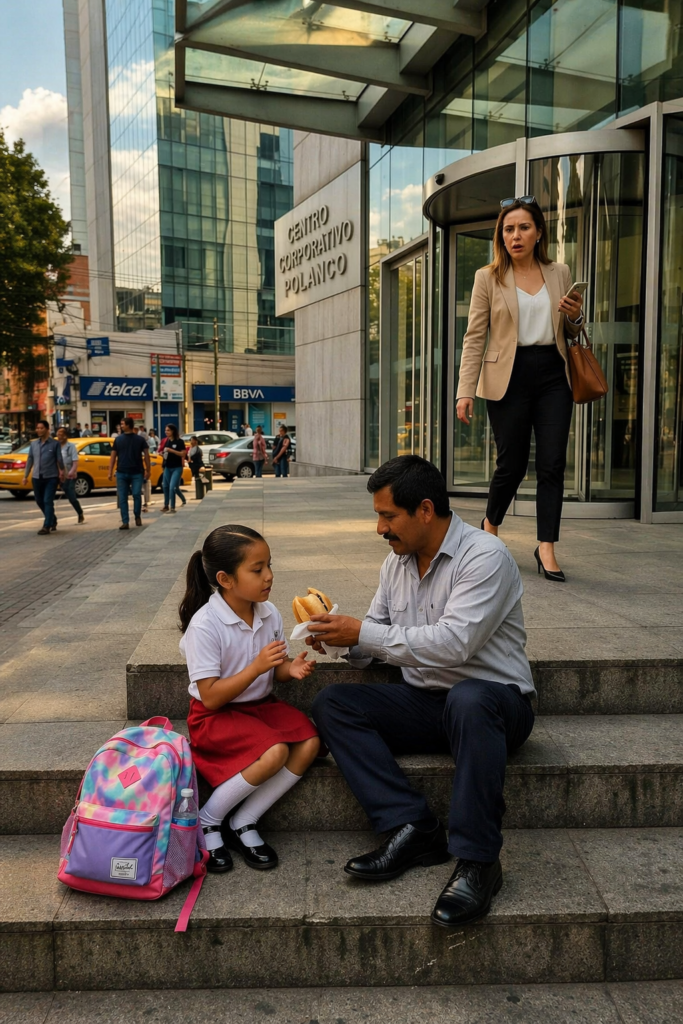
Julián had exactly 47 pesos left in his wallet when he sat down on the side steps of a corporate building in Polanco.
It wasn’t an elegant pause. It was his lunch hour, if one could even call it lunch: a sandwich of eggs and beans wrapped in a napkin, prepared at 5:30 in the morning before waking his son.
He worked as a maintenance technician in a company where everyone only called him when something broke down.
At 34 years old, he wore a clean but worn shirt at the elbows, old sneakers, and had the face of someone who had learned to endure without complaint.
Since his wife left with a black suitcase and never returned, Julián had been raising Mateo, his 6-year-old son, all alone.
That’s why he counted every peso. That’s why he tore the bread at dinner so his son could have seconds, and he could say, “I’m not hungry, kiddo.”
That Thursday, while he bit into the sandwich slowly to make it last longer, he heard a faint cry.
At first, he thought it was a call, a video, something from those executives passing by with expensive headphones. But no.
Just a few meters away, sitting next to a massive flowerpot, was a girl about 8 years old. Impeccable uniform, blue bow, an expensive backpack, and shoes so shiny they looked freshly bought.
But she was crying like children do when they’ve grown tired of waiting.
Julián looked around. No one stopped. No one asked anything.
He approached carefully, knowing how a poor man looked talking to a rich girl in Polanco. In Mexico, kindness can also get you in trouble if you wear worn-out sneakers.
“Are you lost?” he asked, keeping his distance.
The girl shook her head.
“I’m waiting for my mom.”
Julián glanced at his phone. It was 2:18 in the afternoon.
“Since when?”
The girl clenched her hands on her skirt.
“Since 10.”
Julián's jaw tightened.
He didn’t curse. He didn’t raise his voice. He just felt a hot rage, the kind that rises when you know what it hurts to leave a child behind.
“Have you eaten?”
The girl shook her head again.
Julián looked at his sandwich. Then at the entrance of the corporate building. Then back at the girl.
He tore the sandwich in half and gave her the larger piece.
“Here. It’s not fancy, but it’ll fill you up.”
The girl hesitated.
“My mom says I shouldn’t accept food from strangers.”
“Your mom also said she was coming for you,” Julián replied, trying not to sound harsh.
The girl lowered her eyes and accepted.
At first, she ate slowly, then with real hunger. She had dry tears on her cheeks and a sorrow too big for her age.
“My son is 6,” Julián said, trying to make her feel safe. “His name is Mateo.”
The girl looked at him with a seriousness that broke something inside.
“Your son is lucky.”
“Why do you say that?”
She swallowed hard.
“Because you actually pick him up.”
Julián froze.
At that moment, the revolving door of the corporate building swung open abruptly.
A woman in a white suit, dark glasses, and perfect heels appeared at the entrance. Two assistants followed her, carrying folders and speaking nervously.
The girl stopped eating.
The woman stood frozen upon seeing her daughter sitting on the floor, eating half a bean sandwich next to an employee in a worn shirt.
And then the girl said, without crying, but with a voice that sliced through the air:
“Mom, he noticed I was hungry.”
PART 2
The silence that fell over those steps was worse than a scream.
Renata Arriaga, owner of one of the most expensive chains of private hospitals in the country, stood still as if someone had turned off her world.
Around her, her assistants didn’t know whether to advance, hide, or call security. One of them looked at Julián with distrust, as if sharing a sandwich were a crime.
Julián stood up slowly, wiping his hands on his pants.
“Ma’am, I’m sorry. The girl was crying. I didn’t mean to intrude.”
Renata didn’t respond.
Her gaze moved from the bitten sandwich to her daughter’s face. From Julián’s old sneakers to the expensive backpack abandoned on the floor.
The girl, named Sofía, held the napkin against her chest as if it were evidence.
“You left me here again,” she said.
Renata blinked, struck by those five words.
“Sofi, my love, there was a meeting…”
“There’s always a meeting.”
The phrase came out soft, without a tantrum. And that’s why it hurt even more.
Julián tried to leave. That fight wasn’t his. He just wanted to return to the maintenance room before his supervisor docked him half an hour.
But Sofía grabbed him by the sleeve.
“Please don’t go yet, sir.”
Renata lowered her glasses. Her eyes were red, not from crying, but from exhaustion. Those eyes that had spent years staring at screens and contracts but hadn’t seen an empty lunchbox.
“Did you give her food?” she asked.
“Half of my sandwich.”
“Why?”
Julián let out a bitter laugh.
“Because she was hungry, ma’am. It wasn’t that hard to see.”
One of the assistants opened his mouth, indignant.
“Hey, watch yourself…”
Renata raised her hand and silenced him.
Sofía looked at her mother.
“Yesterday was my science presentation.”
Renata closed her eyes.
“Sofi…”
“We won first place. Karina brought me flowers from you.”
The assistant behind her lowered their gaze.
“The card said: ‘I’m proud of you, princess,’” the girl continued. “But when I called you last night, you asked if I did well in ballet.”
Julián felt a knot in his throat.
He didn’t know this family, but he understood that kind of abandonment. The kind that isn’t always visible because there’s a driver, a big house, and a clean uniform.
The abandonment that comes wrapped in gifts.
Renata placed a hand on her chest. For the first time, she didn’t look like a powerful businesswoman. She looked like a woman discovering a debt that no bank could calculate.
“Let’s go home,” she said, her voice broken.
Sofía didn’t move.
“Are you going to scold him?”
Renata looked at Julián.
“No.”
“Are you going to say it was my fault?”
“No, my love.”
The girl swallowed hard.
“Are you going to turn off your phone?”
Renata held the phone in her hand. Calls, messages, important names, millions of pesos disguised as urgency appeared on the screen.
She turned it off.
Just like that, without drama. Without explanation.
Sofía looked at her as if she had just witnessed a miracle.
Julián picked up his backpack.
“I really have to go. My boss doesn’t forgive.”
“And your food?” Sofía asked.
“I already ate.”
It was a lie. His stomach was empty, and the afternoon stretched long ahead.
Renata knew it. You could see it in how her face broke.
“What’s your name?”
Julián hesitated.
“Julián Reyes.”
“Thank you, Julián.”
He just nodded.
“Take care of her, ma’am. You can’t leave kids waiting forever.”
The phrase wasn’t shouted. It wasn’t rude. But it fell like a stone.
Julián left through the service entrance, asking for nothing, expecting no reward, not imagining that he had just opened a crack in a family that had been pretending perfection for years.
That night, Renata took Sofía home to Lomas de Chapultepec.
There was no scolding. No speech. Just a silent dinner at a table that was too big.
When Sofía fell asleep, Renata entered her room to leave her a glass of water. Then she saw a purple notebook under the pillow.
She didn’t want to invade her space. But something in her chest told her the truth was there.
She opened the first page.
“Today, mom forgot to pick me up again.”
She turned another page.
“Karina knows my size. My mom doesn’t.”
Another.
“Grandma says I shouldn’t bother her because she’s building my future. But I don’t want a future if I’m alone in my present.”
Renata sat on the bed as if her legs had been taken away.
She read entire pages. Birthdays with hired clowns but no mom. Festivals recorded by the nanny. Cancelled dinners. Broken promises. Drawings where Sofía painted herself small, almost invisible, next to a huge woman with a cell phone.
On the last page was a sentence that shattered her:
“I think that if I disappeared, mom would notice 4 hours later.”
Renata cried silently.
The next day, she canceled 3 meetings, a signing with investors, and a breakfast with officials. She took Sofía to school and walked her to the classroom door.
The girl walked stiffly, as if she still didn’t trust.
“Are you going to come pick me up?” she asked before entering.
“Yes.”
“You? Not Karina?”
“Me.”
Sofía didn’t smile. She just nodded.
At 2:30, Renata was there.
She arrived 15 minutes early. No escort. No assistants. With her phone turned off in her bag.
Sofía came out of the classroom and stopped.
“You came,” she murmured.
Renata crouched in front of her.
“I’m sorry for all the times I didn’t come.”
The girl jumped on her and hugged her so tightly that Renata understood something terrible: her daughter wasn’t angry because she hated her. She was hurt because she still needed her.
But the real fight began at home.
Doña Elvira, Renata's mother and Sofía’s grandmother, came that afternoon furious. She was an elegant woman, impeccably groomed, educated in that fine cruelty of families that confuse discipline with coldness.
“I was told you canceled the meeting with investors to go to school,” she shot, dropping her bag on the sofa. “Have you lost your mind?”
Sofía was on the staircase, listening.
“I went for my daughter.”
“Karina is there for that.”
Renata stood still.
“No, mom. I’m there for that.”
Doña Elvira let out a dry laugh.
“Don’t be ridiculous. That girl lacks nothing. She has a house, a driver, classes, clothes, a last name. What you’re building is for her.”
“What I’m building is worthless if my daughter thinks she’s a burden.”
The grandmother pursed her lips.
“Oh, please. Kids dramatize. You cried too, and look what you’ve become.”
That was the twist Renata hadn’t expected.
Suddenly, she understood that she hadn’t just neglected Sofía for work. She had repeated the same coldness with which they had raised her.
Doña Elvira never went to her contests. She never asked if she was sad. She always told her that love was shown with stability, not hugs.
And Renata, unknowingly, had turned that wound into inheritance.
Sofía took two steps down.
“Grandma, you told me that if mom didn’t come, it was because I had to learn not to be a burden.”
Renata turned her head slowly.
“Did you tell her that?”
Doña Elvira didn’t deny it.
“I told her the truth. An important woman can’t live worried about tantrums.”
Renata felt shame. Then anger. Then brutal clarity.
“Never say that to my daughter again.”
“Renata…”
“Never.”
Renata’s voice didn’t tremble.
“And as long as you don’t understand that Sofía is not a burden, you won’t be alone with her.”
Doña Elvira paled.
“Are you kicking me out of my granddaughter’s life?”
“I’m removing your poison from my house.”
That day, for the first time, Sofía saw her mom defend her.
Not with money. Not with lawyers. Not with her last name.
With presence.
Months passed.
Renata didn’t become perfect. She still worked a lot. She still had difficult meetings and urgent calls. But she began to set boundaries.
Every Tuesday, she had dinner with Sofía without her phone. On Thursdays, she took her to painting classes. On Sundays, they walked through Chapultepec eating street corn, even if Renata got her coat messy and Sofía laughed at her.
One night, Sofía asked to learn how to ride a bike.
Renata didn’t know how.
“Really, you don’t know?” Sofía asked, surprised.
“Really.”
They rented two bicycles in the park. Renata fell three times, scraped her knee. Sofía doubled over laughing.
And that laughter was worth more than any contract.
Almost a year after the day of the sandwich, Julián arrived at his building in Portales after a heavy workday.
He opened the rusty mailbox and found a thick paper envelope. It read:
“For Mr. Julián, the sandwich man.”
Mateo, his son, saw him come in with the envelope and his eyes widened.
“Is it from the tax office?”
“Don’t scare me, kid.”
They sat on the old couch. Julián opened the letter carefully.
The handwriting was round, like a child's.
“Dear Mr. Julián:
Thank you for sharing your food with me when I thought no one cared about me.
My mom now comes for me. Sometimes she still takes a while, but she lets me know. She doesn’t leave me waiting like I’m an abandoned backpack anymore.
She also turned off her phone for a whole day when we went to Chapultepec. She fell off a bike and said a bad word, but she didn’t cry.
You taught me that a person can have little money and a big heart.
Your friend, Sofía.”
Julián stared at the page.
Mateo watched him suspiciously.
“Dad, you’re crying.”
“No. I just got some dust from the letter.”
“That doesn’t exist.”
“Then I got emotional, okay?”
Inside the envelope was a photo. Sofía and Renata appeared disheveled next to a green bicycle. Both smiled genuinely.
On the back, in adult handwriting, was another message:
“Thank you for giving my daughter the bigger half when I was only giving her what was left of my time.”
Julián stuck the photo on the fridge, next to Mateo's dinosaur drawing and a list of debts that kept growing.
He didn’t become rich. No one gave him a car. Renata didn’t hire him as a manager nor solved his life.
But something in him changed.
He stopped thinking he was a lesser father for not being able to buy Mateo new sneakers every season. He understood that his son wouldn’t remember the brand of his backpack, but he would remember who came for him when the bell rang.
Weeks later, on a school holiday Friday, Julián took Mateo to the corporate building because he had no one else to leave him with.
At lunchtime, they went down to the same steps in Polanco. This time he brought two sandwiches, one for each of them.
Mateo was biting into his when a cheerful voice shouted:
“Mr. Julián!”
Sofía came running in her school uniform and blue bow. Behind her walked Renata, without impossible heels, without hurry, with a paper bag in hand.
Julián stood up reflexively.
“Ma’am…”
“Today we didn’t come to pay anything,” Renata said. “We came to share.”
Sofía pulled out several egg and bean sandwiches, cut in half.
“My mom made them,” she said proudly. “They came out a little crooked, but she tried.”
Renata raised her eyebrows.
“Hey.”
Mateo looked at Sofía.
“Are you the girl from the letter?”
“Yes. And you’re Mateo?”
“Yes. My dad makes the best sandwiches.”
Sofía smiled.
“I know. They cure sadness.”
The four of them sat on the steps.
Around them, Polanco remained the same: armored SUVs, executives with expensive coffee, urgent calls, people who didn’t look at anyone.
But in that piece of concrete, two worlds shared something that money can never fully buy: time.
Renata looked at Julián.
“That day, you embarrassed me without insulting me.”
“I just gave food to a girl.”
“No. You showed me that my daughter was learning to cry in silence.”
Julián looked down.
“Sometimes you do what you can.”
“You did more than I was doing with all my money.”
Mateo, who was half-listening, lifted his green dinosaur.
“Dad also comes home tired, but he always picks me up.”
Sofía looked at him with admiration.
“That’s worth a lot.”
The phrase left Julián breathless.
When they finished eating, Renata and Sofía said goodbye. The girl hugged Julián confidently. Then she approached Mateo.
“Thank you for letting me borrow your dad that day.”
Mateo thought for a few seconds.
“Well, but just a little.”
Everyone laughed.
After they left, Mateo took Julián’s hand on the way to the Metro.
“Dad, can my mom learn to come for me someday too?”
Julián felt his heart break silently.
He crouched in front of his son, right there on the sidewalk.
He didn’t want to lie to him.
“I don’t know, kiddo. Maybe yes. Maybe no. Some people get so lost that they don’t know how to return.”
Mateo tightened his dinosaur.
Julián lifted his chin.
“But listen to me carefully. I’m here for you. Even if it rains, even if I don’t have money, even if I’m exhausted to the bone, I’m going to come for you. I’ll never leave you waiting on a stair.”
Mateo hugged him tightly.
“I love you, dad.”
“And I love you, champ. More than my own hunger.”
Years later, Sofía and Mateo didn’t become inseparable. They lived in different worlds. But every Christmas, a card arrived in Julián’s mailbox with a photo of Sofía and Renata together: at the park, in a flour-filled kitchen, at a school fair.
Always disheveled. Always laughing.
Renata learned that a mother isn’t replaced with assistants, flowers, or elegant cards.
Julián learned that pocket poverty hurts, of course, it hurts, but it doesn’t condemn a child when there’s steadfast love, presence, and a fulfilled word.
And Sofía learned something many adults forget:
Children don’t need you to buy them the world.
They need you to look at them as if they were your world.
Because sometimes, the difference between feeling abandoned and feeling loved comes down to something as simple as a sandwich shared in two.
And in giving the other the bigger half, even when you’re dying of hunger yourself.





