PART 1
For nearly ten years, Diego Miramontes was to his mother-in-law "the little doctor of Abril."
Never Diego. Never the husband of her daughter. Never the man who slept four hours, left before dawn, and returned with his coat smelling of the hospital, reheated coffee, and the exhaustion of saving others’ hearts.
To Leonor Arriaga, her son-in-law was a mistake with a college degree.
—My daughter married down —she said one afternoon at a family dinner in Lomas de Chapultepec—. That man is going to die poor. Doctors think they’re so important, but they always live in debt and with dark circles under their eyes.
Diego had returned for the car keys and heard everything from the hallway.
He didn’t go in. He didn’t make a scene. He didn’t ask for respect.
He just clenched his jaw, took his keys, and left unnoticed, feeling something inside him just shatter.
Abril Arriaga, his wife, didn’t defend him either. She merely stared at her wine glass as if her mother’s words were uncomfortable but not unjust.
That hurt more than the mockery.
Diego came from a simple home in Iztapalapa, raised by his grandmother Consuelo, a retired nurse who taught him to check a pulse with patience and not to respond to insults with rage.
—Mijo, the heart doesn’t lie —she would say—. Sometimes it beats beautifully even when it’s sick, but sooner or later, it shows the damage.
He didn’t understand that phrase as a youth.
He understood it years later, sitting in the kitchen of his home in Coyoacán, staring at a lawyer’s letter that Abril had left on the counter like a wrapped threat.
The house was old, with tile floors, bougainvilleas, and a central patio that Diego had restored over three years, before marrying. He sanded doors himself, changed lamps, chose tiles from Puebla, and built a wooden library where Abril, at first, claimed to feel proud.
Then she began to feel embarrassed.
—Hire someone, Diego. You look like a construction foreman in your own home.
He barely smiled.
—I like to know how what I inhabit is held up.
Abril never understood that this phrase also spoke of their marriage.
The first symptom appeared on a Monday in October. She came down dressed to go to Santa Fe, in beige heels, expensive perfume, and her phone in hand. Diego noticed another phone in the pocket of her jacket, a small one with a red case.
He didn’t ask.
By 7:20, she was on her way to Polanco, to the main headquarters of the Miramontes Cardiological Institute.
Abril knew he worked there.
What she didn’t know, or pretended not to know, was that the name on the wall wasn’t just for show.
The institute was his.
He had founded it six years earlier with two partners when Leonor still mocked his repeated suits and said that Abril deserved a "real" businessman. Now they had five clinics, agreements with private hospitals, fourteen specialists, and two properties secured in medical societies.
Diego never shouted it.
He simply stopped explaining his life to people who had already decided to see him as small.
That night he found the letter.
It wasn’t yet a lawsuit. It was a divorce preparation: asset estimation, standard of living, shared accounts, possible financial compensation, and strategy to pressure him.
Diego read it twice.
Then he opened the account statements from the last eighteen months.
What he found left him frozen.
Abril had been slowly withdrawing money from the joint account. Discreet, separated transfers that raised no suspicion.
The total sum was 1,040,000 pesos.
But the worst wasn’t the money.
The worst came when he climbed the back stairs and heard Abril talking in the study.
—My mom says we shouldn’t wait any longer. Mauricio thinks Diego can’t defend himself. If we push with the standard of living, he’ll give us everything.
Silence followed.
Then Abril lowered her voice.
—Yes, love. The transfers are already made. We just need it to look normal.
Diego closed his eyes.
And for the first time in ten years, he understood that he wasn’t losing his wife: he was discovering who had slept next to him.
PART 2
Diego didn’t make a scene that night.
He went down to the patio, sat next to the fountain, and stared at the falling water as if each drop organized a thought that hurt to arrange.
Abril stayed upstairs, whispering with Mauricio Leal, a divorced financial advisor, elegant, with an expensive watch and the smile of a man who always believed he was winning.
Mauricio had been at four recent family dinners.
Always too close to Abril. Always too attentive. Always laughing at Leonor’s comments as if he already belonged in that house more than Diego did.
Diego recalled a supposed trip of Abril with friends to Valle de Bravo. A meeting in Santa Fe that ended at 11:30 PM. A business dinner that stretched until dawn. Deleted messages. Mood swings. New perfumes.
Everything began to take shape.
And that shape hurt.
The next morning, Diego called Valeria Cárdenas, a lawyer from Reforma known for never raising her voice, because her documents hit harder than any scream.
—I need to protect myself —he said—. I don’t want to destroy Abril, but I’m not going to let her bury me alive.
Valeria received him at 8:00 AM, with black coffee and a clean table.
Diego brought deeds, incorporation certificates, account statements, corporate contracts, tax documents, and screenshots of the transfers. He also brought something heavier than all of that: the certainty that his marriage was already a file.
Valeria reviewed each page with fierce calm.
—Your institute is well protected —she said after nearly two hours—. It was established before the marriage, the assets are separate, and the properties are in medical societies and trusts. She can try to fight, but she has no strong basis.
Diego lowered his gaze.
—She thinks I’m an employee.
—That she thinks is her problem —Valeria replied—. But that she withdrew 1,040,000 pesos while preparing a lawsuit, that’s another matter.
Diego felt a hollow space in his chest.
—I don’t want to see her humiliated.
Valeria closed the folder.
—Then don’t humiliate her. Just let the truth do its work.
That weekend, Diego went to see his uncle Arturo in Xochimilco. He was a man with thick hands, retired from construction, one of those who spoke little but saw everything.
Arturo listened without interrupting.
Then he pulled out his cellphone and showed him a conversation that his daughter had overheard at Leonor’s house.
In the audios, the mother-in-law’s voice was clear.
—Before Diego wakes up, we have to take as much as we can from him. That poor devil doesn’t even know what he has.
Then Abril’s voice could be heard.
—Mom, don’t say it like that.
But she didn’t deny it.
Diego squeezed his phone until his knuckles turned white.
Arturo looked at him sadly.
—Your mother-in-law kept the image of the skinny kid who came to family dinners with dark circles and worn shoes. She never wanted to see the man you became.
Diego took a deep breath.
—My grandmother used to say that the heart always shows the damage.
—Well, it has shown it, mijo —Arturo said—. Now you just have to make sure you don’t let yourself die inside.
The mediation was set three weeks later at Abril’s lawyer’s office in Santa Fe.
Leonor arrived as if it were a coronation: pearl necklace, designer bag, and a smile of triumph. Abril walked in impeccably, but her hands trembled every time she adjusted her gold bracelet.
Mauricio didn’t show up.
Men like him usually hide when the drama turns into a courtroom.
Lawyer Robles, Abril’s attorney, opened the meeting with a confident voice. He talked about the years of marriage, the lifestyle, the house in Coyoacán, the trips, the clinics “where Mr. Miramontes works,” and a financial compensation that, according to them, was “just.”
Leonor nodded with a face of “we’ve already defeated him.”
Diego remained silent.
Valeria let them talk for twelve minutes.
Then she opened her folder.
First, she placed the incorporation certificate of the Miramontes Cardiological Institute on the table, dated before the wedding. Then the corporate contracts, tax returns, trusts, property deeds, and the accounting statements signed by the official accountant of the group.
Each document fell like a door closing.
Leonor blinked.
—Miramontes Cardiological Institute? —she murmured.
Valeria didn’t raise her voice.
—My client does not work for that medical network. He is the founding partner and CEO. And the assets you intend to claim do not belong to the marital estate under the proposed terms.
Abril’s lawyer swallowed hard.
—We would need to review in detail...
—Of course —Valeria said—. And you’ll also review this.
She pulled out the second folder.
Forty-two pages.
Transfers, dates, amounts, cross-referenced with trips, calendars, reservations, and locations. Mauricio Leal’s name appeared linked to financial movements, indirect payments, and meetings that Abril had never declared.
Abril turned pale.
Leonor looked at her daughter as if she had just seen a crack in a statue she herself had built.
—Abril… what have you done?
Abril opened her mouth, but nothing came out.
Diego looked at her for the first time in the entire meeting.
There was no hatred in his eyes.
That was worse.
—I don’t need you to explain what you’ve already documented —he said.
Abril began to cry.
But she didn’t cry like a victim. She cried like someone who had confused patience with stupidity, silence with ignorance, and love with permission to betray.
—Diego, I felt invisible —she said through tears—. You were always at the hospital, always tired, always with your patients. Mauricio listened to me.
He breathed slowly.
—Listening is not the same as helping you steal.
The phrase split the table in two.
Leonor tightened her bag, unsure whether to defend her daughter or save herself.
—I may have been hard on you —she said, trying to regain elegance.
Diego turned toward her.
—Not maybe, Mrs. Leonor. You were cruel. For years you called me poor, insignificant, a burden, a mistake. And when you thought you could take away what I built, you pushed your daughter to do it.
Leonor lowered her gaze.
For the first time, she had no pretty phrase to disguise her poison.
Valeria placed one last sheet on the table.
It was a proposed agreement.
Abril would keep what was legally hers. She would have to return a significant part of the withdrawn money and renounce a property dispute that, if it continued, could open a more serious investigation.
Lawyer Robles requested to speak privately with his client.
Diego stepped into the hallway.
From there, he heard Leonor crying softly.
He felt no pleasure.
He felt exhaustion.
An old exhaustion, as if he had carried a stone that wasn’t his for ten years.
The mediation ended at dusk.
Abril signed.
Leonor said nothing as they left. She walked behind her daughter with a hunched back, without enough pearls to hold her pride.
Diego remained alone on the sidewalk of Santa Fe, watching the glass buildings reflect a city that continued to thrive, indifferent to his divorce.
Valeria approached.
—You won.
He shook his head.
—No. I just stopped losing myself.
The following months were strange.
Diego kept the house in Coyoacán but transformed it. He painted the kitchen white, changed the couches Abril had chosen, opened the windows she always wanted closed, and planted bougainvilleas along the wall of the patio.
On Sundays he returned to cooking like his grandmother Consuelo: tlalpeño soup, red rice, pot coffee, and sweet bread bought around the corner.
He also created a scholarship for medical students from low-income neighborhoods.
He named it "Consuelo Miramontes Scholarship."
When he announced it at a simple ceremony, he said something that made several residents cry:
—There are young people who don’t need the path to be handed to them. They just need someone to stop blocking the door.
At a medical conference in Guadalajara, he met Elisa Rivas, a reconstructive surgeon with a calm voice and honest gaze.
She didn’t try to impress him. She didn’t ask how much he made. She didn’t feign exaggerated admiration.
She just listened to him talk about his grandmother and said:
—How lucky you were to have someone teach you not to become bitter.
Diego smiled sadly.
—I’m still learning.
—Then you’re doing well —she replied.
It wasn’t a telenovela romance.
It was slow, clean, without false promises. Coffees after shifts. Short messages. Walks around Coyoacán. One afternoon planting lavender in the patio, with dirt on their hands and a peace that felt new to Diego.
Meanwhile, Abril moved to a smaller apartment in Del Valle. Mauricio disappeared when he understood there wouldn’t be an easy fortune. Leonor stopped boasting about her daughter at family gatherings.
The story, as always happens in Mexico, was told in many ways.
Some said Diego had been cold.
Others said Abril brought it on herself.
Some aunts defended Leonor with the classic "she only wanted the best for her daughter."
But no one could deny the documents.
And the truth, when it carries dates and signatures, leaves little room for comfortable gossip.
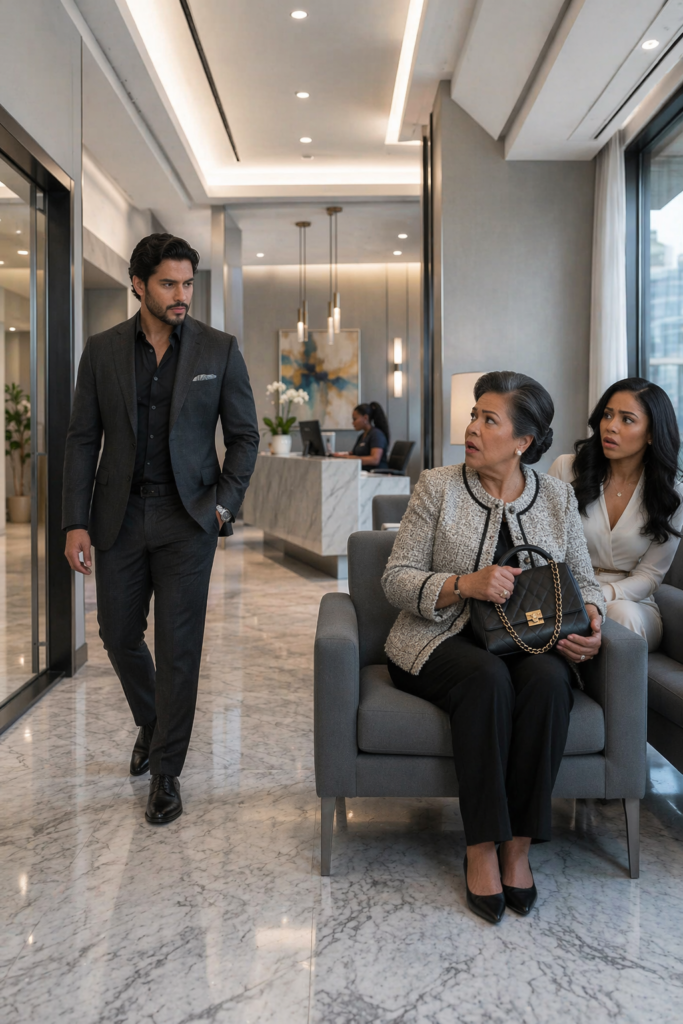
Eight months later, on a Wednesday at 11:35 AM, the receptionist at the Polanco clinic called Diego's office.
—Doctor Miramontes, there’s a patient referred for arrhythmia. She didn’t have an appointment, but she’s very scared. She says her name is Leonor Arriaga.
Diego froze.
He looked out the window. Below, the avenue continued with its noise of horns, hurry, and life.
—Let her in —he said.
Leonor entered minutes later.
She no longer looked like the woman from family dinners, the one with sharp pearls and poisonous comments. She carried an envelope with studies, pale lips, and the tired dignity of someone who had to line up where she once mocked.
Seeing him in a white coat, in a spacious office, with diplomas, awards, and his name engraved on the door, something shattered in her face.
—I didn’t know you… —she began.
Diego pointed to the chair.
—Sit down, Mrs. Leonor. We’re going to review your electrocardiogram.
She obeyed.
There was no revenge.
There were no theatrical phrases.
Diego studied the trace with absolute seriousness. He explained the risks, ordered a 24-hour Holter, adjusted medications, and referred her to the best electrophysiologist on his team.
Leonor looked at him as if she were finally seeing the man she had faced for ten years.
When it was over, she stood by the door.
—You’re very good —she said, her voice breaking.
Diego signed the medical order.
—I know.
She lowered her gaze.
—I was very unfair.
He held silence for a few seconds.
He wasn’t looking for an elegant response. He was looking inside himself and discovered that resentment no longer lived there. Only distance remained.
—Your heart needs attention, Mrs. Leonor —he said—. Not pride.
She cried silently.
She didn’t ask for forgiveness with grand speeches. There were no family members watching, no long table, no Abril sitting beside her.
Just a woman defeated by evidence and a man who no longer needed to prove anything.
That night, Diego returned home. Elisa was in the patio, checking the freshly pruned bougainvilleas. On the table were two cups of coffee and a notebook with ideas to expand his grandmother’s scholarship.
—Rough day? —she asked.
Diego sat beside her.
—Strange day.
—Do you want to talk?
He looked at the fountain, the white walls, the soft light falling on the pots. He thought about Abril, about Mauricio, about Leonor, about the letter on the counter, about the 1,040,000 pesos, about the mediation, and about his grandmother Consuelo telling him that the heart doesn’t lie.
He thought about everything he had lost.
And about everything he had regained when he stopped begging for respect.
—I attended to my ex-mother-in-law —he said.
Elisa didn’t make it morbid or ask uncomfortable questions. She just placed her hand over his.
—And how did you feel?
Diego took time to answer.
Then he breathed as he hadn’t in years.
—Light.
That night they had dinner in the patio. There was no dramatic music or exaggerated promises. Just coffee, sweet bread, and a tranquility that didn’t need witnesses.
Diego then understood that justice doesn’t always arrive with shouts or applause.
Sometimes it comes when the one who called you insignificant has to sit across from you, with fear in her chest, and you discover that you no longer need to humiliate her to know your worth.





