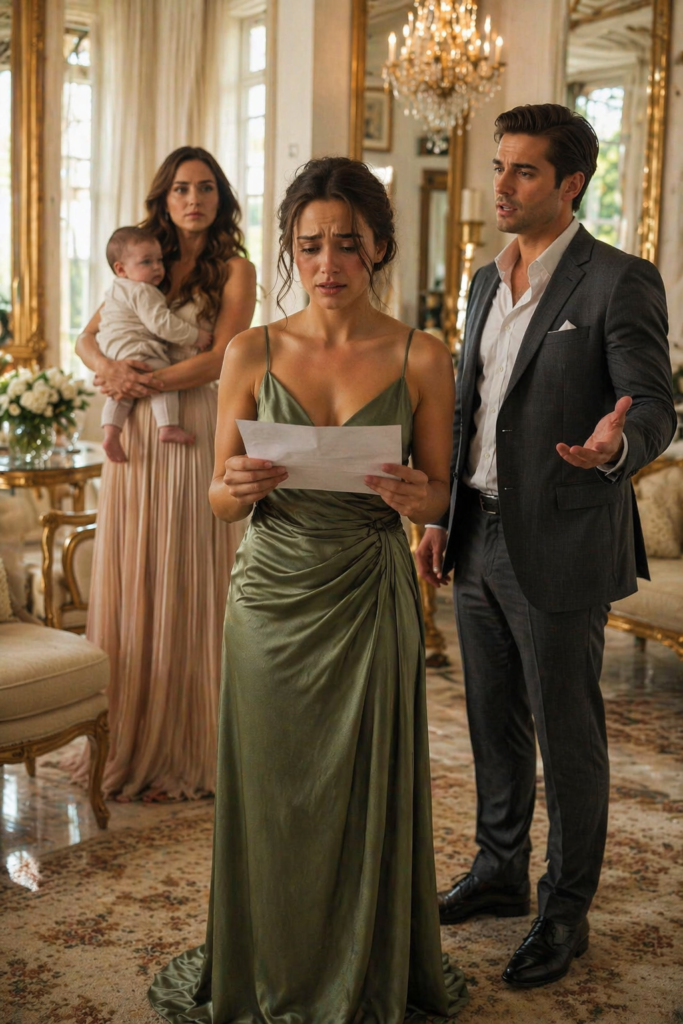
PART 1
Two weeks before her wedding, Camila found her fiancé sitting in the living room of the apartment she had paid for with double shifts, eternal dark circles, and years of not buying herself a single pair of expensive shoes.
The wedding dress hung on the closet door.
The ivory invitations still lay on the table, freshly printed, with both of their last names shining as if that wedding still meant something pure.
Alejandro Del Valle didn’t look guilty.
He looked annoyed.
As if Camila, an emergency doctor, was being too intense for not understanding something "simple."
—It’s not a betrayal —he said, adjusting his watch—. It’s a medical procedure. Fernanda wants to be a mom before her illness worsens.
Camila let out a dry laugh.
—Are you asking for permission to have a child with your best friend?
—Through assisted reproduction.
—And you think that makes it less humiliating?
Alejandro clenched his jaw.
—Fernanda has leukemia. She might have a year left. Her dream has always been to have a baby.
Camila felt the floor shift beneath her.
Not because Fernanda was sick.
But because she had heard that phrase too many times.
Fernanda was “the good one.” “The delicate one.” “The one who saved Alejandro.” The refined girl from Las Lomas whom doña Mercedes, his mother, adored as if she were already part of the family.
Camila came from Iztapalapa.
Her mom sold tamales starting at 5 a.m., and her dad had been a minibus driver. She had studied medicine with scholarships, sleepless nights, and a stubbornness that the Del Valle family found almost disrespectful.
Doña Mercedes never called her doctor.
She always said “the little girl.”
Five years ago, Alejandro had an accident on the Mexico-Cuernavaca road. His truck was crushed against a guardrail after dodging a trailer.
Camila was behind, in a taxi, coming off a shift.
She was the one who ran.
She was the one who broke the glass with a rock.
She was the one who shoved half her body between hot metal to unbuckle him and pull him out before the engine caught fire.
She was also the one who lay on the asphalt, her belly torn inside and her hands covered in blood.
After two surgeries, she survived.
But the doctor told her she might never be able to get pregnant.
When she woke up, Alejandro was alive.
Fernanda sat next to her bed, crying with a hospital bracelet in hand.
Doña Mercedes had said:
—My son lives thanks to Fernanda.
And Camila, broken, in love, weak from so much pain, had no strength to fight the truth.
Now Alejandro looked at her as if she were cruel.
—You can’t have kids, Cami —he said softly—. Fernanda can, but she might not live to raise him. If you love me, you should be grateful that you can be part of that life.
Camila froze.
—Grateful?
—Don’t make it ugly.
—You want me to marry you while you’re expecting a baby with another woman and on top of that feel blessed?
He looked down.
That silence was worse than any insult.
That night, Camila reviewed contracts for the venue, flowers, church, banquet, and music. Everything was paid for with her money.
Alejandro had only put his last name.
At 2:43 a.m., she received a photo from an unknown number.
Fernanda appeared in front of a mirror, wearing Camila’s bridal veil.
Behind her, doña Mercedes adjusted the fabric as if she were her daughter.
The message read:
“There are women who lend their dress. Others keep the whole family.”
Camila felt nauseous.
The next morning, Alejandro acted as if nothing had happened. He asked her to choose between filet in pasilla chili sauce or mole poblano for dinner.
Then he stepped out onto the balcony to take a call.
—Yes, Mom, I already talked to her… she’s still sensitive… Fernanda can stay here after her appointment… of course the baby will be a Del Valle.
When he returned, Camila held a black folder that had fallen from his portfolio.
The first page had her name on it.
“Authorization for prenatal accompaniment and family recognition after marriage.”
Below was a signature resembling hers.
But it wasn’t hers.
Camila kept reading.
There was a clause about the apartment.
Another about child support.
Another about “moral responsibility of the future wife.”
And a date that chilled her blood.
The procedure wouldn’t start.
It had already started 9 weeks ago.
—Nine weeks ago, you were “closing a deal” in Monterrey —she said.
Alejandro paled.
Before he could respond, the doorbell rang.
Fernanda appeared at the door, one hand on her still flat belly, the veil folded over her arm, and a calm, poisonous smile.
—Sorry for coming like this —she whispered—. Doña Mercedes said tomorrow was the photo shoot. I thought Camila could lend me her place just for a bit.
Alejandro didn’t look at Camila.
He just said:
—She can wait.
PART 2
Camila did wait.
But not in the way they imagined.
She waited for Alejandro to step into the shower to photograph each page of the black folder: the false authorization, the receipt from a private clinic in Interlomas, the deposit made from doña Mercedes’s account, the clause about her apartment, and a handwritten note that read:
“After the wedding, use the baby to force her to accept.”
She stored everything in a hidden folder on her phone.
Her hands trembled so much that she had to sit on the kitchen floor to avoid falling.
A part of her still wanted to believe that Alejandro didn’t know everything.
That his mother had manipulated things.
That Fernanda was desperate because of the illness.
That maybe he, deep down, was still that man who brought her coffee at the hospital and waited outside the ER with tacos because he knew she hadn’t eaten.
That was the cruelest part of a long betrayal: the heart tried to save memories, even though reality was already screaming.
The next day, Camila didn’t go to the photo shoot.
Fernanda did.
She put on her veil, took the bouquet of white peonies Camila had chosen, and posed on Alejandro’s arm at a hacienda in Tepoztlán.
That night, she posted a story.
Only her hand over the belly was visible, Camila’s engagement ring on a table, and a glass of sparkling water.
The caption read:
“There are destinies that arrive even if they don’t have the right name.”
When Camila confronted him, Alejandro sighed as if he were talking to a foolish child.
—She’s sick, Cami.
—She’s wearing my veil.
—It’s just a photo. Don’t be dramatic.
—It’s my wedding.
—It will also be my child.
That phrase changed everything.
Because he no longer spoke of procedure.
He no longer spoke of help.
He no longer spoke of last wishes.
He spoke of his child.
That night, Fernanda stayed at the apartment because she “felt weak.” Doña Mercedes arrived with chicken broth, a beige suitcase, and an expensive pharmacy bag.
She entered the guest room as if it were hers.
—Camila —she said, while arranging a blanket on the bed—, in this family, smart women know when to step aside.
—And what do fiancées learn?
Doña Mercedes smiled with fine pity.
—Not to get confused. A wedding doesn’t make you a Del Valle.
Camila didn’t respond.
Not because she had no words.
But because it still hurt to accept that she had begged for love in a house where she was only tolerated.
On the third day, the humiliation became public.
They were going to a medical appointment for Fernanda. She sat in the front seat, where Camila always went.
As soon as they closed the car door, Fernanda began to cough.
—Your perfume —she murmured—. It burns my throat.
Camila wasn’t even wearing perfume. She had just come off a 24-hour shift, with her hair tied back, her lab coat folded in a bag, and a pale, tired face.
Alejandro slammed on the brakes in the middle of Insurgentes Avenue.
—What are you wearing?
—Nothing.
—Fernanda can’t be exposed.
—I’m not wearing perfume, Alejandro.
—Get out.
Camila looked at him, believing she had misheard.
—What?
—Get out. She and the baby are the priority.
Fernanda touched Alejandro’s arm with false sweetness.
—Don’t blame her, Santi… sorry, Ale. She probably doesn’t understand how delicate it is to carry a life.
Camila got out, heels in hand.
She walked eight blocks before managing to get a taxi.
For the first time in five years, she didn’t answer Alejandro’s calls.
At the hospital, Fernanda began to appear in her hallways.
She asked for water.
She asked for pillows.
She asked Camila to review her tests.
She said in front of nurses and residents:
—Ale trusts her so much. He says that even though I can’t be a mom, she’s a good doctor.
That phrase ran through the hallway like poison.
Camila swallowed and kept working.
Until one morning, Fernanda followed her to the emergency stairs.
She pulled a red hospital bracelet from her bag.
Old.
Folded.
With Camila’s name written halfway.
Camila felt the air cut off.
It was the bracelet she wore the night of the accident.
—Where did you get that?
Fernanda smiled.
—There are women who lose more than a man and don’t even realize it.
Camila took a step toward her.
Fernanda let herself fall down three steps.
The scream filled the hallway.
Alejandro appeared with two nurses and saw Fernanda on the ground, clutching her belly.
—Did you push her? —he roared.
—I didn’t touch her.
—You’re sick with jealousy.
—Check the cameras.
Alejandro looked at her with disdain.
—A girl from Iztapalapa should be grateful that someone like me wanted to make her his wife.
Camila didn’t cry.
She didn’t scream.
She just felt something inside her close forever.
That afternoon, she went to security to request the video. The chief refused, saying he needed authorization.
But Lupita, an older nurse who had known Camila since her residency, caught up with her in the old archive.
—Doctor, I saw how she fell on her own —she whispered—. And I also know what happened five years ago.
She handed her a manila envelope.
Inside were copies of Fernanda’s lab results.
Stable markers.
Treatment suspended due to remission.
No relapse data.
There was also a private ultrasound: 9-week pregnancy.
No recent fertilization.
No last wish.
No imminent agony.
There was a perfect lie.
Inside the envelope was also a USB drive.
Camila connected it to her office computer.
First, Fernanda’s voice could be heard:
—What if she finds out the baby wasn’t through treatment?
Then, doña Mercedes’s voice, calm, elegant, monstrous:
—She won’t discover anything. My son has her domesticated. Besides, as long as she keeps believing that you saved him, she’ll never choose that woman.
Fernanda laughed quietly.
—Poor Camila. She lost even the possibility of being a mother for saving him from that car, and still couldn’t earn the last name.
Camila listened to the audio four times.
Not out of doubt.
But out of mourning.
Because there were truths that hurt so much that the body needed to repeat them to accept them.
Lupita told her what she had kept silent for years.
The night of the accident, Camila arrived first. Camila pulled Alejandro from the car. Camila lay unconscious by the roadside.
Fernanda arrived almost 40 minutes later, in doña Mercedes’s truck.
When Alejandro woke up, his mother had already changed the story.
Fernanda cried next to his bed.
Camila’s red bracelet disappeared.
Her file ended up in the wrong archive.
Doña Mercedes couldn’t stand that her son owed his life to a poor doctor from Iztapalapa.
She preferred to invent a heroine from her own circle.
The next morning, Camila sought a lawyer recommended by a supervisor at the hospital.
She delivered copies of the black folder, the video of the stairs, the ultrasound, the labs, the audio, and the forged documents.
She also canceled the wedding.
The church.
The venue.
The flowers.
The banquet.
The mariachi.
Everything.
She paid the penalty with the money she had saved for the honeymoon.
The wedding had been canceled for six days when Alejandro discovered it.
Camila let him arrive at the San Ángel venue dressed in a suit, with doña Mercedes on his arm and Fernanda behind, wearing a simple white dress under a pale pink coat.
The receptionist repeated three times that there was no event.
—Doctor Camila Robles formally canceled the reservation and left a letter for Mr. Del Valle.
The letter had one single sentence:
“Now they can give my place without asking.”
Camila’s phone began to vibrate.
Alejandro called 21 times.
Doña Mercedes 9.
Fernanda sent a message:
“You don’t know who you’re messing with, loser.”
Camila was already in a taxi headed to the airport, with two suitcases, her passport, and the red bracelet in a transparent bag.
She answered when her flight to Madrid was announced, where she would finally accept a research position she had rejected three times for Alejandro.
—What did you do? —he shouted—. Where are you?
—I put an end to what you started.
—Camila, we can talk. My mom got too involved. Fernanda manipulated me. I didn’t know everything.
—You knew enough to humiliate me.
He breathed heavily.
—I love you.
—No. You loved having a woman who would tolerate everything to avoid losing you. That’s not love, Alejandro. That’s comfort.
Then Camila sent the files.
First, the video of Fernanda falling on her own.
Then the 9-week ultrasound.
After that, the labs.
Then the audio of doña Mercedes.
Finally, a copy of the original accident file, which stated:
“Female patient with severe abdominal trauma after extraction of male trapped in crashed vehicle.”
There was a long silence.
When Alejandro spoke, his voice was no longer angry.
It was fearful.
—Camila… you were the one who saved me.
—Yes.
—Why didn’t you ever tell me?
—Because I thought one day you would see me without me having to beg.
He started to cry.
—Forgive me. Please. Tell me where you are.
Camila looked at the boarding gate.
—I’m not sending this for you to thank me. I’m sending it so you’ll never again say that a woman like me should be grateful that a man like you chose her.
Then she hung up.
The scandal fell on the Del Valle family like a storm on a tin roof.
The hospital opened an investigation for altering records.
The private clinic was flagged for irregular documents.
Fernanda was exposed for faking a severity she didn’t have.
Doña Mercedes lost a huge contract when the audio circulated among partners who had previously greeted her with reverence.
Alejandro tried to defend himself, but no one believed too much in a man who had arrived at his own wedding with another woman dressed in white.
Months later, he traveled to Madrid.
Camila saw him from the university hospital entrance, under the rain, with a twisted bouquet of flowers and the face of someone who had finally understood too late.
She didn’t go out.
She asked the guard to deliver an envelope.
Inside was the red bracelet and a note:
“This was proof that I saved you. Today I return it because I no longer need to prove anything to anyone.”
Camila continued to bear her scar.
Sometimes it hurt in the cold.
Sometimes she touched it before putting on her lab coat.
But she no longer hid it.
Because that mark not only reminded her of the night she saved a man who later betrayed her.
It also reminded her of the day a woman stopped begging for a last name and reclaimed her entire life.
And in Mexico, where so many people still believe a woman must endure for love, Camila’s story left an uncomfortable question:
How many weddings are celebrated just because someone was afraid to leave in time?





