PART 1
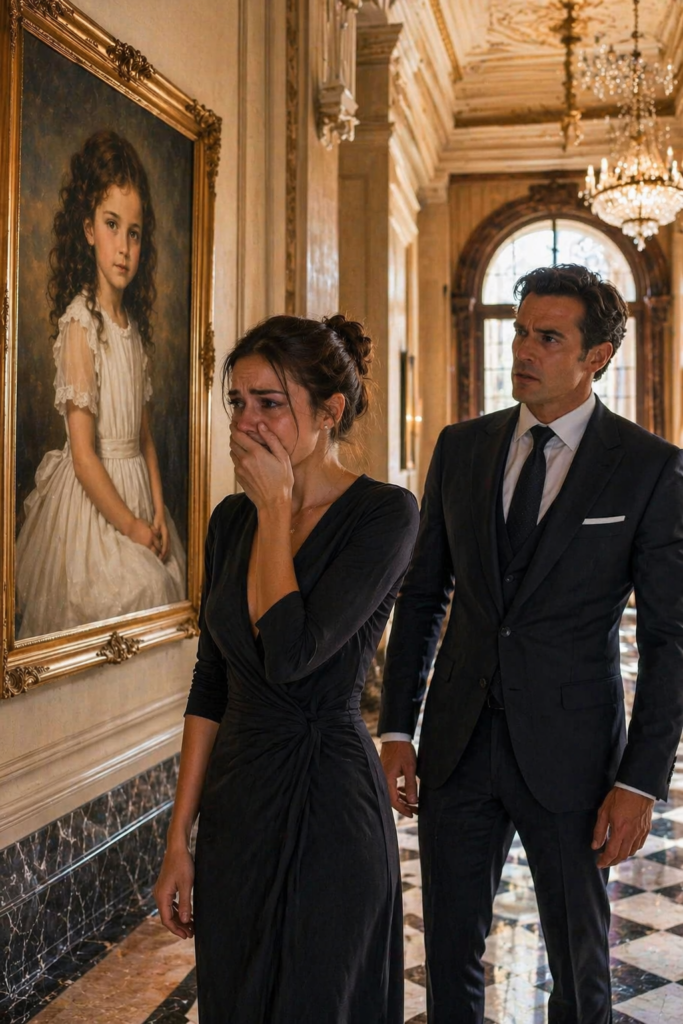
For 28 years, Víctor Arriaga left the portrait of his younger sister untouched in the main hallway of the family mansion in Lomas de Chapultepec.
Not because he believed in miracles.
Víctor believed in contracts, audits, notarized signatures, and numbers lining up. He was the owner of Grupo Arriaga, a company involved in construction, hotels, transportation, and technology. In magazines, they called him 'the lonely king of Mexico City.'
But in his house, in front of that painting, he remained a 14-year-old boy who couldn’t protect Mariana.
Mariana Arriaga had disappeared when she was 6 years old, on a Sunday afternoon in Chapultepec Park. The nanny said she just got distracted buying her a popsicle.
Just 1 minute.
After that, nothing.
No ransom call, no body, no reliable witnesses. Just a girl in a white dress, storm-colored eyes, and dark curls, erased from the world as if someone had turned off the light.
Their parents died without knowing the truth. Víctor inherited the house, the fortune, and the guilt.
That’s why no one touched the portrait.
Until Isabel Cruz arrived.
She was 25 years old, came from Morelia, and was hired as a maid to clean the east wing of the mansion. Doña Rosa, the housekeeper, said she was quiet, hardworking, and very respectful.
Víctor barely glanced at her when she was introduced.
—Discretion and punctuality —he said, without lifting his gaze much.
—You will have them, Mr. Arriaga —Isabel replied.
But from the very first day, Doña Rosa noticed something strange.
Isabel cleaned the furniture, changed flowers, dusted frames, and walked through the hallways as if she recognized ancient sounds. She didn’t seem curious. She seemed nervous.
And she always stopped in front of the portrait of Mariana.
First for 1 minute.
Then 5.
Later, one afternoon, Doña Rosa found her crying in front of the painting.
—Did you know her? —the elderly woman asked, suspicious.
Isabel quickly wiped her tears.
—No, ma’am. It just… felt familiar.
The answer didn’t convince anyone.
That same night, Víctor woke up at 2:17 in the morning. He didn’t know why, but he walked to the main hallway.
The mansion was silent. Outside, the city sparkled behind the windows. Inside, Mariana smiled from the portrait as if she still waited for someone to come for her.
Víctor stood staring at the painting.
Then he heard a voice behind him.
—Sometimes the dead aren’t dead. Sometimes no one just believed them.
Víctor turned sharply.
Isabel stood at the end of the hallway, in a simple robe and loose hair. She looked scared, but not remorseful.
—What do you know about my sister? —Víctor asked.
Isabel lowered her gaze.
—I’m not sure you will believe me.
—Try me.
She took a deep breath, looked at the portrait, and her voice broke.
—That girl didn’t die, Mr. Arriaga. She lived with me in the Santa Lucía Home. Only there, she wasn’t called Mariana… they called her Lucía.
Víctor felt the floor disappear beneath his feet.
PART 2
For several seconds, Víctor couldn’t speak.
The whole house seemed to run out of air. The portrait remained there, with the same innocent smile, but now it no longer seemed like a memory.
It seemed like an accusation.
—Repeat what you said —he ordered, in a low voice.
Isabel swallowed hard.
—The girl in the portrait lived with me in an orphanage in Michoacán. She arrived when I was 7 years old. She said her real name wasn’t Lucía. She said she had a brother, a huge house, a garden with bougainvilleas, and a white piano.
Víctor clenched his fists.
—Anyone could have read that in an old note.
—Not this —Isabel said, trembling—. She said her brother called her 'my little rain mermaid' because once, after a downpour, she said the water sang in the fountains.
Víctor froze.
That nickname had never appeared in newspapers. He had never said it in front of employees. It was a child’s secret, something Mariana invented when she was 5 years old.
Víctor had to lean against the wall.
—Come to my office.
Isabel walked behind him like someone entering a trial.
In the office, Víctor closed the door. Doña Rosa remained outside, praying softly, for she had seen that man break in silence for over 20 years.
Isabel told everything.
Mariana arrived at the Santa Lucía Home with false documents. The papers said 'Lucía Salinas,' approximate age 7 years, parents deceased in a car accident, no living relatives.
A stylish woman brought her in, with dark glasses, strong perfume, and a golden butterfly brooch.
Víctor dropped a glass.
The crystal shattered against the floor.
His Aunt Amalia Arriaga always wore a golden butterfly brooch. It was her favorite piece of jewelry. She said it had belonged to their grandmother.
Amalia had been his father’s younger sister. The woman who consoled the family during the search. The one who organized masses, interviews, donations, and foundations for missing children.
The same one who, after their parents' death, joined the board of Grupo Arriaga and gained power as if tragedy had opened the door for her.
—No —murmured Víctor—. That can’t be.
Isabel pulled something from the lining of her bag.
It was a yellowed piece of paper, carefully folded.
—Mariana gave me this before she escaped from the orphanage. She told me if I ever found her family, to give it to her brother.
Víctor took the paper with trembling hands.
It was a childish drawing.
Two children holding hands in front of a piano. Behind them, a large house with bougainvilleas. In one corner, a woman with a butterfly on her chest.
Below, in clumsy handwriting, it said:
'Mariana and Víctor. For when I come back home.'
Víctor didn’t cry immediately.
First, he stood still.
Then he sat down as if 28 years of strength had been taken from him in one blow.
—Where is she? —he asked.
Isabel lowered her head.
—I don’t know. She escaped at 14. She said she saw the woman with the butterfly again, taking another child to the home. She got very scared. That night, she disappeared.
Víctor stood up.
The cold, calculating businessman, respected by politicians and bankers, returned in a flash. But now, he was not driven by money.
He was driven by rage.
At 7 in the morning, Víctor called Santiago Duarte, a retired private investigator from the Prosecutor's Office. A dry, distrustful man, one of those who don’t get excited by pretty stories until they see proof.
—I need records from the Santa Lucía Home. I need files, photos, names, donations, transfers. And I need to review everything related to my Aunt Amalia.
Santiago didn’t ask much.
—Is this family or criminal?
Víctor glanced at the drawing.
—Both.
That same day, they traveled to Michoacán.
Isabel sat in the back seat, silent. For her, returning to the Santa Lucía Home was stepping on a past full of cold beds, obligatory prayers, and girls who learned too early not to ask for affection.
For Víctor, it was worse.
Every kilometer showed him the life Mariana could have lived while he searched for her in the wrong places.
The orphanage still stood, although older. White walls, green gate, a yard with rusty swings, and a Virgin of Guadalupe at the entrance.
The current director, Sister Elena, received them cautiously.
—The files are confidential —she said.
Víctor placed an original photo of Mariana on the table.
Sister Elena paled.
—My God.
Santiago requested the old records.
In a cardboard box appeared the name: Lucía Salinas.
Date of entry: 1998.
Responsible person for the transfer: Amalia Arriaga de Montes.
Identity document: incomplete.
Death certificate of parents: false.
Víctor read each line as if nails were being buried in his chest.
Sister Elena began to cry.
—We didn’t know. Mrs. Amalia was a benefactor. She paid scholarships, medicines, renovations. No one dared to question her.
—My sister said she had family —Víctor said.
—Many children invent stories to survive.
—She wasn’t inventing. They were erasing her.
No one answered.
Before leaving, an elderly nun asked to see them. Her name was Sister Inés, and she had worked at the home when Mariana was a child.
She was in a wheelchair, but her eyes remained clear.
When she saw Isabel, she smiled sadly.
—I knew you would come back, dear.
Isabel knelt beside her.
—I brought Lucía’s brother.
Sister Inés looked at Víctor and placed her hand on her chest.
—He has the same eyes.
Víctor leaned in.
—Please, tell me what happened to her.
The elderly woman breathed heavily.
—Lucía never believed she had been abandoned. Everyone told her to accept her new life, but she drew the same house over and over. A piano, a garden, a tall boy. And a woman with a butterfly.
—Do you know where she went after escaping?
Sister Inés closed her eyes.
—Years later, I heard of a young woman interned in a clinic near Veracruz. They found her walking on the beach, disoriented, saying she had to return to the place where the sea sang.
Víctor lifted his gaze.
Veracruz.
When they were children, the family had a house near Costa Esmeralda. Mariana loved a rocky area where the wind made the empty shells whistle. She said the sea sang there.
Sister Inés asked them to bring a small box.
Inside was a silver pendant in the shape of a shell.
Víctor gasped.
—I gave it to her on her 6th birthday.
There was also a note.
'On the day the sea sings, my brother will find me.'
That phrase destroyed whatever little calm remained in him.
But the hardest blow came when Santiago reviewed the donation files.
Amalia had not only taken Mariana.
She had used her foundation for years to move children with false identities. Some were given in irregular adoptions. Others disappeared from the records.
—This wasn’t just a family revenge —Santiago said—. It was a network.
Isabel covered her mouth.
Víctor looked at his aunt's name on the papers.
—So we’re not just going to find Mariana. We’re going to expose it all.
They didn’t know that, at that moment, a call had already been made from the orphanage office.
Amalia Arriaga, now 72, received the news in her Polanco apartment. She looked impeccable, with her gray hair slicked back and the butterfly brooch shining on her jacket.
—Veracruz? —she said, without altering her voice—. Then she’s still alive.
And she hung up.
The trip to the coast was long and tense.
Víctor didn’t sleep. He stared out the window as if he could recover the lost years with sheer will. Isabel also kept her eyes open. She held Mariana's drawing on her lap, protecting it as if it were a child.
At dawn, they arrived at a town near the sea.
They asked in workshops, diners, galleries, and markets.
At first, no one knew anything.
Until an old fisherman, sitting next to some nets, heard the name 'Lucía' and then the description of her eyes.
—Ah, you’re looking for the painter —he said—. She lives down the rock path. She hardly speaks to anyone. She signs her paintings as 'M. Lluvia.'
Víctor felt a blow to his chest.
M. for Mariana.
Lluvia for the nickname.
They walked along a narrow path, between palm trees, wet stones, and wildflowers. The wind passed through the shells embedded in the rocks and made a soft sound, like a lament.
The sea sang.
At the end of the path was a blue cottage with a tin roof. Brushes were drying on the porch. Several paintings always showed the same thing: two children in front of a piano, a large house, and a girl looking at the sea.
Víctor climbed three steps.
He knocked on the door.
Eternity stretched for seconds.
Then footsteps were heard.
A woman opened.
She looked about 35. Her dark hair had some gray. Her skin was marked by the sun and a hard life. But the eyes were impossible to confuse.
Storm-colored.
Mariana-colored.
Víctor tried to speak, but he couldn’t.
The woman looked at him first with fear. Then with doubt. Then with a pain so ancient it seemed to rise from her soul.
He barely managed to whisper:
—My little rain mermaid.
The woman brought her hand to her mouth.
—Víctor?
He embraced her before she fell.
Mariana cried like a girl who had waited 28 years for someone to arrive. Víctor held her tightly, repeating:
—I’m sorry. I searched for you. I swear I searched for you.
Isabel cried silently by the door.
When Mariana saw her, she let out another sob.
—Isa…
They embraced like sisters.
Inside the house, Mariana recounted what she remembered.
The popsicle in Chapultepec. The distracted nanny. An elegant woman who said her mother was sick. The sweet perfume. The butterfly brooch. A black car. A lot of sleep.
Then the orphanage.
The new identity.
The nuns telling her her memories were fantasies.
The years drawing her house to not go crazy.
At 14, she saw Amalia again entering the home with a scared boy. She knew that if she stayed, she would disappear forever. She escaped, lived with artisans, learned to paint, and ended up in Veracruz, near the only place she still felt was hers.
—I went to the mansion twice —Mariana confessed—. But both times I saw Amalia enter. I thought you were with her too. I thought no one would believe me.
Víctor closed his eyes.
That was the cruelest part.
Not only had they stolen his sister. They had also stolen her trust to return.
Santiago, who had been watching from the window, tensed up.
—We have visitors.
A black car stopped at the beginning of the path.
Amalia Arriaga descended calmly, as if arriving at a family meal. She wore dark glasses, a beige jacket, and the golden butterfly shining on her chest.
Mariana turned pale.
Víctor positioned himself in front of her.
—You’re not taking her away again.
Amalia ascended the path slowly.
—Víctor, dear. What a melodramatic scene.
—It’s over —he said.
The elderly woman looked at Mariana.
—Lucía.
—My name is Mariana —she replied, trembling—. You took it from me, but you couldn’t kill it.
Amalia barely smiled.
—I gave you a life.
—You gave me fear, hunger, and years believing I was crazy.
Víctor stepped forward.
—Why?
For the first time, Amalia lost a bit of her mask.
—Because your father never let me occupy the place I deserved. Everything was for his heir. Everything for the son. When Mariana disappeared, the family broke. Your father needed help. I became indispensable.
—You destroyed a girl to gain power.
—Power is never given, Víctor. It is taken.
Isabel, with rage in her voice, asked:
—And the other children?
Amalia looked at her with disdain.
—Girl, don’t talk about things you don’t understand.
Santiago lifted a folder.
—We understand quite a bit. False documents, accounts abroad, illegal adoptions, and testimonies from the Santa Lucía Home.
Amalia looked at Víctor.
—We can settle this. I’ll give you my shares. I’ll leave the country. You protect the Arriaga name, and everyone will be calm.
Víctor looked at her as if finally seeing the complete monster.
For years, he believed the name was all he had left.
Now he understood that a name without truth was just an expensive facade.
—No.
Amalia blinked.
—Think it over. The scandal will destroy what you’ve built.
—What I built on top of a lie deserves to tremble.
Mariana stepped forward.
—I hated you for many years. I dreamed of seeing you pay. But now I look at you and only see a woman who traded love for control… and was left without either.
Amalia wanted to respond, but she couldn’t.
Minutes later, the authorities arrived. Santiago had already sent copies of everything. Amalia tried to get into the car, but two agents blocked her way.
The golden butterfly fell to the ground when they handcuffed her.
Mariana didn’t smile.
She only cried.
Justice didn’t return childhood.
It didn’t erase nights of fear.
It didn’t rebuild the parents who died waiting.
But for the first time, the truth had a name, documents, and witnesses.
Months later, the mansion in Lomas de Chapultepec opened the east wing as a support center for people separated from their families due to illegal adoptions. Víctor financed lawyers, psychologists, and searches. Mariana painted murals on the walls. Isabel stayed on as coordinator.
Not all endings were happy.
Some adults didn’t want to reopen wounds. Some families no longer existed. Some truths came too late.
But others arrived right on time.
One afternoon, Víctor placed the old drawing from the orphanage next to Mariana’s portrait.
Two children in front of a piano.
A house.
A garden.
A childhood promise that survived fear.
When someone asked about that yellowed sheet, Víctor always said:
—That drawing brought my sister back.
Mariana corrected him with a gentle smile.
—No. Isabel did.
Isabel shook her head.
—I just believed what everyone called a lie.
And perhaps that was the part that hurt the most for those who listened to the story.
Because sometimes a family doesn’t break from a lack of love, but because someone powerful decides that their ambition is worth more than a child’s life.
And because there are truths that survive even if buried in orphanages, false files, and old portraits.
They survive in a nickname.
In a folded sheet.
In a maid who looks at a painting and dares to say what no one wanted to hear.
'That girl didn’t die.'
'That girl was stolen.'
'And she was still waiting to return home.'





