PART 1
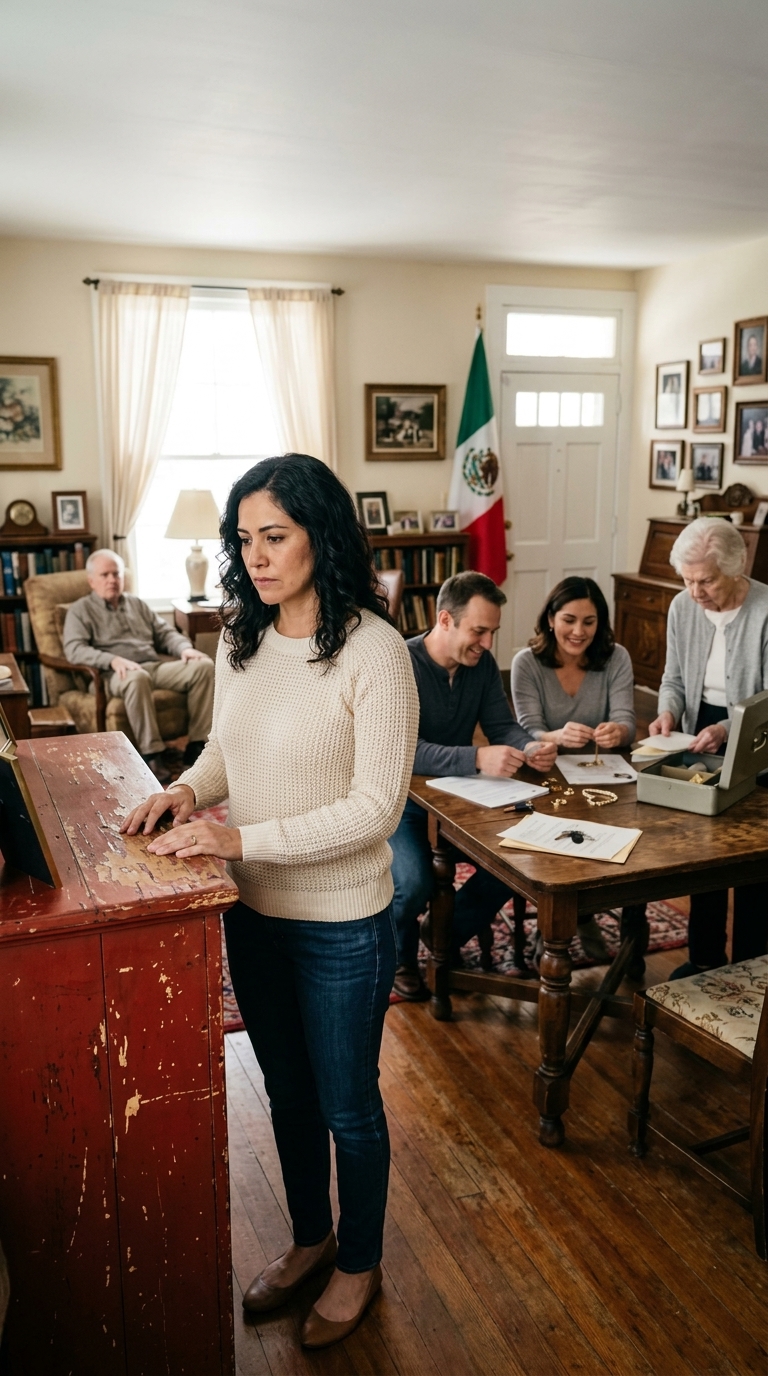
Forty days after burying Don Ernesto, the Rivas family gathered at the house in Naucalpan to divide what he had left behind.
The room smelled of reheated coffee, wilted flowers, and old resentments.
On the table sat a metal box filled with papers, bank books, the keys to the truck, and the gold bracelets that had belonged to Grandma Rosario.
Valeria, the youngest daughter, sat by the window.
No one asked how she was doing.
No one offered her coffee.
No one mentioned that she had spent 73 nights sleeping in a hard chair at the General Hospital, using a jacket as a pillow, listening to her father's labored breathing behind a blue curtain.
For those 73 days, she called her brother Miguel over and over again.
Miguel was always in a meeting, stuck in traffic, with clients, busy with errands.
She also called Sara, her older sister.
Sara claimed she had no one to watch the kids, even though everyone knew her mother-in-law lived just two blocks away.
In the end, Don Ernesto no longer spoke.
He just squeezed Valeria's hand and stared at the door.
He was waiting for them to arrive.
They never did.
When he died, Doña Teresa, their mother, first called Miguel.
He didn’t ask what time the wake would be.
He asked who was going to pay.
Sara didn’t contribute a cent.
Valeria paid for the coffin, the mass, the food, the plot in the cemetery, and all the paperwork.
It totaled $4,500, taken from her savings.
She wrote it all down in a little notebook.
Not to charge them.
She noted it because she knew that someday they would act as if nothing had happened.
That day came sooner than she imagined.
Doña Teresa opened the metal box with a cold calm.
Miguel sat with his wife, Karina, arms crossed as if he already owned the house.
Sara was next to her husband, looking at her phone and smiling every time their mother pulled out a paper.
“Your brother has a mortgage on his place,” Doña Teresa said. “The house should go to Miguel.”
Just like that.
The three-bedroom house.
The yard where Don Ernesto had planted lemons.
The garage where he fixed old radios on Sundays.
The house he had paid for over decades.
Miguel nodded without shame.
Then Doña Teresa pushed the title for the Tahoe truck towards Sara.
“You need space for the kids.”
Sara smiled like a child at a fair with a new toy.
Then she distributed the notebooks.
$1,500 for Miguel.
$2,500 for Sara.
And the gold bracelets also ended up in Sara's hands, because even memories had favorites.
Valeria remained silent.
She watched how over $350,000 in assets passed from hand to hand without her name appearing even once.
Finally, Doña Teresa pointed to the corner.
“Well, you get that.”
In the corner stood Don Ernesto’s old wardrobe.
Dark red, chipped paint, with a broken leg propped up by a brick.
Karina let out a laugh.
“That’s not even good for firewood, seriously.”
Sara scrunched her nose as she looked up.
“I can’t fit that ugly thing in my house.”
Doña Teresa looked at Valeria with that familiar expression, the one that said, “Accept it and don’t make a scene.”
“You're the youngest,” she said. “Don’t be greedy.”
Greedy.
Valeria almost laughed.
Miguel had always been “the man of the house.”
Sara had always been “the princess.”
And Valeria had always been the one who needed to understand, yield, endure, and want less.
She stood up slowly.
Walked to the wardrobe.
Ran her fingers over the peeling paint.
This piece of furniture held her father's flannel shirts, tools, old papers, and boxes that no one ever checked.
She bent down and removed the brick.
The wardrobe creaked and leaned.
In that instant, Doña Teresa went pale.
It wasn’t anger.
It was fear.
Valeria saw it clearly.
Then she smiled calmly.
“Alright,” she said. “I’ll take the wardrobe.”
No one offered to help.
Only Uncle Armando, who had been quiet, stood up with difficulty.
The two of them carried the wardrobe out to the yard.
Doña Teresa followed them to the door, arms crossed and eyes fixed on the piece of furniture.
As if she expected Valeria to change her mind.
But Valeria didn’t.
Because sometimes what everyone scorns is the only thing worth having.
And sometimes the smallest inheritance holds the biggest secret.
PART 2
The wardrobe arrived that same afternoon at Valeria’s apartment in the Portales neighborhood, tied with ropes on a rented truck.
Getting it up to the third floor was a nightmare.
The neighbor from the second floor helped out of sheer pity, and Uncle Armando ended up sweating like he’d run a marathon.
When they finally set it down in the living room, the wardrobe stood crooked, just like in the family home.
Valeria stared at it for a long time.
It wasn’t pretty.
It didn’t match anything.
It smelled of old wood, dampness, and cheap cologne, the same one her father used on Sundays before going out for sweet bread.
Uncle Armando stood in front of the furniture.
“Your mom didn’t want you to take it,” he murmured.
Valeria swallowed hard.
“I saw it too.”
The uncle didn’t say more.
He just stepped closer, touched the base of the wardrobe, and frowned.
“Your dad was clever about hiding things. Once he kept the receipts for a debt in here so your mom wouldn’t throw them away.”
Valeria bent down.
She looked again at the broken leg.
The brick didn’t just prop up the furniture.
It also concealed a different, newer board, poorly painted red to disguise it.
With an old screwdriver, she began to pry it open.
The wood resisted.
Then it cracked.
Underneath appeared a narrow cavity.
Inside was a black plastic bag wrapped with brown tape.
Valeria felt her hands grow cold.
Uncle Armando crossed himself.
“No way,” he whispered.
Valeria tore the tape.
Inside, she found a yellow folder, two sealed envelopes, a USB drive, and a brown notebook.
The first envelope had her name written in Don Ernesto’s shaky handwriting.
“For Valeria. Only if they take the wardrobe.”
She covered her mouth.
Carefully, she opened the envelope.
The letter said that her father knew that when he died, they would leave her out.
It said it hurt him to accept it, but he had seen too many times how Miguel and Sara took without looking back.
It also mentioned that Doña Teresa had asked him to sign papers while he was sick, assuring him they were hospital procedures.
But he didn’t trust her.
That’s why he had asked his friend, Notary Gustavo Rangel, to prepare a formal will six months before he fell ill.
Valeria read the last line with blurred vision.
“Everything that truly belongs to me, I leave to the daughter who was there when I was fading away.”
Uncle Armando sat down suddenly.
In the folder was the will.
Signed.
Sealed.
With copies of identification, deed numbers, and notary data.
The house, the truck, the savings, and the bracelets weren’t for Miguel or Sara.
They were for Valeria.
But the hardest blow was in the brown notebook.
Don Ernesto had written dates, amounts, and names.
Miguel owed him money for the past eight years, over $20,000 for down payments, loans, and “emergencies” that were never paid back.
Sara had secretly sold Grandma Rosario’s jewelry and then cried, saying they had been lost.
And Doña Teresa had taken money from a joint account while Don Ernesto was hospitalized.
These weren’t rumors.
There were receipts.
Photos.
Printed screenshots.
And on the USB were audio recordings.
At first, Valeria didn’t want to listen to them.
She was afraid of confirming what her heart already knew.
But Uncle Armando placed the computer on the table and opened the first file.
Doña Teresa’s voice came through clear.
“Ernesto can’t hold on anymore. We need to move everything before Valeria gets involved. That girl always asks too many questions.”
Then Miguel’s voice could be heard.
“As long as she doesn’t find the will, it’s all good.”
Sara let out a nervous laugh.
“Well, let her keep the filthy wardrobe. That way she won’t complain.”
Valeria stood frozen.
She didn’t cry.
She didn’t scream.
She only felt something inside her, something she had held back since childhood, break forever.
The next day, she went to see Notary Rangel.
The notary was a serious, gray-haired man, one of those who never smiles for good measure.
When he saw the documents, he took a deep breath.
“Miss Valeria, your father came here several times. He was worried. He told me his family would try to erase his wishes.”
He also showed her a certified copy of the will.
“This is valid. What happened yesterday wasn’t a distribution. It was an abuse.”
Valeria left the notary’s office with a folder under her arm and a decision in her heart.
She wasn’t going to fight out of ambition.
She was going to fight because her father hadn’t died for them to betray him in his own living room.
The family meeting occurred a week later.
Doña Teresa thought Valeria was going to ask for money.
Miguel arrived angry, in a hurry.
Sara came wearing the bracelets.
Karina, Miguel’s wife, sat down as if she were watching a soap opera.
Valeria placed the red wardrobe in the middle of the living room.
She had brought it back in the same rented truck.
Everyone mocked her.
“Now what?” Miguel said. “Are you going to show off your trash?”
Valeria set the yellow folder on the table.
Then she placed the USB drive.
Next, she pulled out Don Ernesto’s letter.
Doña Teresa stood up immediately.
“Where did you get that?”
Valeria stared at her without blinking.
“From the wardrobe you left me because, according to you, it was worthless.”
The room fell silent.
Uncle Armando closed the door.
Notary Rangel walked in behind him, wearing a gray suit and carrying a black briefcase.
Miguel paled.
Sara removed a bracelet without realizing it.
The notary spoke with a calmness that hurt more than a scream.
“Don Ernesto Rivas left a will. The principal heir is Valeria Rivas. Any attempt to conceal this document may have legal consequences.”
Doña Teresa wanted to laugh.
“That old man didn’t even know what he was signing.”
Valeria connected the USB to the TV.
Doña Teresa’s voice filled the room.
“We need to move everything before Valeria gets involved.”
Miguel lowered his head.
Sara started to cry, but not out of guilt.
She cried out of anger.
“You always play the victim!” she shouted. “Dad loved us too!”
Valeria pressed the letter against her chest.
“Yes, he loved you. That’s why he waited for you for 73 days.”
No one answered.
“He waited, looking at the door. Until the very last day.”
Miguel swallowed hard.
For the first time, he had no excuse.
Doña Teresa tried to snatch the folder away, but Uncle Armando stopped her.
“No, Teresa. That’s enough.”
That phrase fell like a sentence.
For years, no one had told her that.
That’s enough.
Valeria requested the legal transfer of the house, the truck, the notebooks, and the remaining jewelry.
She also submitted the notebook of funeral expenses.
She didn’t demand payment for taking care of her father.
That had no price.
But she did demand they stop lying.
Miguel had to sign an agreement to return the keys and acknowledge the debt.
Sara returned the bracelets, although one was already scratched inside, as if she had tried to erase Grandma Rosario’s initials.
Doña Teresa didn’t apologize.
She only said:
“Your father humiliated me.”
Valeria shook her head.
“No, Mom. Dad just wrote the truth. You humiliated yourselves.”
The legal process took months.
There were screams, lawyers, venom-filled messages, and family members interfering where they weren’t invited.
Some said Valeria was cruel for leaving her mother without control of the house.
Others said someone had finally set limits.
In Mexico, family weighs heavily.
But sometimes it weighs like a stone on the chest.
Valeria didn’t sell the house.
She fixed it up.
She painted the façade, cleaned the yard, and planted another lemon tree where her father always wanted.
She converted the master bedroom into a small workshop for fixing old radios, with a photo of Don Ernesto on the wall.
And the red wardrobe remained in the living room.
She didn’t fully restore it.
She left some parts peeling.
She left the crooked leg.
She left the mark of the brick.
Because she didn’t want to forget how injustice looked when it came disguised as inheritance.
One Sunday, Miguel came knocking.
He came alone, without Karina, with sunken eyes.
He asked to see the workshop.
Valeria let him in, but she didn’t hug him.
He looked at the photo of their father and broke down.
“I thought I still had time,” he said.
Valeria replied softly:
“Everyone thought that. Except him.”
Sara never returned.
She sent a message months later saying Valeria had destroyed the family.
Valeria read it once and deleted it.
Because she understood something that no one taught her as a child:
a family isn’t destroyed when someone tells the truth.
It’s destroyed when everyone gets used to keeping it quiet.
Doña Teresa ended up living with Sara.
Sometimes she called Valeria, but never to apologize.
She asked about the house.
About the bracelets.
About the papers.
Valeria answered respectfully, but without opening doors that had slammed shut too many times.
On the day that marked one year since Don Ernesto's death, Valeria made a simple meal.
Mole, red rice, warm tortillas, and sweet bread that he liked.
She invited Uncle Armando, the neighbor who helped carry the wardrobe, and the nurse who gave her coffee at the hospital on so many nights.
There were no long speeches.
Just beautiful silence.
The kind that doesn’t demand pretense.
At the end, Valeria placed her father’s letter inside the red wardrobe, in the same cavity where she had found it.
Not as a secret.
As a memory.
Because that broken piece of furniture had given her more than an inheritance.
It had returned her dignity.
And left an uncomfortable question for anyone who read her story:
Does blood make family, or is family proven when no one is watching and there’s nothing to gain?





