PART 1
Laura Mendoza returned from Monterrey on a Friday afternoon, exhausted, with her suitcase in hand and guilt lodged in her chest.
She had left her twelve-year-old daughter, Ximena, with her parents in Querétaro because they insisted.
"Let us spoil her a bit," said Doña Marta, using that sweet voice she reserved to appear benevolent.
But as soon as Laura parked in front of the family home, she felt something was off.
Doña Marta came out first. Don Rogelio followed behind.
And in the back was Ximena.
She didn’t run to her mother.
She just hugged her dance backpack to her chest, her eyes downcast, her face pale.
"My love, I’m back," Laura said.
"She’s tired," Doña Marta said. "It was a hard week. You two go on; it’s going to get dark soon."
Don Rogelio added:
"Drive carefully."
That was it.
In the car, Ximena stared out the window without saying a word.
"How was it, sweetheart?"
"Fine."
The word came out dry.
"And your rehearsal on Sunday?"
Ximena tightened the strap of her backpack.
"I’m not going to dance anymore. I got kicked off the team."
"Why?"
Ximena swallowed hard.
"I don’t want to talk."
Laura didn’t press. Her daughter spoke about everything. If she was silent, it meant something hurt too much.
They arrived home. Laura made quesadillas, though neither felt hungry. Ximena barely took a bite.
Then Laura set down her plate.
"Xime, tell me what happened."
The girl broke down.
"My grandma said I’m a thief."
Laura froze.
"She said I stole Abril's shoes."
Abril was Patricia’s daughter, Laura’s younger sister. The favorite granddaughter. The princess who never made mistakes, she just “got confused.”
Ximena wiped her face with her sleeve.
"Before the competition, Abril couldn’t find her jazz shoes. She said I took them so she wouldn’t dance. I didn’t touch them, Mom. I swear."
Laura felt fire in her hands.
"And your grandparents?"
"They locked me in the guest room. They said I had to confess, that I was jealous, that I always wanted to look better than Abril."
"Then they went to school. They talked to the coordinator, the dance teacher, and the moms."
Laura stopped breathing.
"Did they find the shoes?"
"Yes. My grandma said they appeared in the hallway of her house. But she said that proved I hid them and then regretted it."
Ximena looked down.
"I got kicked off the team. Sofía didn’t invite me to her birthday. At school, they call me a thief."
Laura called her mother with trembling hands.
Doña Marta answered calmly.
"Hello, daughter."
"What did you do to my daughter?"
"We taught her respect."
"There was no evidence."
"Laura," her mother said. "Even if she didn’t steal, she needed a consequence. She was becoming arrogant."
Don Rogelio took the phone.
"We’ll handle it ourselves."
"No," said Laura. "You turned it into a lynching."
Doña Marta came back on the line.
"The family also corrects."
Laura hung up.
The kitchen fell silent.
Then she remembered her grandfather Aurelio’s old lawyer, the only adult who had always defended Ximena.
She took her phone again.
Her parents didn’t know yet, but that call was going to uncover something much worse than a pair of lost shoes.
PART 2
What hurt Laura the most wasn’t just the accusation.
It was recognizing the pattern.
In her family, there were invisible rules. Patricia could yell and they called her “passionate.” Laura voiced an opinion and they called her “conflictive.” Abril cried and everyone rushed to her. Ximena shone, and everyone asked her not to make her cousin feel bad.
When Ximena won the leading role in the school choreography, Doña Marta didn’t congratulate her.
"Don’t boast about it," she said. "Remember that Abril is very sensitive."
That phrase now sounded like a warning.
Laura didn’t sleep that night. She watched her daughter sleep in her uniform, hugging her dance backpack as if it were a lifeline in the middle of the sea.
She was twelve, but in seven days, she had learned that a lie told by an adult could weigh more than the truth.
The next morning, Laura called the school.
The coordinator was polite but cold.
"We understand your frustration, Mrs. Mendoza, but the grandparents came in very concerned. There was distrust among the students."
"Do you have proof?"
"We have the family report."
"That’s not proof."
She also called the dance teacher.
"For now, it’s best if Ximena keeps her distance. There are anxious moms."
And Sofía’s mom replied:
"Sorry, Laura, but we prefer to avoid problems at the party."
Each call was a door slamming in a little girl’s face.
Then Laura dialed the number of Licenciado Escobedo, the lawyer who had worked with her grandfather Aurelio for over twenty years.
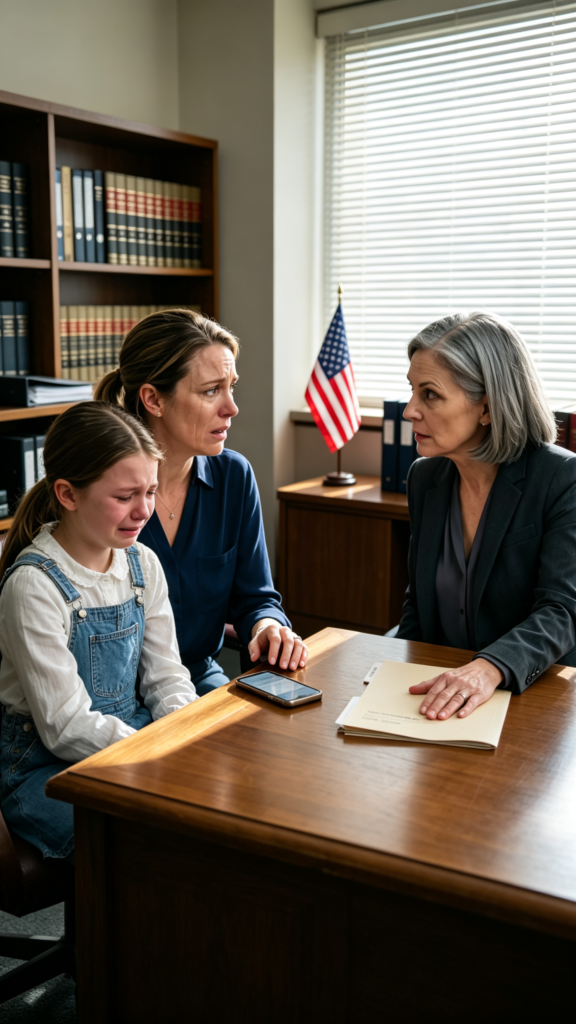
The lawyer received her that afternoon in an old office in the Historic Center. Ximena went with her.
Laura didn’t want to hide the process from her. She wanted her to understand that adults could defend too, not just crush.
The lawyer listened without interruption.
"Publicly accusing a minor of theft without proof can cause moral damage," he said. "If there was a school impact, we will request records, messages, and written reasons."
Ximena looked at him.
"Are you going to believe me?"
The lawyer spoke directly to her.
"It’s not enough for them to believe you. We’re going to force them to prove what they said."
Then he opened another folder.
"I need to ask you something, Laura. Who manages the trust that Don Aurelio left for Ximena?"
Laura frowned.
"What trust?"
The lawyer froze.
"Your grandfather left one. It was for education, artistic activities, and a partial disbursement when she turns sixteen."
Laura felt the ground shift beneath her.
"My mom said there was nothing. That they took care of it."
The lawyer slowly closed the folder.
"Then we’re going to ask for an accounting."
The letters arrived two days later.
Doña Marta called furiously.
"You send a lawyer to your own mother?"
"Answer what’s being asked."
"How ungrateful you are. We took care of your daughter."
"You humiliated her."
Don Rogelio took the phone.
"The girl needed to learn not to think she’s better than her cousin."
That’s when Laura understood it was never about a pair of shoes.
It was about putting Ximena in her place.
But her parents wouldn’t stay silent.
The next day, in a Facebook group for the moms from school, a venomous post appeared.
"Some parents cover for their thieving children and then threaten with lawyers."
It didn’t mention Ximena’s name, but everyone knew.
The comments fell like stones.
"That’s why kids grow up without values."
"If she stole once, she’ll steal again."
"What a nightmare that she studies with our kids."
Someone posted a rat emoji.
Ximena saw the post before Laura could take the phone away from her.
"Mom, everyone hates me now."
Laura hugged her as she felt her body shake.
That night, she saved screenshots of everything: posts, comments, audio, messages.
"People who defame feel brave when they think no one is documenting," she told her.
Three days later, the message that changed everything arrived.
It was from Abril.
"Hey Xime, can we talk? Please."
Ximena showed Laura the phone.
"You’re not seeing her alone," her mom said.
They agreed to meet at school, by the flowerbeds in the yard. Laura would stand a few meters away.
Abril arrived pale, her eyes swollen. She didn’t dare look straight ahead.
Before approaching, Ximena activated her phone’s recorder and slipped it into the pocket of her sweatshirt.
No one asked her to.
She did it because she had learned that the truth without proof stands alone.
Abril spoke softly.
"I’m sorry."
Ximena didn’t respond.
"I shouldn’t have said you took my shoes."
Abril’s voice broke.
"That day I got scared. I thought you... I don’t know. But later, I found them in my dressing bag, at my grandma’s house. I had left them there."
Ximena closed her eyes.
"And why didn’t you say anything?"
Abril started to cry.
"Because my grandma Marta told me not to move anything. She said if I cleared it up, they’d think I was dumb. She said it would help you learn not to feel superior."
Ximena barely breathed.
"Did they know?"
Abril nodded.
"My grandma did. My mom too. My grandpa said it was done."
The recording lasted 2 minutes and 14 seconds.
Enough to split the story in two.
When Laura heard it, she didn’t scream. She just sat up straight, as if a part of her had turned to steel.
She sent the audio to the lawyer.
The school changed its tone in less than 24 hours.
The coordinator spoke of "record correction," "immediate reintegration," and "communication protocol with parents."
The dance teacher called Ximena to ask her to rejoin the team.
But Ximena didn’t smile.
"Do you want me back because you believe me or because you’re scared?" she asked.
The teacher couldn’t answer.
In the groups, the posts disappeared without an apology. The moms who had commented "thief" started writing to Laura privately.
"So sorry, we didn’t know."
"We got carried away."
Laura didn’t respond.
Private apologies don’t undo public humiliation.
The hardest blow came one week later.
Licenciado Escobedo received the documentation for the trust.
Don Aurelio had left 890,000 pesos for Ximena. Not for Laura. Not for the grandparents. For Ximena.
The money was to be used for education, artistic classes, and formative activities. There were authorized annual payments until she turned sixteen, a partial disbursement, and the remainder upon turning eighteen.
Ximena had never received anything.
Instead, the account statement showed withdrawals of 310,000 pesos over three years.
Some were marked as "educational expenses," but coincided with Abril’s trips, payments for her private academy, and even the advance for her quinceañera salon.
Laura felt nauseous.
"They stole from my daughter."
The lawyer took a deep breath.
"There’s more."
The document had a conduct clause. If the beneficiary had a formal accusation of theft, fraud, or proven dishonest behavior, the administrators could suspend disbursements and redirect certain funds to other designated family members.
Laura understood everything.
They didn’t just want to humiliate Ximena.
They wanted to build her a reputation as a thief.
The day the money was claimed, no one would be surprised if they said:
"See? She was always problematic."
Doña Marta didn’t repeat "respect" for discipline.
She used it as a disguise.
The lawyer filed a complaint for fraudulent administration and prepared a civil lawsuit for moral damage. He also requested to remove Doña Marta and Don Rogelio as administrators.
When the notification arrived, Patricia called crying, not for Ximena, but for Abril.
"You’re going to destroy your parents! Aren’t you ashamed?"
Laura responded calmly.
"They should be ashamed for stealing from a little girl."
"It was family money!"
"No. It was my daughter’s money."
Patricia lowered her voice.
"Mom just wanted to balance things out. Ximena always does better."
That phrase was the last piece.
It wasn’t justice.
It was resentment.
In the hearing, Doña Marta arrived with a rosary in hand and a victim’s face. Don Rogelio looked more annoyed than remorseful.
They tried to say it was all a misunderstanding, that the expenses were for "family bonding," that they never meant to hurt Ximena.
Then the lawyer played Abril’s audio.
The room turned cold.
Doña Marta didn’t look at her granddaughter.
She just pressed her lips together.
Ximena sat next to Laura, hands clasped. She didn’t cry. Not because it didn’t hurt, but because finally, someone else was bearing the weight of the truth.
The judge ordered the grandparents removed from the trust’s administration, to return the 310,000 pesos, and cover part of the legal expenses. The school had to issue a written clarification to clean the record.
Don Rogelio and Doña Marta sold the truck and then the family home.
The same house where they locked Ximena up to force her into a false confession.
The same one where the shoes had been all along.
They moved to a small apartment on the outskirts.
Patricia stopped calling.
Abril changed schools.
Ximena returned to dance, but she no longer danced to please anyone. She danced more firmly, more seriously, as if each step spoke something her mouth didn’t want to repeat.
One month later, Sofía wrote to apologize and to be friends again.
Ximena read the message and left it unanswered for a while.
Then she said:
"Forgiving doesn’t mean going back."
Laura looked at her and knew her daughter had lost something, yes.
But she had also gained a clarity that many adults never reach.
From then on, she never left her alone with her grandparents.
There was no reconciliation dinner. No fake Christmas. No "just get over it" so the guilty could sleep soundly.
There was silence.
And that silence weighed more than any scream.
Because Doña Marta wanted to teach a little girl respect by calling her a thief in front of everyone.
But she ended up teaching her something else:
That the family that breaks you to protect its lies also deserves to lose the right to call itself family.





