PART 1
Damián Arriaga forgave no mistakes.
Not from his bodyguards, not from his accountants, not from the politicians who smiled at him in Guadalajara restaurants while asking for favors under the table. Much less from the men who would arrive at his estate that night to decide whether the Bajío would have peace... or graves.
The dinner had been planned for three months.
Five families were going to sit at the same table. The Valdés from Michoacán, the Carranza from Nayarit, the Rivas from the port, the Medina from the mountains, and Esteban Larios, the only man crazy enough to provoke him in his own house.
The meal was not a detail.
For Damián, a good dish could calm an insult, lower a gun, make a proud man swallow hard before shouting. That’s why he had brought in a luxury chef from Mexico City, costly ingredients, and waiters trained not to breathe heavily.
But forty minutes before the first convoy arrived, the chef collapsed on the kitchen floor.
His face was gray, he was sweating cold, and writhing in pain. The pots boiled on their own. The assistants were paralyzed. The mole was half-ground, the ancho chili sauce was burning, and the trays of seafood smelled off.
“It was the seafood, boss,” a cook whispered. “We all tasted a little, but he tasted more.”
Damián understood immediately.
It wasn’t an accident. It was sabotage.
“Throw out everything that came in that truck,” he ordered.
Silvano, his right-hand man, appeared beside him with a stern face.
“We have thirty-five minutes.”
“Call all the restaurants.”
“I already called.”
Damián clenched his jaw.
No chef. No dinner. And without dinner, Esteban Larios would smell weakness like a ranch dog.
Then a soft voice came from the door.
“I can cook.”
Everyone turned.
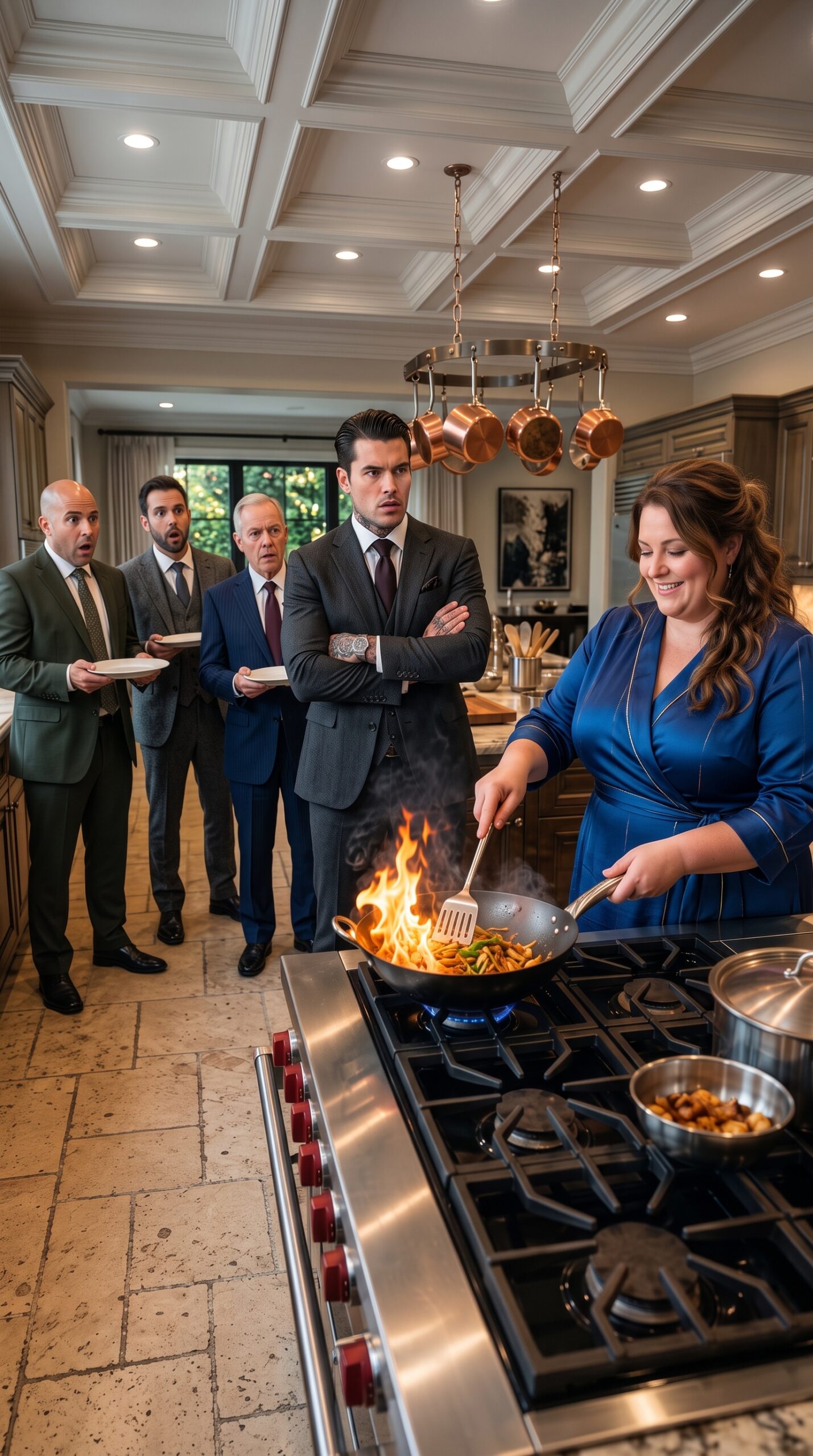
Marisol Arriaga stood there, in a simple blue dress, hair tied back with no jewelry, and her sleeves rolled up. She was a curvy woman, with a sweet face, warm hands, and an easy smile. In that house of armed men, many saw her as mere decoration.
Damián had seen her that way too.
He had married her three years earlier as part of an alliance with his father’s family, owners of legal markets and transportation. He gave her a suite, bodyguards, money, public respect.
But he never gave her trust.
He never asked who she was.
“Marisol,” he said, dryly. “This isn’t food for family.”
“I know.”
“These are men who kill for a bad look.”
“That’s why they need to eat well.”
An assistant dropped a spoon.
Damián almost laughed, but in that moment, the lights of the first cars crossed the courtyard.
Marisol stepped forward.
“Give me the kitchen.”
“You have thirty minutes.”
“Then stop getting in the way.”
The kitchen fell silent.
Silvano looked at the floor to hide his smile.
For the first time in three years, Damián saw his wife not as a tender woman but as a calm force that made everyone adjust around her.
“Obey my wife,” he said.
Marisol tied on an apron and entered the chaos like a warrior stepping into battle.
Half an hour later, the dining room smelled of roasted garlic, pasilla chili, butter, warm dough, and slow-cooked meat. The men who had arrived seeking war found themselves leaning over their plates.
There was soft birria, dark mole, saffron rice, roasted vegetables, cornbread, and freshly made tortillas. Don Valdés closed his eyes as he tasted the broth. The Carranzas stopped insulting each other. Even Esteban Larios, mocking and poisonous, fell silent.
“Who made this?” Don Valdés asked.
Damián looked toward the kitchen.
Marisol emerged with a pot in her hands, her cheeks flushed from the heat, and flour on her forearm.
“My wife,” he said.
Everyone looked at her.
She smiled just a little.
“I hope it’s enough.”
Don Valdés raised his empty plate.
“Madam, if my mother were alive, I’d apologize for comparing her to you.”
The laughter was genuine.
At midnight, the alliance was signed.
But when the last car left through the gate, Silvano arrived with a folder in hand.
“Boss, we found the supplier's note. The poisoned order was signed with an internal code.”
Damián felt something freeze inside him.
“Whose?”
Silvano swallowed hard.
“Mrs. Marisol’s.”
Damián slowly turned toward his wife.
Someone hadn’t just tried to destroy the dinner.
Someone had used her name to put a sentence over him.
PART 2
By dawn, the entire estate knew two things.
Marisol had saved the night.
And someone had tried to blame her for poisoning the guests.
The guards spoke softly. The cleaning ladies cried in the hallways. The drivers checked every truck as if betrayal might be hiding beneath the seat.
Damián expected to find Marisol locked in her room.
But he found her in the kitchen, kneading bolillos.
“You should rest,” he said.
“And you should sleep.”
“I don’t sleep when I have enemies in my house.”
“And I don’t rest when people are scared and hungry.”
He frowned.
Marisol covered the dough with a cloth.
“Fear gets into the stomach, Damián. If I can’t take it out, at least I can give something warm around it.”
He didn’t know how to respond.
That morning, she brought breakfast to the entrance. She gave Enzo, the head of security, a spinach and cheese torta.
“They told me you don’t like tomatoes.”
Enzo, a man who didn’t blink in front of rifles, froze.
“You remembered that?”
“I asked.”
In one week, Marisol learned names, preferences, and wounds.
That Nico sent money to his sick mother in Tepatitlán. That Mrs. Chayo had arthritis in her hands. That a mechanic named Paulino didn’t have breakfast because he arrived before service. That Enzo hated tomatoes but would eat three conchas if no one was watching.
The estate changed.
The men still feared Damián.
But they began to care for Marisol.
And that scared Silvano more than any threat.
“Be careful,” he told Damián one afternoon. “She’s not building an army, but if one day you give an order that hurts her, many will take time to obey.”
Damián wanted to get angry.
He couldn’t.
Because he didn’t know if it was a lie.
Days later, a call came from a safe house near Chapala. Tomás, one of his most loyal captains, had survived an ambush, but wasn’t speaking or eating.
Damián brought in doctors, orders, and threats.
Nothing worked.
Marisol climbed into the truck with a basket.
“You’re not going,” he said.
“I already made soup.”
“It’s dangerous.”
“Locking me up isn’t protecting me. It’s not knowing what to do with me.”
Damián looked at her, defeated for the first time without throwing a punch.
In the safe house, Tomás sat by the window, thin, pale, with a bandaged arm. Marisol didn’t ask him anything. She went to the kitchen, heated beef broth with chickpeas, carrots, cilantro, and lime, and set two plates on the table.
“You don’t have to eat,” she said. “I just didn’t want you to be alone.”
She began to eat.
Tomás looked at the steam.
Then he took the spoon.
By the third bite, he broke down.
“My brother was with me,” he whispered. “He was seventeen. I promised my mom I would take care of him.”
Marisol set the spoon down.
“What was his name?”
“Leo.”
“Tell me about Leo.”
Tomás cried like a child.
Damián stepped into the hallway so his man could break down without his boss watching. That night, he understood something that embarrassed him: he knew how to punish pain, but Marisol knew how to sit beside it.
The problem grew when she returned to the market where she had grown up, in Tonalá.
There she discovered that small groups were extorting bakers, vegetable sellers, and diners. They weren’t Damián’s men. They were leftovers from Esteban Larios, kids without a code, abusing people who sold to eat.
Marisol didn’t ask for permission.
She paid off debts with her own money, opened fair loans, and helped establish a community dining hall in a neighborhood where many families had only coffee and bread for dinner.
She didn’t use the Arriaga surname.
But people saw Enzo. They saw the trucks. They saw Damián standing behind her, silent and attentive.
The rumor spread quickly.
“Your wife is buying territory with charity,” Silvano said. “Larios is saying she feeds the poor to make them loyal.”
Marisol grew pale.
“I just wanted to help.”
Damián looked at her.
“I know.”
“Really?”
Before he could respond, an explosion sounded in the distance.
Enzo’s phone rang abruptly.
“Boss, they burned the dining hall. We got the lady out before the roof collapsed.”
Damián felt the blood drain from his face.
Marisol ran out before he finished putting on his jacket.
The dining hall was ashes.
The new tables were blackened. The stove twisted. The pots were open like wounds. Neighbors cried with blankets on their shoulders. Children hugged bags of groceries saved from the smoke.
Marisol searched for Enzo.
“Did everyone get out?”
“Yes, ma’am.”
“Everyone?”
“Everyone.”
Then her legs gave out.
Damián caught her against his chest.
“Tonight I destroy him,” he said, with a calm that frightened everyone.
“No.”
He looked at her, incredulous.
“He burned what you built.”
“He burned a building.”
“He threatened you.”
“And he failed.”
“Marisol...”
She put a hand on his chest.
“If you respond with fire, the first to pay will be drivers, cooks, children, women selling herbs. Larios wants war because that’s where he knows how to move. Don’t give him his stage.”
“Then what do I do?”
“Rebuild it.”
Damián stood still.
“Bigger. Prettier. Open on Sundays. Let him learn that burning goodness doesn’t make it disappear. It only shows why it’s needed.”
Silvano blinked as if he had just heard madness.
Damián looked at the ashes, then at his wife.
She wasn’t asking for weakness.
She was asking for a strength he had never practiced.
“Silvano,” he finally said. “Materials arrive tomorrow. Pay triple. I want the dining hall standing before Sunday.”
“And Larios?”
“Find the one who started the fire. Alive. No innocent blood.”
On Sunday, the dining hall opened, painted yellow.
Bakers, vegetable sellers, children, grandmothers, and even men from rival families arrived. Marisol served broth with rice while Damián watched from the back, understanding that she wasn’t building an army.
She was building hope.
And hope, in his world, was more dangerous than any weapon.
That’s why Larios called a neutral meeting at a winery in Tequila.
Supposedly, he wanted peace.
Silvano discovered the truth hours before: three external shooters would attack the meeting, kill several bosses, and blame Damián.
“We’re canceling,” Enzo said.
“No,” Marisol replied from the door. “We’re having dinner.”
Damián closed his eyes.
“You’re not going.”
“Yes, I am.”
“They want you dead.”
“Then let them see me alive.”
She organized a meal before the meeting. No separate tables. No bodyguards for families. Everyone together. Pozole for some, barbacoa for others, sweet bread for the guards, coffee for the drivers, beans for those pretending they had already eaten.
The men started rigid.
They ended up sharing tortillas.
When the shots erupted from the vineyards, the impossible happened.
The bodyguards didn’t divide by last names.
Enzo shielded a Carranza. A Valdés dragged a waitress. A Medina protected Silvano. Tomás took down a shooter and left him alive because Damián had ordered proof, not corpses.
Marisol ran towards two kitchen girls paralyzed against a wall.
Damián reached her just as a bullet shattered a planter beside her.
“You’re crazy!” he shouted.
“Then scold me later.”
In minutes, the three attackers were subdued.
The proof came from a cell phone: payments, routes, messages. Larios’s name didn’t appear, but his lieutenant, Rubén Cota, did.
Rubén tried to escape.
He grabbed Marisol from behind and put a knife to her throat.
The entire courtyard froze.
Damián stopped breathing.
“Let her go,” he said in a voice so soft it was more frightening.
Rubén laughed.
“What are you going to do? Shoot through your holy cook? This woman ruined everything. We burned her dining hall and they wanted her more. She fed them and now you hesitate before killing each other. What place is left for men like us if she makes them human?”
Marisol trembled.
But her eyes searched Damián’s.
No.
She didn’t want him to shoot.
Her hand slowly lowered to the pocket of her apron.
“It’s a handkerchief,” she said. “He hurt me.”
Damián saw the lie.
It was a small can of chili powder and flour, the one she had used to season the bread.
When Rubén turned for just a second towards Larios, Marisol threw the powder straight into his eyes.
Rubén screamed.
She dropped to the ground.
Damián, Enzo, and, to everyone’s surprise, Larios himself leaped onto him.
The knife fell to the ground.
Damián embraced Marisol in front of everyone as if his empire could burn as long as she breathed.
“Did he cut you?”
“No.”
“Marisol.”
“No, he didn’t cut me.”
She only had a red line on her neck.
He rested his forehead in her hair.
“You’re brave. And that’s not the same as being okay.”
That night, Rubén confessed. Larios admitted to ordering the dining hall burned, though he swore he hadn’t ordered the massacre. No one completely believed him, but everyone forced him to sign protection for markets, dining halls, schools, clinics, and bakeries.
Marisol didn’t ask for revenge.
She asked him to stop extorting people who barely had enough for dinner.
And that humiliated him more than a bullet.
Four days later, Damián gathered everyone in the estate in the courtyard.
Guards, cooks, drivers, gardeners, mechanics, cleaning ladies. Almost seventy people.
Marisol came out with flour on her cheek.
“Did something happen?”
Enzo smiled.
“Yes, ma’am.”
Damián stood next to the fountain, nervous for the first time.
“When I married Marisol,” he said, “I thought I was giving her protection, money, and a strong surname. But I didn’t give her what she deserved in her own home: to be seen.”
The courtyard fell silent.
“I saw her tenderness and thought it was weakness. I saw her body, her smile, her hands in the kitchen, and I thought she didn’t understand power. I was wrong.”
Marisol covered her mouth.
“She made this house more loyal with breakfasts than I did with years of fear. She seated broken men, fed those no one looked at, rebuilt what they burned, and prevented a war by reminding us that before hating, we all have hunger.”
Damián walked toward her.
He knelt.
The crowd murmured.
“We are married by law,” he said. “But an alliance is not love. A ring given by strategy is not a promise. Marisol Arriaga, I love you. Not for saving my name, nor my people, nor my business. I love you because you saw a house full of fear and decided to set a table.”
He pulled out a braided gold ring with a small green stone in the center.
“Marry me again. As my true wife. My equal. The heart of this house, if you still want a man this foolish who didn’t see the miracle right in front of him.”
She cried and smiled at the same time.
“I told you not to call me a miracle.”
“I’m nervous.”
Laughter erupted in the courtyard.
Marisol extended her hand.
“Yes. But this time you’re going to eat in the kitchen.”
Damián slid the ring onto her finger.
“I’ll eat wherever you tell me.”
Silvano murmured:
“God help us.”
The second wedding was six weeks later, in the rebuilt community dining hall.
Marisol said that a kitchen risen from ashes was a more honest church than any cathedral. She wore an ivory dress that embraced her curves with dignity. Damián waited for her without a mask, without coldness, with the eyes of a man who finally understood what he had.
He promised to protect without locking her up.
To listen before ordering.
To never confuse tenderness with weakness.
When they kissed, the entire dining hall applauded.
Years of fear had made many obey Damián.
But Marisol taught them something more difficult: to stay for love, for gratitude, for that rare and powerful feeling of mattering.
Since then, Sundays at the estate began with freshly made bread, coffee, and Damián chopping cilantro poorly.
“You’re mistreating it,” Marisol would say.
“I’m intimidating it.”
“Cilantro doesn’t respond to threats.”
“It should learn.”
She would laugh.
And he, the man who once believed power meant needing no one, silently understood that his wife did know how to cook.
She knew how to feed.
She knew how to heal.
She knew how to humiliate violent men with hot bread.
And she had filled a mansion built on fear until, at last, there was a place at the table for him too.





