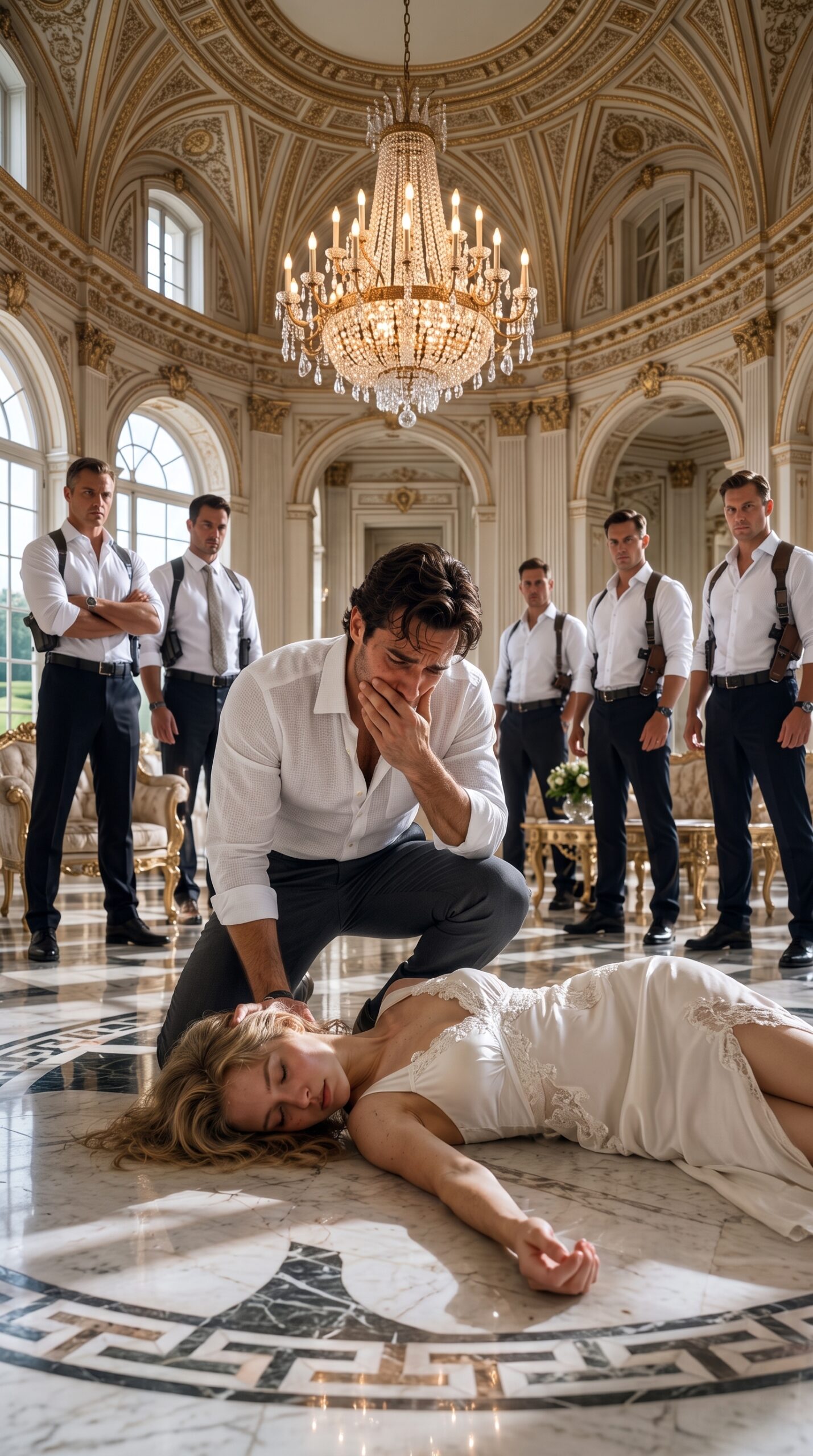
PART 1
Víctor Salvatierra didn't usually repeat an order.
In Polanco, in the docks of Veracruz, and even in the hidden warehouses of Ecatepec, his name alone was enough to make people lower their voices. He was not a man of shouting. Nor of long threats. With just a look, he made it clear who was in charge.
So when he said to bring Sofía Beltrán to his penthouse, no one asked anything.
Sofía was 29, restoring ancient paintings in a small workshop in the Roma neighborhood, and she had never wanted to know anything about her brother Arturo's world. He always arrived with expensive watches, nervous smiles, and bills he didn't explain.
—It's accounting, Sofi —he would say—. Don't ask questions, seriously.
But Arturo had been missing for two weeks.
The last time Sofía saw him, he had come to her workshop soaked from the rain, his shirt stained with dried blood and a USB drive hidden inside a box of paintbrushes.
—If something happens to me, hand it over to the Prosecutor's Office —he said, trembling—. Don’t give it to anyone. Not to Víctor. Not to the guys from Tamaulipas. Nobody.
Sofía wanted to call an ambulance. Arturo forbade it.
That night he slipped out the back door, and since then his cellphone only went to voicemail.
Three days later, as she was closing the workshop, a black van stopped in front of her.
A man covered her mouth. Another twisted her arms. They threw her into the vehicle like a sack.
When she woke up, she was in a freezing warehouse, sitting in a chair, her wrists bound and her face burning.
—Where's the USB? —one of the men asked.
Sofía shook her head.
Not because she was brave. But because she truly didn't know what it contained.
Leonardo, the leader of those men, hit her with the back of his hand.
—Your little brother robbed the boss. Don't play dumb.
She cried, begged, explained that Arturo was just her brother, not her accomplice.
But the more she insisted, the angrier they became.
They beat her until her lip split open. They searched her bag, her shoes, her jacket. When they found the box of paintbrushes and the hidden USB in the false bottom, Leonardo smiled as if he had won the lottery.
—That's it. Tell Mr. Salvatierra.
At midnight, Víctor arrived at the warehouse in a dark suit, with the calm of someone who had seen too much blood.
He entered expecting to find a thief.
But when he saw Sofía lying on the floor, her clothes torn, a black eye, and her ribs marked from the beatings, something in his face went dim.
No one spoke.
Víctor looked at Leonardo.
—Who ordered this?
Leonardo swallowed hard.
—You said to bring her, boss.
Víctor approached slowly, took the USB from the table, and then looked back at Sofía, who could barely breathe.
—I said bring her —he whispered—. I didn't say destroy her.
Then Leonardo tried to justify himself.
—She's Arturo's sister. She must know more than she says.
Víctor didn’t raise his voice.
He simply said five words that made everyone in the warehouse tremble:
—You no longer work for me.
PART 2
The silence that followed was worse than a shout.
Leonardo turned pale. The other men looked down. In that world, losing your job with Víctor Salvatierra didn’t mean looking for another boss on LinkedIn. It meant disappearing from the maps where your name still appeared.
Víctor took off his jacket and placed it over Sofía.
She was only half-conscious. Her breathing sounded broken. When he lifted her off the floor, she let out a whimper so small that Víctor clenched his jaw.
—Call Dr. Méndez —he ordered—. And clean up this mess.
No one asked if he was talking about the blood or the men.
Hours later, Sofía awoke in a huge room, with white sheets, the smell of cedar, and a pain that shattered her body.
The ceiling was towering. Outside, Mexico City sparkled under the gray light of dawn.
For one second, she thought she was dead.
Then she remembered the warehouse.
Arturo.
The USB.
She tried to sit up, but her ribs burned like fire. She had a bandage around her torso, a small patch over her eyebrow, and an IV in her hand.
She clumsily ripped the tape off the needle.
She needed to get out.
She needed her bag.
She needed to find Arturo.
She walked barefoot to the door. Each step stole her breath, but she kept going.
When she opened it, she saw an immense living room with floor-to-ceiling windows, dark furniture, and a black marble kitchen.
Víctor Salvatierra was sitting at the bar, with an untouched cup of coffee in front of him.
He didn’t look like a criminal at that moment. He looked like a businessman who had stayed up too late. But the way he lifted his eyes was enough to remind Sofía that she was facing a dangerous man.
—You shouldn't be walking —he said—. Méndez said 48 hours of rest.
—Where's my bag?
—Your things are stored away.
—The USB.
—in my safe.
Sofía felt the last piece of control taken from her.
—Then you have what you wanted. Are you going to send me back to the warehouse, or do you have another room for that?
Víctor set the cup down on the marble.
—No.
—Then let me go.
—I can't.
She let out a dry, broken laugh.
—How convenient.
—Gael Carranza's men are looking for you.
The name meant nothing to her, and just that made her more afraid.
Víctor stood up but didn’t approach.
—Arturo stole my accounts. He tried to sell them to Carranza's group in Tamaulipas. When Carranza discovered that your brother no longer had the USB, he ordered his death.
Sofía stood frozen.
—No.
Víctor didn't sugarcoat the truth.
—Arturo is dead.
The world slipped from her grasp.
She didn’t cry at first. The pain was too great to come out in tears. She slid against the doorframe until she was sitting on the floor.
Arturo, her distracted brother, the one who bought her pastries when he passed by a bakery, the one who always said that one day they would live near the sea.
Dead.
Thief.
Liar.
And yet, her brother.
—I'm sorry —Víctor said.
Sofía lifted her face. Her healthy eye shone with rage.
—No. You don’t feel sorry. You are just calculating what part you should feel.
Víctor accepted the blow without defending himself.
For four days, the penthouse was a pretty prison.
They brought her new clothes, hot food, medicine, sugar-free hibiscus water because the doctor said she needed to stay hydrated. Outside the private elevator were two men. At the entrance of the building, three more. Her cellphone never reappeared.
Víctor hardly came in to see her.
But she heard his voice in the early morning from the study. Short orders. Names. Routes. Veracruz. Querétaro. Tamaulipas. Frozen accounts. People betraying.
Víctor's world was moving over a USB that Sofía never asked to carry.
On the fifth day, while searching for an exit, she found a hidden library behind the dining room.
There was no marble or coldness there. There was wood, old books, and a huge painting above the darkened fireplace: a ship in the middle of a storm, pushed toward black rocks.
Sofía approached, forgetting for a moment the pain.
The painting was damaged.
A layer of yellowed varnish covered the sky. In one corner, someone had tried to clean it and had burned part of the waves.
—Who did this to you? —she murmured.
—An auction house in Guadalajara —Víctor said from the door.
Sofía jumped and put a hand on her ribs.
He was there, without a jacket, with his shirt rolled up and a look of not having slept.
—I was told it could be a lost work by a Spanish painter —he explained—. I bought it because it looked like how I felt.
Sofía looked at the painting again.
—You were scammed.
For the first time, Víctor almost smiled.
—That obvious?
—The varnish doesn’t match. And the attempt at cleaning was a disaster. You can’t erase a wound by pretending it never happened.
Víctor fell silent.
That phrase hit him where no bullet had entered.
—Can you fix it?
—I can stabilize it —she replied—. Fixing it, no. There are scars that only stop rotting.
Víctor nodded slowly.
That night, he told her he had to go to a meeting in Querétaro. Carranza wanted to negotiate: the USB in exchange for peace.
—Give it to him —Sofía said.
—No.
—You have money, men, buildings, bought politicians. Why is a memory worth a war?
Víctor's voice hardened.
—Because if I give it to him, everyone will understand that they can pressure me by hurting innocents. They killed your brother. They beat you. If I reward that, tomorrow they’ll do it again with anyone.
Sofía hugged her torso.
—Your rules created Leonardo.
He didn’t reply.
He left before dawn.
The next day, the penthouse felt strange. Without Víctor, the silence didn’t seem like freedom. It felt like a tomb with a pretty view.
Sofía needed to do something with her hands. She found mineral spirits, swabs, and paper towels under the sink. It wasn’t professional material, but it was enough to test a corner of the painting.
She carefully climbed onto a leather chair. She touched the varnish with the swab.
Pressure.
Lift.
Pressure.
Lift.
Under the yellowed layer, a deep, vibrant, clean blue appeared.
Then the lights went out.
The hum of the air conditioning died.
Sofía froze.
A dry thud sounded on the terrace.
Then an unknown voice:
—Cut the safety.
They weren’t coming through the elevator.
They had crossed from a neighboring construction site and entered through the windows.
Víctor's fortress had a wound.
Sofía climbed down from the chair, grabbed the bottle of solvent, and hid behind the door.
A man entered with a gun in hand.
—Library's clean —he said—. Check the rooms. Carranza wants her alive.
When he turned, the door moved.
His eyes found hers.
Sofía didn’t think.
She threw the solvent directly in his face.
The man screamed, dropped the weapon, and brought his hands to his eyes. Sofía ran to Víctor's study, closed the door, and locked it.
The thud from the other side nearly made her fall.
Then she saw a wooden panel slightly ajar behind the desk.
A security room.
She slipped inside just as the door to the study began to splinter.
Inside, the darkness was complete.
Through a hidden speaker, a calm voice said:
—Sofía Beltrán, your brother and I left a conversation pending.
Gael Carranza.
She pressed an open letter opener against her chest that she had taken from the desk.
—Víctor Salvatierra is not your savior —the voice continued—. He uses you as he used Arturo. Open up, give me the password, and I’ll put you on a plane with money to start over.
Sofía didn’t know any password.
Arturo had only left her fear.
Hours passed.
Then there were gunshots.
First distant. Then close. Screams. Shattered glass. Footsteps. A body hitting the wall.
The security room emitted a beep.
Sofía raised the letter opener.
The door opened.
Víctor appeared, drenched from the rain and with blood on his shoulder.
—Sofía —he said.
Then he fell to his knees.
She held him as best she could. The pain bit at her ribs, but she managed to drag him to the study’s sofa.
—The meeting was a trap —he murmured—. Carranza bought Méndez. He gave them the codes for the service elevator.
—The doctor?
—He will no longer attend to anyone.
Sofía understood and didn’t want to ask.
She found a tactical first-aid kit in a cabinet. She cut Víctor’s shirt, cleaned the wound, and saw the bullet entry near his collarbone.
—I’m not a doctor.
He gasped for breath.
—you restore broken canvases.
—it’s not the same.
—Tonight it is.
She hated him for saying it so calmly. But her hands obeyed. Gauze. Iodine. Pressure. Suturing.
Broken edges. Fragile material. Don’t panic.
When she finished, Víctor opened the safe. He pulled out a gun and the silver USB. Then he did something Sofía didn’t expect.
He placed it in her hand.
—This killed Arturo —she whispered.
—No. Arturo made choices. Carranza killed him. My world gave him the weapon. That USB is proof, power, and condemnation. You must have it.
—Why?
—Because I can no longer trust myself to be the only one deciding about your life.
Sofía looked at him for real.
For the first time, she didn’t see the untouchable man. She saw someone bleeding inside his own fortress, discovering too late that his walls protected the wrong monster.
They escaped through a maintenance stairwell.
52 floors.
On the 30th floor, Víctor was already leaving blood on the wall.
On the 22nd, Sofía was carrying some of his weight even though each step stole her breath.
On the 18th, he sat on the step, pale.
—Go. Take the USB to the Prosecutor's Office. Tell everything.
—No.
—You owe me nothing.
—I know that.
—Then go.
Sofía looked at him furiously.
—I don’t leave bleeding people on stairs. That’s your world, not mine.
Víctor closed his eyes.
—I never wanted to drag you into the darkness.
—you can’t control the consequences —she said—. You threw a stone into the water, and now you can’t tell the waves where to stop.
No one spoke to Víctor Salvatierra like that.
Maybe that’s why, for the first time, he listened.
—If you want to clean this up —Sofía continued—, you won’t do it with more dead. My brother stole. Carranza killed. Your men beat me. And you created a world where everyone believed that nobody had to answer. It’s over. We’re going to hand over the USB. Not to your contacts. Not to bought prosecutors. To someone who can bury them with files, arrest warrants, and frozen accounts.
Víctor let out a weak laugh.
—I have half the system bought.
—Then find the half that isn’t.
At dawn, they arrived at a service tunnel under the building. Paul, Víctor’s most loyal bodyguard, was waiting for them, beaten but alive, with an armored truck.
—Where to? —he asked.
Víctor looked at Sofía.
She answered:
—to the Attorney General’s Office.
The next 12 hours changed more than a war.
The USB had two main files.
The first proved Arturo's theft and Carranza's murder network. The second was worse: shell companies, judges, police commanders, customs, port contracts, political campaigns, and transfers that crossed Mexico like poison.
Víctor's name was there too.
Sofía knew it before he spoke.
In a cold room, in front of a prosecutor named Elena Robles, Víctor agreed to cooperate.
His lawyer looked like he was about to vomit.
—Total cooperation means total —the prosecutor warned—. Carranza, his operators, and also your own structure.
Víctor nodded.
—Yes.
—Why?
Víctor looked at Sofía.
He didn’t say: because I saw what my name did to him.
He said:
—Because the system I built no longer obeys its creator.
Weeks later, Mexico woke up to headlines that seemed impossible.
Gael Carranza was arrested at a private runway in Nuevo León with two fake passports and three million dollars in diamonds. Méndez accepted a deal. Leonardo appeared alive, handcuffed and crying, at the back entrance of a courthouse.
Agents, businessmen, accountants, judges, and men who had always walked through restaurants as if the country belonged to them fell.
Víctor Salvatierra did not walk free.
That was what mattered most to Sofía.
He cooperated, yes. But cooperating didn’t erase the blood or the fear. He pleaded guilty to money laundering, obstruction, and organized crime. His sentence divided opinions for months.
Sofía visited him once before he was transferred.
The room had no luxury. Just a metal table, two chairs, and a guard behind the glass.
Víctor stood when he saw her.
—You look better —he said.
—You don’t —she replied.
He barely smiled.
Sofía left a folder on the table. Inside were photos of her new workshop in Puebla. It wasn’t the Roma. It wasn’t the penthouse. It was a place with white walls, natural light, and a door whose key only she had.
The sign read: Beltrán Restoration.
—The painting? —Víctor asked.
—It’s still evidence. When it’s released, it will go to a museum.
—I thought you wanted it.
—I want to restore it. Not possess it.
Víctor lowered his gaze.
—I’m sorry, Sofía.
This time she heard the difference.
It wasn’t the elegant apology of a powerful man. It was that of someone who knew there were debts that could never be paid.
—I know —she said.
—Do you hate me?
Sofía thought of the warehouse. Of Arturo. Of the dark room. Of the stairs. Of the USB on the prosecutor's table.
—No —she replied—. But I still haven’t forgiven you.
He nodded.
—That’s fair.
—Maybe I’ll never do it.
—That’s fair too.
As she left, Sofía paused at the door.
—When you get out, don’t look for me.
A silent pain crossed Víctor's face.
—I won’t.
—And Víctor…
—Yes?
—Use whatever life you have left to become someone a woman doesn’t have to survive.
For the first time, Víctor Salvatierra had no response.
One year later, Sofía was in a gallery in the Historic Center, in front of the restored painting of the ship in the storm.
It wasn’t perfect. It never would be. In the corner where a clumsy hand had burned the waves, there remained a fine scar.
Sofía left it visible.
Not as damage.
As testimony.
The plaque read: Restored by Beltrán Restoration, Puebla, Mexico.
In her workshop, the photo of Arturo was on a shelf. Not as a saint. Not as a villain. As her brother. Foolish. Loving. Ambitious. Lost.
Sofía still woke up some nights with the smell of concrete in her throat. She still hated elevators. She still tensed when a man raised his voice too much.
But she had her own keys.
She paid the salary of two assistants.
She offered free workshops to young artists who couldn’t afford a private school.
And she no longer belonged to any boss, any brother, any monster, or any ghost.
On the night of the opening, an envelope arrived with no return address.
Inside was a short note:
The waves reached farther than I imagined. Thank you for making them touch the shore.
There was no signature.
It wasn’t necessary.
Sofía folded the note and tucked it into her pocket. Then she returned to the gallery, where people looked at the restored storm without knowing that the woman who had saved it had also saved herself.
Millimeter by millimeter.
Scar by scar.
Truth by truth.





