PART 1
The night Sebastián Rivas called his wife "a woman without a surname," he did it in front of businessmen, lawmakers, television cameras, and the woman he intended to replace her with.
The main hall of the Gran Hotel in Mexico City sparkled with antique lamps, white flowers, and expensive glasses. This wasn't just any party. It was the celebration of Sebastián's new position as director of international alliances for the capital government.
Clara sat two tables away from the stage.
She wore a light blue dress she had altered herself because Sebastián told her she looked "too simple." But simple had been everything when they started: home-cooked dinners, late rent payments, speeches written by her at 2 a.m. to make him sound like an important man.
And that night, everyone viewed him as important.
They applauded when he thanked officials. They laughed when he spoke of sacrifices. They raised their glasses when he declared that Mexico needed leaders with a global vision.
No one knew that many of those words had been written by Clara with red, tired eyes.
Then Sebastián looked toward her table.
"My wife is here tonight," he said.
Clara felt a ridiculous warmth in her chest.
For months, he had been cold. He hid his phone. He got upset when she asked questions. He corrected her if she spoke "too much from the barrio" in front of rich people.
Still, Clara thought he might actually thank her.
But Sebastián smiled.
"Clara was with me when I had nothing," he said. "But every stage has its place. And my future can no longer carry someone who doesn’t even know where she comes from."
The room felt strange.
Clara tightened the ancient medallion hanging from her neck, the only thing she had carried since she was a baby.
Sebastián didn’t look away.
"I can’t keep pretending that a woman found outside a church in Puebla, without a birth certificate, without family, without history, can represent the future I’m building."
Some people looked down.
Others pretended to check their phones.
Beside the stage, Valeria Montejo, daughter of a real estate magnate, smiled faintly, as if she already felt entitled to Clara’s place.
Sebastián raised his glass.
"So, with respect and transparency, I announce that Clara and I have decided to part ways."
They hadn’t decided anything.
He had decided it in front of everyone.
"And please," he added, with a cruel laugh, "keep the orphan out of my future."
Then the doors of the hall burst open.
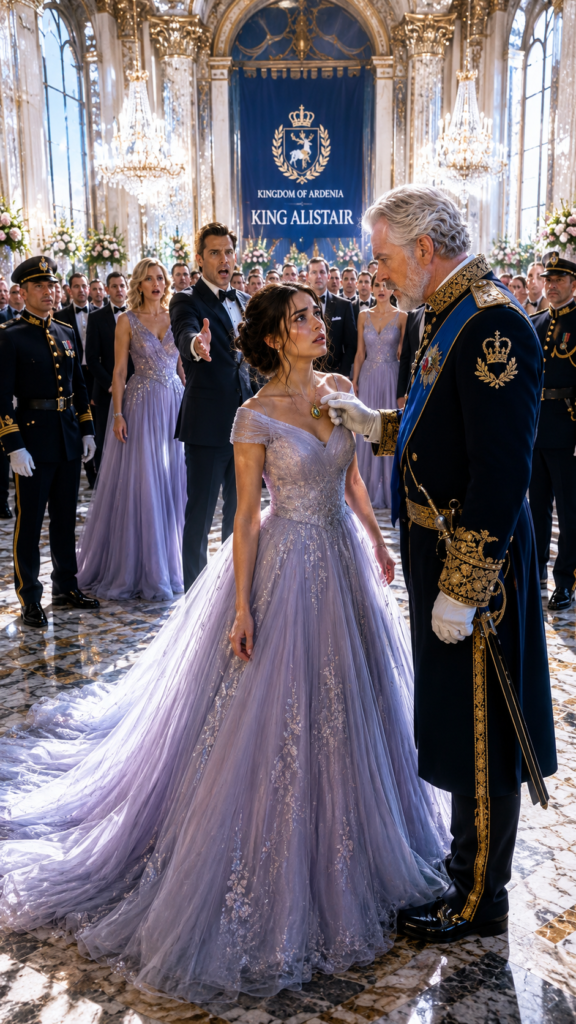
Guards in dark suits entered, followed by men in navy and silver uniforms. On their jackets, they bore the emblem of a white stag with a rose in its mouth.
Someone whispered:
"It's the royal guard of Ardenia..."
An older man entered behind them. Tall, gray-haired, in a black uniform with a blue sash crossing his chest.
Sebastián nearly ran to him.
"Your Majesty, what an honor. King Alistair, if we had known you were coming..."
The king passed by him as if he didn't exist.
His eyes scanned the hall until they landed on Clara.
He looked at the medallion on her chest.
And his face crumbled.
"It can't be... after 26 years..."
Sebastián tried to speak.
"Your Majesty, allow me to introduce you to my new stage..."
"Silence," the king ordered.
And walked straight toward the woman everyone had just humiliated.
PART 2
Clara didn’t move.
Not because she was brave, but because her body stopped responding. Her hands felt cold, her throat was tight, and the sounds of the hall reached her as if she were underwater.
King Alistair stopped in front of her.
He didn’t look at her simple dress. He didn’t look at the tears she was swallowing. He only looked at the medallion.
"Where did you get that?" he asked in a voice so low it hurt.
Clara touched the golden piece.
It was an old, oval medallion, with a tiny crown engraved on the back. Inside was a nearly faded photo of a young woman and a strand of blonde hair carefully glued.
"I've always had it," she replied. "I was found with it when I was a baby, outside the San Miguel parish in Puebla."
The king closed his eyes.
One of the royal guards placed his hand on his chest.
Sebastián let out a nervous laugh.
"Your Majesty, it’s surely a coincidence. In Mexico, there are many ancient jewels. My wife... well, my ex-wife has always had a certain fantasy about not knowing her origin."
Clara looked at him.
For the first time that night, the pain began to turn into rage.
"I’m not your ex-wife," she said. "Not yet."
A murmur ran through the hall.
Valeria Montejo pressed her lips together.
The king raised his hand, and an advisor approached with a black folder. He opened it and pulled out an aged photograph.
In the image was a baby of just a few months wearing the same medallion.
"My daughter, Princess Eliana, disappeared during a diplomatic visit to Mexico 26 years ago," said the king. "Her mother died without knowing if she was alive. This medallion was made only once. I commissioned it for her on the day of her birth."
The hall froze.
Clara felt the floor giving way beneath her.
"No..." she whispered. "That can’t be."
"It has a mark inside," said the king. "A letter A hidden under the clasp."
Clara opened the medallion with trembling fingers.
For years she had opened it a thousand times. But she had never known that the small clasp could lift up more.
A guard offered her a tiny jeweler's knife. She used it carefully.
Underneath appeared the letter A engraved with a crown.
Several people gasped.
Sebastián turned pale.
"That proves nothing," he said quickly. "Anyone can fake things these days, seriously. We can’t create a circus over a necklace."
The king slowly turned toward him.
"Five minutes ago, you called her a nameless woman."
Sebastián swallowed hard.
"It was an unfortunate phrase."
"No," said the king. "It was a confession of character."
Clara felt her legs trembling. The king looked back at her, but this time not with authority, but with a tenderness contained for far too many years.
"I’m not asking you to believe in me now," he said. "I’m asking for permission to confirm the truth with a DNA test."
Clara opened her mouth, but couldn’t respond.
Sebastián stepped forward.
"That’s not necessary. Clara is emotionally distressed. I can take care of..."
"You do not take care of her," the king said. "You've already made it clear that you wanted her out of your future."
The blow was perfect.
The people who had just applauded now avoided looking at Sebastián.
But the worst was yet to come.
A man in a gray suit, one of the king's lawyers, approached Clara and showed her another photograph. It was an image of a young brown-haired woman standing in front of a church in Puebla with a baby in her arms.
Clara frowned.
"That woman..." she murmured.
"Her name was Teresa Morales," said the lawyer. "She was a temporary nanny for the princess during that visit. She disappeared the same night."
Clara felt a blow to her chest.
"The mother superior at the orphanage told me that a woman left me wrapped in a blue blanket... who never came back."
The lawyer nodded.
"Teresa was found dead two days later in a ravine. For years it was believed she had stolen the girl. But three weeks ago, we received an anonymous letter from Mexico. It said that Teresa did not steal the princess. She saved her."
The king clenched his jaw.
"Someone wanted to make my daughter disappear to break a political agreement between Ardenia and Mexico. Teresa fled with her and left her where she believed she would be safe."
Clara looked around.
Everyone was now watching her with a mix of guilt and morbid curiosity.
The same people who minutes ago applauded her humiliation now wanted to be close to her.
Such was Sebastián’s world.
They trampled you when you had no surname.
They smiled at you when you smelled of royalty.
"Clara, my love..." Sebastián said, suddenly changing his tone.
She looked at him incredulously.
"My love?"
He stepped toward her, sweating.
"Understand, I didn’t know. I was under pressure. Valeria and I were merely discussing political strategy. This separation... it was a procedural error."
Valeria stood up from her chair.
"Excuse me?"
Sebastián didn’t even look at her.
"Clara, we can work this out. We’re married. What’s yours is also mine, legally speaking. Let’s not allow a misunderstanding to destroy six years."
Clara let out a brief, broken laugh.
"Misunderstanding? You called me an orphan as if I were trash."
"I was nervous, dude... I mean, Clara, please."
The king stepped forward.
"Watch your words."
But Clara raised her hand.
"No, Your Majesty. Let him speak. I want to hear how far he’ll go."
Sebastián realized too late that he was no longer facing the woman who endured silence in the kitchen, nor the wife who corrected speeches while he slept.
He was facing a woman he had just publicly lost.
And he was still sinking.
Because at that moment, a gossip reporter raised her voice from the back.
"Mr. Rivas, is it true that you asked to investigate your wife's origin a year ago to use it against her?"
Sebastián’s face distorted.
"What?"
The reporter raised her phone.
"We have leaked documents. Payments to a private investigator. Emails where you say: 'I need something that proves Clara doesn’t belong at this level.'"
The hall exploded with murmurs.
Clara felt a deeper chill.
"Did you know?" she asked.
Sebastián shook his head.
"I didn’t know anything concrete."
"But you sought my wound to use it in public."
He didn’t respond.
And that silence was clearer than any confession.
The king's lawyer requested the microphone. No one dared to refuse him.
"Given that this event is being broadcasted, it’s pertinent to clarify something," he said. "The Kingdom of Ardenia has opened a formal investigation into the disappearance of Princess Eliana. Anyone who has concealed, purchased, or manipulated related information may face international charges."
Sebastián turned pale.
"I didn’t hide anything."
Then Valeria Montejo, furious for having been humiliated as well, let her glass drop onto the table.
"No, but your mother did."
The hall fell silent once more.
Sebastián turned toward her.
"Shut up."
Valeria smiled with venom.
"Now you want me to be quiet? Your mom told me that when you hired the investigator, she found something strange at the orphanage. An old file with the name Teresa Morales. And you said that if Clara turned out to be someone important, it would benefit you to stay married until you secured your position."
Clara felt air leaving her.
"What?"
Valeria crossed her arms.
"But since the investigator never confirmed the royalty, you decided to discard her and marry me. How embarrassing, Sebastián. Even as a villain, you didn’t do it well."
Nervous laughter spread through some tables.
But Clara didn’t laugh.
She looked at her husband as if someone had finally pulled a mask off his skin.
"Was that it?" she asked. "I wasn’t an embarrassment when I could serve you?"
Sebastián raised his hands.
"Clara, we all do things to survive."
"No," she said. "You did things to climb."
King Alistair took a deep breath.
"The DNA test will be done tonight if she agrees. My medical team is at the embassy."
Clara looked down at the medallion.
All her life, she had thought of that object as a question.
Who left her?
Why did no one come back?
Was she ever loved?
And now, suddenly, the medallion felt like an answer.
"I agree," she said.
Sebastián tried to take her hand.
Clara pulled it away.
"Don’t touch me."
That gesture was small, but for him, it was a public fall.
The royal guards escorted Clara out of the hall. Before crossing the door, she turned around.
Everyone awaited an elegant phrase, something worthy of a potential princess.
But Clara remained Mexican, still the woman who had learned not to break in offices, trucks, kitchens, and court hallways.
"To everyone who applauded," she said, "thank you. You taught me who you are when you think someone is worthless."
No one responded.
Not the lawmakers.
Not the businessmen.
Not the cameras.
The test was conducted that same night at the Embassy of Ardenia in Lomas de Chapultepec. Clara waited in a private room, sitting across from the king, with a cup of tea she couldn’t drink.
He didn’t talk much either.
He just looked at her as if he were afraid to blink and lose her again.
"Your mother’s name was Amelie," he finally said. "She sang when she was nervous. She carried you by the window because you would say 'ah' every time you saw light."
Clara covered her mouth.
She didn’t know if she was crying for the mother she never knew or for the girl who had lived believing she was abandoned.
"Did she look for me?"
The king lowered his head.
"Until her last day."
That broke her.
Clara cried in silence, without spectacle, without cameras. She cried for 26 years of empty birthdays, for forms where she wrote "unknown," for every time someone asked her about her family, and she had to smile as if it didn’t hurt.
Hours later, the result arrived.
99.98%.
Clara was Eliana Amelie of Ardenia.
Daughter of the king.
Missing princess.
But when the king tried to hug her, she hesitated.
Not from rejection.
But from fear.
She had spent her entire life learning not to belong.
"I don’t know how to be a princess," she whispered.
The king shook his head with tears in his eyes.
"I don't need a perfect princess. I need my daughter alive."
Then Clara let herself be embraced.
And for the first time in her life, the medallion didn’t feel like a burden.
It felt like a key.
The next morning, the video from the hall was all over Facebook.
"Millionaire humiliates his wife and discovers she was a princess."
"Official calls orphan the lost daughter of a king."
"Mexico demands public apology."
Sebastián lost the position before taking office. His allies abandoned him with the same speed they had applauded. Valeria leaked more emails to save herself. Sebastián’s mother was summoned by the investigation.
And he, desperate, arrived at the embassy with flowers, a black suit, and a rehearsed remorseful expression.
Clara received him in a formal room.
She wasn’t dressed like a queen or a millionaire. She wore white pants, a simple blouse, and the medallion.
Sebastián fell to his knees.
"Forgive me. I was wrong. I love you."
Clara looked at him calmly.
"No, Sebastián. You loved what you could extract from me. First my work. Then my patience. Afterward, if it suited you, my surname."
He started to cry.
"We can start over."
"No."
"But we are married."
"For now," she said. "My lawyer has already initiated the divorce. And don’t worry, I won’t ask you for anything."
Sebastián lifted his gaze with hope.
Clara leaned in slightly.
"Because everything you built with my words has already fallen apart on its own."
He had no response.
When they escorted him outside, Clara didn’t feel victory. She felt mourning. Because accepting that someone never loved you is also burying a version of yourself.
Months later, Clara traveled to Ardenia with the king. She didn’t arrive like a fairy tale. She arrived with fear, with doubts, with therapy, and with a folder full of questions.
But before leaving, she returned to Puebla.
She visited the parish where she was left.
She laid flowers for Teresa Morales, the woman who died saving her life.
And in front of the ancient door, Clara understood something that no crown could give her:
Her worth had never depended on a surname.
Not when she was an orphan.
Not when she was a wife.
Not now that she was a princess.
Because what was truly strong wasn't discovering she had royal blood.
It was discovering she had survived even when everyone treated her as if she were worthless.
And that’s why, years later, when someone asked her if she forgave Sebastián, Clara replied:
"I forgave him to sleep in peace. But I never gave him a place at my table again."
Because there are people who only recognize your worth when the world starts applauding you.
And the truth is, those who need a crown to respect you never deserved to be by your side.





