PART 1
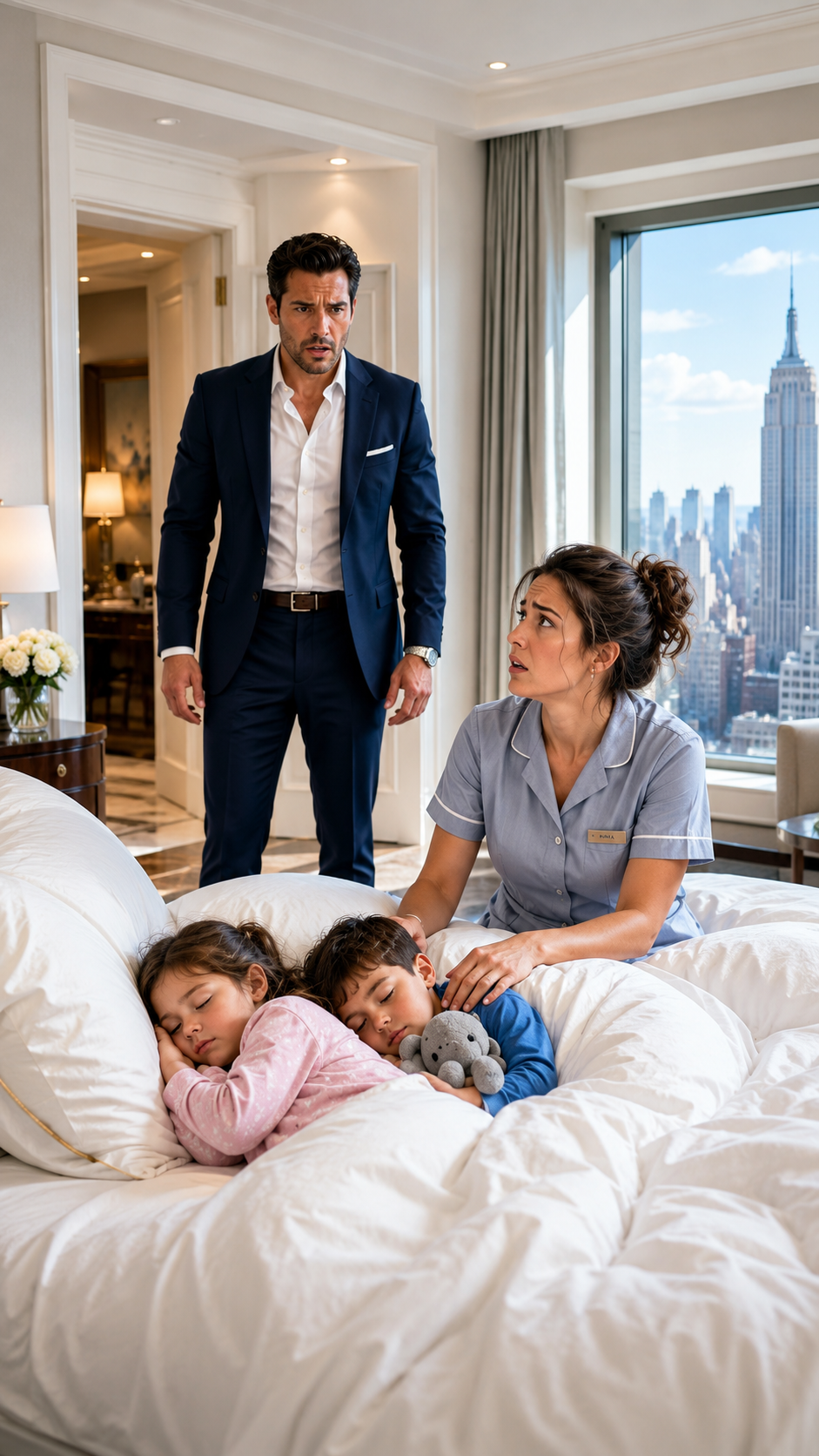
The first thing Rodrigo Alcázar saw as he entered his presidential suite was a small pink sneaker lying on the marble floor.
He froze, the room keycard still between his fingers.
It was 12:43 AM, and the 38th floor of the Gran Alcázar Hotel on Paseo de la Reforma was so silent that he could hear the distant hum of the city through the windows.
Rodrigo had returned for a forgotten folder for the board meeting. He expected to find papers, his jacket draped over the armchair, and maybe a glass of whisky he had left half-finished.
But when he glanced toward the bed, the air caught in his chest.
Two small children were asleep beneath the white sheets.
Twins.
A girl with light brown hair clutching a blue sweater and a boy with tiny fists wrapped around a worn-out stuffed elephant.
They slept pressed against each other, as if the entire world had become dangerous and they only had each other.
First, Rodrigo felt disbelief.
Then, rage.
This wasn’t just any room. This was his private suite. His hotel. His floor. No one came up here without authorization, not even the most senior managers.
The Gran Alcázar wasn’t a roadside motel. It was the jewel of Grupo Alcázar, the hotel chain he had built over 15 years with discipline, coldness, and zero tolerance for mistakes.
Every elevator had cameras.
Every door had logs.
Every movement was recorded.
This was impossible.
Rodrigo walked toward the internal phone to call security.
Then the boy let out a small whimper, almost a broken sigh. The girl, without waking, reached out and grabbed his sleeve.
That simple gesture hit him in a part he had buried years ago.
He crushed it immediately.
It wasn’t tenderness.
It was a security breach.
A scandal.
A legal issue.
Before he could lift the receiver, the door opened behind him.
“Oh my God… no,” a woman whispered.
Rodrigo turned.
In the doorway stood a young woman in a gray maid’s uniform. Her hair was pulled back in a messy bun, her face pale, dark circles under her eyes, and her eyes filled with terror.
Her name tag read: Ana Silva.
For a few seconds, neither spoke.
Then Rodrigo uttered a single word.
“Explain.”
Ana pressed her hands against her chest.
“Mr. Alcázar, please… I can explain. But don’t raise your voice. They haven’t slept well in two days.”
Rodrigo looked at her as if she were speaking madness.
“There are two children sleeping in my bed.”
“I know.”
“In my private suite.”
“I know.”
“Without permission.”
Ana lowered her gaze as if each word were a blow.
Then she looked at the twins, and her face changed. The fear was still there, but something stronger emerged.
Love.
“They are my children,” she said softly. “Their names are Sofía and Samuel. They are three years old.”
Rodrigo fell silent.
Ana swallowed hard.
“This morning, we were evicted from the room we were renting in Doctores. The owner sold the place. We were given a few hours to leave. I had nowhere to take them.”
Rodrigo's anger didn’t fade.
But he hesitated.
“I know I broke all the rules,” she continued. “I know I could lose my job. You weren’t supposed to return until tomorrow afternoon. I checked your schedule. I thought if they could sleep here for a few hours while I finished my shift, I would find something before dawn.”
Rodrigo let out a dry, humorless laugh.
“Did using the owner’s suite as a shelter seem like a good idea?”
Ana blushed with shame.
“No, sir. It seemed like my only idea.”
The answer hit harder than Rodrigo expected.
He lived surrounded by options. He could call a lawyer, a banker, a politician, or a pilot, and someone would answer before the second ring.
His world was one of doors opening.
Ana Silva stood before him with two sleeping children behind her and no doors open.
“I’m going to wake them up,” she said. “We’re leaving right now.”
Rodrigo crossed his arms.
“Where to?”
Ana opened her mouth.
But nothing came out.
He looked at the little backpack lying beside the bed. It held cookies, socks, two folded pajamas, and a children’s book with a torn cover.
A mother who had lost everything still remembered to bring socks.
Samuel whimpered again in his sleep.
Ana rushed to his side and placed a hand on his back. The boy calmed instantly.
Rodrigo observed her in silence.
And suddenly, he no longer saw Ana.
He saw his own mother, returning exhausted from cleaning rooms in an old hotel downtown, still with strength to tuck her children in even though she hadn’t eaten dinner.
Rodrigo swallowed hard.
Then he asked something even he didn’t expect.
“How much time do you need to find a safe place?”
Ana looked at him as if she hadn’t understood.
But before she could respond, the private elevator chimed.
The doors opened.
And the head of security appeared with two guards, looking at the children in the bed as if they had just discovered a bomb.
PART 2
Ana immediately positioned herself in front of the bed.
It was an instinctive, quick, almost fierce movement. The same woman who had trembled in fear just minutes before now seemed ready to confront the entire hotel if anyone touched her children.
Rodrigo raised a hand.
“No one enters.”
The head of security, Ramiro, stopped, confused.
“Sir, we received an alert for unauthorized access. We’re here to remove the employee.”
Ana closed her eyes.
Her career was ending right there.
Rodrigo looked at Ramiro with that coldness that made entire managers tremble.
“I said no one enters.”
“But sir…”
“And I also said to lower your voice.”
Silence fell heavily.
Ramiro complied.
Rodrigo wasn’t a man known for his compassion. At Grupo Alcázar, it was said he could fire someone without changing expression. Some employees called him “the ice boss,” and not always behind his back.
That’s why Ana didn’t understand anything.
Rodrigo picked up the phone.
She tensed.
“Please don’t call the police.”
He looked at her.
“I’m going to order food.”
Ana blinked.
“Food?”
“You look like you haven’t eaten all day.”
Shame flushed her face.
“I’m fine.”
“You’re not.”
Twenty minutes later, a night manager brought hot soup, sandwiches, fruit, warm milk, and chocolate. He asked no questions. No one in that hotel asked questions when Rodrigo Alcázar signed a bill without explanation.
Ana sat on the edge of an armchair, as if she didn’t feel entitled to occupy it fully.
She took the first bite so cautiously it hurt Rodrigo to watch her.
His mother ate like that when she’d say, “I already had dinner, dear,” even though the kitchen had only beans stuck to the pot.
Rodrigo moved closer to the window.
Below, Mexico City sparkled with millions of lights. Cars on Reforma. Distant ambulances. People returning to small homes, to debts, to problems, to families.
For years, he believed that succeeding meant distancing himself from all that.
Distancing himself from hunger.
Distancing himself from rented rooms.
Distancing himself from the humiliation of asking for help.
But that night, in his luxury suite, all of that came rushing back with a small pink sneaker on the marble.
“You should fire her,” he said.
Ana lowered her head.
“Yes.”
“You should call Human Resources.”
“Yes.”
“You should remove her from here right now.”
“Yes.”
Rodrigo turned.
“Do you always agree with whoever threatens you?”
Ana let out a weary smile.
“Only when they're right.”
Rodrigo let out a brief laugh. Almost nothing. But it happened.
Ana seemed surprised too.
The atmosphere shifted just slightly, as if both were standing on different ruins and had just recognized the same dust.
At 1:30 AM, Sofía woke up.
She sat up in bed with tangled hair, looked around the suite, saw her mother, and then Rodrigo.
Instead of crying, she frowned.
“You're really tall.”
Ana covered her mouth with a hand.
Rodrigo looked serious.
“That seems to be the case.”
“Like a post,” Sofía added.
Samuel woke up next, only concerned about finding his elephant. When he had it in his arms, he accepted the fruit as if everything were under control.
In ten minutes, the twins were sitting at the marble table eating bananas and sweet bread.
Sofía was full of questions.
“Do you live here?”
“Sometimes.”
“Why?”
Rodrigo didn’t know how to answer.
Because he worked too much.
Because he didn’t trust anyone.
Because he had houses, but none felt like home.
Samuel, who hardly spoke, looked at him with a strange seriousness.
“Don’t you have a mom?”
The question opened a crack in Rodrigo’s chest.
“Not anymore.”
Samuel nodded as if he understood more than a three-year-old should.
“My grandma isn’t here either.”
Ana stopped chewing.
Rodrigo noticed the gesture.
He didn’t ask.
Not yet.
That dawn, he ordered a vacant staff apartment to be prepared, small but clean, in an internal area of the hotel. He also requested that no one comment on what had happened.
It was a pointless order.
By 8 AM, half the hotel was already whispering.
A maid leaving the presidential floor at dawn.
Two hidden children.
The owner returning at dawn.
In Mexico, rumors don’t take the elevator: they fly.
While Rodrigo was in the board meeting discussing expansion to Monterrey, Cancun, and Guadalajara, his mind drifted to the staff apartment where Ana was trying to keep Sofía and Samuel calm.
The numbers were excellent.
The investors were smiling.
Everything was running perfectly.
And yet, for the first time in years, Rodrigo felt nothing in front of success.
After the meeting, his assistant, Mariana, caught up with him in the hallway.
“Sir, there’s something odd.”
“Define odd.”
“A man called asking about Ana Silva.”
Rodrigo stopped.
“Who?”
“He wouldn’t say. He asked if she worked here and if she had two children with her. He sounded polite but insistent.”
Rodrigo’s jaw tightened.
“What did you tell him?”
“Nothing.”
“Good.”
Mariana handed him a paper with a number.
Rodrigo tucked it away.
He didn’t like coincidences.
That afternoon, he found Ana in the staff cafeteria. Sofía was coloring a unicorn above a microbus. Samuel was drawing a blue dinosaur in boots.
When Ana saw him, she stood up quickly.
“Don’t do that,” Rodrigo said.
“Do what?”
“Stand up every time I appear.”
She smiled faintly.
“Work habit.”
“Break it.”
Sofía raised her crayon-filled hand.
“Mr. Post!”
Rodrigo took a deep breath.
Ana wanted to scold her, but he stopped her with a gesture.
“I’ve had worse names.”
For a moment, they talked about dinosaurs, elephants in shoes, and whether unicorns could drive microbuses without a license.
Ana laughed.
A real laugh.
Rodrigo lingered a second longer than necessary, listening to her.
Then his phone rang.
Unknown number.
The same as the paper.
He stepped into the hallway.
“Alcázar.”
“Thanks for answering,” a man said. “My name is Daniel Rivas. I’m looking for Ana Silva.”
“For what?”
“She has something that belongs to my family.”
Rodrigo narrowed his eyes.
“Be clear.”
“Not over the phone. Just tell her to ask for Margarita Rivas.”
Rodrigo fell silent.
“Who is Margarita Rivas?”
The man breathed.
“The woman your mother cared for before she died. And the reason Ana shouldn’t be hiding in a hotel.”
The call dropped.
Rodrigo returned to the cafeteria with a serious expression.
Ana noticed instantly.
“What happened?”
He placed the paper on the table.
“Who is Margarita Rivas?”
The color drained from her face.
There it was.
The secret.
Ana looked at the twins, making sure they continued drawing.
“Who told you that name?”
“Daniel Rivas.”
Ana closed her eyes.
She didn’t seem surprised. She seemed exhausted from a chase she already knew.
“My mom was a caregiver for Mrs. Margarita during her last years,” she said quietly. “She was a wealthy, lonely, sick lady. She lived in an old house in Coyoacán.”
Rodrigo sat across from her.
“Go on.”
“Mrs. Margarita didn’t trust her family. She said her nephews were just waiting for her to die to take everything. My mom cared for her until the end. Before she died, the lady gave her a sealed envelope.”
Ana pulled out an old envelope from her bag, covered with transparent tape at the corners.
“My mom gave it to me when she got sick. She told me to keep it and not open it until I found someone who could protect us.”
Rodrigo looked at the envelope.
“And you never opened it?”
“I was scared. Then my mom died, I lost the room, I lost almost everything. This was all I had left.”
Rodrigo extended his hand.
“Open it.”
Ana hesitated.
Sofía laughed in the background over her driver unicorn.
Samuel gave wings to the dinosaur.
And Ana broke the seal.
Inside were three documents, a USB drive, and a handwritten letter.
Rodrigo read the letter first.
His expression changed page by page.
Mrs. Margarita Rivas hadn’t died without heirs. She had had a daughter in secret, given up for adoption under pressure from her family when she was young.
That daughter was Ana’s mother.
And Ana, by blood, was the legitimate granddaughter of Margarita Rivas.
But that wasn’t all.
The letter included copies of DNA tests, birth certificates, photographs, and an unfiled complaint: Daniel Rivas and his father had forged documents to seize three properties, an investment account, and a stake in a boutique hotel chain in San Miguel de Allende.
Ana hadn’t just been evicted from a tenement.
She had been stripped of an inheritance that could change her life and her children’s.
Rodrigo felt a cold fury.
“Did you know this?”
Ana shook her head, tears in her eyes.
“No. I swear I didn’t. My mom only said there were truths that could kill if they fell into the wrong hands.”
Rodrigo connected the USB drive to his laptop.
There were audios.
Videos.
One file showed Daniel Rivas arguing with a notary. Another showed a lawyer talking about “erasing the Silva girl before anyone connects her with Margarita.”
Ana covered her mouth.
“That’s why they were looking for me.”
Rodrigo understood everything.
The eviction hadn’t been a coincidence.
The building hadn’t been sold overnight by chance.
They had pushed her into the street to force her to relinquish the envelope or disappear.
“What’s going to happen?” Ana asked, her voice breaking.
Rodrigo closed the laptop.
“Now they’re going to learn the rules.”
The next morning, Daniel Rivas arrived at the hotel dressed in a suit, with a polite smile and expensive cologne. He was accompanied by a lawyer and two men who pretended to be assistants.
He asked to speak with Ana.
Rodrigo received him in a conference room.
“Mr. Alcázar,” Daniel said, “I believe this situation is not beneficial for anyone. Miss Silva is an unstable employee. We can resolve this discreetly.”
Ana was behind the tinted glass with Mariana, trembling.
Rodrigo didn’t smile.
“Discreetly like forging documents? Or discreetly like throwing a mother with two children out on the street?”
Daniel lost color for one second.
Just one.
“I don’t know what you’re talking about.”
Rodrigo pressed a button.
On the screen appeared the video of the notary.
Then the audio.
Then the scanned and enlarged letter from Margarita Rivas.
Daniel’s lawyer stopped breathing normally.
“This is illegal,” Daniel stammered.
“Yes,” Rodrigo replied. “What you did was illegal too.”
The door opened.
Two lawyers from Grupo Alcázar entered, along with a public notary and an agent from the capital’s prosecutor’s office.
Ana appeared at the end, with Sofía and Samuel holding hands.
Daniel looked at her with hatred.
“You don’t know what you’re getting into.”
Rodrigo stood up.
“Don’t speak to her like that.”
“And what do you gain defending a maid?”
The room fell silent.
Rodrigo looked at Ana. He saw a mother who had had to hide her children in a stranger’s bed to keep them safe. He saw his own mother carrying buckets, going down stairs, swallowing her pride.
Then he looked at Daniel.
“I gain sleeping soundly for the first time in years.”
The case exploded.
The documents were solid. The corrupt notary confessed. The properties were frozen. The accounts were investigated. Daniel Rivas and his father ended up arrested for fraud, threats, and forgery.
The news spread like wildfire on social media.
Some said Ana had gotten lucky.
Others said no millionaire helps without wanting something in return.
Some hotel employees defended Rodrigo.
Others remembered all the cold firings he had signed before and wondered if one good deed erases a lifetime of hardness.
Ana didn’t ask for fame.
She asked for safety.
With legal support, she recovered part of Margarita Rivas’ inheritance. She didn’t become boastful or change overnight. She rented a bright apartment in Narvarte, enrolled the children in a good school, and bought two small beds: one with dinosaurs and another with unicorns.
She also returned to the hotel.
But not as a maid.
Rodrigo offered her the chance to direct a new internal support program for employees in crisis: temporary housing, daycare, legal advice, and an emergency fund.
“I don’t want charity,” Ana told him.
“It’s not charity,” he replied. “It’s overdue justice.”
Months later, at the program’s inauguration, Rodrigo took the stage in front of employees, press, and executives.
He didn’t talk about expansion.
He didn’t talk about money.
He talked about his mother.
He told how she had cleaned rooms for years in hotels where no one knew her name. He told how he had built an empire believing that toughness was the only way to survive.
Then he looked at Ana, who was holding Samuel while Sofía waved to the audience like a soap opera star.
“One night, I found two children sleeping in my bed,” Rodrigo said. “I thought someone had broken the rules of my hotel. But the truth is I had been breaking a more important rule for years: forgetting where I came from.”
No one applauded immediately.
Because some truths don’t provoke applause.
They provoke knots in the throat.
Ana lowered her gaze with tears.
Sofía, not understanding the solemnity of the moment, shouted:
“Mr. Post isn’t so grumpy anymore!”
The room erupted in laughter.
Rodrigo laughed too.
And that laughter, for the first time, didn’t sound like an accident.
That night, as he closed the presidential suite, Rodrigo saw the spotless marble where months earlier had been the small pink sneaker.
The hotel was still his.
The empire still stood.
But something had changed.
Because sometimes life doesn’t enter through the front door with an appointment and an expensive suit.
Sometimes it enters after midnight, with two sleeping children, a terrified mother, and an old envelope capable of proving that mercy doesn’t weaken anyone.
What divides people isn’t always wealth.
Sometimes it’s something simpler and more brutal: who had an open door when they had none left.





