PART 1
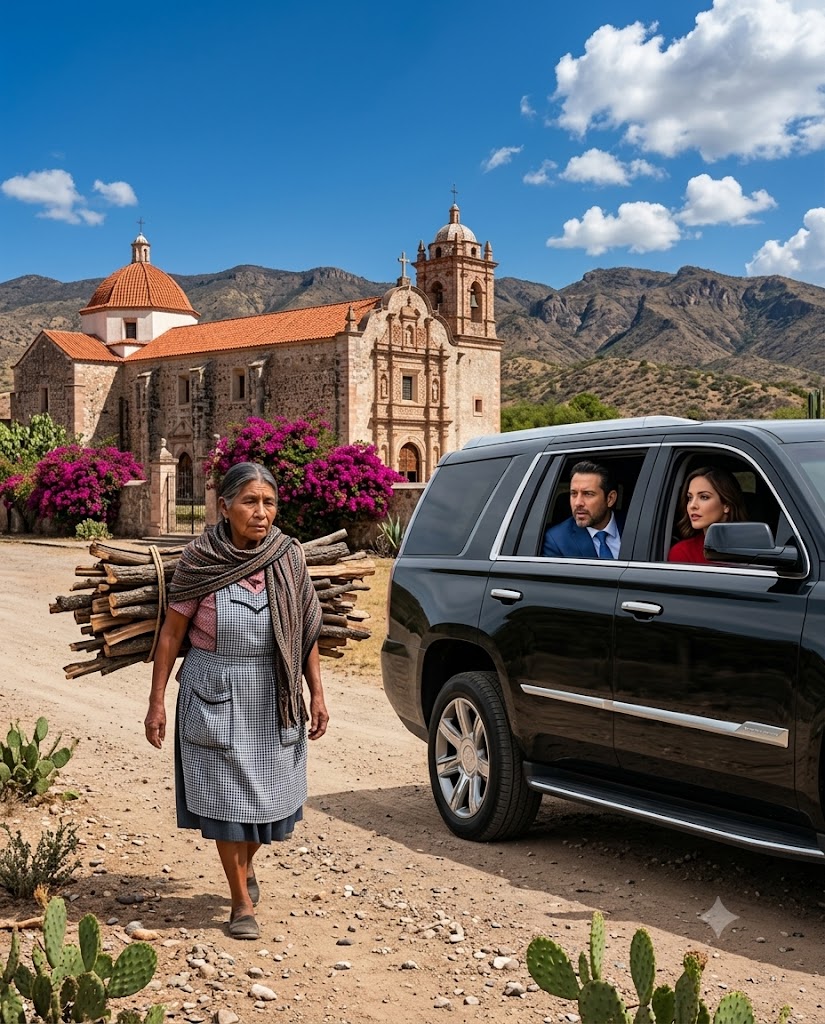
Doña Milagros trudged along the path in San Pedro de los Huizaches, a bundle of firewood strapped to her back, the sun scorching her neck like a brand.
At 72, her feet were stuffed into worn sandals, and her hands were cracked from washing others' clothes, grinding chiles, and gathering dry branches since before the roosters crowed.
She didn’t walk for pleasure.
At home, her 15-year-old grandson, Emiliano, awaited her in their adobe shack, his patched-up high school uniform, a notebook bursting with dreams, and a hunger she pretended not to see.
Doña Milagros could skip dinner.
But Emiliano would never drop out of school.
Never.
Halfway up the hill, a massive, gleaming white truck roared up behind her, kicking up dust. It was speeding too fast for that narrow road.
The horn blared three times.
Doña Milagros tried to step aside, but loose stones sent her off balance.
The driver’s window rolled down slowly.
A man in a fine shirt, expensive glasses, and a gold watch poked his head out, disgust etched on his face.
— Hey, lady, don’t you realize you’re in the way? Get out before you scratch my truck.
She swallowed hard.
— I’m coming, young man. Just give me a moment, the firewood is heavy.
Beside him, in the passenger seat, sat an elegant woman, her hair sleek, nails painted red, and a necklace gleaming as if it had never seen dust.
She glanced at the old woman for barely a second.
Something flickered across her face, like a memory piercing her chest.
But she pressed her lips together and said nothing.
The man wrinkled his nose.
— Good grief. It smells like smoke, sweat… pure poverty.
Doña Milagros lowered her eyes.
She wanted to move to the edge, but the load shifted, and she fell to her knees on the dirt road. The branches tumbled and rolled before the tires.
Pain shot up her leg like a bite.
The woman in the passenger seat opened her mouth, as if she were about to say something.
But the man accelerated.
A tire crushed the thickest branch.
The wood snapped with a dry crack.
— Learn not to block the way of important people —he spat out before rolling up the window.
The truck sped off, leaving Doña Milagros covered in dust, her knee bleeding and her soul knotted.
She didn’t cry.
The poor, she thought, don’t have time to completely fall apart.
When she got home, Emiliano was sitting at a rickety table doing homework. He jumped up when he saw her.
— Grandma, what happened to you?
— Nothing, dear. I just slipped.
Emiliano looked at the blood. Then he looked at the broken firewood, marked with black rubber.
His face hardened.
— That wasn’t a fall.
She wanted to remain silent, but the boy grabbed the broken branch between his hands.
— Tell me who did this.
Doña Milagros sighed.
— A rich man. One of those buying up land by the river. He was with a very well-dressed woman.
Emiliano clenched his jaw.
— The ones from “Green Future.”
The next day, the town square was filled with tarps, cameras, food packages, and banda music. The same man stood atop the platform, smiling like a fairground saint.
Beside him, handing out bags of rice, was the elegant woman.
Emiliano froze.
The bag of bread he carried fell to the ground.
— Grandma… —he said with a cracked voice—. That woman is my mom.
PART 2
Doña Milagros felt the world tilt beneath her.
For 11 years, she had told Emiliano that his mother, Daniela, had gone to work far away because she had no choice. That one day she would return with money, new clothes, and a long-held hug.
She had lied so he wouldn’t grow up thinking he wasn’t worth even a goodbye.
But Daniela wasn’t far away.
Daniela was in the square, dressed in white linen, smiling for the cameras, standing next to the man who had humiliated her own mother just the day before.
Emiliano took a step toward the platform.
Doña Milagros grabbed his arm.
— No, dear. Wait.
— Wait for what, grandma? —he replied, his eyes red—. Another 11 years?
On the platform, Arturo Salcedo spoke into the microphone with a politician's voice.
— San Pedro deserves development. It deserves investment. It deserves to leave behind the poverty that has held us back for so long.
The word hit Doña Milagros again.
Poverty.
The same word he had spat on the road when there were no cameras or applause.
The line moved forward. Women in aprons received oil and beans. Farmers grabbed food packages as a photographer urged them to smile.
Daniela handed out bags without looking too closely at the people.
Until she saw Emiliano.
Her smile vanished.
The package she was holding fell to the floor. A bag of rice burst open, and the grains scattered across the platform.
— Emiliano… —she whispered.
The boy climbed two steps.
— What a miracle. You still remember my name.
Arturo turned to her, uncomfortable.
— Daniela, what’s going on?
She tried to compose herself.
— Nothing. It’s… a young man from the village.
Emiliano let out a dry laugh.
— Wow. You used to call me your son. Now I’m just a young man from the village.
The square fell silent.
Murmurs began slowly, like embers igniting among the crowd.
Doña Milagros struggled to climb up. Her injured knee burned, but she stood next to Emiliano.
Daniela looked at her and lowered her gaze.
— Mom…
Arturo’s eyes widened.
— Mom? Is this woman your mother?
Doña Milagros lifted her face.
— Yes. The old woman who smelled like smoke yesterday is your wife’s mother. And the boy she just denied is your son.
The microphone was still on.
The phrase echoed throughout the square.
A girl pulled out her phone. Don Beto, the butcher, stopped organizing boxes. People began to gather.
Arturo snatched the microphone and forced a smile.
— Neighbors, please, don’t turn this into gossip. These are family matters.
— You made it a spectacle when you came to buy applause with food packages —said Doña Milagros.
Daniela cried silently.
Emiliano looked at her as one looks at someone who hurts more alive than dead.
— Why didn’t you ever come back?
Daniela wanted to touch him.
— Because I couldn’t, son.
He pulled back.
— Don’t call me son just because there are people watching.
The phrase shattered her.
Arturo lost his patience.
— That’s enough. Ma'am, get down with the kid before I call security.
Doña Milagros reached into her shopping bag.
Two bodyguards moved swiftly.
But she pulled out the broken branch.
She lifted it with both trembling hands. The black tire mark still crossed the wood.
— Yesterday, this man threw dust in my face. He called me a nuisance. Said I smelled like poverty. Then he drove his truck over my firewood, which was my food for the week.
Then she looked at Daniela.
— And my daughter was sitting next to him.
The square erupted in murmurs.
Daniela shook her head, crying.
— I didn’t know it was you. You had your shawl on, there was dust, I…
— A daughter recognizes her mother even if she comes covered in dirt —Doña Milagros interrupted—. But you learned to look like a rich woman before you learned to say sorry.
Daniela sat on the step, not caring about dirtying her dress.
— I was ashamed to come back —she confessed—. I left saying I would send money, but everything went wrong. I slept in borrowed rooms, cleaned houses, went hungry. Then I met Arturo. He offered me a home, a name, a truck… and asked me to bury my past.
Emiliano listened with his fists clenched.
— And was I your past?
Daniela didn’t respond.
Arturo seized her arm forcefully.
— Shut up. You don’t owe him any explanations.
That gesture ignited Doña Milagros.
— Let her go.
Arturo looked at her with disdain.
— You don’t order me around, nosy old hag.
The insult echoed through the speakers.
Now no one could pretend they didn’t understand.
Doña Carmen, the tortilla maker, shouted from the line:
— That’s how he talks when the photo doesn’t suit him!
Then a farmer raised his hand.
— They tried to buy my plot for 25,000 pesos, and later I found out they were going to resell it for millions.
Another man added:
— My dad signed to receive support, and then his signature appeared on a sale contract.
A teacher from the village raised her voice:
— The foundation asked for copies of IDs saying they were for scholarships. Several families already have problems with papers they never read.
Arturo turned pale.
— That’s defamation.
— No —said Emiliano, pulling out his phone—. That’s called evidence.
The boy played a video recorded from a distance. It showed the white truck on the road, Doña Milagros falling, and Arturo’s voice saying:
— It smells like smoke, sweat… pure poverty.
Then the sound of wood cracking under the tire followed.
Emiliano swallowed hard.
— My friend Toño filmed it. He was riding his bike behind my grandmother. He sent it to me last night. She didn’t want to make a scene because she still believes dignity should be kept quiet.
The crowd was frozen.
The local journalist was already broadcasting live.
Comments surged like flames.
“That’s Arturo Salcedo.”
“Isn’t he from Green Future?”
“He humiliated his mother-in-law?”
“And the wife abandoned her son?”
Arturo tried to leave the platform, but several neighbors stood in front of the stairs. No one touched him. No one insulted him.
They just wouldn’t let him pass.
Daniela slowly rose, her makeup smeared.
— I signed papers to buy land in my name —she said—. Arturo told me it was legal, that it was for the good of the project.
— Daniela —he growled—, shut up.
But she didn’t obey anymore.
— He also asked me to convince my mom to sell her house. They want to put the entrance to the eco-hotel there.
Doña Milagros felt a blow to her chest.
— My house?
Daniela nodded, crying.
— That’s why we came back. It wasn’t to help the village. We came for your land.
Emiliano looked at his mother as if she had just abandoned him again.
The betrayal was no longer just leaving.
It was returning after 11 years to take away the only thing they had left.
Doña Milagros lowered the broken branch and placed it before Arturo’s expensive shoes.
— Here is your progress. Stepping over the old, buying hunger, and using a daughter to steal her mother’s roof.
An elderly woman dropped her food package to the ground.
Then another.
Afterward, a man let go of a bag of beans. Then oil, cans, rice, cookies. One by one, the food packages fell as if they burned their hands.
No one wanted to take them.
Doña Carmen said loudly:
— Hunger can be endured. Humiliation cannot be swallowed.
Arturo exploded.
— Ungrateful! That’s why you’re still the same! Without people like me, this town is worth nothing!
The microphone remained on.
That phrase was his ruin.
In less than an hour, the video was on Facebook,
Arturo didn’t end up in jail immediately.
Rich men rarely fall quickly.
But he fell from the only thing he valued most: his image as a benefactor.
Daniela arrived at the adobe house three days later.
She wore no jewels or dark glasses. She walked alone, with a bag of sweet bread, fruit, and an envelope of money.
Doña Milagros was sweeping the patio.
Emiliano was inside, behind the curtain.
— Mom —Daniela said—. I know I have no right to ask for anything.
— Then don’t ask —the old woman replied.
Daniela lowered her head.
— I just want to see him.
Doña Milagros leaned the broom against the wall.
— Your son isn’t a food package. You don’t come, hug him for the photo, and then disappear again. If you want to return, you’ll have to knock on this door many times and bear it when it doesn’t open.
Daniela cried silently.
— I deserve it.
— Yes —said Doña Milagros—. But he didn’t deserve to wait for you for 11 years.
Emiliano heard everything.
He didn’t come out.
That night, they had beans, reheated tortillas, and salsa from a molcajete. Emiliano placed the broken branch in the middle of the table.
— I’m going to keep it.
Doña Milagros looked at him sadly.
— For what, dear? That’s no good even for kindling.
He ran his fingers over the rubber mark.
— It’s useful. To remind me that someone can step on you, but they can’t convince you that you were born to live bowed.
Doña Milagros cried for the first time without hiding.
In the village, there was debate for weeks. Some said Daniela deserved a chance because she was manipulated too. Others said a mother who abandons cannot return demanding forgiveness.
Doña Milagros never forced Emiliano to forgive her.
Because she knew that forgiveness, when demanded, resembles too closely another humiliation.
Months passed.
The hotel project was suspended. The complaints continued to advance. The adobe house remained poor, but no one managed to take it away.
Emiliano kept studying.
Daniela kept coming, sometimes with bread, sometimes just with tears. Sometimes they let her in. Other times they didn’t.
And every time a luxury truck crossed through San Pedro de los Huizaches, people no longer stepped aside in fear.
Doña Milagros walked slowly, with her clean shawl and her head held high.
Because that day the village understood something no rich man could buy with food packages:
dignity can have hands full of dirt and smell like smoke, but when it stands tall before everyone, it shakes even the man who thought he owned the road.