PART 1
—Daddy's snake is back... and it's biting me —Sofía whispered to 911, her voice so faint that the operator had to press the headset closer to her ears.
On the other end, there was no calm house.
Heavy footsteps echoed on the floor, a door slammed shut, and the short, stifled breaths of a girl trying not to cry were audible.
Maribel Ortega had been taking emergency calls in Guadalajara for 14 years. She had heard screams, crashes, fires, midnight brawls, and mothers begging for ambulances.
But that phrase tightened her chest in a way that felt different.
Because Sofía wasn’t talking about an animal.
—Honey, tell me your name —Maribel asked, lowering her voice.
—Sofía.
—How old are you, Sofía?
—8.
The location flashed on the screen: a house in the Jardines del Bosque neighborhood, a beautiful area with black gates, bougainvilleas on the walls, and neighbors greeting each other as if they all knew everything about everyone.
The address was Calle Naranjo 218.
Registered owner: Mauricio Rivas.
—Where are you right now, Sofía?
The girl took time to respond.
—In the closet.
A chill ran down Maribel's spine.
—Is your dad with you?
A thud echoed in the background. Then a low, annoyed male voice spoke, something that couldn’t quite be understood.
Sofía’s breathing quickened.
—He says that if I talk, my mom won’t wake up.
The operator activated high priority. The nearest patrol was 4 minutes away.
4 minutes that, for a girl hidden in a closet, could feel like a lifetime.
The unit arrived at 10:18 PM. Officer Julián Torres got out first, followed by his partner, Officer Camila Navarro.
The house was lit from within. In the yard, a pink bicycle leaned against the wall, and a pot of wilted poinsettias sat by the entrance.
Everything seemed normal.
And that was what made it scarier.
Julián rang the doorbell twice.
The door opened, revealing Mauricio Rivas, 43, impeccably dressed in a white shirt, denim pants, hair styled as if he had been waiting for them.
He smiled.
—Good evening, officers. Did something happen?
Camila studied his face. The smile was there, but his eyes didn’t smile.
—We received an emergency call from this house. A minor asked for help.
Mauricio let out a short laugh.
—It must be my daughter. She has a vivid imagination. Ever since her mother left us, she makes up stories to get attention.
—We need to see her —Julián said.
The smile vanished slightly.
—She’s asleep.
—Then we’ll wake her for a minute and check that she’s okay.
Mauricio placed a hand on the door frame.
—You’re not coming into my house for a prank.
In Julián's radio, Maribel's firm voice came through:
—Unit 12, the call is still active. Movement can be heard inside the residence.
Camila noticed a landline phone on a small table in the living room.
It was off the hook.
—Did your daughter use that phone? —she asked.
Mauricio turned his head too quickly.
—I don’t know. She sometimes plays.
Then, from upstairs, a small whimper could be heard.
It wasn’t the wood. It wasn’t the air. It wasn’t a pipe.
It was a girl trying not to make noise.
Camila stepped inside.
—Sofía, I’m Officer Camila. You’re not in trouble.
Mauricio turned toward the stairs.
—Don’t talk to her.
Julián positioned himself between him and the hallway.
—Mr. Rivas, step aside.
—This is my house.
—And there’s a girl asking for help inside.
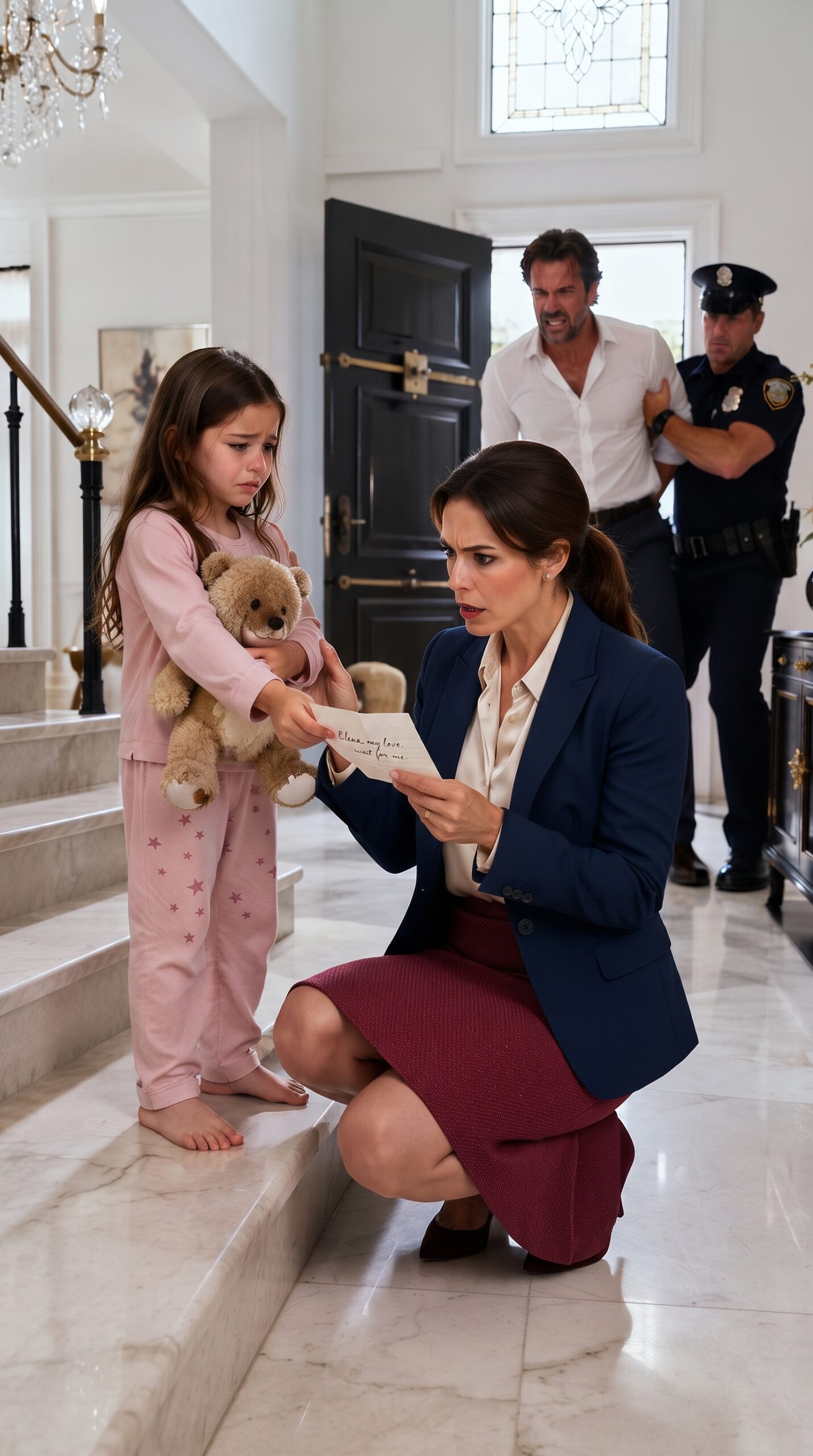
A tiny hand appeared over the banister. Then a girl with disheveled hair, bare feet, and a blue pajama, hugging an old teddy bear.
Sofía wasn’t crying loudly.
That was what hurt Camila the most.
Children who learn to cry in silence have already learned too much.
—Sofía —Mauricio said with false sweetness—. Go back to your room, my love.
The girl tightened her grip on the bear.
She stepped down 1 stair.
Then another.
Mauricio tried to approach, but Julián stopped him.
—No.
When she reached the bottom, Sofía slipped her hand into a seam on the bear and pulled out a paper folded many times.
Mauricio lunged at her.
—Give me that!
Julián held him back tightly.
Camila unfolded the paper.
The childish handwriting read:
“If I don’t wake up tomorrow, tell my mom that I waited for her.”
Camila looked up.
Sofía pointed toward the upstairs hallway.
And at that moment, a closed door creaked slowly, as if someone had been listening from the darkness.
PART 2
Camila didn’t rush upstairs. She knew a sudden reaction could make Mauricio explode.
She signaled to Julián to keep his distance from Sofía and began to ascend the stairs, one by one.
—Who’s upstairs? —she asked.
Mauricio let out a dry laugh.
—No one. I told you, my daughter makes things up. She’s just like her mother, very manipulative.
Sofía shrank at that.
Not out of surprise.
Out of habit.
Julián noticed it and ordered him to stay still.
—You don’t have the right to search my house —Mauricio said.
—We have an active call from a minor and clear signs of danger —Julián responded—. We do have the right.
Maribel continued listening from the dispatch center. On the open line, she could hear Camila’s footsteps, Sofía’s breathing, and Mauricio’s increasingly nervous tone.
Then another voice was heard.
A woman’s voice.
Very weak.
—Sofía...
Camila stopped in the hallway.
—Did you hear that?
Mauricio paled.
—It’s the TV.
But there was no television on.
Upstairs were 3 doors. One was the bathroom. Another led to a children's room filled with dolls, books, and a moon lamp.
The third one was locked from the outside.
Camila looked at the padlock.
—Why does an interior door have a lock on this side?
Mauricio tried to rush up.
—I keep personal documents in there!
Julián held him back.
—Not another step.
Camila knocked on the door.
—Police. Is anyone there?
Silence.
Then, the same voice:
—Please...
Camila requested authorization over the radio. Once granted, she forced the lock with Julián’s help, who had already cuffed Mauricio when he attempted to run to the kitchen.
The door opened.
There were no documents.
Only a windowless room, a mattress on the floor, a nearly empty bottle of water, and a woman sitting against the wall, thin, pale, her face hollowed from days of terror.
Sofía screamed:
—Mom!
The woman raised her arms as best she could.
—My girl...
Camila felt the air leave the house.
Mauricio had sworn for months that Valeria, Sofía’s mother, had left with another man.
He told everyone at school. In the family. At Sunday dinners. In the group chats.
But Valeria hadn’t left.
She was locked in her own home.
Downstairs, Mauricio began to shout.
—She’s crazy! You don’t understand! That woman is dangerous!
Sofía clung to Camila’s arm.
—He said my mom didn’t love me anymore —she whispered—. He said that if I talked, the snake would bite her too.
Valeria tried to stand, but fell to her knees.
Camila covered her with a blanket.
—You’re safe now —she said.
But she knew that wasn’t completely true.
Because the worst was just beginning.
When they searched Sofía’s room, they found more papers hidden inside the bear. Drawings of a black snake wearing men’s shoes. Fractured phrases. Big doors. A small girl inside a box.
On one sheet, she had written:
“Dad behaves well when visitors come.”
That phrase broke something in Julián.
Because Mauricio didn’t seem like a monster.
He was an accountant. He greeted everyone. Organized holiday gatherings. Took Sofía to school with a cute lunchbox. Posted pictures with captions like “my princess” and helped at bake sales.
The monster had no scales.
He had an ironed shirt and a reputation as a good dad.
On the nightstand, behind a first communion photo, they found an old, switched-off cell phone. Valeria explained, her voice breaking, that before Mauricio locked her up, she managed to record an argument.
In the audio, Mauricio could be clearly heard:
—No one will believe a fanciful girl. And even less you. I pay for the school. I talk to the teacher. I talk to everyone. You are nobody without me.
Camila had to take a deep breath.
Justice isn’t built on anger.
It’s built on evidence.
Paramedics carried Valeria out on a stretcher. Neighbors began to peek, some with shame, others with that ugly morbid curiosity.
Then doña Teresa, Mauricio’s mother, appeared, wrapped in a robe and holding a rosary.
—What are you doing to my son? —she shouted—. Valeria has always been a liar!
Sofía hid behind Camila.
Doña Teresa pointed at her.
—Look what you caused, kid!
Valeria, from the stretcher, lifted her head with a strength no one expected.
—No —she said—. She didn’t cause anything. She saved us.
Sofía looked at her mom as if those words opened a door within her.
At the prosecutor’s office, Sofía wasn’t forced to testify that night. A psychologist from the DIF requested that no one pressure her. They didn’t want her to repeat with adult language what she had barely been able to name as “snake.”
The priority was to protect her.
Valeria was taken to the hospital. She was dehydrated, had old bruises, and a fear that didn’t show up in any X-ray.
Every time a door closed, she trembled.
Every time she heard Mauricio’s name, she searched for Sofía with her eyes.
Mother and daughter reunited hours later in a white room, with a social worker nearby.
Sofía entered slowly.
She didn’t run.
Children who have lived under threats learn to distrust even happiness.
Valeria opened her arms.
—Forgive me, my love.
Sofía stood still.
—Did you really believe me?
The question broke Valeria more than any blow.
—I believed you from the first day —she said, crying—. That’s why he wanted to separate us. That’s why he locked me up. He told me that if I spoke, he would hurt you more. I thought that by staying silent, I was protecting you, but I was wrong. Forgive me, my girl.
Sofía looked at the floor.
—He said you left because I was bad.
Valeria brought a hand to her mouth.
—No. Never. You are not bad. You were braver than all of us.
Sofía took 1 step.
Then another.
In the end, she let herself be embraced.
It wasn’t a movie hug. It didn’t heal everything. It didn’t erase the fear. But for the first time in a long while, the two breathed without Mauricio’s permission.
The investigation moved forward carefully.
The 911 call was key. Maribel delivered the complete audio, with time, duration, recorded phrases, and exact location.
Valeria’s cell phone provided recordings, photos of bruises on doors, and messages where Mauricio controlled every move.
They also found a neighborhood camera that recorded Mauricio days before taking out bags with Valeria’s clothes and telling a neighbor:
—She finally left.
But in the video, Valeria was never seen leaving.
That was the twist that silenced many.
Mauricio had fabricated a complete disappearance in front of everyone.
And several believed him because it was more comfortable to trust the educated man than to listen to a scared girl.
Doña Teresa returned to the prosecutor’s office to see Sofía. They didn’t allow her.
—I’m her grandmother —she insisted—. My son would never do that.
Valeria, sitting on the other side of the hallway, looked at her without lowering her gaze.
—You saw things.
Doña Teresa tightened the rosary.
—Don’t make things up.
—You saw how Sofía stopped wanting to be alone with him. You saw how she cried without explanation. You saw when I asked for help, and you told me: “Don’t make a scene, Mauricio is a good father.”
Doña Teresa opened her mouth but found no defense.
Because deep down, she did remember.
And remembering was also a condemnation.
The trial wasn’t swift. There were hearings, expert testimonies, protected testimonies, and legal debates.
Mauricio’s defense tried to paint Valeria as unstable. Tried to say that Sofía was impressionable. Tried to use happy family photos as if an old smile could erase a night of terror.
But the evidence held firm.
The 911 audio.
The locked room.
The papers inside the bear.
The drawings.
The recording of threats.
The condition in which they found Valeria.
And the camera that revealed the lie.
When the judge issued preventive detention and protective measures for Sofía and Valeria, no one applauded.
There was no celebration.
Only silence.
Because when justice arrives, it doesn’t always bring joy. Sometimes it merely confirms everything many preferred not to see.
Months later, Maribel received a letter at the dispatch center.
It had no return address. Only a drawing of a bear with a sewn ear.
Inside there was a sheet written in a child’s handwriting:
“Thank you for listening to me. I thought I was speaking quietly, but you heard me.”
Maribel read the letter 3 times and placed it in the drawer where she kept things that reminded her why she continued doing this work.
Camila saw Sofía again at a DIF event in a small park.
The girl was sitting next to Valeria, her hair tied back, with the bear on her lap. The ear was already stitched up with purple thread.
—Look —Sofía said—. It doesn’t fall off anymore.
Camila knelt in front of her.
—It looks strong.
Sofía petted the plush toy.
—The doctor says that scars aren’t anyone’s fault.
Camila felt her eyes fill with water.
—The doctor is right.
Before leaving, Sofía handed her a drawing.
It wasn’t a snake.
It wasn’t a closed door.
It was a house with open windows. Outside were 3 figures: a woman, a girl, and a bear. Above was a huge sun drawn in yellow crayon.
In one corner, it read:
“The secrets that hurt shouldn’t be kept.”
Some time later, when someone in the neighborhood said that “these things don’t happen in decent families,” Valeria replied without wavering:
—That’s exactly what allows them to happen.
And for the first time, many fell silent.
Because violence doesn’t always scream.
Sometimes it greets you on the street, pays tuition, posts pretty pictures, and serves coffee to neighbors.
Sometimes everyone calls it “a good father.”
Until an 8-year-old girl, hidden in a closet and trembling with a bear in her arms, dares to speak the truth.
And the truth, when it enters a house where everyone pretended not to see, doesn’t knock on the door.
It tears it down.