PART 1
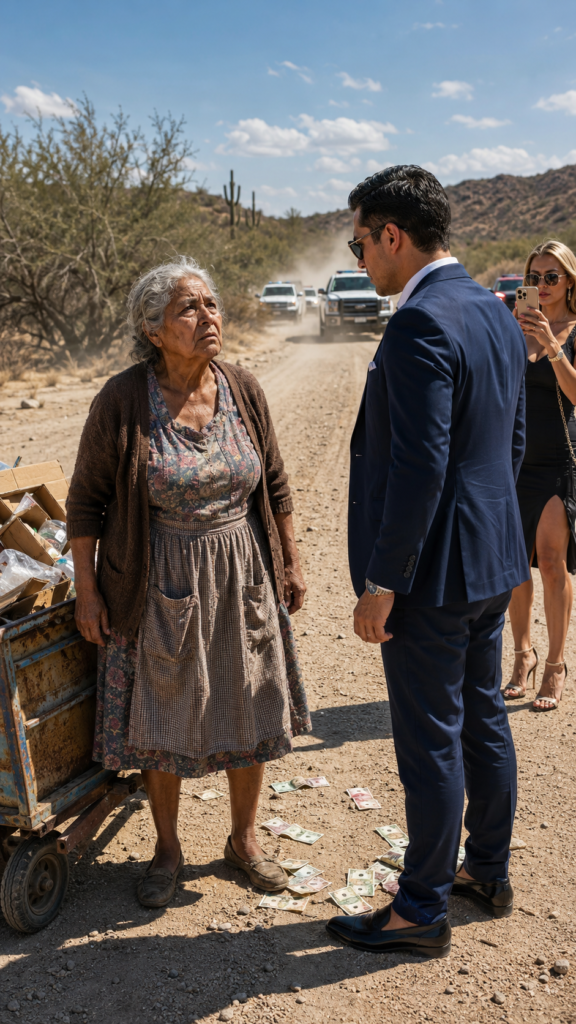
Under the sun of Hermosillo, where even the air seemed to burn, Mercedes Valenzuela pushed a cart filled with cardboard, cans, and empty bottles.
At 63, her hands were cracked, her back hunched, and a gaping absence was embedded in her chest.
Her son Julián had left ten years ago with a scholarship to study engineering in Monterrey.
To cover the expenses, Mercedes sold her wedding rings, an old sewing machine, and the small plot of land her mother had left her.
"When I return with my degree, you won't have to scavenge for another bottle, Mom," Julián promised before boarding the bus.
But he never came back.
For years, brief messages arrived from different phones.
"I'm fine."
"Don't look for me."
"I'll be back soon."
Mercedes wanted to believe them, even though Julián had never spoken to her so coldly.
That afternoon, a black truck screeched to a halt in front of the dump. From the driver’s side emerged a man in a gray suit, dark glasses, and a luxury watch.
Mercedes recognized the face immediately.
"Julián!"
She ran towards him, but the man raised a hand.
"Don't touch me, ma'am."
From the truck also descended a young woman named Renata, dressed like an influencer, filming with her cell phone.
"Is this your mom? Seriously, babe, how intense. You said she lived humbly, not that she smelled like this."
Mercedes felt shame, but also something worse: this man had her son’s face, yet lacked his gaze.
"I sold everything for you to study," she said. "I waited for you every birthday."
He let out a dry laugh.
"Well, no one asked you to make such a dumb investment."
He pulled out several 500 peso bills and threw them onto the ground.
"Pick that up and stop saying she's my mother. I have clients, partners, and a reputation. I'm not going to carry around a scavenger."
Renata continued filming while laughing.
Mercedes did not pick up the money.
Then the man shoved her.
She fell to her knees on the gravel, palms scraped, blood mixing with the dust.
"Come on, pick it up," he ordered. "That's more than you earn in months."
Mercedes lifted her face.
She wasn’t crying.
Because for the past four years she had known that the real Julián was dead.
She also knew that this man had returned not to see her, but to force her to sign something.
And when three vehicles from the Prosecutor's Office appeared at the end of the road, the false son stopped smiling.
PART 2
Renata slowly lowered her cell phone.
The man in the suit looked at the road and then at Mercedes, as if trying to gauge how much this woman, whom he had just thrown to the ground, knew.
Two agents emerged from the vehicles, a forensic expert and a gray-haired man who walked with a slight limp.
It was Esteban Valenzuela, Mercedes’ husband and the father of the real Julián.
For eight years, Mercedes believed that Esteban had abandoned them. After their son disappeared, he left a single note:
"I will find him, even if I have to cross the entire desert."
She thought it was just another broken promise.
She didn't know that Esteban had slept in terminals, checked hospitals, and inquired at shelters and mass graves in Sonora, Chihuahua, and Nuevo León.
She also didn’t know that he had followed the trail of Nicolás Duarte for years.
Julián’s best friend.
The boy Mercedes had fed since he was twelve because his mother disappeared for weeks, and his stepfather beat him.
Nicolás had eaten at her table, worn Julián’s clothes, and slept under her roof.
Julián called him brother.
Esteban stopped in front of the man in the suit.
"State your real name."
"I am Julián Valenzuela."
"You can't even respect the dead while lying."
Renata looked at her fiancé.
"Why did he say 'the dead'?"
"Because they are confused," he replied. "These people want money. The lady is sick."
An agent helped Mercedes to her feet. She then showed a photograph of a broken chain with a medal of the Virgin of Guadalupe.
Mercedes recognized it.
She had given it to Julián when he turned fifteen. On the back, she had engraved:
"Always return, son."
"Four years ago, human remains were found near Santa Ana," the forensic expert explained.
"Genetic testing confirmed they belong to Julián Valenzuela, biological son of Mercedes and Esteban."
Renata stepped back.
"It can't be."
The man took a step toward the truck, but the agents blocked his path.
Esteban pulled out two photographs. One showed Julián with a blue backpack. The other showed Nicolás, thinner and wearing a borrowed jacket.
Both were of similar age, height, and resemblance.
But Mercedes knew how to distinguish them.
Julián had a scar over his left eyebrow.
The man in front of her did not.
"You are Nicolás," Mercedes said. "The boy I fed when you had no home. The one who called me 'second mom' when he needed shoes."
For a moment, the elegant mask slipped away.
"You're crazy," he murmured.
"You and Julián left Hermosillo together," Esteban continued.
"My son carried his birth certificate, diplomas, the acceptance letter, and 32,000 pesos that his mother saved by selling even her rings. You were fleeing after stealing from your stepfather."
"I was going to study too."
"Julián took you because he believed he could save you."
Renata stopped recording.
"You told me you traveled alone and that your mother died when you were a child."
Mercedes felt the lie pierce her chest.
Nicolás had not only stolen a name.
He had also invented a dead mother to erase the woman who had fed him.
The agent opened another folder.
"For ten years, Nicolás Duarte used Julián’s identity to study, open accounts, register two companies, and request loans for over 18,000,000 pesos."
Nicolás smiled contemptuously.
"They found a body. That doesn’t prove I killed him."
Esteban looked at him coldly.
"No one said you killed him."
Silence fell abruptly.
Nicolás had responded too quickly.
"I didn't admit anything," he stammered.
Mercedes pulled a document from her apron, protected inside a bag.
It was the record of a rural clinic near Magdalena de Kino. It indicated that ten years ago, two young men sought help for dehydration.
One identified himself as Julián Valenzuela.
The other as Nicolás Duarte.
The nurse noted that Julián had a high fever and couldn't walk. Before an ambulance arrived, Nicolás took him away, claiming he had arranged transportation.
The ambulance never found them.
"The nurse recognized you," Esteban said. "She remembered you didn't want to call family."
Nicolás let out a nervous laugh.
"After ten years, anyone can be mistaken."
"A gas station camera also made a mistake, I suppose," the agent replied.
She showed a grainy image.
That morning, Nicolás had arrived alone at a store carrying Julián's blue backpack. He bought water, food, and a bus ticket with Mercedes' money.
"You entered with three bottles of water and never returned for him," the agent added.
Renata began to cry.
"Did you leave him in the desert?"
"I was going to die too," Nicolás screamed. "You don't know what it's like to be without signal, without help, and with the sun beating down on you."
Esteban gritted his teeth.
"The highway was less than three kilometers away."
Mercedes held onto the cart to avoid falling.
"Was my son alive when you left?"
Nicolás looked down.
"He was very sick."
"Was he alive?"
"He had a fever. He was collapsing. He asked me for water."
"Did you give him any?"
Nicolás took too long to respond.
"There was only one bottle left."
"You were recorded buying three."
Nicolás breathed in desperation.
"When I got to the gas station, I thought about asking for help. Then I saw his documents. We looked alike. He had a scholarship, money, family, a future. I had nothing."
"You had our home," Mercedes responded.
"It was pity."
"You had a warm plate of food."
"It was leftovers."
"You had Julián."
Nicolás lost control.
"He had everything! Even while dying, he talked about you. 'Call my mom,' 'tell my mom,' 'promise me you'll go back to my mom.' No one had ever waited for me like that."
Mercedes closed her eyes.
For ten years, she thought her son was ashamed of her. Each cold message made her think poverty had driven him away.
Now she knew that Julián had called for her until the last moment.
"So he was alive when you abandoned him."
Nicolás did not respond.
That absence of words was the most brutal confession.
Esteban covered his face.
Renata looked at her fiancé as if she had never known him.
The agent approached with handcuffs.
"You are under arrest for unlawful use of identity, forgery, fraud, and possible responsibility in the death of Julián Valenzuela."
Nicolás struggled.
"I was 20! I was scared! I didn't kill him!"
Mercedes stood in front of him.
"Maybe you didn’t push him or stab him. But you left him sick, without water and help. Then you chose to lie every day for ten years."
"I just wanted to survive."
"Surviving was leaving that night. The rest was ambition."
The handcuffs clicked shut.
However, there was still a revelation to be made about why he had returned.
The agent pulled out a notarial file.
"Three months ago, Desarrollos del Norte attempted to purchase 70 hectares belonging to the Valenzuelas near Bahía de Kino. The value exceeds 26,000,000 pesos."
Mercedes looked at Nicolás.
He avoided her gaze.
"To sell them, he needed the signature of the mother of the titleholder," the agent continued. "He planned to obtain it today."
Renata checked her phone.
"He told me we were coming to reconcile and then we’d take his mom to a notary."
She found several messages from Nicolás:
"The old lady will sign if she thinks her son came back."
"First, I’ll make her feel guilty."
"If she gets difficult, we’ll record that she’s crazy."
Mercedes felt nauseous.
The humiliation had not been an impulse.
It was part of the plan.
Nicolás wanted to portray her as a confused woman, declare her incapable, and steal Julián's last inheritance.
Renata removed her engagement ring.
"You’re a piece of trash."
She threw it on the bills strewn about.
"Renata, your dad knows lawyers. He can fix this."
"My dad won't clean this up. I'm going to turn in the videos, your messages, and the contracts."
"You also enjoyed that money."
"Because I thought it was yours. I didn't know that every trip and every bag were paid with the identity of a dead man."
Nicolás looked at Mercedes.
"Forgive me."
She took one of the 500 peso bills.
"Do you know why I didn’t pick it up?"
He shook his head.
"Because you thought being poor meant having no dignity."
Mercedes tore the bill in two.
"I scavenged trash to feed my son. You used his name to buy respect. Tell me who should feel ashamed."
The agents led him toward the patrol car.
Before getting in, Nicolás shouted:
"I was also an abandoned child!"
Mercedes felt pain, but she did not let it erase the truth.
"Yes. That's why I opened my home to you. What was done to you explains your wound, but it does not justify destroying the one who extended their hand to you."
The door closed.
As the patrols pulled away, Esteban remained by the cart without daring to look at her.
"Why didn't you come back sooner?" Mercedes asked.
"Because I couldn't prove who had taken his identity. I thought returning without justice would destroy you."
"You left me alone."
"Yes. I was a coward with you while trying to be brave for him."
Mercedes wanted to claim the empty birthdays, the hunger, and the years spent carrying cardboard.
But she saw his worn boots, the limp, and the folders filled with receipts and photographs.
He had also lived under a sentence.
"I thought Julián was ashamed of me."
"Our son died asking that you be informed."
Mercedes doubled over.
She cried for every "don’t look for me."
For every birthday with a plate served.
For the nights she imagined Julián rich and happy, hiding his poor mother.
The truth was crueler, but also cleaner.
Her son had not abandoned her.
He was abandoned.
Esteban embraced her, and after a few seconds, she clung to his shirt.
That night, Renata's video went viral.
First, the clip circulated where Nicolás pushed Mercedes and threw money at her.
Then the full recording appeared: the Prosecutor's Office, the medal, the stolen identity, and the confession.
Mexico was divided.
Some claimed that Nicolás had also been a victim of abandonment and poverty.
Others responded that no painful childhood justified stealing a life.
Many criticized Renata for mocking Mercedes. Others acknowledged her for turning in the evidence.
But one phrase was shared millions of times:
"Being poor is not the same as having no dignity."
During the investigation, another cruelty emerged.
On a seized computer, they found a folder with screenshots of the messages sent to Mercedes from disposable numbers.
Nicolás had written every "I'm fine," every "Don't look for me," and every "I'll be back soon."
He sent them on calculated dates to keep her waiting and to prevent her from publicly denouncing the impersonation.
He also kept photographs of the house, the cart, and Mercedes walking toward the dump.
He had monitored her poverty from afar while flaunting a story of overcoming that belonged to Julián.
When the agent told her, Mercedes felt one last stab.
Then she asked to print the cruelest message.
She took it to the funeral, placed it under a candle, and let it burn.
She didn’t want to keep another word written by the impostor.
From that day on, she would only keep the true letters from her son.
Weeks later, Julián's remains were returned to his family.
The funeral was simple. Neighbors, former classmates, and workers from the dump attended.
Renata stayed at the back and returned all the contracts, videos, and messages that allowed the sale of the land to be canceled.
"I'm not here to demand forgiveness," she said. "Just to return what I can."
"Money doesn’t bring back my son," Mercedes replied. "But telling the truth can prevent them from continuing to steal his name."
Months later, Nicolás was linked to the process. His companies were intervened, and the assets registered with Julián’s identity were secured.
Mercedes did not become rich overnight.
Real justice doesn’t work like it does in the movies.
She continued working for a time until several neighbors founded a recycling cooperative and named her manager.
At the entrance, they placed a plaque:
"Julián Valenzuela Cooperative: no honest work brings shame."
One afternoon, Mercedes and Esteban took the medal to the place where they found the remains.
She planted a small cross and wrote her son's full name.
Not the name used in companies.
Not the name pronounced by partners.
The name of the boy who shared his food with someone who was hungry and trusted the wrong friend.
"You've returned home, son," she whispered.
The wind lifted sand, but Mercedes did not feel the desert take him away again.
At last, the truth was giving him back to her.
When asked if she would ever forgive Nicolás, she replied:
"Forgiving can free the heart, but it must never erase responsibility. Some suffer and choose not to destroy anyone. Others use their pain as permission to become what they vowed to hate."





