PART 1
—If you throw another tantrum, Diego, I’ll take you to a clinic tomorrow, and then you’ll really learn how to behave.
Andrés's voice thundered in the master bedroom, now turned into a sickroom, as the rain lashed against the windows of that grand house in San Ángel.
Diego, ten years old, didn’t respond.
He simply lifted his cast-covered arm and smashed it against the corner of the wall.
Tap.
Tap.
Tap.
Each blow sounded worse than the last.
This wasn’t a tantrum.
This wasn’t a whim.
It was pure desperation.
—Get it off me! —the boy screamed, his face drenched in sweat—. Something’s biting me! They’re getting in, moving around, crawling inside me!
His right arm, encased in a white plaster cast from wrist to above the elbow, trembled as if something alive were trapped inside.
With his other hand, Diego tried to shove a pencil through the edge of the cast, scratching himself blindly until the skin split open, staining the bandages.
Marina, Andrés's new wife, appeared in the doorway, draped in satin pajamas with perfect hair, as if she had dressed up for a performance.
She didn’t approach.
She didn’t ask if it hurt.
She merely sighed.
—Andrés, this is enough —she said with a cold calm—. This isn’t normal anymore. Ever since he fell at school, he’s been making things up to get your attention.
Diego looked at her with terror-filled eyes.
—You know! You know what you did to me!
Marina opened her mouth, feigning injury.
—See? Now he’s blaming me too. Honey, this is serious. He needs psychiatric help.
Andrés, exhausted, rubbed his hands over his face.
Since Valeria, Diego’s mother, had died, he hadn’t known how to hold the house together without everything collapsing around him.
He worked too much.
He arrived home late.
He bought expensive toys to compensate for absences that no toy could fill.
And when Marina entered his life, elegant, attentive, seemingly affectionate, Andrés thought his son would finally have a maternal figure again.
But since Diego fractured his arm playing soccer at school, everything turned into hell.
First, he said the cast burned.
Then he said something was moving.
After that, he started crying at night, saying he was being bitten from the inside.
Andrés wanted to believe him at first.
Until Marina began to repeat that Diego was manipulative, that he couldn’t accept their marriage, that he wanted to separate them.
And little by little, doubt began to take hold.
In one corner of the room stood Teresa, the nanny who had raised Diego since he was a baby.
She had worked in that house for 18 years and knew the boy better than anyone.
She knew when he pretended to be sleepy.
She knew when he lied out of fear.
And she also knew that scream wasn’t a lie.
—Mr. Andrés —she said softly—, the boy is burning up.
—He’s hot because he won’t stop moving —he replied.
Teresa touched Diego’s forehead and quickly withdrew her hand, frightened.
—No, sir. This is a fever.
Marina let out a dry laugh.
—Oh, Tere, with all due respect, you’re not a doctor. Don’t put more ideas in the boy’s head.
Diego began to cry with a broken voice.
—Nana, please… get them out. I swear I’m not crazy.
Teresa bent down to adjust the blanket around him.
Then she saw it.
Something tiny was crawling on the white fabric.
A red ant.
It wasn’t heading for the floor.
It wasn’t looking for crumbs.
It walked directly toward Diego’s cast and disappeared through a dark crack, right between the inflamed skin and the inner bandage.
Teresa froze.
—Sir… I just saw an ant go into the cast.
Andrés looked at her with annoyance.
—Then clean the room better. He must have hidden sweets again.
—Diego hasn’t eaten much in two days.
Marina stepped forward.
—See? Everyone is covering for him. That’s why he’s like this. Tomorrow I’m calling a clinic. Before he really hurts himself.
Diego shook his head, desperate.
—Dad, don’t lock me up. Please. I’m not crazy.
Andrés couldn’t hold his gaze.
He took a belt from the closet and clumsily tied Diego’s healthy hand to the bed’s headboard to stop him from slamming the cast.
Teresa felt her heart sink.
A child asking for help.
A father blinded by fear.
A stepmother far too calm.
When Andrés went out to make a call, Marina approached the bed and adjusted Diego's blanket without really touching him.
—Look at the show you’ve put on —she whispered, just for him to hear—. If you keep this up, your dad will grow tired of you.
Diego closed his eyes and trembled.
Teresa caught the tail end of it from the door.
She said nothing.
But that night, as the rain fell over Mexico City and the sweet smell of plaster grew stronger, the nanny understood something terrible.
Beneath that white shell lay a truth rotting away.
And if no one dared to look, Diego wouldn’t survive to tell it.
PART 2
The next morning, Andrés came down for breakfast with his cell phone in one hand and a folder tucked under his arm.
His shirt was wrinkled, his eyes red, and he had the face of a man who had already given up.
—I spoke with a clinic in Tlalpan —he said without looking at Teresa—. They’ll take him this afternoon.
Diego heard from the stairs.
He came down slowly, cradling his casted arm as if he carried fire.
—Dad, no —he murmured—. Don’t take me.
Andrés clenched his jaw.
—Son, it’s for your own good.
—I’m not crazy!
Marina appeared behind Andrés and placed a hand on his shoulder.
—Don’t argue, love. The more attention you give him, the worse he gets.
Teresa slammed a coffee cup on the table so hard that the liquid spilled.
—Before you commit him, take him to the emergency room.
Andrés lifted his gaze.
—Teresa, please.
—Smell his arm. Look at his fever. See how he trembles. This isn’t madness, sir. This is infection.
Marina immediately stepped forward.
—And what if they ask in the emergency room why the cast is bruised? What if they call child services? They’ll say Andrés neglected him. Is that what you want? To get him in trouble?
The word “child services” fell like a threat.
Andrés paled.
Marina knew exactly where to hit.
The scandal.
The guilt.
The fear of everyone discovering that he hadn’t known how to care for his son.
Diego approached Teresa, taking her hand with his swollen fingers.
—Nana —he whispered—, bring me the bread knife. Cut off my arm. I don’t want it anymore.
Teresa felt her soul shatter.
A child who once cried over a vaccine now preferred to lose an arm rather than keep feeling this.
—Don’t say that, my boy.
—Then help me. She did something to me.
Teresa glanced at Marina.
The woman didn’t seem worried.
She looked vigilant.
That afternoon, while Andrés was signing papers for the admission, Teresa went up to Diego’s room.
The smell was already unbearable.
Sweet.
Sour.
Rotten.
Like spoiled fruit mixed with an infected wound.
Diego was pale, his lips dry, his breathing shallow.
He no longer screamed.
And that frightened her even more.
—Nana… are they gone? —he babbled.
—Who, my dear?
—The ones who walk.
Teresa checked the edge of the cast and saw the red, damp, open skin.
Then she saw dark spots moving between the bandage.
Ants.
Not one.
Several.
She rushed down to the kitchen with her heart pounding in her chest.
She didn’t look for the knife.
She searched for proof.
In the trash bin in the patio, she found sticky napkins, a nearly empty jar of honey, and a bottle of sugar syrup, wrapped in a black bag.
Diego hadn’t had any sweets in days.
Teresa pocketed a napkin.
Then she heard footsteps.
—What are you looking for? —Marina asked.
Teresa straightened up slowly.
—Cleaning out the trash.
Marina barely smiled.
—Don’t get involved where you’re not wanted. You’re too old for this, Tere. It would be a shame if you ended up in the street for defending a child who isn’t even yours.
Teresa didn’t respond.
But at that moment, she decided that if she had to lose her job to save Diego, she would.
That night, the clinic confirmed they would pick up the boy early.
Marina packed a small bag with folded clothes, as if Diego were going to camp and not to a place where everyone would call him sick.
At midnight, Teresa heard a thud.
She rushed to the room.
Diego was convulsing on the bed, the cast shaking against his chest, his eyes lost.
There was no time to convince anyone.
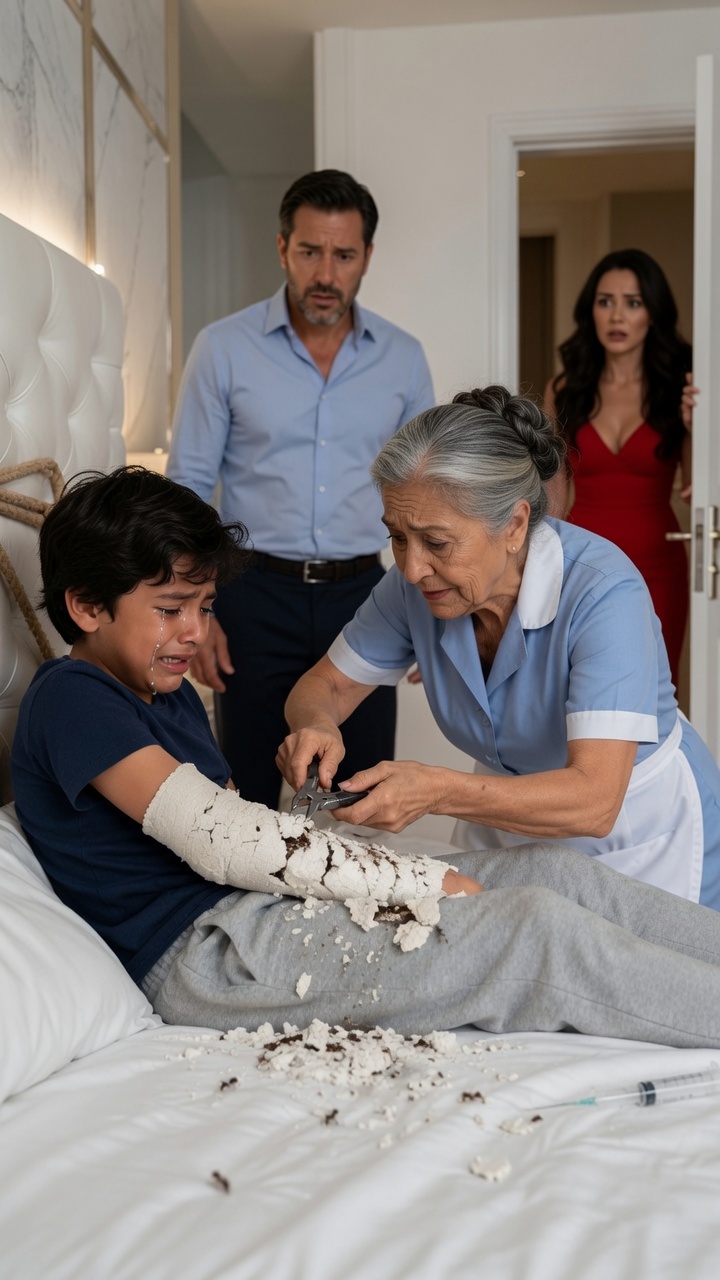
Teresa dashed to the garage, opened Andrés's toolbox, and took some heavy, rusty industrial pliers, the kind used for cutting thick wire.
She ran back upstairs.
She entered the room.
Locked the door.
Andrés pounded on the door.
—Teresa! What are you doing?
Marina screamed from the hallway:
—She’s crazy! She’s going to kill the boy!
Teresa knelt beside Diego and stroked his damp hair.
—Hold on, my love. The nanny is going to get the monster out of you.
She placed the pliers at the edge of the cast.
She squeezed with all her might.
Crack.
The first piece broke open.
A smell so horrible wafted from inside that Andrés stopped pounding for a second.
Teresa squeezed again.
Crack.
The cast shattered like an old shell.
And what appeared beneath wasn’t just a wounded arm.
It was living cruelty.
Diego's skin was inflamed, red, filled with open wounds. There was dried blood, moisture, sticky remnants, and a golden sheen that smelled of fermented honey.
Red ants poured out, desperate for the light, crawling between the inner gauze and the skin.
There were also small white larvae stuck to the bandage.
Teresa stifled a scream.
Not out of disgust.
But because Diego had always told the truth.
At that moment, Andrés managed to break open the door.
He charged in, furious, ready to take the pliers from Teresa.
But he froze.
He saw the broken cast.
He saw the ants on the carpet.
He saw his son’s arm.
And the world collapsed around him.
—No… —he whispered.
Teresa kicked a piece of the cast toward him.
—Look closely, sir. Your son wasn’t crazy. They were eating him alive while you tied him to the bed.
Andrés brought a hand to his mouth.
He remembered every scream.
Every threat.
Every time he chose to believe Marina over his own son.
He doubled over and vomited on the floor.
Diego barely opened his eyes.
—Dad… it was true.
Andrés fell to his knees.
—I’m sorry, son. I’m so sorry.
Teresa wouldn’t let him drown in guilt.
—To the bathroom! We need to clean him up and call an ambulance.
Andrés carefully lifted Diego as if he were made of glass.
As they washed his arm with warm water, every insect that fell into the drain seemed to rip something from within.
—I’m sorry, my boy. Dad was an idiot. Dad didn’t listen to you.
Diego didn’t respond.
He just rested his head on his chest, exhausted.
Teresa went for clean gauze and the phone.
Then she saw Marina in the doorway.
She wasn’t looking at Diego.
She was looking at the nightstand.
Teresa followed her gaze.
In the drawer were painkillers, bandages, small scissors, and at the back, a thick culinary syringe, the kind used for filling pastries.
The tip was sticky.
Inside were crystallized golden residues.
Dried honey.
Teresa picked it up with a towel.
—Mr. Andrés.
He emerged from the bathroom with Diego wrapped in a white towel.
Upon seeing the syringe, he froze.
—What is that?
Marina stepped back.
—I don’t know. It must be from the kitchen.
—It was in Diego’s medicine drawer —Teresa said.
Andrés walked toward his wife.
—What did you do to him?
—Nothing. You’re exaggerating. He must have snuck sweets into the cast.
Diego, weak, opened his eyes.
—She came in when you traveled to Puebla —he murmured—. She told me that if I talked, you’d send me away. She grabbed my arm. I felt cold. Then sticky. After that, they started to come.
Andrés stopped breathing.
The trip to Puebla.
Two weeks ago.
Marina had been alone with Diego.
And when he returned, she told him the boy was unbearable, that he was making up pains to separate them.
Everything fit together with brutal precision.
—You injected honey into the cast —Andrés said—. You injected sugar into him.
Marina's mask shattered.
—It wasn’t that serious —she stammered—. I just wanted you to understand. Ever since we got married, it’s all been Diego. Always Diego. I’m family too.
Andrés looked at her as if seeing a stranger.
—You tortured my son out of jealousy?
—You never gave me my place! —she shouted—. His dead mother was always going to be the saint, and I the intruder. If they committed him, maybe we’d finally be at peace.
The silence was louder than any blow.
Andrés took his cell phone and called 911.
—I need an ambulance and a squad car. My son was attacked by an adult in this house.
Marina tried to grab the phone from him, but Teresa interposed herself.
—Don’t you dare.
—You’re nobody —Marina spat.
Teresa lifted her chin.
—I’m the woman who believed the boy.
The sirens arrived 12 minutes later, cutting through the rain.
The paramedics rushed upstairs.
Upon seeing Diego’s arm, they stopped asking questions.
They put him on IV, covered the wound with sterile gauze, and took him down on a stretcher.
Andrés wanted to get into the ambulance.
But Diego reached out his healthy hand toward Teresa.
—Let my nanny come.
Andrés felt another wound open, but he nodded.
—Of course, son. She’s going with you. I’ll follow behind.
On the sidewalk, the police listened to Marina cry and play the victim.
But Andrés handed over the syringe, the sticky napkins, and the remnants of the cast.
—I also want to report threats —he said—. And I’ll be requesting a restraining order.
Marina glared at him with hatred.
—Without me, you can’t handle that boy.
Andrés replied under the rain:
—Without you, I almost lost him.
In the hospital, the doctors confirmed the worst.
Diego had a serious infection beneath the cast. The sugary mixture had attracted insects, kept moisture, and worsened the wounds caused by rubbing and scratching.
—If you had waited 24 more hours —the doctor said—, we could be talking about bone infection, amputation, or septic shock.
Andrés sat in the hallway, covering his face.
The surgery lasted more than two hours.
When the doctor emerged, she said the arm had been saved.
Diego would need dressings, antibiotics, and therapy, but he was stable.
Later, when he woke up, the first thing he saw was Teresa.
Then he saw his father, crushed by guilt.
—Did Marina leave? —he asked.
—She’s never coming back —Andrés replied—. I swear it.
Diego stared at him for a long time.
He didn’t say “I forgive you.”
Not yet.
He only whispered:
—Then stay.
Andrés sat beside him and took his healthy hand.
He didn’t apologize again.
He didn’t justify himself.
He just stayed.
Weeks later, Diego returned home.
The room was completely cleaned out.
The bed, the sheets, and the carpet were gone.
But Andrés’s guilt couldn’t be thrown in the trash.
That he would have to learn to carry.
Teresa welcomed him with chicken soup, gelatin, and a soft blanket.
Diego smiled for the first time in a long while.
—Nana, can I sit with you?
—As long as you want, my boy.
Andrés watched them from the entrance.
It used to hurt him that his son sought Teresa first.
Now he understood.
Trust isn’t demanded.
It’s earned.
And he had lost it when it mattered most.
Days later, Andrés asked Teresa to stop calling him “sir.”
—You saved my son. This house is also yours as long as you want to be here. Not as an invisible employee. As family.
Teresa looked at Diego, who was playing with toy cars, carefully using the hand he almost lost.
—I don’t need to be the queen of any house —she said—. I just need someone to believe a child when he says he’s hurting.
That night, the house fell silent.
But it was no longer a silence of fear.
It was a clean silence.
Of open doors.
Of calm breaths.
Of a broken family trying to learn how not to break anymore.
And although the marks on Diego’s arm would take a long time to heal, each one would tell a truth that no adult should ever forget:
Sometimes the monster doesn’t live in a child’s imagination.
Sometimes it lives in the comfort of those who prefer to call him exaggerated rather than look at what’s in front of them.





