PART 1
When doctor number 14 closed his briefcase and lowered his gaze, Mariana understood that hope could also make a sound when it shattered.
“We did everything we could,” the pediatrician said, not daring to look at the crib.
Santiago, barely 6 months old, struggled to breathe in a vast room of a mansion in Las Lomas. He had an Italian crib, embroidered sheets, imported toys, and a monitor that beeped like it was counting down the moments he had left.
Rodrigo Aranda, owner of private hospitals and construction companies across Mexico, stood by the window. He had money to bring in specialists from Monterrey, Guadalajara, and Houston, but he couldn’t buy air for his son.
Mariana hadn’t slept in weeks. Her face, once made up for social events, was now pale, swollen from crying, her hair pulled back in a messy bun.
Doña Leonor, Rodrigo’s mother, entered the room with a rosary in her hand and poison on her tongue.
“A baby doesn’t end up like this for no reason,” she said in front of the nurses. “You’re doing something wrong, Mariana.”
Mariana looked up.
“He’s my son. I love him more than my life.”
“Well, it doesn’t seem that way,” Leonor shot back. “Fourteen doctors, and none can find anything. Maybe the problem isn’t with the child, but with the useless mother he has.”
The nurses froze.
Mariana waited for Rodrigo to defend her, like he used to. But he said nothing. He just clenched his fists, defeated, staring at Santiago as if the world was collapsing around him.
That silence hurt more than the insult.
That night, a storm fell over Mexico City. Rodrigo drove aimlessly along the Viaduct, his shirt wrinkled and his eyes red. At a traffic light under a bridge, he saw a boy about 12 crouched next to an elderly woman.
The boy wasn’t begging for money. He was grinding leaves in a tin can and carefully placing them on an infected wound.
The old woman stopped complaining.
Rodrigo got out of the car.
“What’s your name?”
“Nico,” the boy replied, unafraid.
“Who taught you that?”
“My grandmother. She was a healer in the mountains of Oaxaca.”
Rodrigo swallowed hard.
“My son is dying.”
Nico looked him straight in the eyes.
“Then we need to see him now, man.”
Half an hour later, Rodrigo entered the mansion with a soaked, skinny boy, barefoot and carrying an old sack over his shoulder.
Doña Leonor shouted from the stairs:
“Have you lost your mind? Are you going to bring that filthy kid into my grandson’s room?”
But Nico didn’t respond.
He stood still in the hallway entrance, took a deep breath, and frowned.
Then he looked toward the baby’s room and said something that left everyone breathless:
“There’s something rotten here… and it’s stuck to the crib.”
PART 2
Mariana shot up as if those words had pierced her chest.
“What did you say?”
Nico moved slowly. He didn’t rush toward Santiago or touch anything. He walked through the room as if he could hear something the others couldn’t.
The nursery looked perfect. Beige curtains, warm lamps, soft carpet, toys neatly arranged by color, and a huge piece of fine wood furniture filled with expensive plush toys.
But the boy wrinkled his nose.
“It smells like trapped moisture,” he murmured. “It smells like a sick wall.”
One nurse let out an uncomfortable sigh.
“Mr. Aranda, with all due respect, this is not a game. The baby is delicate.”
Doña Leonor crossed her arms.
“Of course it smells bad. He walked in.”
Mariana turned to her, her eyes filled with rage.
“Shut up.”
It was the first time in months she dared to speak to her like that.
Rodrigo looked at Nico.
“Where?”
The boy pointed to the toy cabinet.
“Behind that.”
Doña Leonor went pale for just a second, but Mariana noticed.
“That cabinet doesn’t move,” Leonor said quickly. “It cost a fortune, and it could get damaged.”
Rodrigo didn’t take his eyes off his mother.
“Move it.”
Two employees came in. The cabinet was heavy. At first, it didn’t budge an inch. Then, with effort, it pulled away from the wall.
The smell hit them like a slap.
Sour. Damp. Black.
Mariana covered her mouth. A nurse stepped back. Rodrigo felt his legs give way.
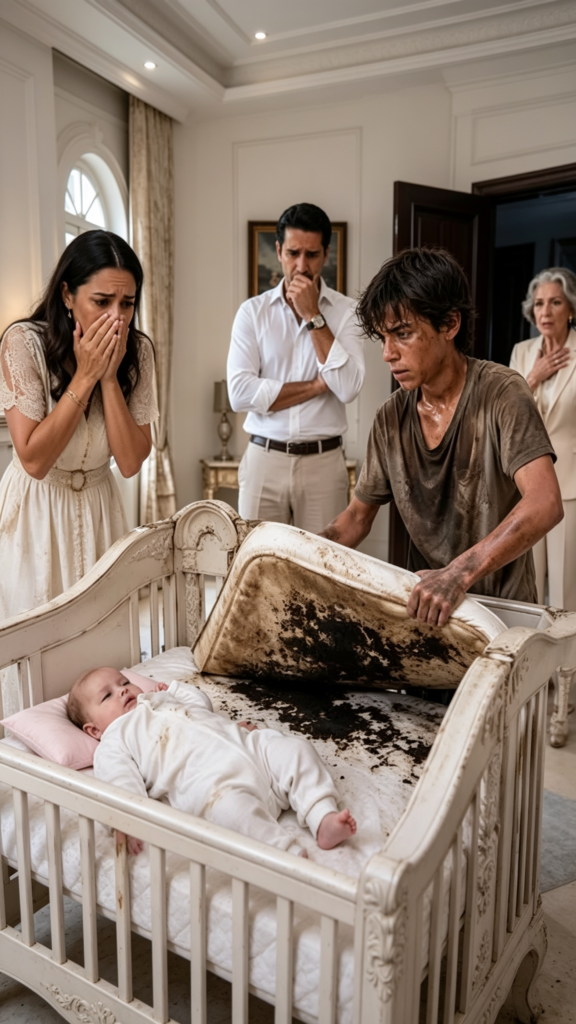
The wall behind the cabinet was covered in dark mold. The paint had bubbled like sick skin. There were black stains creeping up from the floor, hidden just behind the crib where Santiago slept every night.
“No…” Mariana whispered. “My baby breathed this.”
Nico crouched down, touched the base of the cabinet, and frowned harder.
“This didn’t just end up like this.”
Rodrigo stepped closer.
Beneath a molding, there was fresh tape. Someone had sealed the back of the cabinet against the wall so that no one could easily move it.
Mariana turned to Doña Leonor.
“You insisted on putting it there.”
“Because the room looked empty,” she replied, nervous.
Nico carefully reached behind a loose board and pulled out a plastic bag. Inside was dark, damp gray powder mixed with bits of rotten wood.
The silence was brutal.
“What is that?” Mariana asked, trembling.
“Sick earth,” Nico said. “My grandmother said that kills slowly when a baby breathes it.”
Rodrigo looked at his mother.
“Who put this here?”
Doña Leonor immediately began to cry, but it wasn’t tears of pain. It was the cry of someone caught.
“Don’t you dare make a scene, Rodrigo. Your son is gravely ill.”
“My son is gravely ill because someone hid garbage behind his crib.”
Rodrigo called security and requested the recordings from the past three months. Meanwhile, they took Santiago out of the room. They opened windows, turned off the air conditioning, and called environmental specialists.
The pediatrician, upon seeing the wall via video call, changed his tone.
“This explains a lot. Constant exposure to mold could have aggravated his respiratory system. We need to treat him now.”
Mariana crumbled.
Not because she hadn’t loved her son. But because she had tenderly decorated the same room that was killing him.
Nico didn’t promise miracles. He asked for hot water, clean blankets, and eucalyptus leaves, bougainvillea, and mullein from the garden.
“Don’t take away his medicine,” he said. “Just help him breathe clean.”
The nurse hesitated, but the doctor approved using soft steam away from the baby, without touching his skin or substituting the treatment.
For hours, Santiago remained weak. Mariana spoke to him softly. Rodrigo stood by, devastated. Nico watched his breathing rate with a strange calm for a boy who slept under bridges.
At 3 in the morning, the head of security arrived with the recordings.
In the first, workers could be seen examining the wall after a leak that had occurred months earlier. One was clearly pointing out the moisture and talking to Doña Leonor.
In the second, Leonor appeared alone in the nursery. She carried a dark bag. She pulled something out, placed it behind the cabinet, and then called the workers to push it against the wall.
Mariana let out a dry scream.
Rodrigo couldn’t breathe.
“Mom… what did you do?”
Leonor shook her head. Then she cried. Then her mask broke.
“I didn’t want to kill him!” she shouted. “I just wanted him to get a little sick.”
Mariana stood frozen.
“A little?”
“You took my son from me,” Leonor spat. “Since that child was born, Rodrigo no longer obeyed me. It was all about you, your baby, your rules. I wanted him to see that you weren’t a good mother.”
Rodrigo looked at her as if she were a stranger.
“You used my son to punish my wife.”
“He’s my grandson too.”
“No,” he said, his voice breaking. “A grandson doesn’t get poisoned out of jealousy.”
The police arrived before dawn. Doña Leonor was led away in handcuffs, screaming, praying, and threatening. She claimed Mariana had provoked her, that no one understood the pain of a displaced mother.
But no one defended her.
Not even Rodrigo.
The first day out of that room, Santiago barely improved. The second day, he moved his fingers. Mariana saw it and stopped breathing for a moment.
“Rodrigo…”
The baby weakly squeezed his mother’s finger.
Rodrigo fell to his knees.
On the third day, Santiago opened his eyes. Not like in a movie, not suddenly. He opened them slowly, tired, as if returning from far away.
Mariana cried on his chest.
“Forgive me, my love. Forgive me.”
Nico watched from a corner. He didn’t ask for applause. He didn’t smile like a hero. He just lowered his gaze, relieved.
Rodrigo approached him.
“You saved my son.”
“I just smelled the wall.”
“No, Nico. You saw what everyone ignored.”
The scandal exploded all over Mexico. The press talked about the wealthy grandmother being detained, the sick baby, the hidden mold, and the street boy who discovered the truth that 14 doctors couldn’t see.
Some defended Leonor, saying she was a desperate mother. Others tore into Rodrigo for allowing Mariana to be humiliated in her own home.
Mariana didn’t give interviews.
She simply cared for Santiago.
Weeks later, when the baby was laughing again, Rodrigo searched for Nico in the garden.
“Where’s your family?”
The boy took a moment to answer.
His grandmother had died in Oaxaca. His mother had left years ago. Since then, he had lived among markets, bridges, and terminals, healing small wounds in exchange for food.
Mariana cried upon hearing him.
“A child shouldn’t live like that.”
Nico shrugged.
“One lives as one can, ma’am.”
Rodrigo didn’t offer him money. This time he understood that money only covers guilt when it doesn’t come with commitment.
They offered him school, documents, shelter, doctors, and the chance to study plants without anyone mocking him.
Nico hesitated.
“I don’t want to be a rich person’s pet.”
Mariana approached him.
“We don’t want to show you off. We want to take care of you.”
The boy looked at Santiago sleeping in her arms.
“Can I keep learning from my grandmother even though she’s not here?”
Rodrigo nodded.
“And also medicine, if you want.”
Years later, Nicolás Aranda — because Mariana and Rodrigo ended up legally giving him their last name — studied environmental medicine and Mexican herbalism.
He never rejected science. But he also never allowed anyone to mock the knowledge of grandmothers, of villages, of the mountains, of the humble hands that learn by watching the earth.
Santiago grew up healthy, knowing he had an older brother who one night smelled the truth behind his crib.
Rodrigo changed forever. He reviewed his hospitals, his daycare centers, and his buildings. He understood that danger doesn’t always come with screams. Sometimes it grows in silence, behind an elegant piece of furniture.
And Mariana learned something even more painful: a mother can love with all her soul and still be blamed by those who hide malice under prayers.
That’s why the story continued to divide opinions.
Because some said Nico was a miracle.
Others said it was pure luck.
But Mariana always responded the same:
“It wasn’t luck. For the first time, someone looked where the rich didn’t want to look.”
Sometimes life isn’t saved by those who arrive in white coats, with names, or armored trucks.
Sometimes it’s saved by the boy everyone calls filthy.
The one no one invites in.
The one who learned to survive by smelling the rain.
The one who dares to move the furniture when everyone only looks at the crib.





