PART 1
—If my mom marries him, she'll be sleeping next to the man who killed my dad.
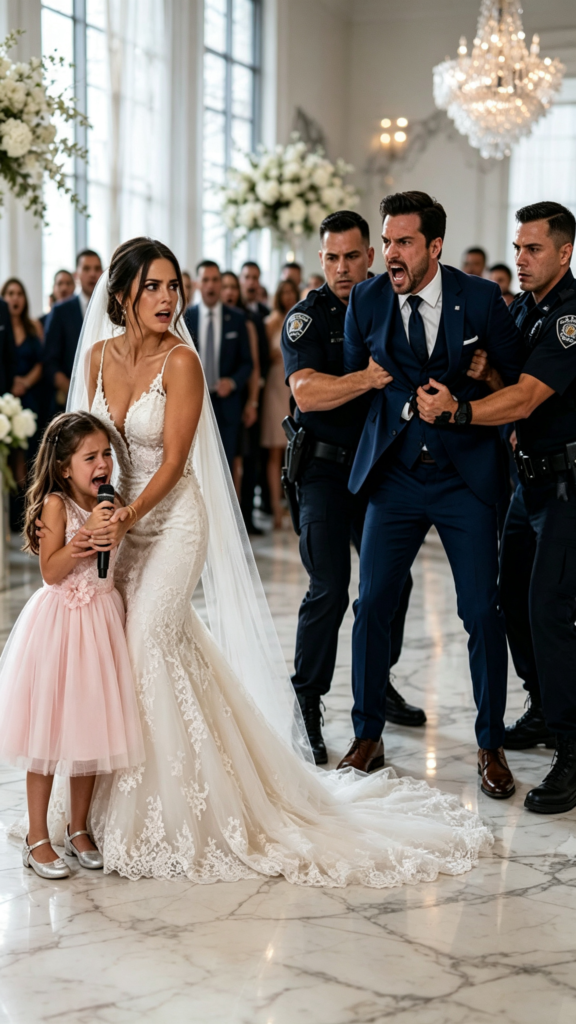
Camila's voice was small, broken, almost lost amidst the speakers in the hall. But it was enough to make the laughter, the clinking of cutlery, and the music abruptly stop.
She was 5 years old, wearing a lilac dress with white bows and shoes that barely touched the floor of the stage. She held the microphone with both hands, trembling as if the device weighed more than she did.
In the midst of 40 guests, Renata froze in her wedding gown. The smile she had rehearsed all afternoon faded slowly away.
—Camila, my love… what did you say? —she asked, taking a step toward her daughter.
Before the girl could repeat it, Mauricio sprang from the head table so fast that he knocked over a glass.
—Get down from there! —he shouted—. Right this moment, Camila!
The event hall, in an elegant estate near Tlaquepaque, froze. The bougainvillea arrangements, the warm lights, the mariachi waiting for their turn—all suspended in an uncomfortable silence.
Until that moment, everyone believed Mauricio was a miracle.
The loyal friend.
The noble compadre.
The man who stood by Renata when she lost her husband.
Renata had known him since college. She was studying design, her husband Julián was in civil engineering, and Mauricio was in business administration. The three became inseparable in Guadalajara. Julián was the type of guy who made friends while waiting in line for tortas ahogadas; cheerful, simple, a good father even before he became one.
Mauricio was different. Quiet, observant, always watching more than he spoke. But Julián loved him like a brother.
—This guy is family —he would say, hugging him in front of everyone.
When Renata and Julián got married, Mauricio signed as a witness. When Camila was born, he showed up at the hospital with a huge balloon and a little blanket embroidered with her name.
And when Julián died falling from scaffolding on a construction site in Zapopan, it was Mauricio who arrived at Renata's apartment to deliver the news.
That night, Renata collapsed at the entrance. Camila was only 3 years old and didn’t understand why her mom was screaming while clutching a yellow helmet.
Mauricio stayed.
He made calls, paid fees, got papers, attended the funeral, and carried one of the handles of the coffin. He cried in front of Julián's picture as if he had lost a brother.
Over time, he began to appear all the time.
If Camila had a fever, Mauricio would drive her to the hospital. If Renata couldn’t make rent, he left groceries at the door. If she worked late doing nails at a salon downtown, he watched the girl.
—You’re not alone, Ren —he would say—. Julián would have wanted me to take care of you.
Renata wanted to believe it.
Two years passed. The grief turned into exhaustion, the exhaustion into routine, and Mauricio became a daily presence. One Sunday, he took them to Tapalpa. He rented a cabin, lit the fireplace, and when the girl fell asleep, he confessed that he had loved her since before.
—I don’t want to take Julián’s place —he said—. I just want to give you a peaceful life.
Renata felt guilt. And fear. But she was exhausted from crying alone, pretending to be strong, carrying everything.
A month later, she agreed to marry.
The move was quick. Too quick. Renata left her small apartment in the Americana neighborhood and settled into Mauricio’s modern apartment, with an elevator, a park in front, and a new room for Camila.
But the girl changed from day one.
She no longer ran to Mauricio. She no longer called him “Uncle Mau.” She hid when he arrived and asked to sleep with the light on.
—Mom, let’s go to our little house —she whispered every night.
Renata thought it was sadness. Mauricio said the same.
—It’s normal, sweetheart. She misses her dad. She’ll get over it.
But she didn’t.
On the wedding day, Camila walked ahead of her mother scattering white petals. She didn’t smile. She didn’t want to dance. She didn’t taste the cake.
During dinner, while the adults toasted, the girl stood up, climbed onto the stage, and took the microphone.
—Mom, I’m sorry for being quiet.
Mauricio screamed as if a mask had been ripped from his face.
And then Camila raised her gaze, pointed at the groom with her trembling little hand, and said something that left everyone breathless.
PART 2
—He pushed my dad.
A woman’s scream echoed from a table at the back. Someone dropped a plate. The mariachi lowered their instruments, unsure if this was a macabre joke or a live nightmare.
Renata felt the dress weigh on her as if it were soaked. She climbed onto the stage almost without breathing.
—Camila, come with me, my love.
—Don’t listen to her! —roared Mauricio—. She’s jealous. She’s a bratty little girl who doesn’t want you to be happy.
The word “bratty” landed ugly. Very ugly.
Several guests exchanged glances. Mariana, Renata’s best friend, immediately stood up.
—Mauricio, calm down. You’re scaring the girl.
But he no longer looked like the polite groom who minutes earlier had kissed Renata’s hand. His face was red, his jaw clenched, and his eyes filled with panic.
Camila cried, but she didn’t let go of the microphone.
—I heard everything —she said—. A woman came to the apartment when my mom went out with Aunt Mariana. She told Mauricio that if he didn’t give her money, she would tell the police about the construction site.
Renata felt a horrible chill in her stomach.
—What woman, my life?
—A woman in a black jacket. Short hair. She said she saw him push my dad. And he told her to shut up because he had already paid her.
A murmur of horror swept through the hall.
Mauricio took a step toward the stage, but Javier, Renata’s brother, stepped in.
—Don’t you dare come closer.
—Get out of the way, idiot.
—No, man. Not today.
Renata hugged Camila to her chest. The girl clutched the wedding dress and let out a cry that seemed to have been held back for months.
—Why didn’t you tell me earlier? —Renata asked, almost voiceless.
Camila buried her face in her neck.
—Because he told me that if I spoke, you would also die like my dad.
The hall fell silent.
Not a chair moved.
Not a glass clinked.
Renata lifted her gaze to Mauricio. For two years, she had seen him as a refuge. Now she only saw the man her daughter had feared since he moved in with them.
—Tell me it’s not true —she whispered.
Mauricio let out a dry, desperate laugh.
—Are you going to believe a 5-year-old? Seriously, Renata. Think. She’s confused. She misses Julián.
—She’s not confused —Mariana said, already dialing 911—. She’s terrified.
—You have no proof —Mauricio spat.
Renata froze.
—Proof of what? No one mentioned proof.
Mauricio blinked. And in that second, everyone understood he had just made a mistake.
He tried to leave the hall, but Javier and two of Renata’s cousins stopped him. Mauricio struggled, cursed, yelled that it was all slander. Camila covered her ears.
The police arrived 12 minutes later.
The wedding turned into an absurd scene: white flowers on the tables, an untouched cake, rice prepared for a happy exit, and a groom handcuffed in front of everyone.
—Renata, look at me —Mauricio said as they dragged him out—. I took care of you. I was there when no one else was. I lifted you off the floor.
Renata didn’t respond. She just held her daughter tighter.
That night, at the prosecutor’s office, Camila testified with a specialized agent. She told them that the woman in the black jacket had gone to the apartment. She told them that Mauricio threatened her. She recounted how he once squeezed her arm and whispered in her ear:
—Your mom will be mine, and you’re going to behave.
Renata vomited in the bathroom upon hearing that.
In the early morning, she returned to Mariana’s house with smeared makeup, a wrinkled dress, and no ring. Camila slept in her arms, exhausted from crying.
But the worst was yet to come.
When reviewing the building’s security footage, the woman in the black jacket appeared entering the apartment 6 days before the wedding.
Her name was Claudia Barragán, and she had worked as an administrative assistant at the site where Julián had died.
When investigators located her in Tonalá, she first denied everything. Then they found three cash deposits in her account. In total, $180,000 pesos.
Claudia asked for protection and spoke.
She said that on the night of the accident, Julián was still reviewing blueprints on the upper level of the structure. Mauricio arrived unannounced. They argued. Claudia was near a booth and heard snippets of the conversation.
—She should have chosen me —Mauricio yelled.
Julián tried to calm him. He told him that Renata was his wife, that Camila was his daughter, that he should go home and seek help.
Mauricio lost control.
He grabbed him by the shirt. Julián tried to break free. There was a shove. Then another. And then, the void.
Claudia saw Julián fall.
She also saw Mauricio freeze for a few seconds, staring down. Then he ran down and pretended to have found him.
—Why did he keep quiet? —Renata asked when the commander told her everything.
The man lowered his voice.
—Fear. And then money. That doesn’t make him innocent, ma’am.
Renata didn’t cry in front of him. She remained still, hands on her knees, as if her body had shut down everything to avoid breaking.
She thought of Julián laughing with Camila in his arms. Of his last kiss before leaving for work. Of Mauricio knocking on her door that night, pretending to be in pain. At the funeral, carrying the coffin of the man he had killed.
—He cried with me —she murmured—. He hugged me while I buried my husband.
The trial began 5 months later.
Renata arrived dressed in black, holding Camila’s hand with Mariana by her side. She wasn’t looking for a spectacle. She sought for the world to stop calling it an “accident” the crime that took her family.
Mauricio entered handcuffed. He looked thinner, with an unkempt beard, but his gaze remained possessive. Upon seeing her, he tried to smile.
Renata looked away.
The prosecutor presented the building’s videos, the deposits, Claudia’s statement, and Camila’s protected testimony. The girl didn’t enter the room; her voice was played on a recording.
When Renata heard her daughter say, “he told me my mom was going to die,” she felt something that was already broken shatter even more.
Claudia took the stand with trembling hands.
—I saw when Mauricio pushed Julián —she said—. I kept quiet out of fear. Later, I sought him out for money. I did wrong. But I saw it. He pushed him.
Mauricio’s lawyer tried to dismantle her.
—You’re a blackmailer. Why should we believe you?
Claudia cried.
—Because a little girl heard the same truth I saw. And because I can’t sleep with that anymore.
When Mauricio testified, he denied everything.
—I loved Renata —he said—. Julián didn’t deserve her. But I didn’t kill him. We just argued. He fell.
The prosecutor approached.
—If it was a fall, why did you pay $180,000 pesos?
Mauricio gritted his teeth.
—Because Claudia was extorting me.
—With a lie?
He didn’t answer.
Then he looked at Renata. For the first time, the mask fell completely.
—I was going to make you happy —he said with rage—. I was there from the beginning. I loved you before he did. I took care of your daughter when he could no longer.
Renata stood up.
—Don’t say his name as if you had the right to.
The judge demanded order, but no one was breathing.
—You didn’t love me —she continued, tears in her eyes—. You hunted me. You waited for my life to break before diving in. You used my pain, hugged my daughter, and pretended to be family. That’s not love. That’s a sickness.
Mauricio looked at her with hatred.
—If Julián hadn’t gotten in the way…
—Julián was my husband —she interrupted—. And you were his friend.
That sentence landed harder than any verdict.
On the fourth day, the judge declared Mauricio guilty of homicide and threats against a minor. He received 28 years in prison.
Renata didn’t smile. She didn’t celebrate. She just closed her eyes and breathed as if she had been underwater for 2 years.
Outside the courthouse, Guadalajara remained the same: traffic, vendors, women buying flowers, children leaving school. The world didn’t stop even though a family had just learned the truth.
Mariana hugged her.
—It’s over.
Renata shook her head slowly.
—No. Now it begins to learn to live without fear.
That afternoon she went for Camila. The girl ran to her, and Renata lifted her in her arms, even though she was getting heavier. She squeezed her as if she wanted to promise with her body that she would never doubt her fear again.
—Did Dad win? —Camila asked.
Renata cried and smiled at the same time.
—Yes, my love. Today your dad won. And you won too.
That night, they lit a candle next to Julián’s photo. Camila placed a drawing underneath: three people holding hands and a star above.
—Dad warned us —said the girl.
Renata kissed her forehead.
—And you had the courage to listen to him.
Over time, Camila began to laugh again. Renata returned to work. The house stopped feeling like a place of fear and slowly started to resemble, little by little, a home.
But Renata never forgot the lesson.
Sometimes danger doesn’t arrive with blows or screams. Sometimes it arrives with favors, flowers, messages of “I’ll take care of you,” and perfect hugs at just the right moment.
Sometimes the monster doesn’t come in through the window.
Sometimes they invite him to the wedding.
And that time, the truth didn’t come from a strong adult or a famous detective. It came from a 5-year-old girl, her voice trembling, who dared to say what everyone needed to hear.





