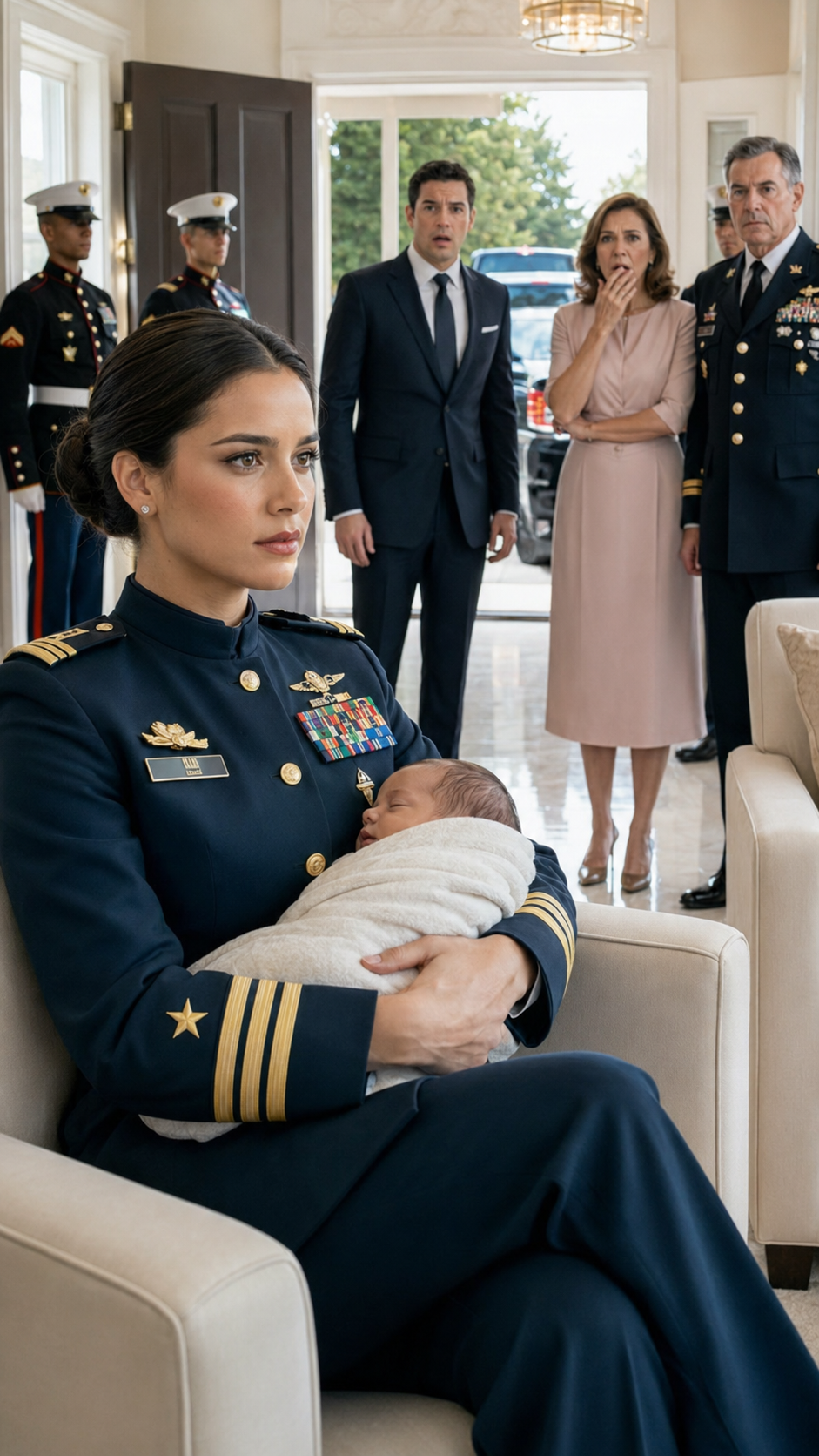
PART 1
The first contraction hit Mariana Ríos while she was in the kitchen of her home in Coyoacán, water glass in hand, her swollen feet screaming from 38 weeks of pregnancy.
The pain was so intense that the glass slipped from her grasp.
The glass shattered against the white floor.
—Diego... —she managed to say, hands clutching her belly—. Something's wrong.
Diego Santillán didn’t even bother to look up from his phone. He stood in front of the dining room mirror, adjusting the cuffs of his gray Oxford jacket, smelling of cologne, perfectly styled, ready to step out to the hall where his mother, Lourdes, was celebrating her 65th birthday.
As if the whole world should pause for her.
Another contraction hit Mariana, deeper, more brutal. She doubled over the kitchen counter, trying to breathe as they’d taught her in prenatal classes.
But this wasn’t normal.
Doctor Camila Barrera had told them three times that Mariana had dangerously high blood pressure. She had looked him in the eyes and warned that if intense pain, dizziness, bleeding, or blurred vision appeared, there was no time to waste.
They needed to rush to the hospital.
—I think the baby is coming —Mariana whispered—. Please, take me to the ER.
Diego sighed as if she had asked him to carry a water jug.
—Oh, Mariana, come on, don’t start.
She looked at him in disbelief.
Sweat trickled down her forehead. The light blue dress clung to her back. Her face had turned pale, almost gray.
—I’m not exaggerating —she said, her voice breaking—. It hurts terribly.
Diego grabbed the car keys from the table.
—You always find a way to ruin something important for my family.
That phrase cut deeper than the contraction.
Because it wasn’t the first time.
Since they married, Lourdes had treated Mariana like an intruder. She called her “the delicate one,” “the opportunist,” “the one who trapped my son with a pregnancy.” Even though Mariana was a lawyer, even though she earned her own salary, even though she never asked for a dime from anyone.
To Lourdes, no woman was ever good enough for Diego.
And Diego always chose his mother.
—He’s your son too —Mariana said, tears welling up—. Our baby needs you.
He let out a dry laugh.
—My mom only turns 65 once. You’ve been pregnant for 9 months. You can wait a few hours.
Mariana froze.
—Diego, please...
She tried to take a step, but the pain shot down her back like a knife. She fell to her knees on the floor, among the shards.
Diego opened the front door.
—I’m not going to be late for your tantrum.
And he left.
The door slammed shut, echoing throughout the house.
Mariana called once.
Then again.
Then again.
All calls went to voicemail.
Outside, the car engine started and drove away.
Then Mariana looked down.
There was blood.
Not just a little spot.
Real blood, running down her legs.
Her whole body began to tremble.
With her sweaty hand, she fumbled for her phone among the glass and dialed 911.
—My husband left —she cried when they answered—. I’m alone... I’m pregnant... I’m bleeding... please, help me.
The operator urged her not to hang up.
Mariana couldn't promise anything.
She could barely breathe.
She crawled toward the front door, leaving a crimson trail on the floor. Each movement was torture. Every second felt like the baby was slipping away from her grasp.
The siren arrived nine minutes later.
A young paramedic entered first and turned pale upon seeing her lying there.
—Possible placental abruption! —he shouted—. Notify the hospital to prepare the operating room!
Mariana barely heard him.
She managed to squeeze the hand of a paramedic who was saying:
—Hang in there, ma'am. You and your baby will fight.
Before they loaded her into the ambulance, Mariana murmured a name.
—My dad...
The paramedic leaned in.
—Who should we call?
Mariana, her eyes fading, barely managed to say:
—General Arturo Ríos... he’ll know what to do.
Then, everything went black.
PART 2
As Mariana was rushed to Hospital Ángeles del Pedregal, Diego arrived at the event hall in Polanco, flashing a perfect smile.
Lourdes welcomed him among mariachis, golden lights, and a huge three-tiered cake.
—My beautiful boy —she said, hugging him—. And where’s the drama queen?
Diego poured himself a whiskey.
—According to her, she’s in labor. But you know how she gets.
Lourdes rolled her eyes.
—Oh, please. Women of the past gave birth and were cooking mole the next day. Now it’s all hospital, doctor, and show.
Diego laughed.
But then his phone began to vibrate.
1 call.
3 calls.
7 calls.
Unknown number.
Then a call from Doctor Camila.
Then another.
Then messages.
“Your wife is in serious condition.”
“We need authorization.”
“It’s an emergency.”
“Mr. Santillán, please answer.”
Diego read the screen and turned it off.
—Not today —he murmured—. Not today will she manipulate me.
At 10:48 PM, while Lourdes danced to “El Rey” surrounded by her friends, Mariana entered the operating room.
Her blood pressure was sky-high.
She had lost too much blood.
The baby was in distress.
Doctor Camila didn’t wait any longer.
—Emergency C-section —she ordered—. Now.
Mariana awoke hours later, with a dry throat, her body torn apart by pain, and a machine beeping beside her.
The first thing she did was touch her belly.
Flat.
Empty.
—My baby... —she whispered.
Doctor Camila appeared at her side, tired eyes staring back.
—He’s alive, Mariana.
Mariana broke down in tears.
—Alive?
—Yes. It’s a boy. He was born with respiratory distress, but he’s fighting in neonatal care. He weighed 2,600 grams. He arrived just in time.
Mariana closed her eyes, trembling.
—Diego?
The doctor lowered her gaze.
That silence said it all.
Diego hadn’t arrived.
He hadn’t signed anything.
He hadn’t even seen their son born.
Who did arrive was General Arturo Ríos.
He didn’t come alone.
He entered the hospital at 3:15 AM with two escorts, a military jacket over his shirt, and the face of a man who had seen war, but never something as cruel as finding his daughter nearly dead from abandonment.
When he saw Mariana in the bed, hooked up to IV, with cracked lips and dark circles under her eyes, his voice cracked.
—My girl...
Mariana tried to smile, but sobs escaped her.
—Dad, he left.
Arturo said nothing at first.
He just kissed her forehead.
Then he stepped into the hallway and asked to speak with the doctor, the paramedics, and the social worker.
That same night, he learned everything.
That Diego left her on her knees.
That she called for help alone.
That there was blood in the kitchen.
That the husband ignored 18 calls.
That the messages were recorded.
That the mother-in-law mocked in an audio sent to the family group:
“I'm sure she’s faking it to keep Diego from coming. Let her learn.”
Arturo listened to the audio once.
Then again.
The second time, he squeezed his phone so tightly he almost broke it.
But the real twist came at 8 AM.
A nervous nurse entered with a folder.
—General, there’s something you need to know.
At admissions, someone had tried to change the baby’s details.
A man had called saying he was the father and that, for “family reasons,” the newborn should not be handed over to Mariana without authorization from the Santillán family.
The call had come from Diego’s phone.
And 20 minutes later, Lourdes had sent a lawyer friend to ask if they could register the baby under the Santillán name only.
As if Mariana were merely an incubator.
As if, after leaving her bleeding, they still wanted to snatch the child from her.
Arturo Ríos ordered every recording, every camera, every log to be preserved.
He didn’t shout.
He didn’t threaten.
That was what terrified them the most.
Because when a man like him spoke softly, it meant he had already decided to act.
Mariana spent two days hospitalized.
Her baby, whom she named Santiago, remained in the incubator, tiny, full of wires, but alive. She visited him in a wheelchair, wearing a loose gown and a broken heart.
Every time she slipped her hand through the little window of the incubator, Santiago held her finger.
As if he knew she had never let him go.
Diego appeared on the second day, at 11:20 AM.
He came with the same arrogance as always.
White shirt, dark glasses, neatly trimmed beard.
He carried a blue balloon that read “Welcome, champ” and an expensive gift bag.
—Enough drama —he told his friend on the phone as he got out of the car—. I’m going to meet my son and then I’ll sort this out with Mariana.
But upon arriving at his house in Coyoacán, he slammed to a stop.
The street was filled with official vehicles.
There were trucks from the Prosecutor’s Office.
Two units from the National Guard.
Armed personnel at the entrance.
Forensics coming out of the house with evidence bags.
And his gate, that black gate he had installed to feel important, stood open like a crime scene.
Diego removed his glasses.
—What the hell is this?
An officer approached.
—Diego Santillán Robles.
—That’s me. This is my house.
—You need to come with us.
Diego let out a nervous laugh.
—No. There’s been a misunderstanding. My wife is very emotional.
Then he saw his mother-in-law, Carmen, Mariana’s mom, standing next to a patrol with red, swollen eyes from crying.
And behind her, General Arturo Ríos.
Diego swallowed hard.
—General... I was just on my way to the hospital.
Arturo looked at him as if he were trash on the sidewalk.
—My daughter almost died two days ago.
—I didn’t know it was that serious.
The officer pulled out a tablet.
—Mr. Santillán, here are the call logs from the hospital, from emergencies and the doctor. We also have footage from your home, showing your wife collapsing on the floor while you leave the house.
Diego turned pale.
He had no idea Mariana had installed a camera in the kitchen weeks ago, after Lourdes started coming in unannounced to “check” how the house was.
The camera recorded everything.
The fall.
The blood.
The pleas.
The line: “You can wait a few hours.”
And the door slamming shut.
Diego opened his mouth, but nothing came out.
Then Lourdes appeared in a white truck, furious, with huge glasses and her party dress still wrinkled.
—This is an abuse! —she shouted—. My son did nothing! That woman always wanted to separate him from me!
Carmen turned to her.
—Your grandson is in an incubator.
Lourdes didn’t even ask if he was okay.
She just said:
—Well, take care of him, that’s what hospitals are for.
Everyone heard that comment.
A heavy silence fell on the street.
Even one of the officers looked down in anger.
General Arturo stepped toward Lourdes.
—Ma’am, you called the hospital to ask how to take the baby away from my daughter.
Lourdes turned red.
—I just wanted to protect my family.
—No —Mariana said from the doorway.
Everyone turned.
She came in a wheelchair, pushed by Doctor Camila, weak, pale, wearing a gown and her hair tied back without strength. But her eyes were steadier than ever.
Diego froze.
—Mariana...
She didn’t look at him with love.
She looked at him like one looks at a stranger who has lost the right to explain.
—You didn’t want to protect anyone —she told Lourdes—. You wanted a grandchild without a mother.
Lourdes tried to respond, but Mariana raised her hand.
—and you, Diego, didn’t abandon me out of fear or confusion. You abandoned me because to you, my life was worth less than a party.
Diego took a step closer.
—Mariana, please, I was under pressure. My mom...
She let out a sad laugh.
—You’re 36 years old. You can’t blame your mom for the cowardice you chose.
The blow was direct.
Diego looked around, searching for support.
He found none.
No neighbors.
No officers.
Not even his own family, because even one of his cousins, who had arrived to see the scandal, was recording with a horrified expression.
—I want to see my son —Diego said desperately.
Mariana tightened her fingers over the blanket on her lap.
—No.
—I’m his father.
—A father doesn’t leave his child to be born among blood and sirens while he goes off to toast with tequila.
Diego broke for the first time.
—Give me a chance.
Mariana slowly shook her head.
—You had your chance when I was on my knees, begging you to save me.
The officer signaled that he needed to accompany them.
Diego tried to resist.
Lourdes screamed.
Carmen cried.
Arturo Ríos didn’t move.
He simply watched as the man who had made his daughter suffer was handcuffed in front of the house he had abandoned her in.
The investigation revealed more things.
Diego had been transferring money from the shared account to Lourdes's account. He had used savings meant for the delivery to pay for the hall, the mariachis, and a dessert table costing 48,000 pesos.
It was also discovered that Lourdes had messaged Diego weeks before:
“When the baby is born, Mariana will want to control you. We need to put her in her place from the start.”
But the message that sealed their fate was one from Diego, sent while Mariana was in surgery:
“Let her get scared. That way, she learns not to blackmail me with the pregnancy.”
That text became the most painful evidence.
Because it wasn’t ignorance.
It was cruelty.
Months later, Mariana was granted full custody of Santiago. Diego faced charges of neglect, domestic violence, and manipulation of hospital documents. Lourdes received a restraining order and lost any right to approach the baby.
Santiago left the hospital after 19 days.
Tiny, strong, with enormous eyes.
The day Mariana held him for the first time without wires, she cried so much that the nurse cried too.
Arturo, the general who seemed made of stone, covered his face with one hand.
—That boy will know his mom saved him —he said.
Mariana held him close to her chest.
She never returned to the house in Coyoacán.
She sold it.
With that money, she bought a small, sunlit apartment where no door closed with disdain and no woman had to beg for her life to be believed.
Sometimes, on Facebook, people debated the case.
Some said Diego deserved forgiveness because “he messed up.”
Others claimed Lourdes was the root of it all.
But those who watched the full video never forgot the image of Mariana on the floor, bleeding, while her husband drove off to a party.
Because some mistakes can be corrected.
And some abandonments reveal, once and for all, who never should have been called family.





