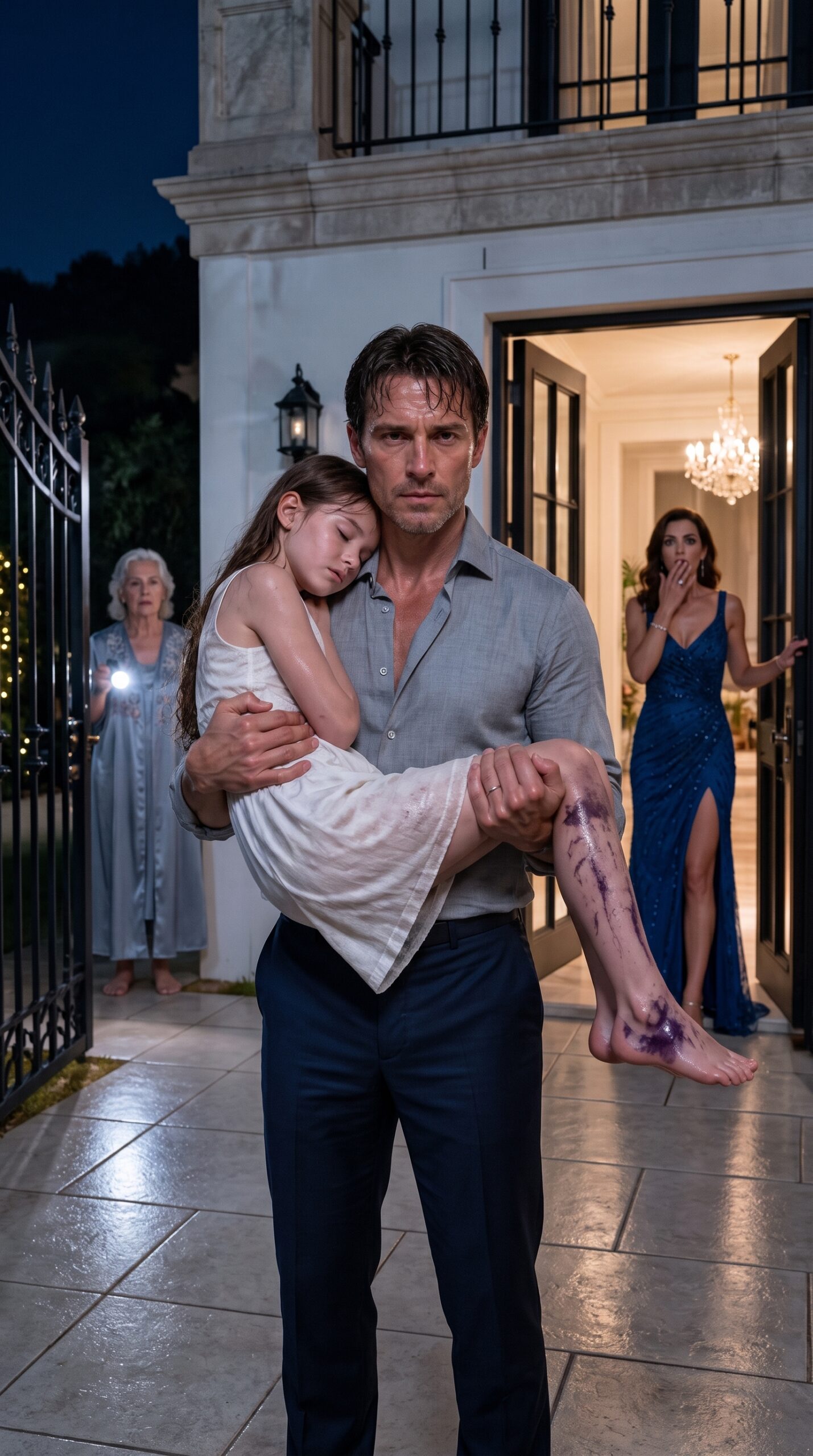
PART 1
—Dad, my back hurts... but Mom said that if I told you, they would send me away.
Julián Navarro dropped his suitcase at the entrance of his home in a neighborhood in Zapopan. He had just returned from a five-day work trip to Monterrey, expecting to find his daughter waiting for him with drawings, hugs, and questions.
Instead, he found Emilia, eight years old, sitting on the floor by her bedroom door.
The little girl clutched a stuffed rabbit, her hair tangled, wearing a jacket zipped up to her neck, even though the heat that night was unbearable.
—Where's your mom? —Julián asked, kneeling down.
Emilia pointed toward the garage.
—She went out. She said she needed to breathe because I was driving her crazy.
A void opened in Julián's stomach.
—Show me where it hurts.
The little girl immediately shook her head, looking down the hallway, terrified.
—Promise me you won't tell her I spoke.
—I need to know what happened first.
With trembling hands, Emilia lifted her jacket. A dark bruise covered part of her back. In the center, a metallic line marked her skin, as if her body had collided with the edge of a piece of furniture.
—The milk spilled —she whispered—. Mom said I messed everything up when you weren't here. She grabbed my arm and threw me against the closet.
Julián closed his eyes. His first impulse was to break something, but he understood that Emilia didn't need more yelling. She needed safety.
—We're going to the hospital.
—No, Dad. Mom said doctors lock up lying kids.
—That's not true.
At that moment, the front door swung open.
Mariana walked in, carrying shopping bags from a department store. Upon seeing Emilia in Julián's arms, she stopped.
—What drama did you invent this time?
—I’m taking her to the ER.
Mariana dropped the bags onto a chair.
—She hurt herself playing. I already put ointment on it.
—She says you pushed her.
—Of course she says that. She always manipulates you when you come back from your little trips. You arrive with gifts, and I’m left here dealing with tantrums, homework, and disasters.
Emilia buried her face in her father's neck.
Julián walked toward the exit, but Mariana stood in front of the door.
—If you leave with her, everyone will think I’m a criminal.
—Move.
—You’re not going to destroy this family over a bruise.
—The family was destroyed by the one who made a little girl afraid to ask for help.
Mariana glared at him with hatred.
—If you cross that door, don’t come back.
—Perfect.
Julián stepped outside, carrying Emilia. From across the street, Doña Refugio, a 67-year-old widow, watched from behind her gate. Her eyes were wet, and she held her phone as if wanting to say something but daring not to.
Before getting into the car, Emilia grabbed her father's shirt.
—Mom said I’d end up just like Lucía.
Julián froze.
He had never heard that name before.
—Who is Lucía?
Emilia looked toward the house, where Mariana was still watching them from the door.
—The other girl Mom ruined the life of.
PART 2
In the emergency room of the General Hospital of Zapopan, Emilia didn’t let go of her father’s hand. A pediatrician examined the bruise, ordered X-rays, and asked a nurse to photograph the injury to add it to the file.
—There’s no fracture —Dr. Elisa Cárdenas explained—, but the impact was strong. The shape of the injury matches an impact against a rigid object. By protocol, we must notify social services and the prosecution.
Julián looked at his daughter.
—Do what you need to do.
Emilia began to cry.
—I don’t want them to put Mom in jail.
—You didn’t do anything to anyone —Julián replied—. Adults are responsible for what we do.
Shortly after, Claudia Serrano, a social worker, arrived. She didn’t interrogate Emilia as if she were guilty. She sat down to her level, offered her water, and explained that she could stop the conversation whenever she wanted.
The little girl recounted what had happened in short phrases.
Mariana had gotten upset because she spilled milk on a carpet. She insulted her, pulled her arm, and shoved her. Then she forced her to wear a jacket to hide the bruise.
She also took away her tablet and locked the front door.
—Were you alone? —Claudia asked.
Emilia nodded.
—Mom left when I stopped crying. She said she’d come back when I learned to stop being a nuisance.
Julián clenched his fists under the table.
At 11:20 PM, Mariana appeared accompanied by her mother, Ofelia. Both arrived made-up and perfumed, as if they were going to a dinner instead of facing a report of child abuse.
—This has gone too far —Ofelia declared—. Emilia is a fanciful child. Mariana has been sacrificing for her for years.
Mariana approached the bed.
—My love, tell the doctor you fell. Dad is tired and misunderstood.
Emilia hid behind Julián.
Claudia stepped in.
—The minor asked you not to approach.
—I’m her mother.
—And your daughter is afraid of you.
Ofelia let out a derisive laugh.
—What an exaggeration. Parents used to correct their children, and nobody made such a circus out of it.
Julián was about to respond when he received a message from Doña Refugio.
“Forgive me for not speaking up sooner. My camera recorded what happened in the garage. You can also hear what Mariana yelled at Emilia. I have videos from other days. I can’t stay silent anymore.”
Julián opened the file.
The recording showed part of the living room through a side window. Mariana could be heard screaming:
—It’s your fault I have no life! You’re just like her!
Then Emilia appeared, running toward the hallway. Mariana followed her, a thud was heard, and then the desperate crying of the little girl.
Minutes later, Mariana left the house perfectly groomed, got into her SUV, and drove away. Emilia was left alone for almost three hours.
Julián raised the phone.
—Was that also a fall?
Mariana lost her color.
Ofelia tried to snatch the phone from him.
—That video is illegal.
—What was illegal was abandoning an injured child and locking her up.
Claudia requested security support. Before they could escort Mariana out, Emilia spoke from the bed.
—Mom said Lucía didn’t know how to stay quiet either.
Mariana turned around abruptly.
—Never mention that name again!
The scream confirmed that Lucía existed.
Emilia covered her ears. Julián approached Mariana with a calmness that made her step back.
—Who is she?
—Nobody.
—My daughter didn’t make up a name she never heard from me.
Ofelia grabbed Mariana by the arm.
—Don’t say a word without a lawyer.
Claudia ordered them both to leave. As security escorted them down the hallway, Julián heard Ofelia murmur:
—I told you to burn those papers.
That phrase changed everything.
Julián called his sister, Verónica.
—I need you to go with Doña Refugio to my house. Don’t go in alone. Ask for a patrol for support and record everything. Look for any document related to someone named Lucía.
Verónica didn’t ask why.
Throughout the night, Emilia managed to fall asleep. Julián stayed by her side, mentally reviewing their ten years of marriage.
Mariana always avoided talking about her youth. She said she lived with an aunt in León to study design between the ages of 18 and 21. However, she never showed photographs from that time.
At 3:46 AM, a message from Verónica arrived.
“We found a metal box inside a suitcase. It has letters, photographs, and adoption documents.”
The first image showed Mariana at 19, sitting on a hospital bed, holding a newborn.
On the back of the photograph, it was written:
“Lucía Méndez. August 14, 2010.”
The second file was a document signed by Mariana and Ofelia. It authorized the delivery of the baby to an adoptive family.
There were also unsent letters.
In one of them, Mariana had written:
“Forgive me for choosing my freedom. Mom says no one will marry me if they know you exist.”
Julián felt compassion for that scared teenager, but then he opened another photograph.
Lucía appeared about six years old in front of Ofelia’s house.
That meant Mariana had seen her again after the adoption.
The next morning, Adrián Lomelí, Julián's trusted lawyer, arrived. He reviewed the medical report, the video, and the documents.
—We will request provisional custody, a protection order, and suspension of visitations —he explained—. Moreover, the temporary abandonment was recorded.
—I don’t want revenge.
—Protecting Emilia isn’t revenge.
At 10:00 AM, Mariana returned with a lawyer. She no longer dressed like an indignant mother. Her face was pale, and her eyes swollen.
—I want to talk to you alone —she told Julián.
—My lawyer stays.
Mariana took a deep breath.
—Yes, I had another daughter. I was 19. Her father disappeared when he learned about the pregnancy. My mother said keeping her would throw my future away.
Ofelia, behind her, kept her gaze fixed on the ground.
—I was sent to León —Mariana continued—. I had Lucía and signed the adoption. For years, I tried to convince myself it was the right thing to do.
—Why is there a photograph of her at six?
Mariana fell silent.
Ofelia intervened.
—The adoptive family had financial problems. They asked us for help. That’s all.
—That’s not all —Julián replied—. Emilia said Lucía “also didn’t know how to stay quiet.”
Mariana began to tremble.
The lawyer advised her not to respond, but she was already collapsing.
—Lucía looked for me when she was 15 —she confessed—. She discovered my name in some documents and came to my mom’s house. She wanted to meet me. I was already married to you, and Emilia had just turned five.
Julián felt the air leave his lungs.
—Did she come to our house?
—Only once. You were working. She asked me for an explanation. She said she didn’t want money, just to know why I had given her up.
—What did you do?
Mariana covered her face.
—I told her to leave. Her insistence frustrated me, and I pushed her.
Ofelia tried to stop her.
—Enough.
—No, Mom! —Mariana shouted—. You’ve been telling me for 16 years what to hide.
Julián remained motionless.
—Did you hurt her?
—She fell down the stairs. She fractured a wrist. My mom paid the medical expenses and convinced her parents not to report it to protect her from the scandal.
The silence in the hallway became unbearable.
Julián then understood the true origin of Emilia's words. Mariana wasn’t just comparing her daughters. She had repeated the same pattern with both: fear, a shove, silence, and guilt.
—You didn’t see Emilia when you hurt her —he said—. You saw Lucía demanding answers.
—I need help —Mariana sobbed—. I’m tired, angry, and broken. You go on trips, and I’m left with everything.
—I also failed for not noticing Emilia's fear. But my absence didn’t put your hands on her body.
Ofelia lifted her head.
—Don’t let a mistake destroy your daughter’s name.
Julián glared at her with disdain.
—You sacrificed two girls to protect a name that means nothing.
The video from Doña Refugio wasn’t the only one. The neighbor had kept recordings for several weeks because she heard screams when Julián traveled.
In one, Mariana called Emilia a “nuisance.”
In another, she threatened to send her to a boarding school.
Another recording showed Ofelia advising:
—Don’t hit her where it shows. Kids talk too much.
That audio ended any possibility of the grandmother presenting herself as a protector.
The prosecution opened an investigation. A judge granted Julián provisional custody and prohibited Mariana and Ofelia from approaching Emilia while psychological evaluations were conducted.
Mariana had to start specialized therapy and could only request supervised visitations after demonstrating real progress.
Julián did not return to the family home. He rented an apartment near Bosque Los Colomos. Emilia chose green curtains, a lamp shaped like a moon, and a blanket full of butterflies.
During the first nights, she slept with the door open.
—Does Mom know where we are? —she asked.
—She can’t come.
—What if she gets mad?
—Her anger doesn’t rule here.
The therapy began 12 days later. Emilia drew houses without windows and girls hiding under beds. As the months passed, open doors, trees, and people holding hands appeared.
Doña Refugio visited Emilia on Sundays. She never called herself a hero. She admitted that she had taken too long to intervene.
—I heard several things and thought I shouldn’t get involved —she confessed to Julián—. But when I saw that child alone, I understood that keeping silent is also choosing a side.
Three months later, Adrián located Lucía, who was now 16 and living with her adoptive parents in Aguascalientes.
Lucía agreed to write a letter but requested not to meet Mariana.
“I don’t want to be anyone’s punishment or salvation,” she wrote. “I have a family that loves me. What happened to me wasn’t Emilia’s fault. Tell her that daughters are not born to pay for their mothers’ decisions.”
Julián read the letter to Emilia.
The little girl remained silent for a few seconds.
—So Mom was mad about something that happened before I was born.
—Yes.
—And I didn’t make her lose control?
Julián knelt before her.
—No one forces another to hurt. It was never your fault.
A year later, Emilia participated in her school festival. She portrayed a butterfly escaping from a garden without light. Julián sat in the front row alongside Verónica and Doña Refugio.
At the end of the play, Emilia opened her cardboard wings and said:
—Love doesn’t ask you to hide your wounds to protect the one who hurt you.
Julián cried unabashedly.
Mariana was still in therapy and had legally acknowledged the harm. She had yet to regain the right to unsupervised visits. Ofelia continued blaming everyone but herself and was prohibited from approaching Emilia.
That night, the little girl put her old stuffed rabbit inside a drawer.
—It can rest now —she said.
Julián turned off the light and left the door ajar.
He had understood that a family is not preserved by hiding bruises, buying silence, or burying names. Sometimes, saving a family means forever breaking the lie that kept it together.
Because the past can explain an adult’s wound, but it can never justify that the adult hands it over to a child.





