PART 1
—I'm not going to ask your permission to go to my daughter's wedding. I’m just letting you know I’ll be arriving with my husband, so don’t play the victim.
Julián Cárdenas read the message three times, standing in the kitchen of his home in Celaya, hands covered in flour as he finished the cookies his oldest daughter had requested for the dessert table.
The message was from Renata.
The woman who had left that same house fifteen years earlier with two new suitcases, abandoning six little girls and a phrase Julián could never forget:
—I wasn’t born to live counting pennies.
Since then, Renata hadn't called on birthdays, holidays, graduations, or during illnesses.
Not even when Sofía, the youngest, was hospitalized with bronchitis at six years old and cried out, wondering if her mom even knew she existed.
But now she wanted to walk into Valeria’s wedding as if she had been in every family photo.
Valeria appeared in the kitchen with a folder full of payments for the venue, flowers, and catering. She was 28, with the serene poise of a strong woman, and an ancient sadness that makeup couldn’t erase.
—What happened, Dad?
Julián handed her the phone.
Valeria read without blinking. She didn’t scream. She didn’t cry. She simply folded the corner of the folder tightly.
—It says ‘my daughter’ —she murmured—. How easy that was for her.
—I can tell her not to come.
—No —Valeria replied—. Let her come.
Julián looked at her, concerned.
—It’s your wedding, honey. You don’t have to allow her anything.
Valeria placed the folder on the table.
—She’s not coming for me. She’s coming so her new family believes she was a suffering mother.
Renata had left with Arturo Lomelí, the owner of a luxury real estate company in León. He had armored trucks, expensive dinners, shiny watches, and that life Renata repeated she deserved.
The night she left, Julián was holding Sofía, who was just eight months old. Valeria was 13. Daniela was 10. And the triplets, Abril, Natalia, and little Renata, were barely five.
—You can’t abandon six little girls —Julián pleaded.
Renata closed the suitcase without looking at him.
—You can’t give me the life I want.
—They are your life.
Renata looked toward the living room, where the triplets were crying together.
—Don’t make me feel guilty for wanting something better.
Valeria, from the stairs, asked with a broken voice:
—And aren’t we something better?
Renata barely glanced at her for a second.
—One day you’ll understand that a woman shouldn’t settle.
Then she left.
Without kissing Sofía. Without hugging Daniela. Without promising to return.
For fifteen years, Julián was dad, mom, chauffeur, cook, nurse, uniform seamstress, braider of crooked braids, and guardian of six broken hearts.
That night, Valeria sat across from him.
—Dad, I want the box.
Julián froze.
—No.
—Yes.
—That box isn’t for a wedding.
—That box is for a lie.
He knew exactly which one it was. In the laundry room closet, he kept an old blue box, filled with returned envelopes, school photos, drawings, invitations, letters, and printed emails.
For fifteen years, he had tried to make Renata aware of her daughters.
Almost everything had come back unopened.
Valeria swallowed hard.
—She wrote to me two weeks ago. She said you kept her away. That you manipulated us. That you never let her get close.
Julián's hand trembled.
—Why didn’t you tell me?
—Because I wanted to see how far her lie would go.
The next day, Julián took out the box.
Valeria traced her fingers over the lid.
—I won’t use it if she’s lying.
Julián wanted to believe her.
Three days later, the wedding venue sparkled with white flowers, warm lights, and soft music.
Then the doors opened.
Renata entered wearing a golden gown, diamonds around her neck, and Arturo by her side.
She smiled as if she were returning to a house she had never burned down.
And before Valeria could say anything, Renata opened her arms and shouted in front of everyone:
—My precious girl! Your mom is finally here!
PART 2
The hall fell silent in an instant.
Julián felt fifteen years choking him, but he said nothing. Daniela, next to the memory table, gripped a glass so tightly that Abril had to take it from her before it shattered.
Sofía, now sixteen, hid behind Natalia.
—Do I have to greet her? —she whispered.
Julián leaned toward her.
—No, sweetie. No one earns your hug just for sharing blood.
Sofía nodded, though her eyes remained fixed on Renata.
Valeria received her mother with a polite smile, cold as glass.
—So glad you made it.
Renata touched her cheek.
—I dreamed of seeing you in a wedding dress since the day you were born.
Valeria blinked slowly. Julián recognized that gesture: she was holding back something powerful.
Arturo greeted everyone as if he owned the place. He came with two adult sons and a sister with a piercing gaze. They all watched Julián with the uncomfortable curiosity of those who had already heard a full version.
Renata had prepared the ground.
During the ceremony, Julián walked with Valeria on his arm. When the judge asked who was giving the bride away, he was about to answer, but Valeria stepped forward.
—I’m accompanied by the man who raised me.
She didn’t say “my parents.” She didn’t say “my whole family.”
She said that, clear and firm.
A murmur rippled through the garden.
Renata stopped smiling.
The ceremony continued beautifully. Diego, the groom, cried when he saw her arrive. The triplets cried with him. Daniela pretended not to, though she wiped her eyes with a napkin.
Julián danced with Valeria to an old Juan Gabriel song, the same one he played in the kitchen when she studied math while he cooked rice for six girls.
For a few minutes, it almost seemed like there would be peace.
But Renata hadn’t come for peace.
During the meal, a woman in a green dress, a relative of Arturo’s, approached with a curious smile.
—Renata, it must have been tough raising so many girls, right?
Renata lowered her gaze like an actress entering a scene.
—Difficult. Especially when you’re robbed of the opportunity to be a mother.
Julián set his fork down on the plate.
Arturo sighed.
—Renata suffered a lot. Julián punished her for leaving and isolated her from her daughters for years.
Daniela stood up.
—What did you say?
Julián raised his hand.
—Daniela, calm down.
But Renata had already sensed an audience.
—Daughter, I don’t blame you for believing what you were told. You were a child. Your father sold them a very convenient story.
Natalia let out a dry laugh.
—Convenient? Sofía didn’t even know what your voice sounded like.
Renata put a hand to her chest.
—Because they wouldn’t let me talk to them.
Sofía paled.
Valeria, from the main table, looked at Julián.
He shook his head. He didn’t want this. Not at his daughter’s wedding.
But Renata took a napkin and wiped a tear that hadn’t yet fallen.
—A mother never stops loving. Sometimes she’s pushed away. Sometimes doors are closed. Sometimes she’s made into a villain so others can seem like saints.
Several guests turned to look at Julián.
He felt the weight of their gazes. The same ones he had borne at school meetings when people asked about their mom. The same ones that hurt when he had to sign six report cards alone.
Then Renata did the unforgivable.
She stood up and asked for the microphone.
—I’m sorry, I know this wasn’t planned —she said sweetly—, but a mother must speak at her daughter’s wedding.
Valeria stood rigid.
Diego took her hand.
Renata looked at everyone.
—Valeria, my girl, since you were born, I dreamed of this day. If I wasn’t in every moment, it wasn’t because I didn’t want to be. It was because the resentment of others separated a mother from her daughters.
The air split.
Julián stood up so quickly that the chair scraped against the floor.
But Valeria was faster.
She walked to the center of the hall.
—Before you continue, Mom, I also have something for you.
Renata smiled, confused.
—For me?
Valeria looked toward the gift table.
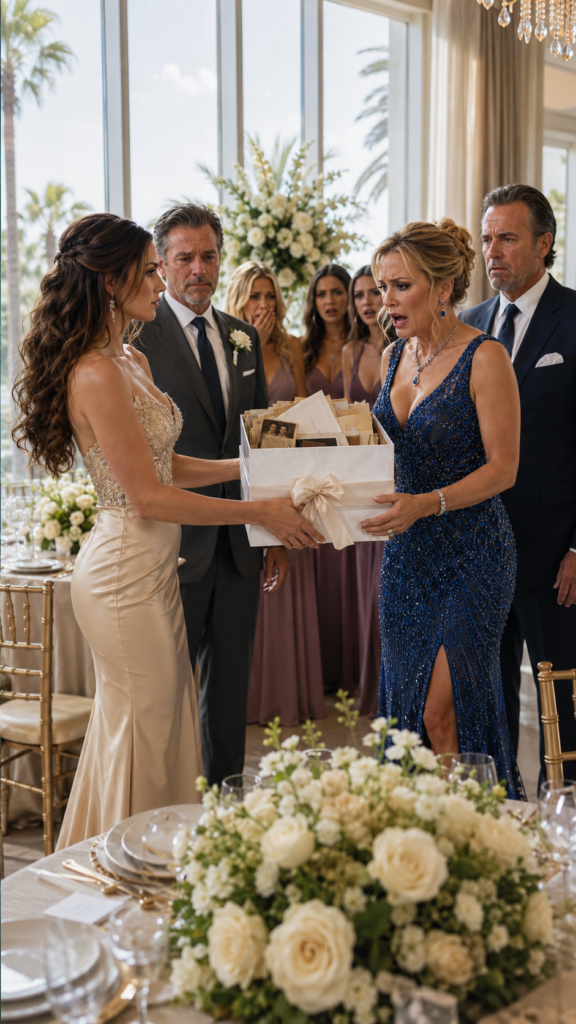
Abril and Natalia brought out the blue box, now tied with a white ribbon.
Julián felt his heart sink.
—Valeria… —he whispered.
She didn’t turn.
She placed the box in front of Renata.
—Open it.
Renata looked around, still smiling to maintain her victim role.
—What a lovely detail.
She untied the ribbon.
Lifted the lid.
And as soon as she saw the first envelope marked with her own handwriting as “rejected,” her smile died right before everyone’s eyes.
No one moved.
The music continued for a few seconds, absurd, as if it didn’t understand that something had just shattered. Diego gestured to the organizer, and the hall fell silent.
Renata looked at the box as if a snake were inside.
Valeria took the first envelope.
—Year 1. My 14th birthday. Invitation sent by Dad to your apartment in León, the same one that appeared on your real estate account statements.
Renata pressed her lips together.
—That doesn’t prove anything.
Valeria pulled out an old pink card, glitter still stuck to it.
—I made this. It said: “Mom, if you come, you don’t need to bring a gift. Just come.”
Daniela covered her mouth.
Julián looked down. He remembered that afternoon. Valeria had waited until 10 PM in her dress, even though the party ended at 6.
Valeria placed the card on the table.
—It came back unopened.
Renata tried to take the microphone.
—This is cruelty.
—No —Valeria replied—. Cruelty was when Dad told me “maybe she had a problem” to spare me the heartbreak.
Abril pulled out another envelope.
—Year 3. Mother’s Day Festival. I was dressed as a flower.
Natalia held up a folded photo.
—I was a butterfly.
Little Renata spoke in a trembling voice:
—I cried because all the moms went up on stage except ours.
Arturo’s sister looked at Renata.
—You said you were never informed.
Renata turned to her.
—You don’t understand. Julián controlled everything.
Julián took a deep breath.
For years, he had chosen silence because he believed it protected his daughters. But that day, silence no longer protected anyone. It only held Renata’s lie.
—I never changed my number —he said at last.
His voice came out low, but everyone heard it.
Arturo frowned.
—She told me you blocked her calls.
Julián pulled out a folded sheet from his pocket. He hadn’t planned to use it, but he had carried it since he learned Renata would come.
—These are my phone numbers from the last fifteen years. The same cell. The same email. The same house. Here are copies of the emails I sent her.
Valeria opened a folder inside the box.
—Delivery confirmations. Printed emails. Messages where she replied: “Don’t insist, Julián. That life is no longer mine.”
Renata stepped back.
—That’s taken out of context.
Daniela raised her voice.
—Was it also taken out of context when Sofía got sick and Dad wrote to you four times?
Sofía looked at her father, confused and broken.
—Did you write to her?
Julián closed his eyes.
—Yes, sweetie.
Valeria pulled out another sheet.
—Year 6. General Hospital of Celaya. Sofía with bronchitis. Dad sent location, diagnosis, and message: “If you want to see her, come. She won’t blame you for anything. She just needs her mom.”
Sofía began to cry silently.
Little Renata read the response with a broken voice:
—I’m out of the country. Don’t make me carry the guilt you caused.
Arturo turned pale.
—Out of the country? That weekend we were in San Miguel de Allende.
The phrase fell like a stone.
Renata looked at him furiously.
—Don’t expose me.
He stepped back.
—You exposed us all with a lie.
Valeria reached deep into the box and pulled out a worn notebook, the spine broken.
Julián felt his chest tighten.
—Not that one, honey.
Valeria looked at him.
She was no longer the girl on the stairs. She was a woman holding the truth with both hands.
—Dad, she said you stole our mother from us. Let us show who held us up when she chose not to look.
Julián couldn’t speak.
He simply nodded.
Valeria opened the notebook.
—Year 2. Note from Dad: “Valeria asked if her mom left because she answered wrong. I told her no. I told her adults fail, but children are never to blame.”
Valeria swallowed but continued.
—Year 5. “Daniela broke her Mother’s Day gift because she said she had no one to give it to. I held her until she fell asleep. Then I washed dishes crying so she wouldn’t hear me.”
Daniela let out a sob.
Valeria turned the page.
—Year 9. “Sofía called her teacher mom. She apologized six times. She asked me if that was betrayal. I told her no, that love doesn’t end because you find affection in someone else.”
Sofía ran to Julián and hugged him around the waist just like when she was little.
The whole hall was still.
Renata had a twisted expression.
—What did you want? —she exploded—. For me to rot in a house where there was no future? For me to give up a better life to change diapers, make lunches, and wash uniforms?
No one breathed.
Julián looked at her with old sadness, without anger.
—No. You could have left as a wife, Renata. That would have hurt too, but it was understandable. What we never understood was your choice to leave as a mother as well.
Renata opened her mouth, but couldn’t find a phrase to save her.
Valeria pulled out one last thing: an empty frame.
Inside was a small card.
She read it aloud.
—“Pending photo: mom with her 6 daughters.”
The triplets hugged. Daniela cried openly. Sofía still clung to Julián.
Valeria placed the frame in front of Renata.
—For years we thought maybe you didn’t know how to return. Today we understood you never wanted to carry what you left behind.
Renata looked at Arturo, seeking support.
But Arturo was no longer at her side. His sons had also backed away.
—We’re leaving —he said, flat.
—Arturo, don’t do this.
He looked at her as if he had just met her.
—You told me you were a mother separated by a resentful man. Not that you returned invitations from little girls.
Renata was left alone in the middle of the hall, surrounded by the box she had filled for fifteen years.
Then she looked at Julián.
—Say something. Tell them I’m not a monster.
Julián felt all the nights accumulate: fevers, homework, poorly done braids, patched uniforms, six pairs of shoes to buy, six hearts asking for a woman who chose not to show up.
—I’m not going to call you a monster —he finally said—. That would be too easy. You’re someone who could love and chose not to when they needed it most.
Renata cried.
But no one rushed to comfort her.
Valeria took the microphone.
—This wedding wasn’t meant to punish anyone. It was to celebrate the family that stayed. My dad wasn’t perfect, but he was there. And sometimes, that changes everything.
Diego approached her and kissed her forehead.
Then he looked at Julián.
—Sir, the dance is missing.
Julián tried to smile, but his face broke.
—I don’t know if I can.
Valeria stretched out her hand.
—You’ve carried alone for too long.
Daniela moved closer.
—Now it’s our turn.
Abril, Natalia, little Renata, and Sofía surrounded Julián.
The music started again, soft and different.
Julián first danced with Valeria. Then Daniela took his hand. After that, the triplets, one by one. Finally, Sofía placed her feet on her father’s shoes, just like when she was little, and hugged him, crying.
Renata watched from afar for a few more seconds.
Then she left the hall without applause, without shouts, without pursuit.
Just with the terrible sound of a door closing, the same sound that fifteen years ago had left six little girls without a mother.
But this time, when the door closed, no one was abandoned.
Julián looked at his daughters surrounding him and understood something he had never allowed himself to feel: he hadn’t failed for not giving them a mother.
He had triumphed because they had never lacked a home.
And when Valeria raised her glass at the end of the night, she didn’t toast for blood or surnames.
She toasted for those who stay when love stops being easy.
Because a family isn’t always who appears in photos.
Sometimes it’s who keeps the returned photos until the truth finally learns to speak.





