PART 1
Camila Rivas hid in the laundry room, an old box of glasses pressed to her chest, ready to emerge and surprise her guests with her grandmother's crystal set.
It was the grand opening of her house in San Ángel, a white residence draped in bougainvillea at the entrance, with original pasta tile floors and a terrace her mother-in-law already boasted about as if it were a family heirloom.
But that house wasn’t theirs.
It was Camila's.
Or at least, that’s what she believed until she heard her husband utter a word that did not belong at a party.
—Interdiction.
Camila stopped breathing.
On the other side of the door, her father-in-law, Ernesto Salvatierra, spoke calmly, almost elegantly.
—The doctor has already signed. Tonight, officially, she will be deemed a woman who cannot decide for herself.
The noise from the living room continued unabated: laughter, clinking glasses, soft music, the waiter offering cochinita canapés, and the shrill voice of her mother-in-law, Patricia, declaring that finally "this house had a surname."
Camila was 34 years old, running an art restoration workshop in Coyoacán, with the bad habit of confusing patience with love.
Diego Salvatierra had won her over with discreet gestures: coffee brewed over an open flame when she worked late, flowers without a card, respectful silences when she spoke of her deceased mother.
When they bought the house, he told her:
—Here we will heal everything that has hurt you.
Camila wanted to believe him.
Half of the money came from the sale of her grandmother's apartment in Del Valle. The other half came from a “facilitated” loan from Ernesto, a retired corporate lawyer who smiled like a saint yet negotiated like a vulture.
For weeks, Ernesto had insisted on placing the property in a family trust.
—It's purely precautionary, sweetheart. In Mexico, you never know.
Camila had always refused.
She wanted a house with two names, not a legal trap where the roof she paid for would end up in the hands of a family that called her “my girl” when they wanted to silence her.
Behind the door, Diego asked:
—What if she doesn’t sign in front of everyone?
Ernesto let out a dry laugh.
—She will sign. After the dizziness, she’ll be confused. We’ll present the document as an insurance update. Two signatures, and tomorrow she won’t remember the order of things.
Camila tightened her grip on the glasses.
After the dizziness?
Since the party began, Diego had insisted she take a drink “to relax.” She hadn’t drunk it. She poured it into the pot of the Ficus because something about its smell disgusted her.
The plant was already wilting.
—Is the medical file in your truck? —Diego asked.
—In the glove compartment. With the statement from Dr. Barajas: severe anxiety, episodes of confusion, financial impulsivity. It’s not definitive, but it’s enough for a judge to doubt if she gets intense.
A chill crept down Camila's back.
They didn’t just want her house.
They wanted her word to stop mattering.
Ernesto lowered his voice.
—Above all, she must not go down to the basement before the toast. Did you lock it?
—Yes. The key is in the little dish at the entrance.
—Idiot. Not that one. The other.
There was silence.
Then a bag rustled as it was checked.
—The one with the blue label?
—That one. She must never see it.
At that moment, Patricia yelled from the living room:
—Ernesto, Diego! Come for the photo!
The men moved away.
Camila waited a few seconds, stepped out of the laundry room, and walked toward the entrance with trembling legs.
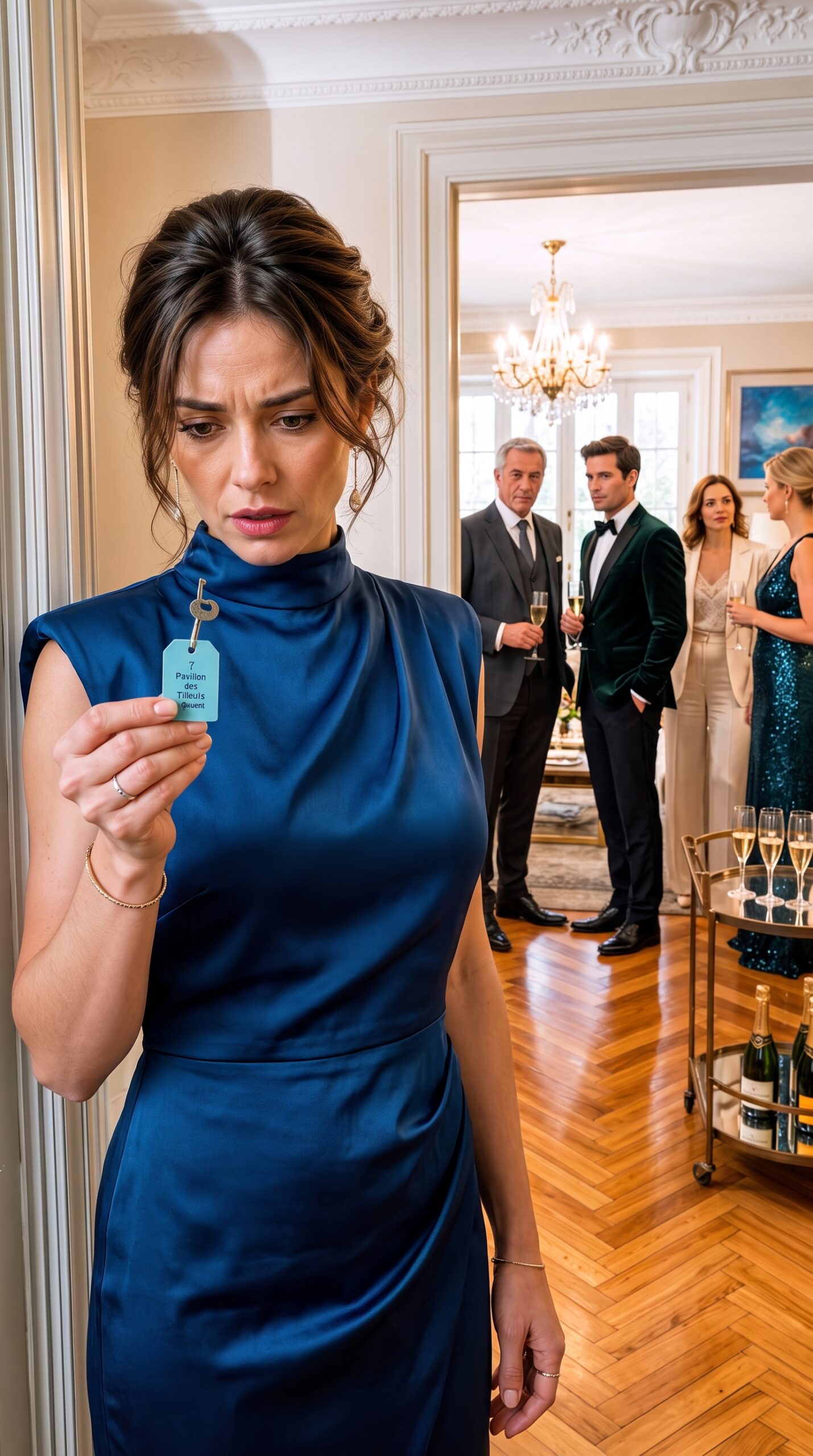
On the talavera dish, there were three keys, a valet ticket, and a blue label flipped over.
She picked it up.
It wasn’t a house key. It was small, old, flat, with a number engraved: 17.
On the back of the label was an address written in black ink:
Clínica Los Laureles — Tlalpan.
Camila recognized that name.
Her mother had said it just once, the night before she died, as the morphine shattered her voice.
She thought she was delirious.
Then she flipped the label completely.
Under the address, there was a phrase written in her mother’s handwriting:
If a Salvatierra offers you a roof, run before they close the door.
PART 2
Camila read the phrase three times.
If a Salvatierra offers you a roof, run before they close the door.
The noise of the party vanished for a few seconds. All that remained was her shallow breath and that handwriting she hadn’t seen in ten years.
Her mother hadn’t been delirious.
She had warned her.
And Camila hadn’t just ignored the warning. She had married danger, opened her house, her bank account, her bed, and even her most painful memories to it.
From the terrace, someone shouted:
—Camila! The owner of the house is hiding from us!
She tucked the key into the pocket of her emerald green dress.
Then she did the one thing Diego would never have imagined.
She smiled.
She crossed the hallway, passed the golden mirror Patricia already wanted to replace "because it didn't match the family energy,” and entered the living room with her hands still.
Diego was by the window, a glass in hand.
At first, he looked at her like a worried husband.
Then he lowered his gaze to her empty hands.
—Where were you? —he murmured, approaching her.
—Looking for my grandmother’s glasses.
—You look pale. Are you okay?
Camila held his gaze.
—The drink was strong.
Something ignited in Diego’s eyes.
It was minimal.
But enough.
—Did you drink it? —he asked too quickly.
Camila tilted her head.
—Why are you so worried?
He smiled instantly.
—Because you hardly ever drink, love.
Behind him, Ernesto Salvatierra was already watching her.
It wasn’t the gaze of a concerned father-in-law. It was that of a man checking if his trap had worked.
Camila understood she had only one chance: she had to make them believe they still had control.
Ernesto gently tapped his glass with a spoon.
—Dear friends, a moment of your attention. Let’s toast to this wonderful house, but above all to the family that begins here.
Everyone turned.
The house smelled of expensive flowers, white wine, imported perfume, and well-pressed lies.
Ernesto placed a hand on Diego’s shoulder.
—A house isn’t just walls. It’s heritage, stability, future.
The word heritage churned Camila’s stomach.
He was talking about her money as if it were already their inheritance.
—And that’s why —Ernesto continued—, Diego and Camila have decided to protect what they have built with so much effort.
Patricia opened her Chanel bag and pulled out a cream-colored folder.
Camila felt her blood freeze.
They would do it in front of everyone.
They would turn the party into a witness.
—Don’t be alarmed —Ernesto said—. These are administrative papers. Just an update to avoid problems if someday there’s a medical emergency.
Diego leaned closer to Camila.
—We sign quickly, and then we eat, okay?
His voice was sweet.
His fingers, on the other hand, tightened on Camila's arm.
She almost recoiled.
But she spotted Doña Rebeca, her neighbor across the street, a gossipy widow she had invited out of courtesy. The lady looked at Diego's hand on her arm with an unusual seriousness.
She hadn’t heard anything.
But she had seen enough.
Camila breathed slowly.
—Alright —she said.
Diego blinked.
Ernesto smiled.
—That’s how to talk, sweetheart. Always sensible.
They placed the documents on a console.
Camila took the pen.
Then she let her hand tremble a little.
—Excuse me… I need to sit down.
—Camila… —Diego started.
She hesitated.
Not too much.
Just enough.
A restless murmur crossed the room.
—She’s tired —Diego said immediately—. The move, the construction, the excitement…
Ernesto added in a grave voice:
—Moreover, she has had episodes of confusion lately.
The word fell like dirty earth over the party.
Camila understood the method.
They didn’t just want to rob her.
They wanted everyone to start doubting her.
So she lifted her gaze to Ernesto.
—Episodes of confusion?
He feigned compassion.
—No one judges you, Camila.
She smiled faintly.
—Of course not.
Then she placed the pen on the table.
—In that case, before I sign, I want to call my notary.
Ernesto’s demeanor hardened.
—It’s unnecessary.
—Precisely if I’m confused, it’s even more necessary.
Diego leaned toward her.
—Camila, enough. You’re making people uncomfortable.
—You’re right —she replied—. A woman who wants to read what she’s signing always makes people uncomfortable.
Silence was immediate.
Someone lowered their glass.
Doña Rebeca stood up.
Ernesto tried to regain control.
—Very well. Let’s read together. It’s a document for creating a family administration trust…
—With progressive assignment of rights? —Camila asked.
Diego clenched his jaw.
—What have you been reviewing?
Camila finally looked him in the eye.
—I didn’t review. I listened.
The air left the room.
Only the hum of the refrigerator and an old Luis Miguel song playing softly could be heard.
Ernesto straightened up.
—Be careful with what you insinuate.
—You should also be careful with what you sign.
Camila pulled out her phone.
Diego turned pale.
—What are you doing?
—I’m sending a message.
—To whom?
She turned the screen toward him.
The message was already sent.
Mónica, call the police. Come with Licenciada Arriaga. Bring what we discussed three weeks ago. Urgent.
Mónica wasn’t just her university friend.
She worked in the family court in Mexico City.
Licenciada Arriaga was the notary Camila had consulted when Diego’s questions started to smell like a trap.
Ernesto let out a laugh.
—How ridiculous. Are you going to turn a family gathering into a circus?
—No —Camila replied—. I think the circus has already arrived with you.
Diego took a step toward her.
—Give me that phone.
He didn’t shout.
And that was worse.
He spoke as if he already had the right to take her voice from her.
Then Doña Rebeca stepped between them, short, firm, in her purple dress, with her glasses hanging from her neck.
—Don’t you dare touch her, young man.
Diego glared at her in anger.
—Ma’am, this doesn’t concern you.
—Oh, yes, it does. When a man doesn’t let his wife call her notary, that concerns the entire neighborhood.
Several guests murmured.
The facade began to crack.
Ernesto changed tactics.
He approached Camila and lowered his voice enough for only she and Diego to hear.
—You don’t know what you’re getting into, girl.
Camila took the key from her dress pocket.
Ernesto’s eyes widened.
Finally.
The mask fell.
—Where did you find that? —he asked.
—In my house.
—Give it to me.
—Why? What’s in Clínica Los Laureles?
Diego turned sharply to his father.
He didn’t know.
That detail pierced Camila like a knife.
Diego knew the plan for that night: the fake file, the signatures, the drink, the public humiliation.
But perhaps he was unaware of what his father had done before.
Ernesto extended his hand.
—That key doesn’t belong to you.
—It has my mother’s handwriting.
Patricia let out a moan.
Ernesto shot her a deadly glare.
Too late.
Camila understood that her mother-in-law knew.
The doorbell rang.
Once.
Then again.
No one moved.
Camila crossed the room and opened the door.
Mónica entered first, wearing a black jacket and a fighting face. Behind her came Licenciada Arriaga with a briefcase. Two police officers followed them.
Diego stepped back.
—Camila, you’re crazy…
Mónica interrupted him.
—I wouldn’t use that word tonight if I were you.
The notary greeted Camila with a gesture.
—You did well to call me.
Ernesto regained his composure.
—Licenciada, this is private property.
Arriaga looked at the documents on the console.
—Exactly. I want to see what you were inviting the owner to sign.
Ernesto placed his hand on top.
—They’re family documents.
—Then you won’t have a problem showing them.
A police officer stepped closer.
Ernesto slowly withdrew his hand.
Licenciada Arriaga read the first sheet.
Then the second.
Her face changed.
—Camila, did you authorize the transfer of 70% of the rights to this house to a trust controlled by Mr. Ernesto Salvatierra?
A murmur swept across the room.
—No —she replied.
—Did you request any measures for someone else to administer your assets due to supposed incapacity?
—No.
Arriaga looked at the police officers.
—There are elements for possible forgery, breach of trust, attempted fraud, and patrimonial violence.
Diego exploded.
—She’s lying! For months, she’s been acting strange. She forgets things, invents threats, talks about her dead mother as if—
Camila slapped him.
It wasn’t hard.
It was precise.
To stop him.
The silence was complete.
—Don’t you ever use my mother to defend yourself again.
Diego stood frozen, hand on his cheek.
Ernesto, on the other hand, was no longer looking at anyone.
He was looking at the key.
Mónica noticed it.
—Camila mentioned a place in her message. Clínica Los Laureles.
The notary paled.
—The one in Tlalpan?
Camila looked at her.
—Do you know it?
Arriaga hesitated.
—it was a private clinic. It closed years ago. There were reports of elderly women and vulnerable patients being admitted for "rest," while their properties changed hands.
Camila felt the room spinning.
—My mother…
Ernesto finally spoke.
—Your mother signed.
His voice no longer sounded refined.
It sounded naked.
—She signed because she was sick, alone, and scared —the notary replied—. And because people like you know when to place a pen in front of a woman who is exhausted.
Diego looked at his father.
—What did you do?
Ernesto didn’t answer.
It wasn’t necessary.
Everything was there: the clinic, the key 17, the mother’s handwriting, the drink, the documents, the medical file, and the house.
Patricia collapsed onto a sofa.
—I didn’t want it to repeat —she whispered.
Camila approached her.
—Then why didn’t you say anything?
Patricia looked up, her eyes filled with shame.
—Because the first time I was afraid of losing my comfort. And this time I was afraid of losing my son.
Camila stared at her for a long time.
—Well, you lost both.
The police asked Ernesto and Diego to accompany them to make statements. The party ended with glasses untouched, waiters collecting plates, and neighbors pretending not to record, although half of San Ángel already had the gossip.
The following weeks were hell.
Diego tried to present himself as a worried husband, manipulated by his father. But the messages on his cell told another story: appointments with Dr. Barajas, drafts of the file, searches on the value of the house, rehearsed phrases to make her seem unstable.
Ernesto fell with his past.
With the key 17, they opened an old locker at Clínica Los Laureles. Inside was a plastic bag with three letters, copies of deeds, and a photograph.
In the photo, Camila’s mother stood in front of the same house in San Ángel.
On the back, she had written:
He took it from me. Don’t let him take it from you too.
Camila then discovered that Ernesto had advised the man who ruined her mother years before. They changed names, companies, notaries, and doctors.
But the method was identical.
Isolate.
Make doubt.
Get signatures.
Erase.
This time, they couldn’t.
The divorce came months later. Diego pleaded to sell the house, cried in front of the judge, and swore he did everything "for love." No one believed him.
The property remained in Camila’s name, completely, thanks to the documents Licenciada Arriaga had prepared three weeks earlier when Camila decided to listen to her intuition, even though she didn’t yet have proof.
Ernesto was convicted.
Diego too.
Not as much as Camila would have wished in her nights of rage, but enough for their surnames to stop opening doors and start closing them.
For a long time, Camila couldn’t live in that house.
Every time she entered, she saw the console, the cream folder, Diego’s hand tightening her arm.
But one morning, Doña Rebeca arrived with sweet bread and a bag of coffee.
—Are you going to let those bastards keep your walls even though they haven’t taken your deed?
Camila didn’t respond.
She just opened the windows.
Then she painted the living room.
She removed Patricia’s mirror.
And in the laundry room, where she had heard how they tried to destroy her, she set up her restoration workshop.
Today, by the window, there is a small flat key framed under glass.
It’s not there as a reminder of fear.
It’s there as proof.
Underneath, she had engraved a phrase.
Not her mother’s.
Hers.
A closed door can protect a woman, but only her voice can give her life back.