PART 1
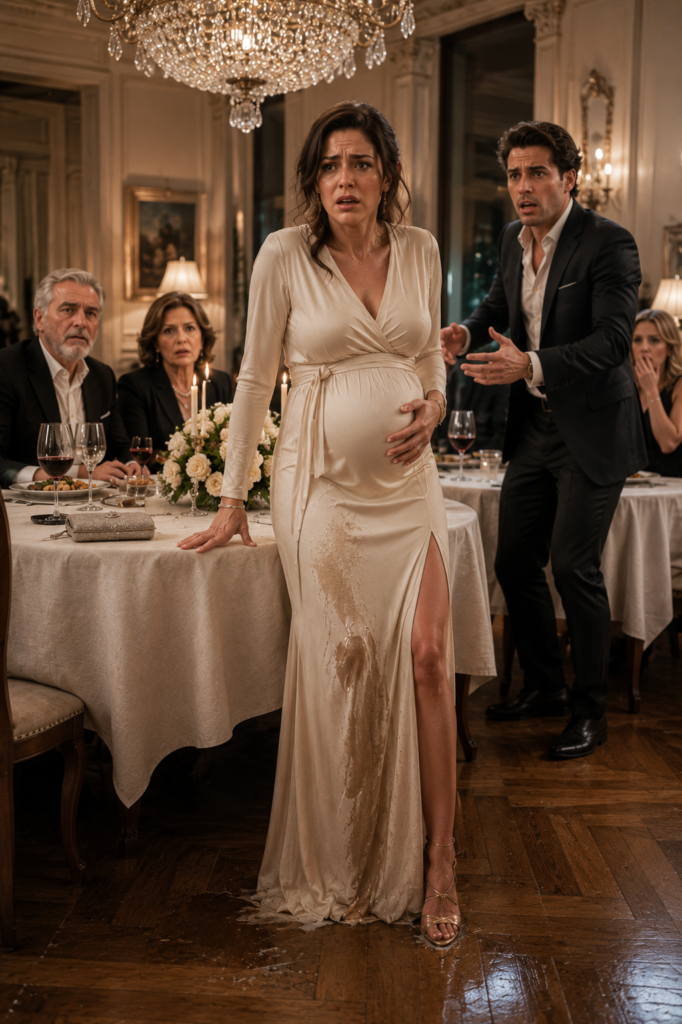
"Don’t turn your sister’s dinner into another one of your dramas. If you need to go to the hospital, call an Uber." Arturo Salgado didn’t even set down his glass when he uttered those words.
His daughter Mariana stood near the dining room, clutching her 38-week belly. Her blue dress was soaked from the waist down, and her legs trembled.
Around her, the guests remained seated, facing plates of birria, glasses of wine, and a huge cake adorned with the initials of Lorena and Sebastián.
It was Lorena’s engagement dinner, the youngest daughter.
In that house in Chapalita, Guadalajara, any celebration for Lorena was deemed sacred. No one could fall ill, argue, or need help while she was the center of attention.
Mariana had known this rule since childhood.
When she earned a scholarship, her parents asked her not to boast because Lorena had failed math. When she broke her arm, she had to wait at home because her sister was participating in a festival.
Now, at 32, Mariana still hoped that one day they would see her as a daughter and not a nuisance.
Hours earlier, she had texted her mother:
"Contractions are coming every 5 minutes. The doctor said I should go to the hospital if they continue."
Beatriz replied:
"Don’t start today. Your sister has been preparing for this night for months."
Mariana should have stayed in her apartment.
Instead, she packed her hospital bag in the trunk and went to the dinner. A part of her believed that seeing her on the verge of giving birth would stir something within her family.
She was wrong.
"Do you want me to call an ambulance?" Sebastián asked as he saw her double over from another contraction.
Lorena dropped her fork.
"Don’t be ridiculous. There are still 2 weeks to go."
"I can’t control this," Mariana gasped.
"You always find a way to steal the spotlight," Lorena snapped. "First, you announced your pregnancy while I was choosing my dress, and now you decide to give birth during my engagement party."
Sebastián looked at her incredulously.
"It’s an emergency, Lorena."
"It’s my night."
Mariana felt a brutal pressure in her back. Then came the warm liquid, running down her legs to form a puddle on the floor.
The guests fell silent.
"My water broke," Mariana said, almost breathless. "Dad, please, take me."
Arturo first glanced at Lorena.
His youngest daughter’s eyes were filled with rage, not concern.
"If you leave now, everyone will remember my engagement for this," she complained.
Beatriz approached Mariana but only to place a napkin over the puddle.
"You still have plenty of time."
"Mom, I’m scared."
Beatriz looked away.
"We can’t leave the guests."
Sebastián grabbed the keys to his vehicle.
"I’ll take her."
Lorena grabbed his arm.
"If you step out that door, our engagement is over."
The silence became unbearable.
Sebastián hesitated for just a few seconds.
But that was enough.
Mariana grabbed her bag and walked toward the exit, breathing through her moans.
No one followed her.
She drove alone through the rain on Avenida López Mateos, one hand on the wheel and the other protecting her belly.
When she arrived at the hospital, the doctors identified fetal distress and ordered an emergency cesarean.
"We need to notify a family member," a nurse said. "Who should we call?"
Mariana remembered her parents sitting in front of the cake.
She closed her eyes and dialed Rosario, the woman who cleaned offices and sold coffee outside her building.
PART 2
Doña Rosario answered on the first ring.
She arrived at the hospital at 1:46 AM, still wearing the floral apron she used to sell coffee, her hair half up, and a pharmacy bag pressed against her chest.
Inside were diapers, wet wipes, a yellow blanket, and a pack of cookies.
She wasn’t a relative of Mariana’s.
She didn’t even know her last name.
But ever since the young woman moved into the building, Rosario would bring her soup when she was sick, help her carry shopping bags upstairs, and ask her each morning how the baby was feeling.
"I’m here, girl," she said, taking her hand. "You focus on bringing your baby back."
Mariana wanted to respond, but another contraction stole her breath.
She entered the operating room crying.
She wasn’t crying only from the pain.
She cried because a woman who barely had enough to pay rent had crossed half the city to be with her, while her own family continued celebrating less than 20 minutes away.
The baby was born at 2:19 AM.
She weighed 2 kilos and 650 grams, with the umbilical cord wrapped around her neck.
For several minutes, Mariana heard no cries.
The doctors worked around the tiny form with quick movements. Finally, a weak sound broke the silence.
Then came the strong wail.
Mariana cried too.
She named her Renata.
Doña Rosario was the first person to stand by the bassinet. She remained there with her hands clasped, watching the newborn as if she were guarding the world’s most precious treasure.
When Mariana woke up, a doctor sat next to her bed.
"Your daughter is stable, but you did well to come when you did. The heart rate was dropping. A further delay could have turned out very badly."
Mariana turned her face toward the window.
She had driven through contractions, with her water broken and the rain pounding against the windshield.
She could have fainted.
She could have crashed.
She could have lost Renata because her family didn’t want to interrupt a toast.
For the next 5 days, Doña Rosario came every morning. She brought soup, clean clothes, and decaf coffee.
The neighbors in the building also helped.
The doorman found a chair for the bathroom. A couple from apartment 4C gifted a stroller that their child no longer used. The lady from 2A prepared meals to freeze.
None of them shared blood with Mariana.
They all did more than her parents.
Beatriz sent a message 11 hours after the birth:
"I hope you’re feeling better. Let us know when we can come."
Arturo wrote that same afternoon:
"Your mom says it was a cesarean. Take care of yourself."
Lorena didn’t ask about the baby.
She only posted photos from the dinner with the caption:
"The happiest night of our lives."
In one of the images, the cake, the white flowers, and Lorena’s smile were visible. Mariana caught a glimpse in the background of the liquid stain that no one had bothered to clean before taking the picture.
She felt nauseous.
Sebastián wrote the next day.
His message was long.
"Mariana, I have no right to ask you to forgive me. I should have taken you. I let Lorena threaten me, and I froze. But there’s something you need to know."
Mariana kept reading.
"Your mom knew the doctor had ordered you to go to the hospital. Lorena took her phone before dinner and read all your messages. I heard them talking in the kitchen."
"Lorena said that if they took you, everyone would talk about your baby. She always finds a way to take away what’s mine. Your mom replied that it was better to make you believe you were exaggerating."
Mariana had to set the phone down on the bed.
Renata was sleeping beside her, oblivious to the world.
A few minutes later, another message came in.
"I also saw your mom take the hospital bag out of your trunk. She hid it in the service room so you wouldn’t leave before the toast."
Mariana felt her chest tighten.
She checked the parking cameras from her parents’ house through an app that Arturo had installed months ago and that she had never remembered to remove from her phone.
There was Beatriz.
At 7:12 PM, her mother opened Mariana’s car, took out the bag, and walked with it toward the back of the house.
It hadn’t been indifference.
It had been a decision.
Her mother had seen the packed bag, had read the doctor’s warning, and still tried to prevent her from leaving.
Something inside Mariana dimmed.
She didn’t scream.
She didn’t call to confront.
She saved the video, took screenshots of all the messages, and sent them to her lawyer, an old college classmate.
She also changed the building passwords, removed her family from the list of authorized people, and left clear instructions at reception.
On the sixth day, Mariana returned to her apartment.
Doña Rosario arranged the pillows, made oatmeal atole, and left the crib next to the armchair.
"You don’t have to prove to anyone that you can do it alone," she said. "Being strong also means accepting help."
Mariana looked at that humble woman who had spent 5 nights sleeping in a chair at the hospital.
"Thank you for not leaving me."
Rosario stroked her hair.
"A woman giving birth should never be left alone. Even someone who didn’t go to school knows that."
At 11:08 the next morning, the intercom buzzed.
Beatriz, Arturo, and Lorena appeared on the screen.
Beatriz carried pink balloons. Arturo held a box with a huge bow. Lorena had a bouquet of flowers and kept glancing at her watch.
"Let us in, daughter," Beatriz pleaded. "We came to meet our granddaughter."
Mariana looked at the crib.
Renata slept with one hand next to her face.
"What granddaughter?" she asked.
Beatriz stopped smiling.
"Renata, of course."
"Renata? How strange. I thought to you, she was just 'the drama that could wait.'"
Arturo stepped closer to the camera.
"Mariana, don’t do this over the intercom. Let us come up."
She opened the door.
Not because she wanted to reconcile.
She needed to look them in the eyes.
When they entered, Doña Rosario was sitting by the crib. Lorena scanned her with disgust and wrinkled her nose.
"What is she doing here?"
"What you didn’t do," Mariana answered. "Take care of me."
Beatriz placed the balloons near the door.
"Daughter, we know you’re upset, but you also have to understand that everything happened so fast."
Mariana took several sheets from the table.
"The contractions started at 4:30. I texted you at 5:06. You read the message at 5:07."
Beatriz paled.
"I didn’t know it was that serious."
Mariana showed a screenshot.
"Here I wrote that my doctor ordered me to go to the hospital. You replied not to make a scene."
Arturo looked at his wife.
"Did you know about the doctor?"
"I was nervous about the dinner," Beatriz stammered. "I thought Mariana could hold on a bit longer."
"You also took my bag out of the car."
Beatriz opened her mouth.
Lorena intervened immediately.
"Enough. Mom just wanted you to be present at an important moment for me."
"More important than my daughter’s life?"
"Both are fine," Lorena said. "Seriously, you’re making a scene over something that’s already past."
Doña Rosario stood up, but Mariana raised a hand.
She didn’t need anyone to defend her.
"Renata is alive because the doctors acted quickly. If I had arrived 20 minutes later, maybe this conversation would be about a funeral."
Arturo dropped into a chair.
"Don’t say that."
"The doctor said so."
Beatriz started crying.
"We made a mistake."
"It wasn’t a mistake," Mariana replied. "A mistake is forgetting the keys. You saw a woman 38 weeks pregnant with her water broken and decided a cake was more important."
Lorena let out a sigh.
"You’ve always been dramatic. Since childhood, you make everyone feel guilty."
The apartment door opened.
Sebastián appeared with a folder under his arm.
Lorena froze.
"What are you doing here?"
"Finishing what I should have finished that night."
Sebastián placed the folder on the table. On top was the engagement ring.
Lorena lost all color in her face.
"You can’t be serious."
"I’ve never seen someone pleading for help while their family argued over pictures," he replied. "And I’ve never seen a woman threaten her fiancé to prevent him from taking his sister to the hospital."
"She ruined our dinner!"
"You ruined our relationship."
Lorena looked to her parents, hoping they would intervene.
Arturo didn’t move.
Sebastián pulled out his phone.
"I also accidentally recorded something. I was sending a voice message when you entered the kitchen."
He pressed the screen.
Lorena’s voice filled the room:
"If they take her, everyone will talk about her baby. She always finds a way to take what’s mine."
Then Beatriz’s voice was heard:
"I’m going to hide the bag. When the toast is over, we’ll see if she’s really still in pain."
Beatriz covered her mouth.
Arturo slowly raised his gaze.
"You hid the bag?"
"I just wanted the night to go well."
"Our daughter was giving birth!"
The shout made Renata cry.
Mariana stood with difficulty and took the baby in her arms.
Beatriz took a step toward them.
"Let me hold her."
Mariana stepped back.
"No."
"I’m her grandmother."
"That night, I was also your daughter."
Beatriz froze.
"I just want to meet her."
"I just wanted you to take me to the hospital."
Arturo covered his face.
"Mariana, forgive us. We were idiots."
"You’ve been that way my whole life."
The young woman breathed slowly to endure the pain of the wound.
"When I had pneumonia at 9 years old, you left me with a neighbor because Lorena had a performance. When I got my first job, you canceled dinner because she fought with her boyfriend. When I announced my pregnancy, Mom changed the subject to talk about the wedding."
Beatriz cried silently.
"We never wanted to hurt you."
"You never cared enough to stop it."
Lorena grabbed her purse.
"How convenient. Now you’re a victim since birth."
Arturo slammed his hand on the table.
"Shut up, Lorena!"
It was the first time he raised his voice against the youngest daughter.
Lorena’s eyes widened in disbelief.
"Are you really going to blame me?"
"I heard you call drama the birth of your niece. I heard you say a party was more important than your sister’s life. And I’m ashamed to know we taught you to be this way."
Lorena looked at Sebastián.
"Are you really going to cancel the wedding for her?"
"It’s not for Mariana," he replied. "It’s because I finally understood who you are when no one is applauding you."
Lorena picked up the ring from the table and threw it at his chest.
"Everyone will regret this."
Mariana settled Renata against her shoulder.
"Maybe. But I already regret waiting so long to set boundaries."
Beatriz approached again.
"Tell me what I have to do to be allowed to see her."
"Nothing for now."
"Mariana, please."
"No visits. No pictures. You won’t show off on Facebook a granddaughter you left alone before she was born."
Arturo stood up.
"We are her family."
Doña Rosario spoke for the first time.
"The family was the one who answered the phone at 1:18 AM."
Beatriz glared at her with resentment.
"You have no right to interfere."
Mariana held her mother’s gaze.
"She has more right than you. She was the one who accompanied me to the operating room. She was the one who waited in front of the bassinet. She was the one who helped me bathe when I couldn’t stand.
Rosario looked down, her eyes filled with tears.
"She was there when you all decided to keep eating cake," Mariana continued. "So don’t ever say she’s nothing."
Beatriz hugged herself.
"I’m your mom."
"A mom isn’t a title. It’s someone who comes when her daughter says she’s scared."
Arturo took Beatriz by the arm.
He looked like he had aged overnight.
"Let’s go."
Lorena walked toward the door, but before leaving, she turned back.
"When you need a family, don’t come looking for us."
Mariana kissed Renata's forehead.
"I couldn’t seek something that was never there."
The door closed without violence.
Only the click of the lock was heard.
Beatriz apologized for months. Arturo started therapy and stopped paying for Lorena's expenses, who blamed Mariana for the wedding cancellation.
Sebastián didn’t return to Lorena.
Mariana didn’t forgive immediately either.
She learned that forgiving didn’t mean opening the door or returning privileges. Some wounds needed distance before hugs.
Doña Rosario became Renata’s godmother.
Every birthday, she arrived early with tamales, coffee, and a small yellow flower for the girl. She never asked to be called grandma, but Renata began to do so as soon as she learned to talk.
One night, while the baby slept on her chest, Mariana watched the lights of Guadalajara from the window.
For years, she had believed that a good daughter was one who endured, yielded, and never bothered.
Renata taught her otherwise.
Loving also meant protecting.
Even when the person she needed to protect her daughter from was her own blood.
"You’re never going to beg for them to believe you," Mariana whispered. "If you call me, I’ll come. Even if everyone says you’re exaggerating, I’ll come."
Doña Rosario, sitting nearby, wiped away a tear.
That night, Mariana didn’t lose a family.
She simply stopped chasing people who only called her daughter when the danger had passed.





