PART 1
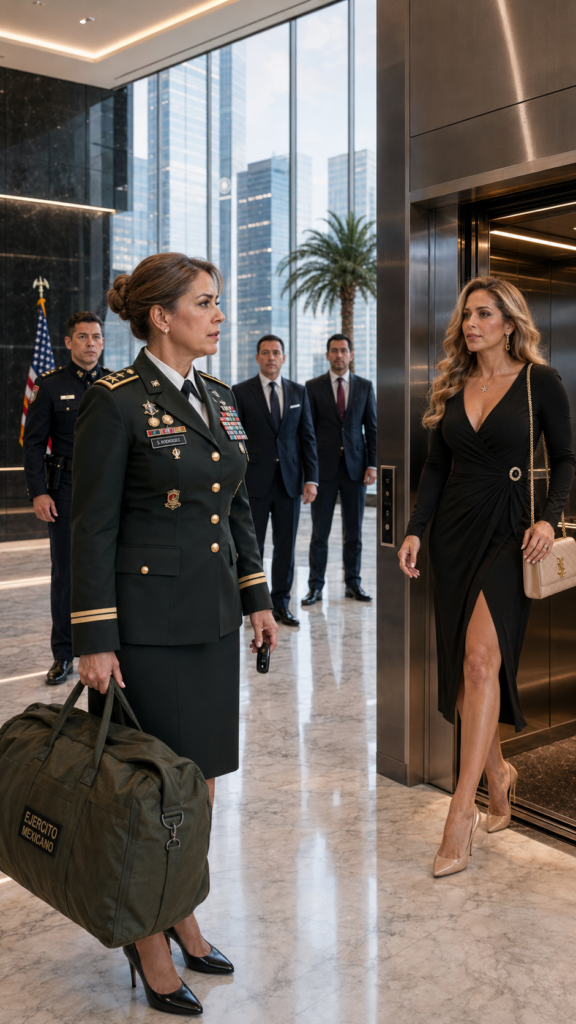
After nine months away from Mexico, Colonel Elena Salgado just wanted to see the look on her husband’s face when she surprised him.
She had gotten an unexpected leave after concluding an international military observation mission. She flew to Monterrey and drove straight to Villarreal Logística del Norte, the company that Mauricio had built over their 31 years of marriage.
The reception guard smiled as she explained that she was there to surprise the general director.
—What a lovely gesture, ma'am. Though Mrs. Villarreal is already upstairs.
Elena thought she had misheard.
—I am Mrs. Villarreal.
The man let out a nervous laugh, as if she were confused.
—I’m sorry, but Mr. Mauricio’s wife comes almost every morning.
The lobby looked the same: gray marble, huge windows, executives rushing about, and a Mexican flag next to the counter. Everything seemed normal, except for Elena’s life.
Before she could respond, the guard pointed to the private elevators.
—Look, here she comes.
A woman with brown hair emerged, accompanied by two executives. She wore an ivory suit, high heels, and walked with the confidence of someone who knew every corner of the building.
—Good morning, Mrs. Villarreal —several employees greeted her.
She smiled in response.
Then she looked at Elena.
No surprise. No confusion.
She recognized her.
And around her neck hung the silver military medallion that Mauricio had given Elena when she was promoted to colonel.
For two seconds, the world fell silent.
Elena could have screamed. She could have stormed upstairs to find Mauricio and demand an explanation.
But the Army had taught her something: when a scene doesn’t make sense, first observe, then gather evidence, and finally act.
She walked out of the building without a word.
Minutes later, she received a message from Mauricio.
“I miss you, my colonel. I’m counting the days until you return.”
Elena read that from her car, parked in front of the company.
He still thought she was out of the country.
She booked a room under her maiden name and turned on her computer. The corporate page showed openings, charity dinners, and campaigns supporting military families.
In almost every photograph were Mauricio and that woman.
The caption repeated the same:
“Lic. Mauricio Villarreal and his wife, Renata Villarreal.”
There were images in their home in San Pedro Garza García, in front of the fireplace that Elena had designed. Renata wore her pearl earrings, drank from her glasses, and smiled while sitting on the couch where their daughter Andrea had taken her first steps.
The last photograph left her frozen.
Renata was handing out scholarships to children of fallen soldiers. She wore Elena’s military medallion and spoke in front of a banner with the name of a foundation created using the rank, history, and decorations of the true wife.
The phone rang.
It was Andrea, her 31-year-old daughter.
—Mom, are you back yet?
Elena stood still.
—Why do you ask?
Andrea lowered her voice.
—Dad called me four times. He said that if you reached out to me, I had to let him know immediately.
Elena watched the lights of Monterrey flicker on behind the glass.
Then she understood that Mauricio didn’t fear she would discover an infidelity.
He feared she would find something much worse.
PART 2
Elena asked Andrea not to return any calls and not to reveal where she was.
The young woman fell silent before responding.
—You called him Mauricio, not Dad.
Elena closed her eyes. Children always perceive the crack before adults accept that the whole house is about to collapse.
—I don’t know the whole truth yet —she said—. But I need you to trust me.
She then called Marina Ponce, a former military investigator who had worked with her for years. Marina arrived in Monterrey the next morning with two coffees, a laptop, and the calm of someone who never asked useless questions.
She listened to everything without interruption.
—Don’t confront him —she warned—. A man who has spent so long building a lie has already prepared a version where you are the guilty one.
For four days, they watched the company.
Renata arrived at nine, entered board meetings, and met with officials and suppliers. Mauricio had lunch with her, opened the car door for her, and rested his hand on her back with a familiarity that wasn’t improvised.
However, Marina noticed something strange.
Renata never stayed alone with him in public. When Mauricio tried to hug her, she stiffened her shoulders. Moreover, every afternoon she left the building looking back, as if she feared someone was following her.
The first piece of evidence came from the Civil Registry.
According to the documents, Mauricio had married Renata five years ago in Santiago, Nuevo León.
To do so, he presented a divorce decree supposedly signed by Elena.
The signature was fake.
There was also an address where Elena had never lived and a lawyer named Tomás Barrera, legal advisor to Villarreal Logística.
—This isn’t just adultery —Marina said—. It’s forgery, procedural fraud, and probably money laundering.
The second piece of evidence was worse.
Elena owned 42% of the company because she had invested her savings and an inheritance from her father when Mauricio had only three trucks. But in the commercial files, there was a share transfer executed three years before.
According to the document, Elena had transferred her share to a trust administered by Mauricio and Renata.
Another forged signature.
Elena felt nauseous.
For decades, she had slept in barracks, spent Christmases away from home, and risked her life, convinced she was protecting her family’s future. Meanwhile, Mauricio had turned her absence into an opportunity to erase her.
Andrea arrived at the hotel that night.
She entered crying and left a blue folder on the table.
—Dad asked me to keep this two years ago. He said it was paperwork for the house insurance.
Inside were copies of powers of attorney, account statements, and a letter signed by Andrea. The young woman thought she authorized a property protection procedure; in reality, the document named her the beneficiary of a trust that received money from the Honor and Military Family Foundation.
—I didn’t know, Mom. I swear.
Elena hugged her.
—You didn’t do this.
Marina reviewed the account statements until dawn. The foundation had received millions of pesos in donations and private contracts. A portion went to real scholarships, enough to maintain a good image. The rest ended up in three shell companies linked to Tomás Barrera.
Elena understood why Mauricio was so nervous.
A federal audit would begin in ten days.
If she returned and denied having authorized the trust, the whole scheme would collapse.
—So Renata is his accomplice —Andrea said angrily—. She uses your name, your jewelry, and even your story.
—Maybe —Elena replied—. But I want to hear from her before deciding what kind of woman she is.
Marina got Renata’s private number and sent her a single photograph: Elena wearing the medallion on the day of her promotion.
The response arrived six minutes later.
“Café Las Dalias. Tomorrow, 7:00. Come alone. If Mauricio finds out I spoke with you, we will both be in danger.”
Elena went without her uniform and sat at the back of the café. Renata arrived pale, without makeup, and with a cloth bag in her hands.
She no longer looked like the elegant Mrs. Villarreal from the photographs.
She looked like a woman exhausted.
—I knew you would come back someday —she said.
Elena placed the medallion on the table.
—Start by explaining why you were wearing this.
Renata lowered her gaze.
—Because Mauricio said that without symbols, no one would believe I was you.
That sentence ignited Elena’s fury.
Renata spoke quickly. She told how she had met Mauricio six years ago when she was working as an event coordinator. He assured her that Elena had abandoned him and that they were secretly divorced to protect the company’s reputation.
At first, Renata only pretended to be his wife at dinners where the presence of an “exemplary military family” helped secure contracts. Then Mauricio showed her the fake decree, proposed marriage, and convinced her that everything was legal.
—And you never tried to confirm anything? —Elena asked.
—I wanted to believe him. It suited me to believe him —Renata admitted with tears—. That’s my fault.
Months later, she discovered the divorce was fake. She tried to leave, but Mauricio threatened to accuse her of fraud and take custody of Mateo, her eight-year-old son. Tomás Barrera had copies of transfers made from accounts in Renata's name.
Elena felt no immediate compassion.
Renata had slept in her house. She had worn her jewelry. She had allowed herself to be called by a stolen last name.
—You could have reported him.
—Yes —Renata replied—. And I didn’t. I was cowardly. But that’s why I kept this.
She pulled out a USB drive, an old phone, and several receipts from the bag.
On the phone were audios of Mauricio and Tomás planning to destroy documents before the audit. They also discussed a strategy to declare Elena incapable due to “psychological damage from military service” if she returned early.
The last recording made Elena clench her fists.
—If she shows up —Mauricio said—, Andrea will sign that her mother has episodes of confusion. With that, we control the shares and get her into a clinic long enough to close everything down.
Andrea was not the beneficiary of the plan.
She was the next victim.
Elena left the café with a decision made.
For three days, she gathered certified copies, signature analysis, bank statements, and testimonies from former employees. She discreetly informed the prosecutor’s office and the unit responsible for investigating financial operations.
Then she called Mauricio.
—I’m in Monterrey.
There was a dry silence.
—My love, what a surprise. Where are you?
—I’ll be attending the board meeting tomorrow.
—That’s not necessary. You need to rest. The missions leave you very shaken and…
—At 10:00, Mauricio.
She hung up.
The next day, the board of directors was gathered when the doors opened.
Elena entered in her dress uniform, her insignias, and the medallion on her chest. Andrea walked beside her. Behind them came Marina, two lawyers, and a notary.
No one spoke.
Mauricio stood up so quickly he knocked over his glass of water.
—Elena… this isn’t what it looks like.
—What a comfortable phrase for a man who has two wives, forged signatures, and 42% of a stolen company.
Tomás Barrera tried to leave, but two agents were waiting for him in the hallway.
Mauricio changed his tone.
—You’re confused. You’ve spent too much time under pressure.
—Confused enough to remember my own signature?
The expert laid the assessments on the table.
Then Renata entered.
The directors began to murmur.
Mauricio looked at her with hatred.
—You’re ungrateful.
Renata trembled, but she didn’t back down.
—No. I was cowardly. Today, I am not.
She handed over the phone with the recordings. In one, Mauricio ordered the falsification of Elena’s medical reports. In another, he admitted to using the foundation to pay for a house in Valle de Bravo and accounts abroad.
The truth ceased to be a suspicion.
It became evidence.
Mauricio was arrested that very morning along with Tomás. The authorities froze accounts, intervened in the trust, and suspended several contracts. Weeks later, a judge annulled the marriage to Renata, restored Elena’s shares, and opened proceedings for fraud, forgery, fraudulent administration, and operations with illicit proceeds.
But the legal justice did not repair everything.
Elena returned home and found empty drawers, replaced photographs, and five years of celebrations where another woman had taken her place. She did not cry for the jewelry or the money.
She cried because Mauricio had used her loyalty as a hideout.
Andrea spent months carrying guilt for a signature she never understood. Renata agreed to testify, returned every object, and faced the consequences of having participated. She was not presented as innocent, but neither as the only villain.
The foundation changed administration. By Elena’s decision, the recovered money was truly allocated to the children of fallen soldiers and to women returning from service to discover their families had moved on without them.
A year later, Elena attended the first scholarship delivery without Mauricio, without false speeches, and without a woman pretending to be her.
Andrea placed the medallion around her neck before she went on stage.
—This was always yours, Mom.
Elena looked at the gathered families and understood something painful: sometimes the greatest betrayal isn’t loving someone else, but erasing the one who trusted you and using their story to build a lie.
Mauricio lost the company, his freedom, and the respect of his daughter.
Elena lost 31 years of certainties.
But she regained her name.
And for many, that’s where the real debate began: did Renata deserve forgiveness for delivering the evidence, or was living for years as another woman an unforgivable betrayal?





